
How the Music Business Works in 2026
From physical records and CDs to streaming beats and digital bits—and how music creators got shortchanged.
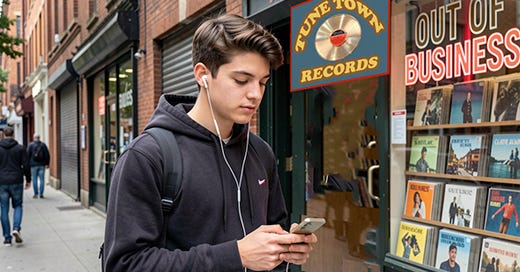
In the old days, the gatekeepers were the Artists and Repertoire (A&R) representatives who worked for record labels. A&R people reviewed demos submitted by hopeful artists, visited clubs, and auditioned new talent, always looking for someone with sales potential to sign. I did this myself for Elektra in Los Angeles. Other gatekeepers were the publishing companies, who invested in demo recordings of songs they thought had promise. Sometimes a demo impressed a label A&R department enough that they signed the artist who had made it. That’s how I got signed to RCA at seventeen.
Once promising artists were signed, money flowed into recording, pressing records, hiring promotion staff, and advertising. Then there was the distribution network—dozens of people who got the music from the pressing plant to record stores and finally to the consumer. When the internet came along, it’s amazing how quickly all that infrastructure was eliminated.
The Digital Disruption
When internet engineers figured out how to build hardware that could pass a decent musical bandwidth, the cat was out of the bag. There was no longer any need to press records and pay all those people to deliver music to consumers. The music lover could simply click and download their favorite artist’s work to their device as a digital file.
The first streamer was Napster, a file‑sharing system. A digital music file transferred from one subscriber’s hard drive to another’s, with Napster providing the connection. Napster became wildly popular but was unplugged when the Recording Industry Association of America (RIAA) sued and won for copyright infringement. Still, the music industry couldn’t ignore the massive demand Napster had revealed. Their response: “You want digital music? We’ll sell it to you.” That gave rise to Pandora, Spotify, Apple Music, and others.
Millions of people appreciated the convenience of digital music distribution and storage and were willing to pay for it. The entrepreneurs saw a cash cow. Unlike the old system, which had well‑established legal requirements for paying music creators, no regulations were in place for the new streaming technology. The capitalists who quickly cornered music storage and streaming decided how much of a monthly fee subscribers would tolerate—and how much of that would be passed down to creators as their “fair share”. This operated entirely outside of the existing music industry framework.
How Streaming Pays (and Doesn’t)
Streaming services do not pay artists or songwriters directly. The money flows through several intermediaries before reaching the creator. Royalty money originates at the streaming services from subscriptions and advertising. The collected funds are allocated to artists using a concept called streamshare—the percentage of total streams that an artist’s music generates during a specific period. There is no fixed per‑play rate. This tilts payments toward big artists whose music gets the majority of streams. A lesser‑known artist with fewer streams receives a small payment that reflects their streamshare.
More than half of all streaming revenue goes to artists whose music earns $500,000 a year or more, and that group represents less than 1% of all artists on streaming platforms. The other 99% of artists get a share based on the total streaming revenue pool and their percentage of total streams—their streamshare. For example, if an artist’s music accounts for 0.001% of all music streamed, they receive 0.001% of the revenue generated in that period. The often‑cited average of $0.003 to $0.005 per stream is just a derived average, not a set rate. As of 2026, there is still no legally defined per‑stream rate.
Where are my royalties?
The route royalties take gets even more convoluted. Some fast‑thinking lawyers made deals with the old royalty collection agencies to funnel the artists’ share—whatever the streaming services were willing to give—through “royalty distribution services”. If an artist is to receive any compensation today, they must allow a distributor such as TuneCore or DistroKid to collect and distribute what the streaming service allocates. It’s rampant capitalism at its finest.
The Self‑Promotion Requirement
“Independent artist” used to mean you had a small independent label distributing your music as opposed to a major label. Now it means nobody is helping you. You are your own content creator, publicist, and tour manager—and you had better come up with an impressive social media strategy if you want anyone to notice you. As the landscape changed, many artists had to focus more on content creation and social media than they did on their music. The streaming services call this empowerment. “Squeezing the music creator” is probably a better term.
Technology and Genre Shifts
Other influences along the way were rap and hip‑hop. New technology played a large part in defining these genres. Loops and audio‑sampling software enabled modest recording environments; new and interesting tracks could be created in an apartment or basement with minimal investment. Sampled beats and digital bits replaced musicians and expensive recording sessions. With no help from the major labels, early hip‑hop enthusiasts built their own ecosystem. They pressed records, ordered CDs, held promotion parties, and managed artists, creating a DIY blueprint for success. They disrupted the traditional record business gatekeepers with the genre’s hustle mentality. More of the record business “same as always” was slip‑sliding away.
Music as Background
In the final analysis, the purpose of music in today’s culture has changed, and streaming fits neatly into how music is now perceived. When asked who they are listening to on their phone, many listeners cannot name the artist. They just load up some tracks, and it becomes background sound for whatever activity they’re engaged in—work or play. There is little interest in the song’s lyrics or story. Songs don’t mean what they once did; bars and melody have been replaced by loops and beats. There are few singer‑songwriter listening rooms anymore. What about concerts? In many cases, the audience is there for the spectacle, not the music. A lot of the music being created today serves the purpose of the Muzak of yesterday.
The Next Wave: AI
It’s a fast‑changing landscape, and we are now entering another phase with AI music creation. AI content generation potentially eliminates any concern about paying artists because there are no artists. You can bet streaming executives are dancing to that idea: content without consequences. It remains to be seen how this will be accepted by consumers. We will need to wait and see how talented AI songcrafters can become. If they create music that didn’t exist before, and if it generates a fan base, it will be hard to stop. Based on what I’ve heard and some of the songs I’ve created myself, I know not all AI music is “slop,” as some critics preach; some of it is very appealing musically. On the other hand, if all music streamers want is background, AI can provide unlimited content at no cost. It depends on how the new tools are used.
A Glimmer of Hope
For those of us who care about music and appreciate listening to a well‑crafted melody and lyrics composed by talented humans, like we used to do, there is hope. LPs are outselling CDs. People who appreciate how music can best be delivered to their ears are investing in good audio equipment again. If you want to enjoy music for music’s sake, discard your earbuds and invest in some good equipment and speakers or headphones. Streaming and earbuds will never deliver true high‑quality audio. Listen to songs for the musical integrity, the craftsmanship and the sonic quality.
The Future
A central question today is whether AI will replace human music creators. While AI excels at mimicking predefined music styles it struggles to write original lyrics. Human judgment, cultural sensitivity, originality and creative direction are still irreplaceable. The future I see is a collaboration where AI handles the groundwork, allowing artists to focus on storytelling and nuance.
I have focused mainly on how advances in technology have shaped the evolution of the business of music over the sixty or so years that I have been observing it. There are many other influences not mentioned… but hopefully this article has covered some of the most important.
Comments
Nothing yet. Say the first thing.
Sign in to join the conversation.