
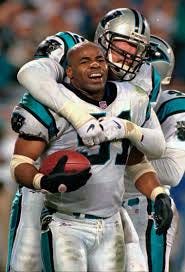
The coaches call them “exceptions.” It’s not a compliment. If you are a 280-pound guard and your football program has a template that demands a 300-pound guard, you’re an exception. Same thing if you’re a cornerback and you run 40 yards in 4.62, when your coach wants 4.5 or better. You can tolerate an exception here and there, like the too-short Drew Brees or the too-slow Le’Veon Bell. But if you have more than two on your starting 22, call Mayflower. Someone else will have your job soon.
Or as Damon Runyon said, “The race is not always to the swift, nor the battle to the strong. But that’s the way to bet.”
Nobody put a nickel on Sam Mills’ chances to get out of Long Branch, N.J., at least not in a football sense. Mills was 5–foot-9. He was a terrific high school wrestler but he saw himself as a linebacker, and was politely stubborn enough to retain that belief his whole life. One by one, in frustratingly deliberate speed, Mills embarrassed the high school, college and pro coaches who not only doubted him but refused to consider him. He is in the Pro Football Hall of Fame, where the busts of 22 undrafted exceptions gatjer and, according to John Madden, talk to each other when the lights go out. Those Hall of Famers who were tackled by Mills probably don’t call him “Shorty.”
This is truly one of the most spectacular stories in NFL history, and Paul Domowitch has all the details in his book, “Just Give Me A Chance To Fail.” As one of Mills’ early coaches said, there was nothing small about him. He had devastating hands, and Herschel Walker once said Mills hit him harder than anyone else had. He was just short. All that sinew and fast-twitch ability was trapped in a economy-sized body, and, unfortunately for the opponents, Mills spent many a Sunday letting them all out.
Mills played 12 NFL seasons, nine with New Orleans, three with Carolina. He didn’t retire until he was 38. He started 173 games, forced 24 fumbles, recovered 23 and had seven seasons in which he contributed to 100 tackles. Five times Mills made the Pro Bowl, and was first-team All-Pro when he was 37. And even though he was the prototype run-stopper, he found time for 20 ½ sacks.
But Mills always had a soft spot for the three years he spent before that. He joined the Philadelphia Stars of the fledgling United States Football League, which played in the springtime. He wasn’t drafted when he got out of Montclair State, of course, but he went to Stars’ camp and just kept knocking people down until all the resistance dissipated, and there was plenty of it. Jim Mora was Mills’ head coach in Philadelphia nad New Orleans and became his biggest advocate, but in the preseason meetings with the Stars in 1983, he flatly said he wasn’t giving Mills a chance to fail because it would obviously lead to his own failure.
Vince Tobin, the defensive coordinator, made Mills his personal cause. Every time Mora asked him to rate his linebackers in a staff meeting, Tobin put Mills at the top, to which Mora would lament, “We can’t do this. People will laugh at us.” Tobin never relented, and Mills kept getting his chances to fail and kept turning them down. Mills was All-USFL that first year, and the Stars won two of the three USFL championships that ever were played, and got to the finals in the other.
Teammates began joking the Stars’ running backs kept getting shorter because Mills kept belting them in practice. “Everybody thought Sam was an overachiever,” Mora said, “but he wasn’t. He had a lot of ability. He could run, he could cover, he could play the run. He was just an amazing guy.”
Before that, Mills thought he had made the Cleveland Browns’ roster out of nowhere, but at the very end, defensive coordinator Marty Schottenheimer decided he couldn’t. Schottenheimer would win 200 games as an NFL head coach, thanks to decisions far better than this one. Then Mills tried out for the Toronto Argonauts of the CFL and came up empty again.
It was the moment of truth. Even though Browns’ head coach Sam Rutigliano had told him to keep his eyes and ears open, Mills took a job teaching black-and-white photography at his local high school. Before that he had worked as a security guard on the Long Branch pier. Without the USFL, it’s virtually certain that Mills would have been a very good 5-foot-9 high school football coach and maybe gotten a chance at college someday. Instead, Mills used the USFL to make a reputation, played for Mora and several other Stars’ coaches in New Orleans and teamed with Rickey Jackson, Pat Swilling and Vaughn Johnson in an All-Pro Bowl linebacking corps. But even then, Mora had his doubts that Mills could cut it in the big-boy league, and when he overccame those he had to convince general manager Jim Finks. In a searingly hot prctice in Hammond, La., Mills stopped every Saints running back in his tracks, and Mora and linebackers coach Vic Fangio caught each other’s eye and smiled.
When the Saints’ run ended, Mills was the most popular and most community-oriented player they had. But he began telling people that he was actually beginning to think he was an elephant, “because the Saints pay me peanuts.” That rare burst of discontent led Mills to sign with the Panthers, an expansion team, as a free agent. Bill Polian ran the Panthers and, with the Bills, had been one of the many who had disqualified Mills on the basis of insufficient verticality. He embraced this chance to redact that mistake.
Carolina went to the NFC Championship Game in its second season, losing at Green Bay. Mills retired after the third year, although he didn’t turn it into a farewell tour. He was on the coaching staff the next year.
And that should be it, right? Maybe Mills becomes the defensive coordinator or even the head coach. Maybe he becomes the community relations director and exploits his own popularity. Instead, he went to a doctor after a couple of low-energy days, and there it was, cancer in his small intestine. He was given a few months to wrap things up, but it actually took him a couple of years, and he was on the sideline when Carolina lost the Super Bowl to New England after the 2003 season.
The Panthers had Dallas coming to town in the first round of the playoffs, and Mills, uncharacteristically, gathered the team the day before for a speech. The theme was “Keep pounding,” no matter the score, or the rejection notice from the coaches or the cancer results. The Panthers indeed pounded the Cowboys, and it became a motto that the Panthers use to this day, and it adorns the statue of Mills that owner Jerry Richardson ordered, upon his retirement.
Mills died at 45 and joined the Hall of Fame in 2022. He joins Kurt Warner, Dick “Night Train” Lane, Warren Moon, John Randle and others who never heard their name called by a commissioner. Undrafted players are all over today’s rosters, despite the forensic methods every team uses during the draft process. Sam Mills is one of their north stars, and Domowitch’s detailed, faithful book is their instruction manual. Square pegs, when they keep pounding, make their own holes.
Comments
Nothing yet. Say the first thing.
Sign in to join the conversation.