
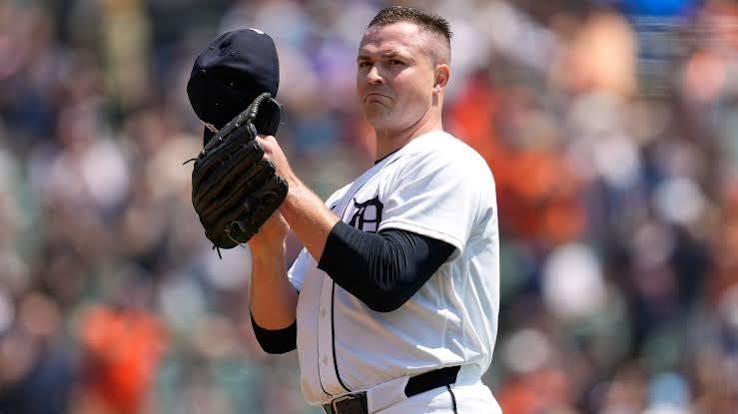
Graduation is such an emotional time. When Tarik Skubal pitched Detroit to a 7-0 lead over Baltimore on Thursday, he waved to the Comerica Park fans and they saluted him right back. The other Tigers were so overcome with grief that they allowed the Orioles to come back for a 10-9 win, but that just reinforced the theme. Detroit, which got to the 15th inning of the clinching game of the Division Series last year, has again become a place to serve your apprenticeship.
Skubal will almost certainly be dealt before Monday night’s trade deadline. He won’t necessarily go to the oligarchy, although the Cubs badly need him and the Dodgers, Yankees, Braves and Rangers could use him, since he’s won the past two American League Cy Youngs. But the Brewers, Rays, Astros and Diamondbacks could rent him, because Skubal, a Scott Boras client, isn’t signing a long-term deal until the last conceivable moment next spring. And for all we know, next season could be 2028.
The surprise is that Casey Mize might be walking down that aisle as well. Skubal is pitching for $32 million this year, thanks to arbitration, but Mize, the first overall pick in 2018, is getting $6.15 million in his final year before freedom. The Tigers have invested a lot in Mize, stuck with him through injury and wheel-spinning, and Mize has been outstanding this season, with an 0.992 WHIP and only five home runs permitted in 16 starts. But the Tigers scratched Mize from his scheduled start on Friday, in Sacramento, which probably means his next start will be a debut somewhere else.
This is always the shell game. If you’re trading Skubal and/or Mize, you’re not doing it from a position of strength, so don’t bother asking for someone’s minor league wonder child. But if you’re trading for Skubal and/or Mize, you’re gambling that (A) each pitcher will provide the magic carpet to the postseason and (B) he’ll be enchanted enough by your club and city that he’ll set down roots for the rest of his career. Your nightmare is that he will leave instead, and the players you dealt will prove that you were right in your evaluation, tragically wrong in your judgment. Case in point: San Diego trading James Wood and CJ Abrams to Washington for Juan Soto, who stuck around for a turbulent year and a half and then signed with the Yankees. Wood leads the National League in OPS and Abrams, a shortstop, leads the league in RBI.
In 2008 CC Sabathia was coming to the end of his deal in Cleveland. Milwaukee needed a boost to make the playoffs. The Brewers traded Zach Johnson, Rob Bryson and Matt Laporta to Cleveland to get Sabathia, who was saluted in Milwaukee like the man who invented the pop top, and rewarded all that love by going 11-2. The Brewers did make the playoffs but lost in the first round. Laporta hit 31 home runs in four years at Cleveland; Jackson was 2-3 on the mound in two years. Then Sabathia, who had said he might want to stay in the N.L. so he could hit, picked the Yankees, where he helped win a World Series the next year and proceeded to the Hall of Fame.
Obviously nobody ever made a bad trade for Randy Johnson, but Houston’s celebration in 1998 might as well have been timed by the pitch clock. Seattle traded Johnson to the Astros for infielder Carlos Guillen and pitchers Freddy Garcia and John Halama. Johnson went 10-1 for the Astros with a 1.28 ERA; with the Mariners, he was 9-10, 4.33. Houston steamed into the playoffs, where Johnson ran into the one pitcher who was hotter than he was. San Diego’s Kevin Brown beat him, 2-1, and then Johnson lost another tough one in the deciding Game 4. Johnson’s Astros career ended, and he signed with Arizona, won a World Series, won four consecutive Cy Youngs and strolled into the Hall. Meanwhile, Seattle won 116 regular season games three years later.
But pitchers like Sabathia and Johnson no longer roam the earth. Giving a pitcher a near-decade’s worth of torrential money is not something your financial advisor recommends.
The 200-inning pitcher has gone the way of the .330 hitter and the $3 hot dog. In looking over the past eight full seasons (excluding 2020) of MLB pitching, let’s say 185 innings is a reasonable goal. For those who make 32 starts, that’s 5.8 innings per. Bob Gibson was just breaking a sweat at that point, but the 185-inning mark has become the pitching equivalent of 26.2 miles for today’s generation. There were 25 pitchers to hit 185 innings in 2017. There were 13 last season.
The assumption, if you’re going to bestow a nine-figure contract on a starting pitcher, is that 185 innings should be the absolute minimum.
No pitcher has more than five 185-inning seasons since 2017. Jose Berrios, now with Toronto, and Philadelphia’s Aaron Nola are the only ones with five. San Francisco’s Logan Webb has hit 185 in the past four seasons, and Seattle’s Logan Gilbert did it in 2022-24.
Most teams, of course, are using “openers” in the first inning, or “piggybacking” two starters to cover the nine innings. Skubal’s workaday model is now an aberration. But when the Dodgers got to October last year, they rode Yoshinobu Yamamoto to their third World Series title in six years and cared not one bit that he’d given them only 125 regular-season innings. Yamamoto signed a 12-year, $325 million deal in 2014 and still is owed $248 million of that. The interest gets compounded in October.
It’s just amusing to see today’s baseball executives, bred in the Ivy and schooled on probability, betting Bugatti money that pitchers can stay upright for six months and then unleash their brilliance in the postseason. Deadlines do strange things to judgment but, with each hour that passes until Monday night, the ace next door is always greener.
Comments
Nothing yet. Say the first thing.
Sign in to join the conversation.