
Jenni Adams, Miranda Lynn Barnes and colleagues put together a zine on feminist open science, including some quotes from Elizabeth Bennett’s (2021) article: “Open Science From a Qualitative, Feminist Perspective.”

My favourite quote from Bennett (2021) is:
From which position(s) is this [open science] framework speaking? Where is it located in a hierarchy of research power and epistemological dominance?
Adams, J., Needham, L., Barnes, M., Givans, S., He, S., Sadler, R., Smithson, D., & X, A. (2026). Fragments of rebellion (a zine about feminism and open research). Knowledge Commons. https://doi.org/10.17613/7eeq1-4yb53

Batool Almarzouq (2026) considered how the open science movement’s promise to return science to the public is not being realised with respect to researchers from the Global South.
The movement behind Open Science emerged with noble aims and genuine intentions but has evolved into a flawed reality. The goal of open science is not openness itself; it’s about redistributing power in knowledge production—challenging the extractive systems that enrich the Global North at the expense of the Global South. Real change requires actively divesting from and delinking with the economic engines that Open Science systematically ignores or even relies upon. To fail in this is to betray everything the movement claims to stand for.
Helen Longino (2026) recently made a similar point:
In spite of conceptual commitment to the openness of science, disadvantaged regions have less access (as contributors to or readers of) international publications, less access to networks of communication, fewer material resources with which to conduct research, and less input to the international scientific research agenda. Furthermore, their economic and political weakness leaves them vulnerable to extractive practices, whether of natural resources or of local knowledge.
These international imbalances between the highly resourced (dare we say over-resourced?) and the under-resourced are the context in which openness of science would have to be implemented.

Raffaela Kunz (2026)
traces the evolution of open science from a grassroots movement for knowledge democratization into a policy-driven and increasingly contested governance framework. [She] then examines how constitutional law should respond to the diminishing autonomy of science, arguing that traditional legal protections centered on individual academic freedom are inadequate to address systemic encroachments.

Paralleling some of Almarzouq’s (2026) points about open science in an unequal world, Kunz argues that:
What began as a bottom-up movement rooted in the ideals of knowledge democratization has evolved into a policy-driven framework increasingly shaped by broader political and economic agendas. In this process, open science—more broadly understood as open scholarship—has not only lost some of its critical edge, but has also come to reflect, and at times reinforce, the very dynamics it initially sought to resist.
Open science is increasingly losing its liberating and democratizing potential, as it becomes entangled with the interconnected and mutually reinforcing logics of commercialization, political instrumentalization, and media-driven visibility of science. Rather than challenging the dominance of commercial publishers and reinforcing the public nature of knowledge, open science policies have often sustained or even deepened existing market structures, increasing academia’s dependence on private infrastructures.
The original promise of open science—to enhance accessibility, foster collaboration, and strengthen scientific autonomy—risks being sidelined, diluted, or co-opted by powerful institutional and corporate actors.
Kunz, R. (2026). Between democratization and instrumentalization: A constitutional perspective on open science. International Journal of Constitutional Law. https://doi.org/10.1093/icon/moag057

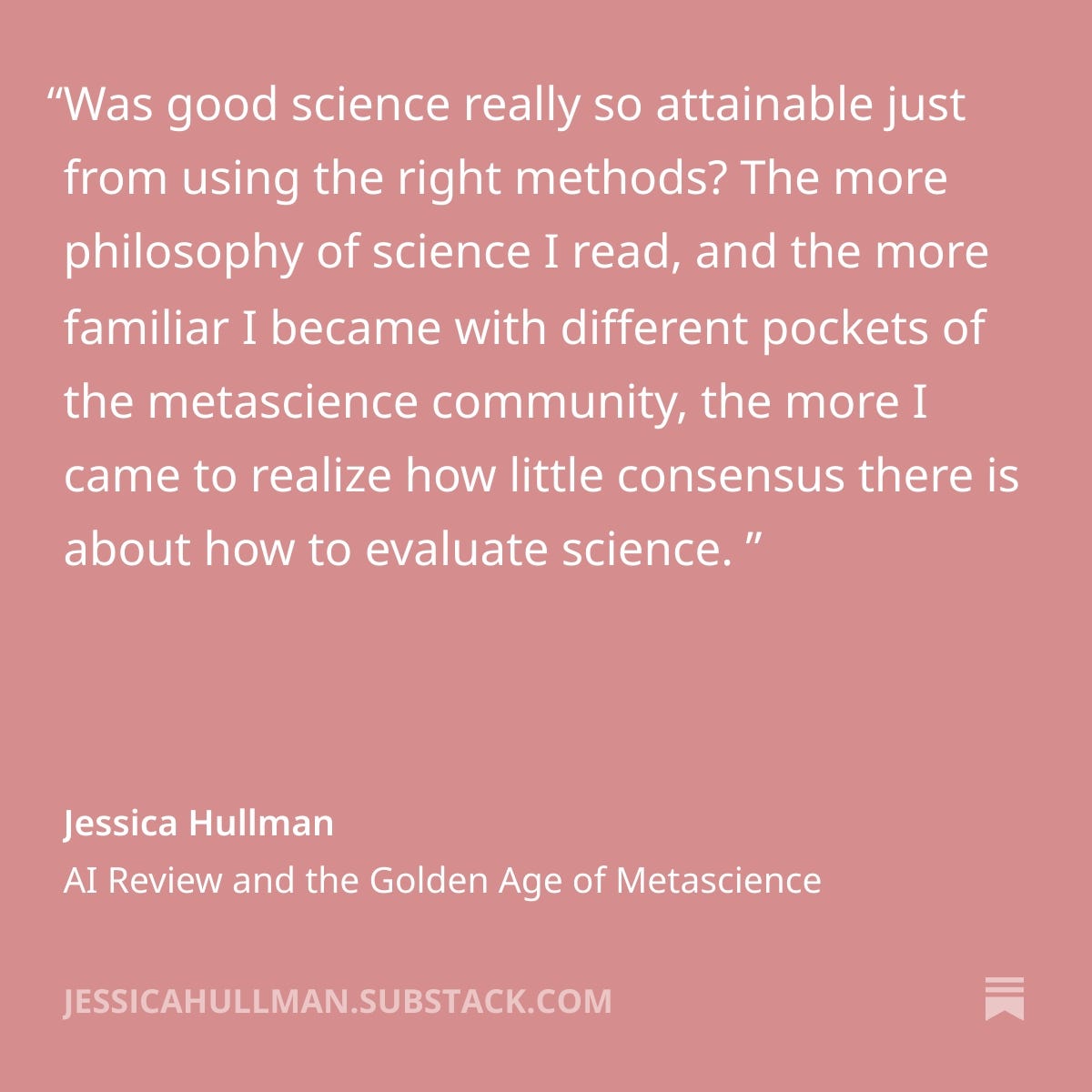
In a new preprint, Jessica Hullman (2026) argues that we should “stop treating metascientific heuristics as quality filters in AI review”:
AI-implemented checks for reproducibility, robustness, preregistration, claim scope, and other intended proxies for scientific credibility can extend human reviewers’ capabilities. However, treating metascientific heuristics–whose theoretical grounding remains contested or incomplete–as necessary and sufficient signals for filtering out bad science is counterproductive to scientific progress. The emerging literature blurs the line between integrity filtering, based on necessary but insufficient signals of validity like reproducibility of stated results or lack of fake citations, and epistemic filtering, which uses machine-detectable signals to judge scientific quality. Drawing on critical metascience, we show that commonly proposed signals of research quality are insufficiently justified as general indicators of scientific value.
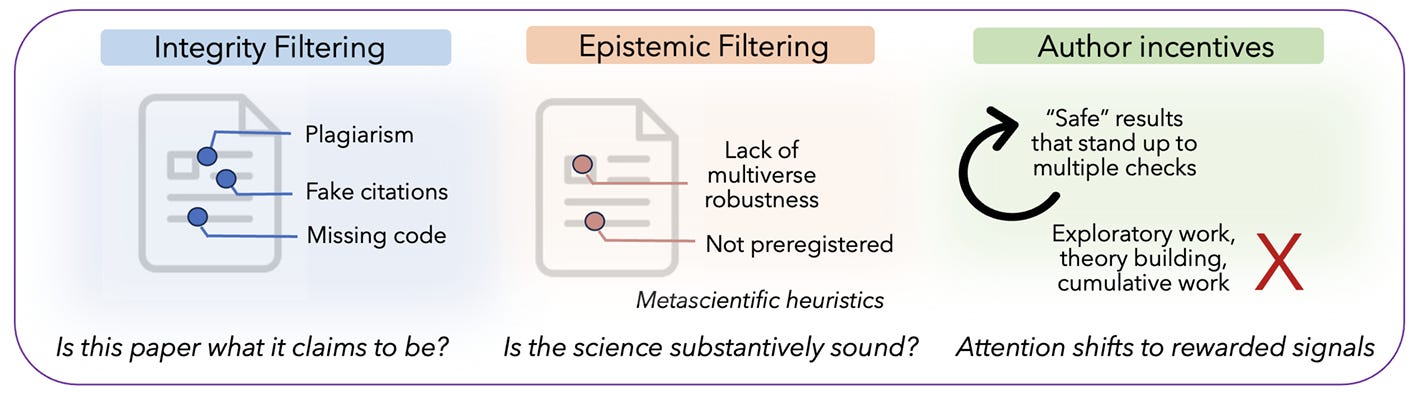
Hullman wrote a Substack post about her new preprint here:

We had a great symposium at the General Meeting of the European Association of Social Psychology yesterday titled: “Who critiques the critique? Toward a reflexive metascience.”
I began by asking “what is critical metascience and why is it important?” I argued that critical metascience’s “external criticism” can help to highlight collective biases that occur within mainstream metascience. A copy of my slides can be found here.
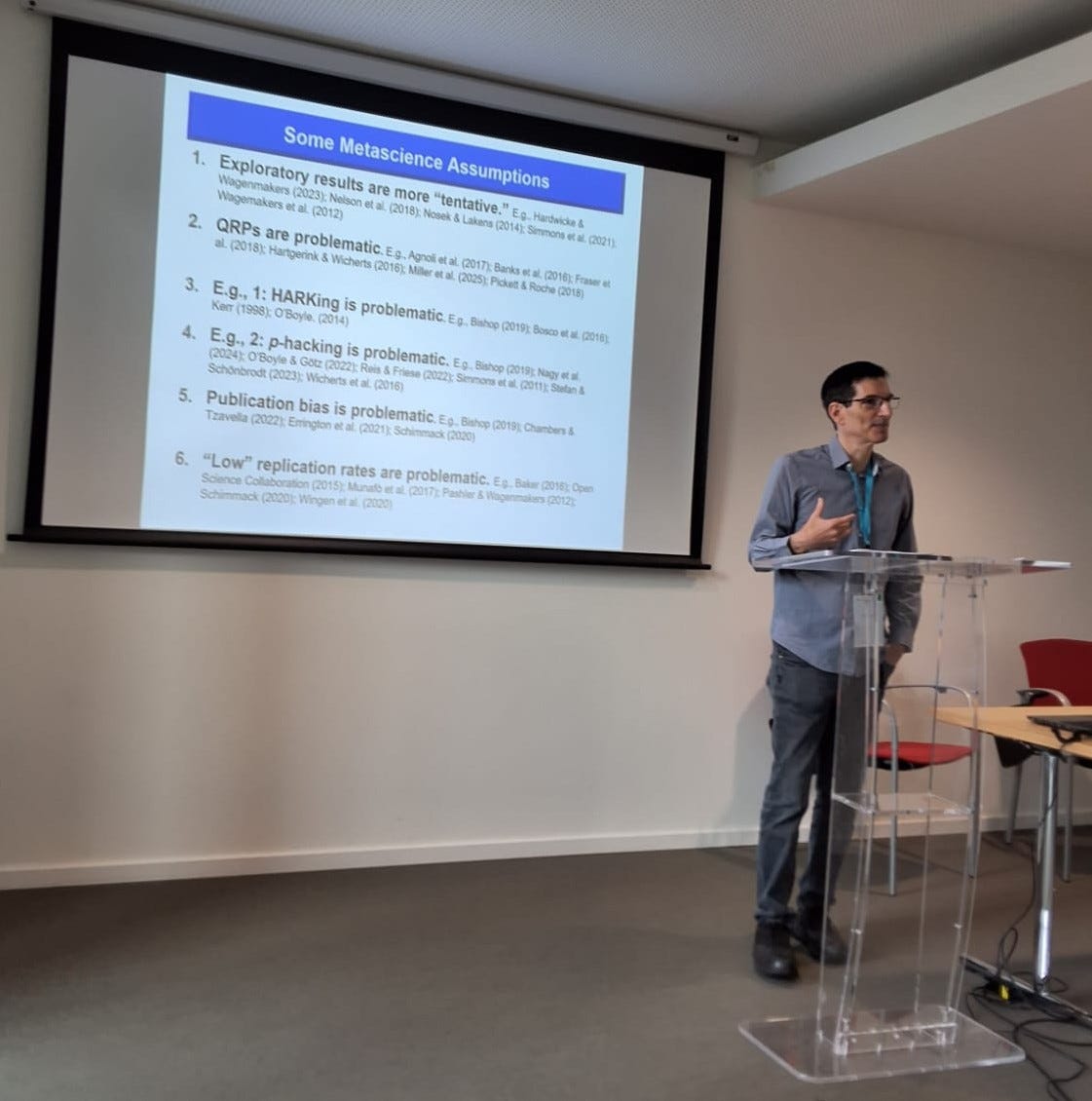
Rizqy Zein and Mario Gollwitzer then considered “the role of context in explaining effect size heterogeneity in replication studies.” They distinguished between “conceptually relevant” and “conceptually irrelevant” variables and found evidence that “conceptually relevant context characteristics explain effect heterogeneity in the effects found by Shnabel and Nadler (2008).” Hence, “context does matter!” A copy of their slides can be found here.
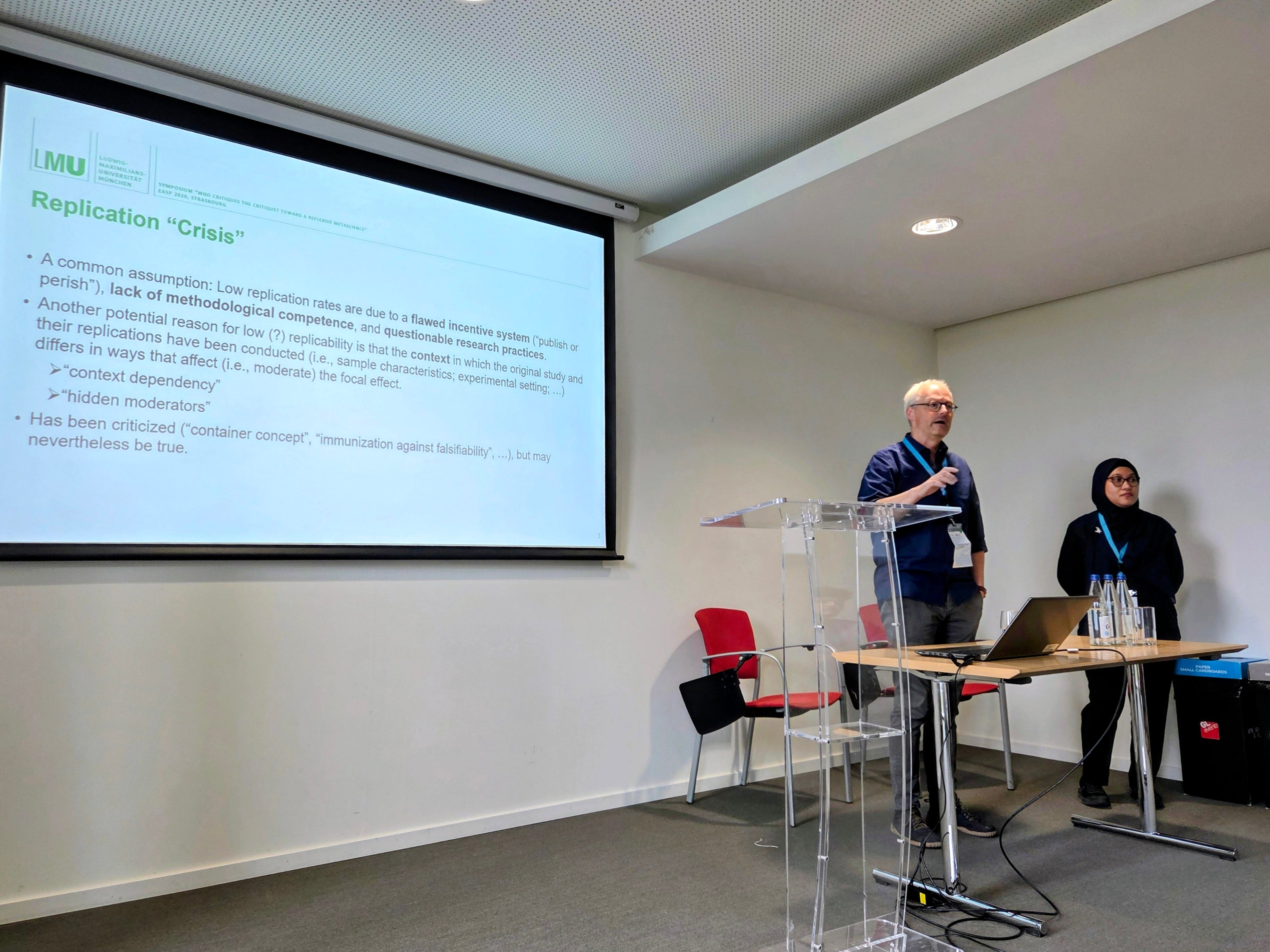
Finally, Fabrice Gabarrot asked “Why do we need critical meta-science? From normalizing to problematizing the replication crisis.” He argued that the three crises in psychology (early 1900s, 1960s-70s, & 2010s) produced the same “immune response” of redefining “rigor” and excluding non-congruent work. He distinguished between “normative problematization” (identify a malfunction, propose a procedural fix, reconduct the frame) and “reflexive problematization” (interrogate the frame itself). He argued that critical metascience can assist with the reflexive approach. A copy of his slides can be found here.
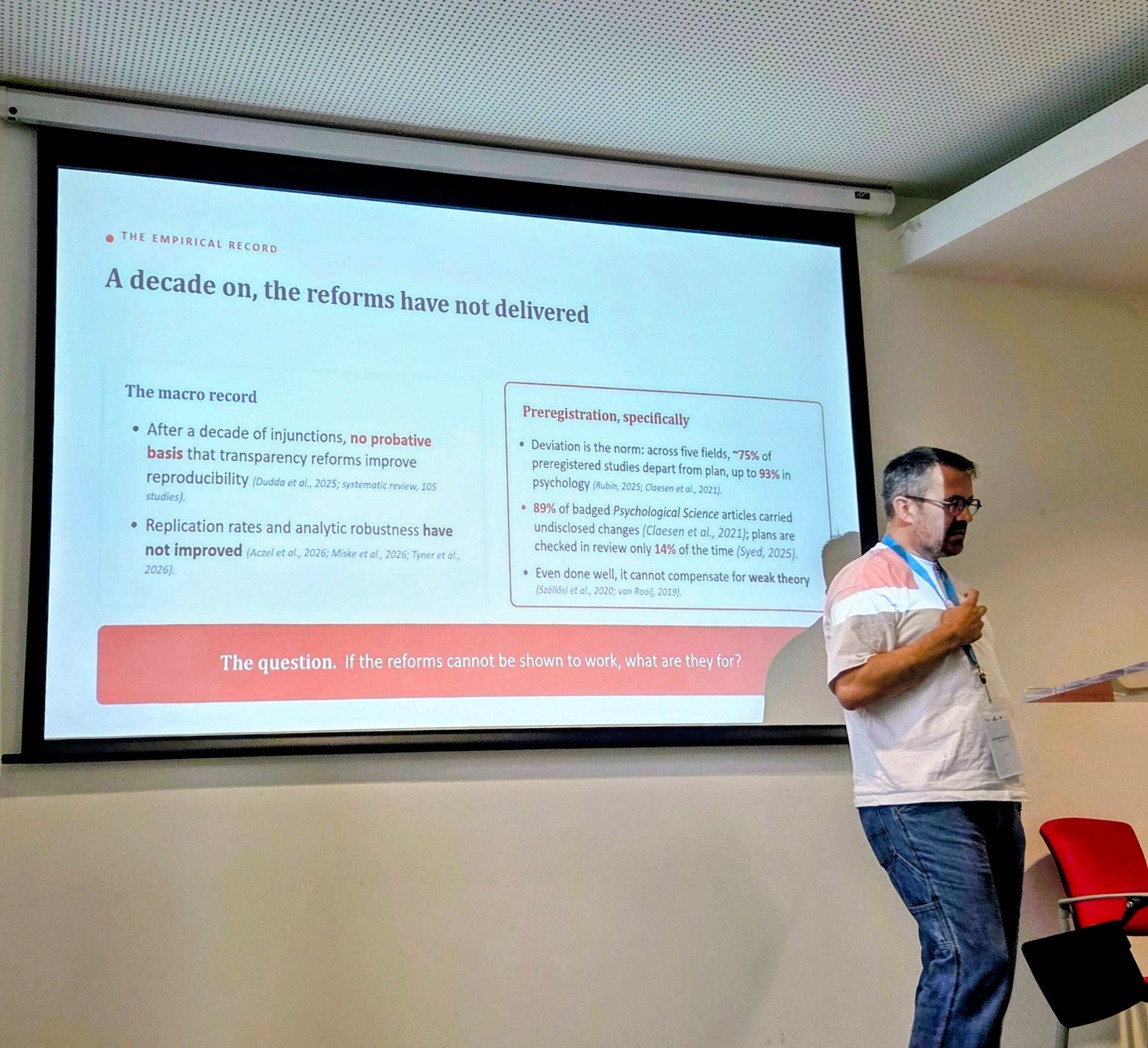
F. Gabarrot & M. Rubin (Convenors) (2026, July 1), Who critiques the critique? Toward a reflexive metascience. General Meeting of the European Association of Social Psychology, Strasbourg, France.

Related to my EASP presentation, I published a new article today that asks: “What is critical metascience and why is it important?”
I define critical metascience as a multidisciplinary research area that takes a step back to question some of metascience’s commonly accepted assumptions, methods, problems, and solutions …. In the current article, I aim to raise the profile of this research area and offer a rationale for viewing it as a distinct field of multidisciplinary inquiry.
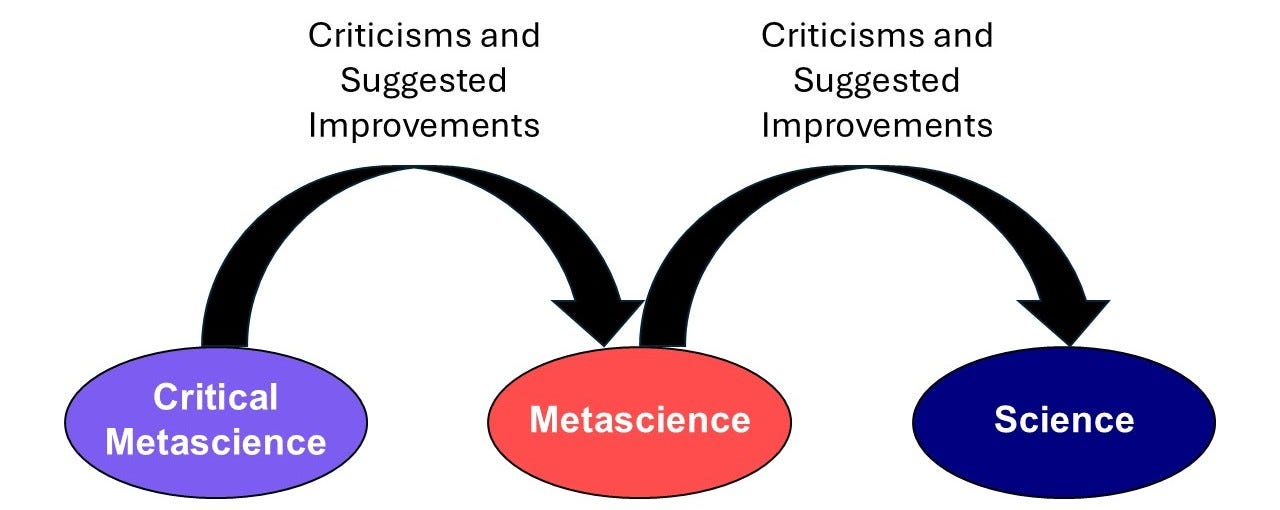
In my article, I:
define critical metascience;
explain why it’s important;
address some potential concerns about it;
consider some emerging themes in the area; and
evaluate its potential relationships with metascience.
I conclude by reflecting on Popper’s (1976) point that “the objectivity of science is … [the result] of the friendly-hostile division of labour among scientists” (p. 95). I argue that:
Critical metascience can play an important part in Popper’s “friendly-hostile division of labour” by offering a special type of external criticism that exposes and challenges potential biases and dogma in metascience in order to improve its objectivity and approach.

Daniel Gilbert and colleagues (2016) published a comment on the Open Science Collaboration’s (OSC; 2015) “Estimating the reproducibility of psychological science.” They concluded that:
Metascience is not exempt from the rules of science. OSC used a benchmark that did not take into account the multiple sources of error in their data, used a relatively low-powered design that demonstrably underestimates the true rate of replication, and permitted considerable infidelities that almost certainly biased their replication studies toward failure. As a result, OSC seriously underestimated the reproducibility of psychological science.
Consistent with Gilbert et al.’s (2016) view, reviews of more recent well-powered, high quality replication studies have found much higher replication rates than the OSC’s original estimate of 36%. For example, Nosek et el.’s (2022) review of 307 replication studies found a replication rate of 64%, Cobey et al.’s (2023) review of 116 replication studies found a replication rate of 71%, and Tyner et al.’s (2026) test of 274 claims found a replication rate of 55%. Based on these more recent estimates, the observed replication rate appears to be around 63% rather than 36%.
Is a 63% replication rate grounds for a “crisis”? As I’ve discussed recently, it depends on what you expect the replication rate to be. Glibert et al. also raised concerns about the “correct benchmark” in their follow-up article, arguing against a purely statistical interpretation based on random sampling error per se:
The correct benchmark must recognize all genuine sources of variability and cannot be limited to the fiction that the only way in which the replications differed from the originals was that they drew different subjects from the identical population.
A key challenge for future work which claims to have found “low” replication rates is to explain and justify an “acceptable,” “optimal,” or “expected” replication rate (see also Rubin, 2023).
Gilbert, D. T., King, G., Pettigrew, S., & Wilson, T. D. (2016). Comment on “Estimating the reproducibility of psychological science”. Science, 351(6277), 1037-1037. https://doi.org/10.1126/science.aad7243

Comments
Nothing yet. Say the first thing.
Sign in to join the conversation.