
Metascience is not a monolith! It has many different aspects, including the fast-growing area of feminist metascience. I’ve recently discussed feminist metascience and open science on this Substack here and here, including work by Jenni Adams, Miranda Lynn Barnes, Madeleine Pownall, Elizabeth Bennett, and others. So, it’s great to see that a special issue on the topic is forthcoming in the journal Gender and Society.
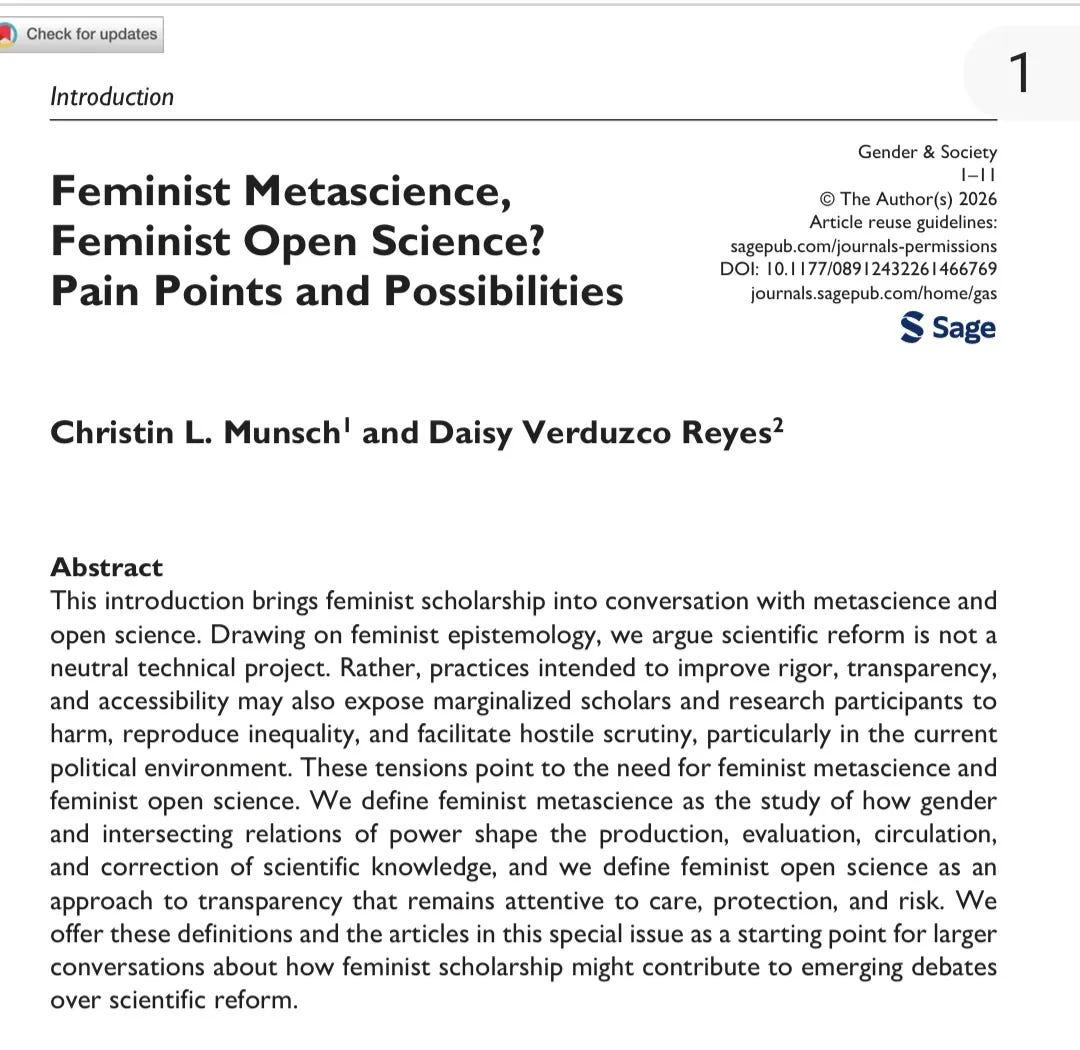
Munsch, C. L., & Reyes, D. V. (2026). Feminist metascience, feminist open science? Pain points and possibilities. Gender & Society. https://doi.org/10.1177/08912432261466769
In their Introduction to the special issue, Christin Munsch and Daisy Verduzco Reyes define feminist metascience:
Gender organizes social life, is historically and socially produced, and operates in relation to other axes of domination like race, class, sexuality, nationality, coloniality, and disability. Broadly speaking, then, we might define feminist metascience as an approach to the study of science that brings this orientation to bear on how knowledge is produced, evaluated, circulated, and corrected.
They also define feminist open science:
If open science is committed to transparency, sharing, and reproducibility, a feminist open science necessitates asking how those commitments can be pursued in ways that also attend to power, inequality, care, and the unequal conditions under which knowledge is produced. In this sense, feminist open science might be defined as an approach to open science practice that seeks to advance transparency and accountability while remaining attentive to the ethical, political, and epistemic consequences of openness itself. Such an approach treats openness not as an absolute good or fixed checklist, but as a situated set of practices whose value and risks must be assessed in relation to specific communities, methods, and institutional conditions.
They then guide us through the articles in the special issue. As they explain:
We open the issue with Madeleine Pownall’s article, “Women as the First Open Scientists.” Much like Morris’s (2015) landmark account of how Du Bois’s foundational contributions to sociology were obscured by racism, Pownall recovers five pioneering women in the field of psychology whose work laid important foundations for what are now framed as contemporary open science reforms. By documenting women’s early contributions to practices such as replication, analytical precision, and conflict-of-interest disclosure, she challenges narratives that cast openness and transparency as recent innovations.
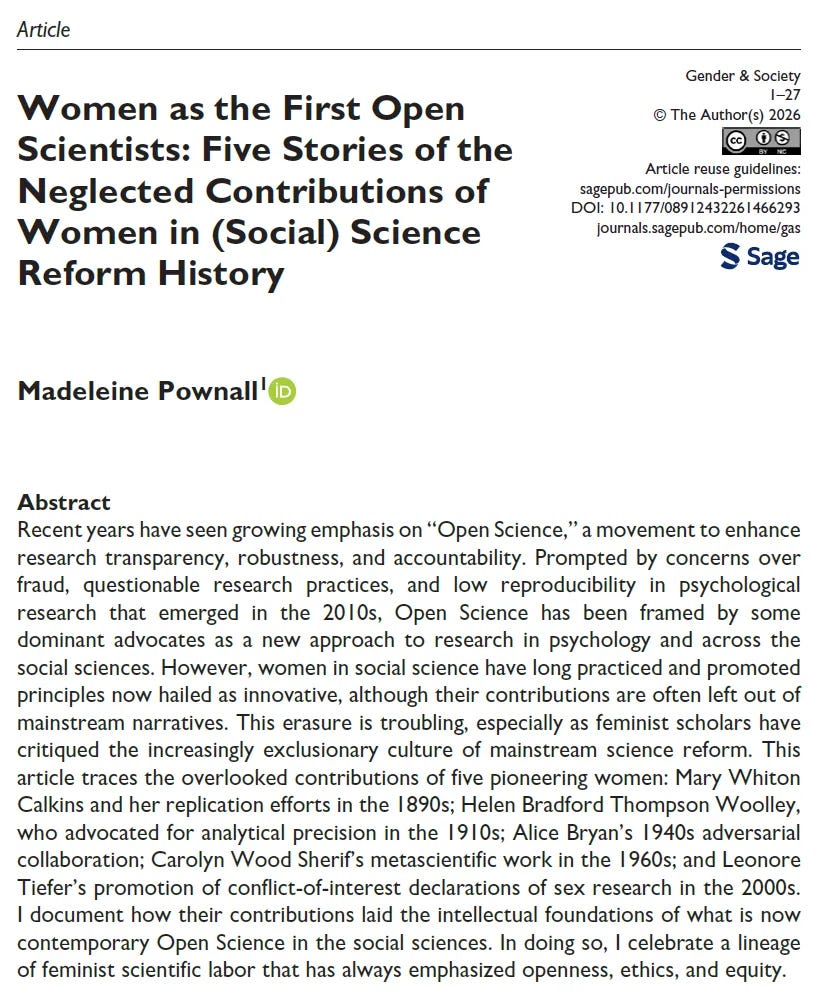
Pownall, M. (2026). Women as the first open scientists: Five stories of the neglected contributions of women in (social) science reform history. Gender & Society. https://doi.org/10.1177/08912432261466293
The next two articles examine specific professional practices, drawing attention to the ways everyday scholarly activities are themselves gendered. For example, Jina Lee’s article (“Claiming Novelty, Claiming Authority”) shows that scientific authority is performed through routine rhetorical practices. Specifically, Lee finds that the use of novelty claims—rhetorical assertions that frame research as groundbreaking—vary by gender and disciplinary context. In science, technology, engineering, and mathematics (STEM) fields, which possess a high level of paradigmatic consensus, professional success is narrowly tied to assertive, masculine-coded self-promotion, creating a double bind for women that results in fewer novelty claims and, in turn, fewer downstream citations. Conversely, the humanities and social sciences offer more varied pathways to recognition, which appear to mitigate these constraints.
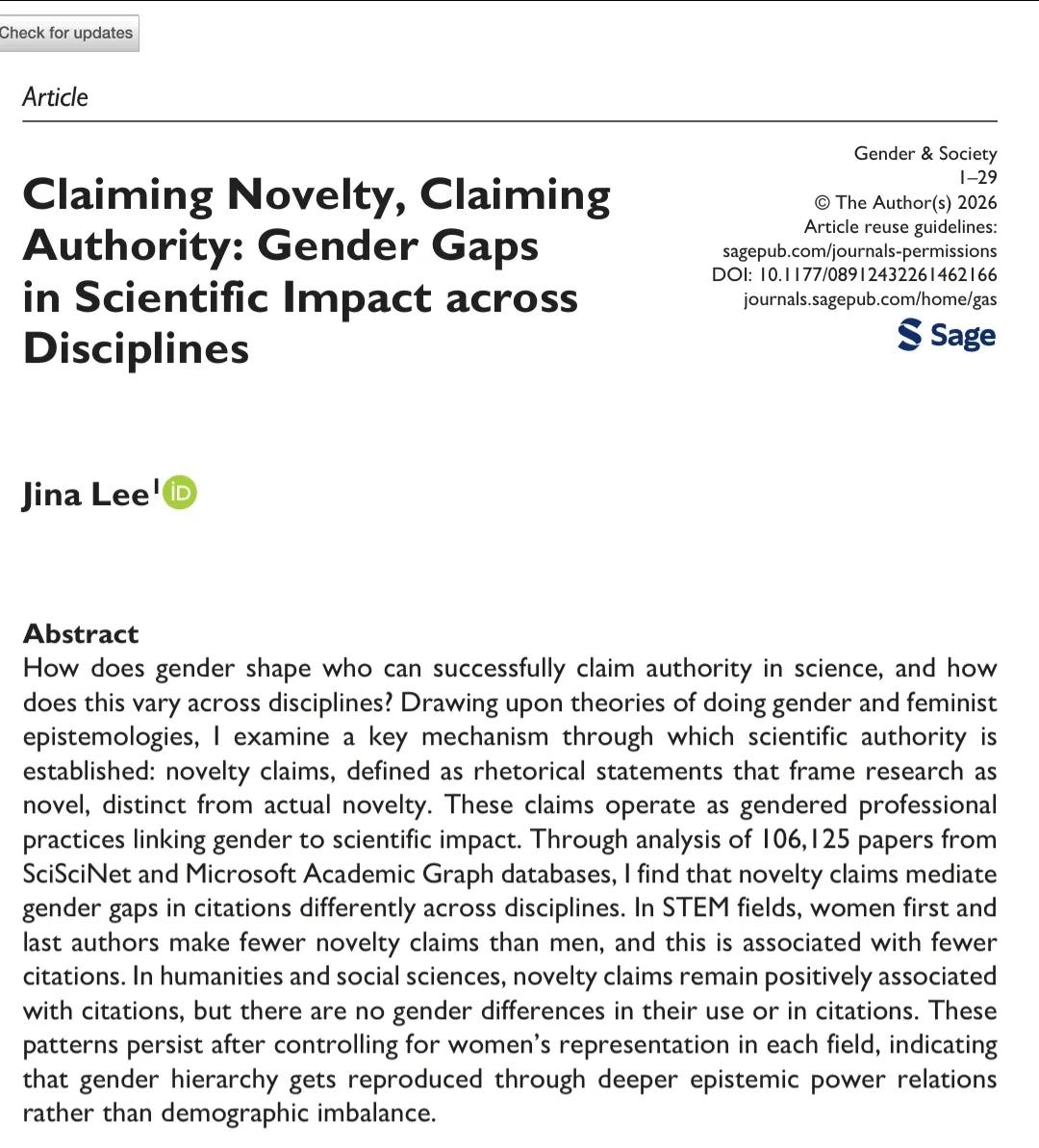
Lee, J. (2026). Claiming novelty, claiming authority: Gender gaps in scientific impact across disciplines. Gender & Society. https://doi.org/10.1177/08912432261462166
Likewise, in “Sharing Knowledge Openly,” Molly King and Jeffrey Lockhart examine open access and repository participation not as straightforward indicators of scholarly virtue, but as practices embedded in unequal institutional and interpersonal conditions. They find that women and scholars of color are underrepresented in “green” open access publishing—the practice of self-posting alternate versions of papers online for free—and situate these patterns within “bropen science” culture, differential exposure to harassment, unequal access to resources, and uneven distributions of time and labor.
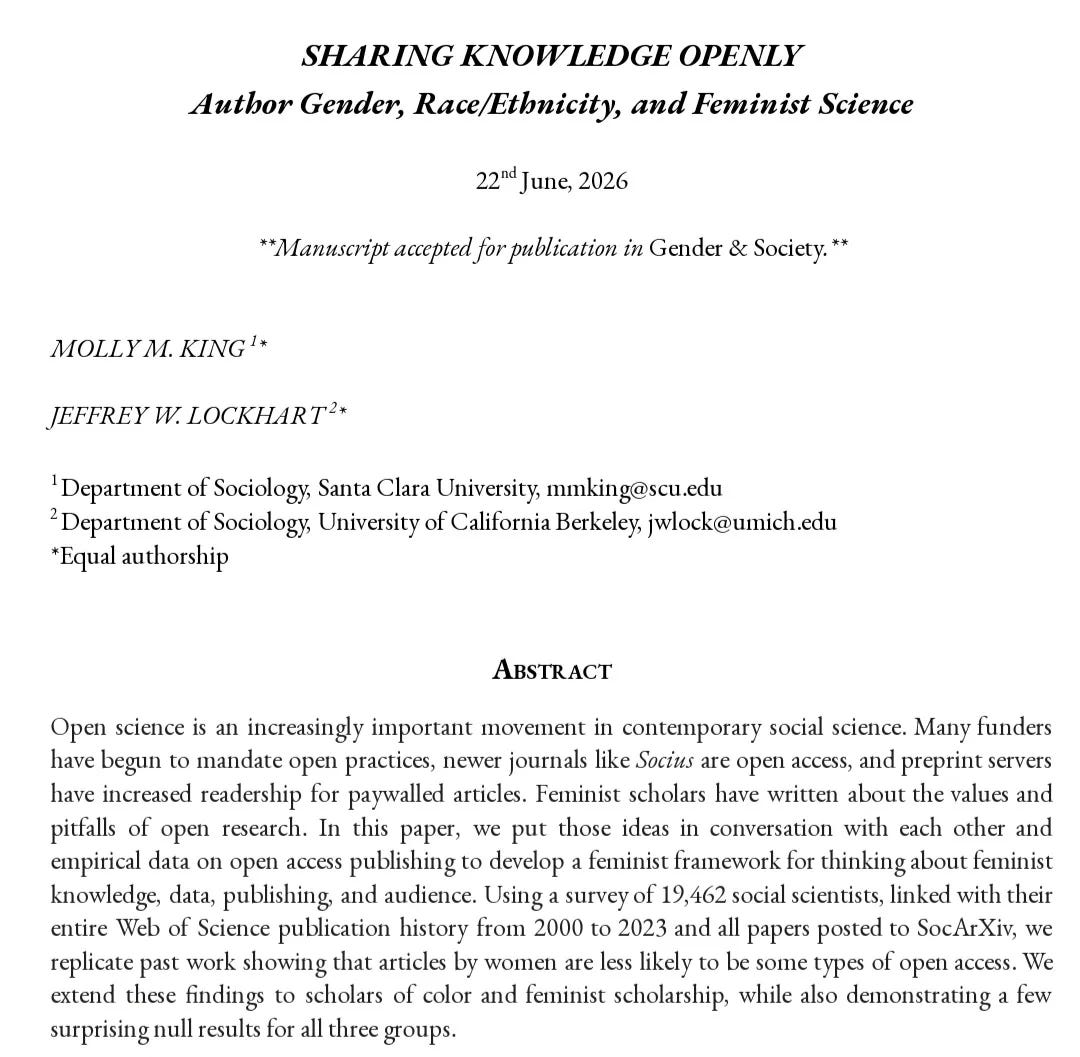
King, M. M., & Lockhart, J. W. (2026, June 23). Sharing knowledge openly: Author gender, race/ethnicity, & feminist science. SocArXiv. https://osf.io/preprints/socarxiv/a2d86_v2
The final set of articles concern the spread of ideas both in and outside of the academy. Laura K. Nelson and colleagues (“What Gets Lost in Translation?”) develop a feminist-informed metascience framework showing that the success of academic ideas depends not only on who produces them, but also on how those ideas are translated. Using publications tied to the NSF ADVANCE program, the authors propose a creation-diffusion model demonstrating that context, author expertise, and the substantive content of ideas shape whether ideas are taken up and spread. Ideas framed in more institutionally palatable ways diffuse more widely, whereas sharper feminist critiques of structure and inequality are more likely to be resisted, softened, or left behind.
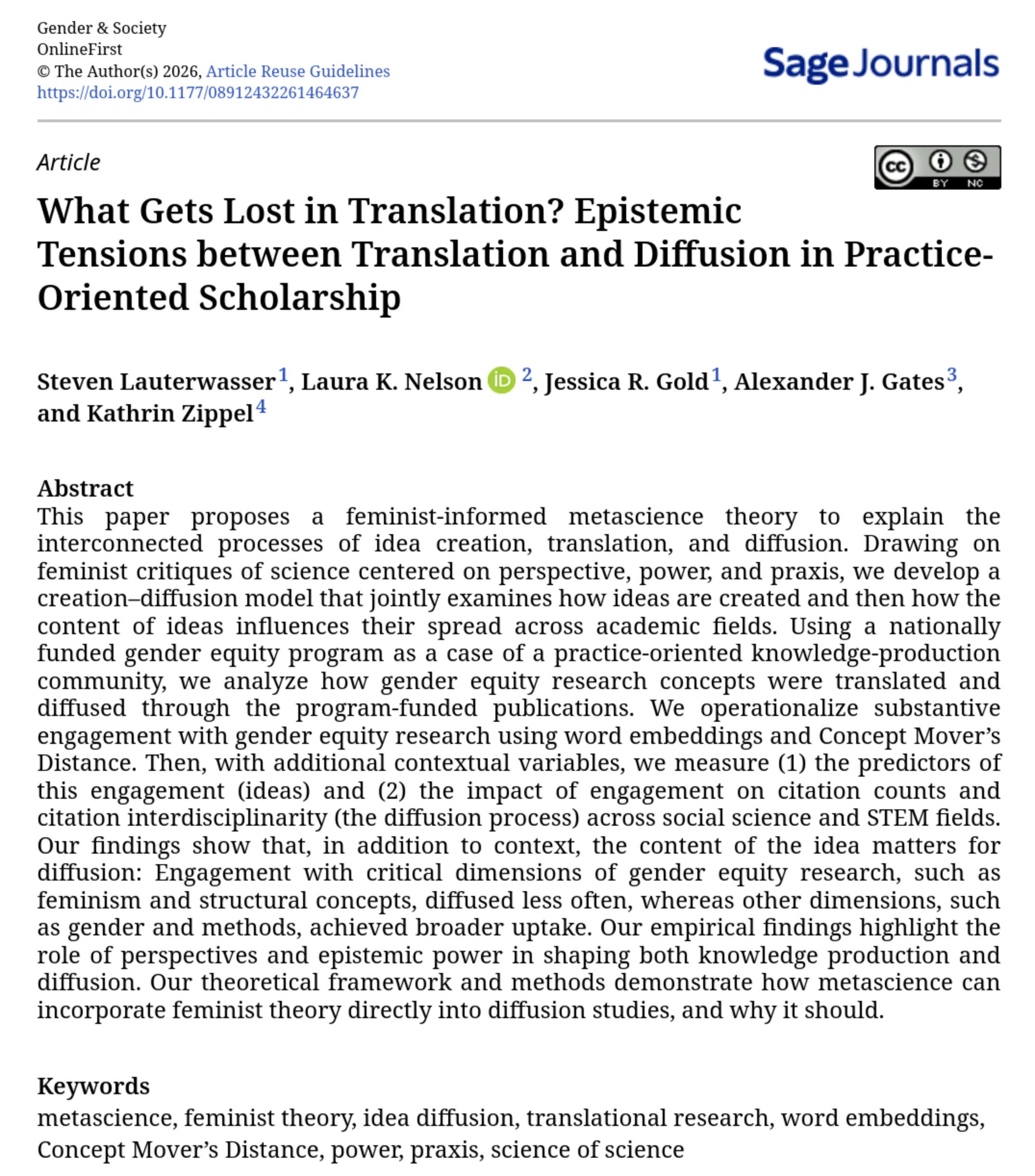
Lauterwasser, S., Nelson, L. K., Gold, J. R., Gates, A. J., & Zippel, K. (2026). What gets lost in translation? Epistemic tensions between translation and diffusion in practice-oriented scholarship. Gender & Society. https://doi.org/10.1177/08912432261464637
Similarly, Jennifer Lee (“Who Receives Scientific Deference?”) examines what happens when scholarly ideas enter public discourse. Through an examination of media representations of women and men social scientists, she shows that the public reception of expertise is filtered through gendered cultural schemas. Women’s work is often trivialized, politicized, or recoded as popular writing, whereas men’s work is more readily framed as rigorous, objective, and properly scientific. In positioning these articles at the end of the issue, we emphasize that the fate of ideas depends not only on their creation and dissemination, but also on their visibility and diffusion. For this reason, we call for a broader conception of metascience that attends to the processes through which scientific findings are legitimated, undermined, or distorted.
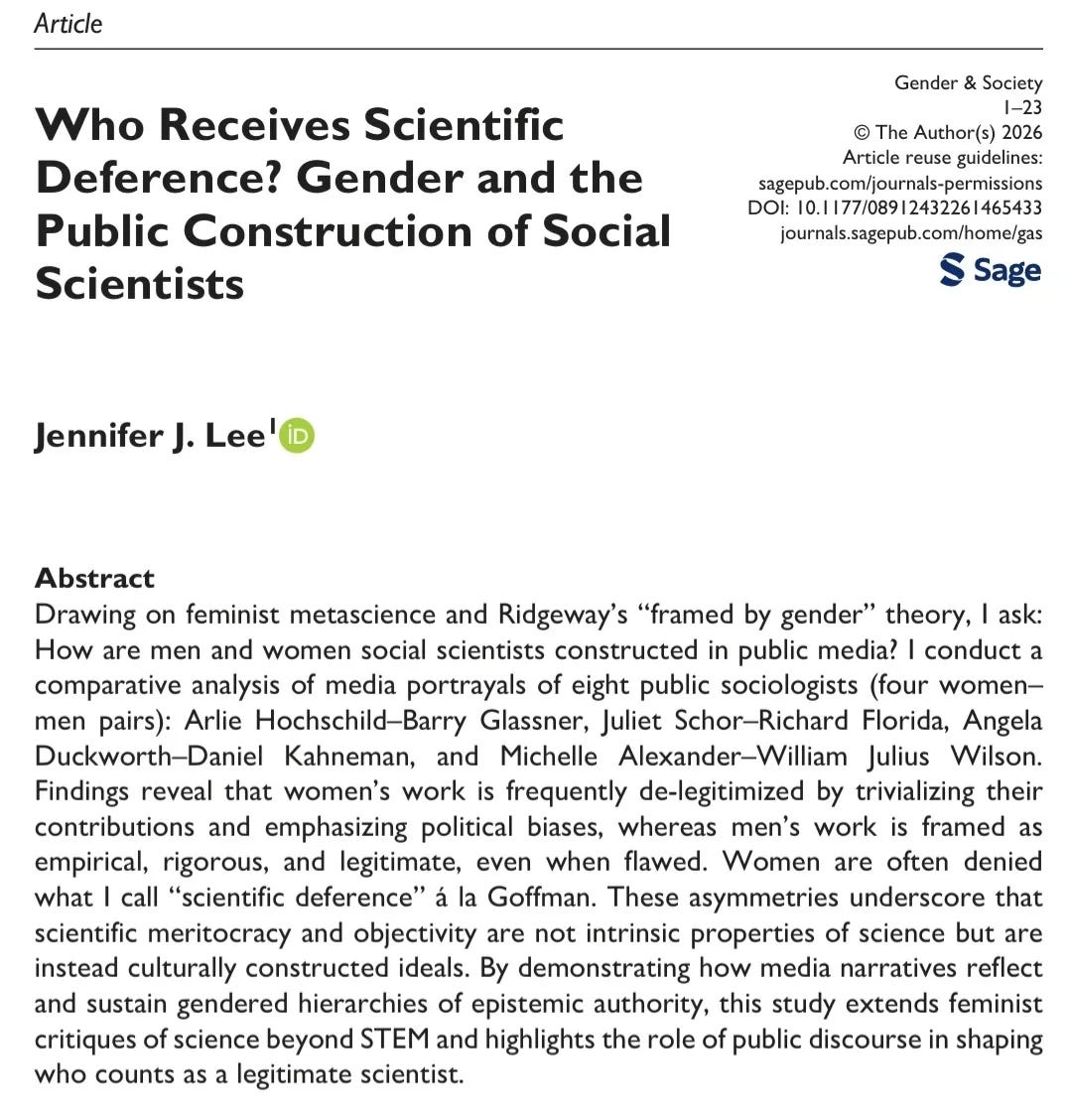
Lee, J. J. (2026). Who receives scientific deference? Gender and the public construction of social scientists. Gender & Society. https://doi.org/10.1177/08912432261465433
The editors conclude that:
Science requires more than technical reform. It requires metascientific work and open science initiatives capable of reckoning with the gendered and intersectional conditions that shape every aspect of knowledge production itself.

Comments
Nothing yet. Say the first thing.
Sign in to join the conversation.