
Most of the time, home-recorded lo-fi music is heard most clearly in its moment. With fewer barriers between those making the art and those experiencing it, recordings can feel more like letters from friends than “records” preserved for posterity. Which might explain why so much of the lo-fi from the past that hit me hard and seemed terribly important when I first heard it is most mostly forgotten now. Take Weed Forestin from Lou Barlow’s Sentridoh, for example—when I reviewed a reissue of it in 2012, it seemed like I couldn’t get anyone who hadn’t heard it back in the day excited about it. To me it was a stone classic and I found myself wondering if you had to be there.
And then there’s Sukpatch, a trio (mostly) who made lo-fi indie pop in a style jokingly (and accurately) called Casiocore. I discovered them in the ’90s because their label, Slabco, had an affiliation with fellow Seattle imprint Up. The latter, home to Modest Mouse, Built to Spill, Quasi, and others, was the kind of label whose taste was so good and matched my own so perfectly I’d buy one of their new records without knowing a thing about it. And Slabco seemed like a kind of feeder for the indie-pop side of Up’s offerings, as embodied by the romper-room psychedelia of a sample-based project called Land of the Loops.
Since Sukpatch was on Slabco, I first assumed they were from Seattle and later learned they were from Minneapolis. So much of the home-recorded lo-fi stuff I’d enjoyed was a mix of noisy and abstract and folky but Sukpatch basically seemed like they took Depeche Mode’s “Dreaming of Me” as a starting point and set out to create their own version with half-busted samplers, cheap keyboards, awesome basslines, and tape loops. Their tunes were funny, wildly catchy, and streaked with a bit of melancholy.
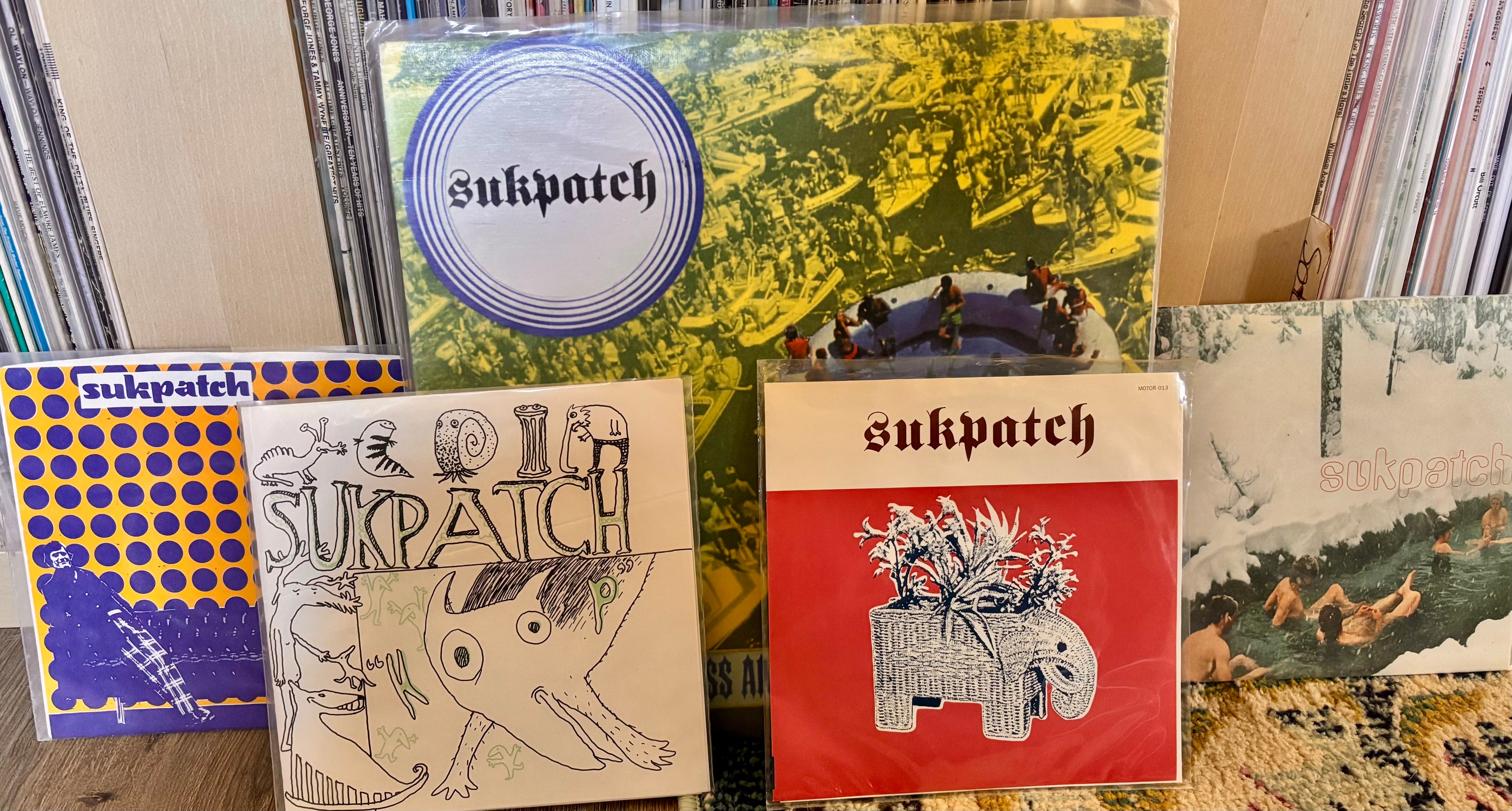
I couldn’t get enough of this stuff. I bought Sukpatch’s album, Haulin’ Grass and Smokin’ Ass, along with an EP and several singles. Later, I saw that Slabco was selling a number of its early cassettes and bought two from Sukpatch (one actually a side project under the name Patch), one from Land of the Loops, and one from Australia’s Stinky Fire Engine. (I wrote about several of these releases for the Allmusic Guide around the turn of the millennium, which might be the only reviews of them on the entire internet, or indeed the known world).
In 1998, Sub Pop re-launched its singles club, where you’d subscribe for a year and they’d send you two new 7-inches every other month. If memory serves, the first installment was Modest Mouse’s “Never Ending Math Equation” b/w “Workin’ on Leavin’ the Livin’” and Sukpatch’s “Stolen Chrome” b/w “Bubble Shaff” and let me tell you, it was thrilling. Both were so good, and exactly what I wanted to hear at that moment. Not unlike the earlier tapes I’d been enjoying, it was like this package had been prepared just for me. Not long after came word that Sukpatch had signed with the Beastie Boys imprint Grand Royal, bringing together two of my personal obsessions in a very unexpected way. They released one EP, Tie Down that Shiny Wave, and Grand Royal shut down soon after.
I didn’t hear anything about Sukpatch for quite a while after that. Slabco wound down, Up Records stopped releasing new music after founder Chris Takino died, and the mini-scene I found so captivating seemingly vanished. Sukpatch released one more album in 2006 on Moshi Moshi but somehow I missed it entirely. I kept their ’90s music in rotation, however—nothing since has quite scratched that itch—and now and then I’d wonder if they might reenter the conversation somehow.
To my surprise, there’s been quite a bit of Sukpatch activity in the last year or so. Lite Hits, one of those early tapes, was reissued on vinyl, and in the past few months put out the compilation Thin Skin Diver, which gathers some of their best work from 1991 to 1996 (the date cutoff might explain why “Stolen Chrome,” possibly my favorite Sukpatch song, wasn’t included). I never knew much about Sukpatch while they were a going concern, information was scarce. Michaelangelo Matos has an informative interview with them over at The Current, I believe it’s the first I’ve read.
A while back I was talking lo-fi with my friend and colleague Sydney Salk (subscribe to her newsletter Compilation Nation). She’s a student of home-recorded music and knows the history. I mentioned Sukpatch to her, and she dug what she heard, bought a copy of Lite Hits, and she wound up playing them on her WFMU show, which I consider a feather in my cap. All of which suggests that this music can indeed reach people who care from later generations, a thought I find reassuring.
Thanks for reading Beauty Blew a Fuse! This post is public so feel free to share it.
Comments
Nothing yet. Say the first thing.
Sign in to join the conversation.