
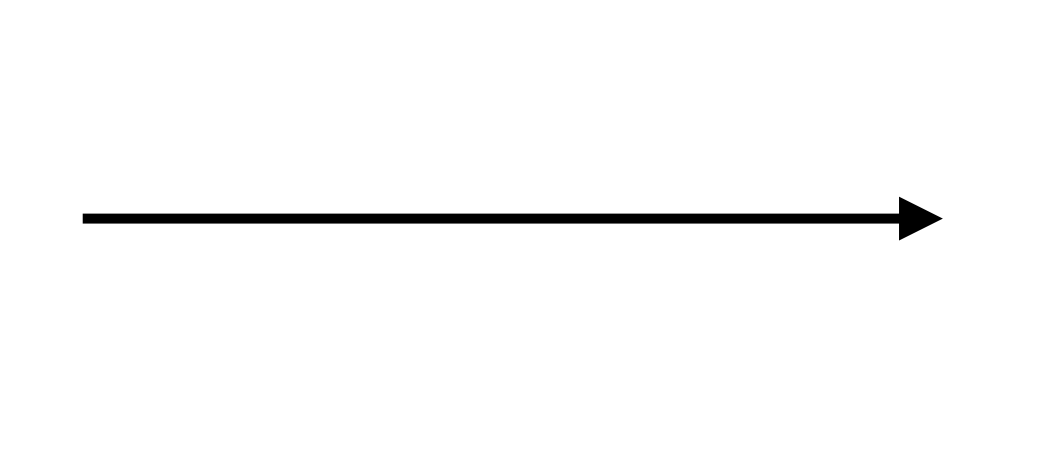
When someone refers to “history” they either mean the minutiae of wars and plagues that somehow string together to produce the current moment––which is fun to learn as much as possible about but a general outline naturally suffices––or they mean something to do with a Paul Klee painting and samsara. I’ve been to college and I still picture a straight line pointing right when I think of “history,” like this.
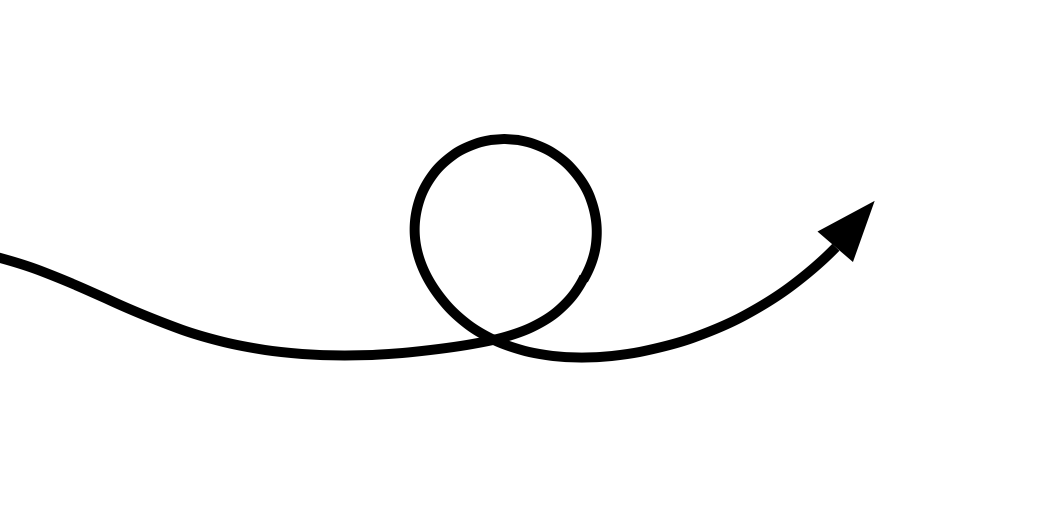
Or when I have just read Kojeve it’s something of a straight line with a loop in it still pointing right but a little bit northeast and the left part spans the rest of the length of the page, hinting at potentially more loops. Like this.
The philistine notion that “time is a flat circle,” borrowed from the HBO show True Detective Season 1, elects time to be one’s recent memory with the flat circle being a self-impressed stupor induced by one’s own ability to detect patterns. Sorry, but I wouldn’t even know what to do with a pattern if I saw one. The real problem is in misunderstanding memory as anything but a tool to mentally index things you encounter in reality in order to make plans and draw conclusions. Those not prone to challenge themselves begin to get scared when codified entities reappear in their thoughts. Some have diagnosed this as “hauntological” and killed themselves over it. I am talking about when people start wearing distressed jeans after 10 years of not doing that, or when there will inevitably be another Legally Blonde movie.
People will get scared and think, what happened to culture? When any given movie in theaters was original and worth seeing? When rock music had subgenres? The fact that you even ask these questions is the source of the problem. History stagnates when it begins to recycle recent memory as supposedly mythical. The midcentury was an artistically fresh era because its constituents rejected the past wholesale in order to create and enjoy the current moment. Neither in the hearts of truly American poets like Berryman or Lowell was there an interest in producing utopia. To be really self-centered, one eliminates the self and just does. Director Pedro Costa had said, “there’s nothing before and the future doesn’t exist, therefore, we have to do it now.” The future is a hangup and history is gay.
Thus the only people that understand history are the obsessive nerds like Braudel that select a topic and relish in learning as much about it as possible. It’s the minutiae (or the monads if you’re nasty) that constitute the myth. Once you have the myth you can index it as your own and make plans, untethered from time. The cool kids of the present moment (who are about 28 to 35) are weary with nostalgia for 10-15 years ago. For swag, the creative class, and characters in teen movies calling things retarded. Subjects of nostalgia nowadays swirl around a certain freedom that’s been lost, an imperceptible vibe. How to revive this?
Authenticity is approached inadvertently, and coolness is enjoying life in the bubble produced thenceforth. Looking around I see bubbles everywhere. That is, homes! People in places enclosed against the world, with the people and the things that they curate with absolute prejudice. Right now outside my window I see another window housing a dim light and a human shadow, another world. In my experience the greatest sense of esteem there is is when I am invited into someone’s home, by special permission, and I trespass the invisible membrane that separates my world and their own. Now the impossible has happened. I hang up my coat with some others. I pet their small dog. Nothing is true, everything is permitted.
While intoxicating at first, the surreality of a dinner party or a simple kickback is not necessarily a knock at the doors of perception. Rather my gaze becomes scrutinizing, narrower. Like a dream, a single misstep may cause it all to vanish at once. Consider my world and the host’s world, two bubbles now intervening, they create an aperture that serves as the commonality in this venn diagram. Analogously, when historical streams meet they create an interstice where a cultural vacuum occurs. People no longer know what purpose their traditions served and are left only with the remnants, the vibe, the affect. I traverse the strange apartment seeing ghosts everywhere.
Best to ignore them, as if I had never noticed in the first place. Relax; having forgotten how many Peronis I have already had I have another Peroni. No, still too tense, and now bloated. Having become morose and silent I leave leaving no notice, hoping that the next opportunity will be more fruitful as a man collects empty cans beside the bus stop. I stare at the bus schedule in my phone and then open a tab to jot down a couple thoughts so that the night may not be a total waste. O.K. I have a thought: what if rent was cheaper? This is a trendy position among hack artists, that counter-culture was only possible when kindred dejects had walking-around money to throw at one another and fund polaroid collections of each others’ ass holes. Patti Smith even told her aging fans to move to Detroit, or wherever, so that the high cost of living in her native NYC may not inhibit their creativity. Fran Leibowitz said what I just said. Nan Goldin probably said something similar. Do they have a point? Have I lost touch with the pulse that these 80-year-old Jewish women hold down unscrupulously with their rumpelstiltskin fingers? I resolved to board a Greyhound bus heading South, then East, towards Southeast Philadelphia where rent is slightly cheaper so that I may find out for myself.
Eating the foam from the headrest I was facing cured me of a future hangover but also induced a forgetful delirium in my brain that made me forget to find someone to hang out with at 5am on this Saturday. It was too late for that, I just needed to find somewhere to stay. I plugged my phone into the bus to charge and opened Tinder on my phone’s web browser to find a woman around my age who would let me sleep in her apartment for free that night. I kept doing this hours later while in Adventure Aquarium in New Jersey when Peyton, 22 accosted me under the shark tunnel. She was really not my type so I suspected I was not as sober as I thought when I planned the date at 5:45am and then forgot. I said you must be looking for someone else and left through the emergency exit and walked back to Philadelphia. Even though at this moment Peyton, 20, Peyton, 20, and Marge, 44 were likely waiting in the Marketplace Café and the Flying Fish Beer Garden respectively, I had to chalk this operation up to a bust and find a different way forward.
I soon found myself in the living room of someone I had worked with once. I said thanks for letting me stay the night and he said no problem man and that was the extent of our interaction. I didn’t disclose that I was here with anthropological intent, I didn’t want to disturb the tenuous thread that the act of hanging out hangs onto. For all intents and purposes I was also there to hang out with all 15 of the roommates present. With three of them I shared an afternoon walk, brisk, lush with lore about the city and all the buildings that had burned down in the past year, posthumously condemned. I said almost nothing. That evening I watched two others take turns playing Grand Theft Auto V with all the cheats on, trespass a virtual airport, hijack a plane, jump out mid-flight, land and return to the airport to do it again. I tried to play but accidentally accessed the story mode, prompting another to load a previous save file and continue jumping out of the plane. A catatonic sixth was robotripping while a seventh serenaded him on the melodica to remarks such as “I can feel this music,” “Wow,” and “Ah damn” as a matted Maine Coon crawled onto his lap cemented into its hot cushion.
I laid back. The scent of the couch I sat on and the tasseled lampshade beside it suggested that this house smoked indoors. I lit another Camel Turkish Delight. Steely Dan’s Katy Lied played on cassette. I ventured upstairs for a beer because the refrigerator was in a different room than the kitchen. A purple light peered from a bedroom to my right, could the fridge be in here? As I open the door five more roommates glare at me and shift around like caged tawny owls. I approach the white monolith towards the corner as they continue to move, blink and rotate their heads. A Behringer on top of a vast persian rug soaks the room in neon light, buzzing all the while at a constant, binaural frequency. I take a Modelo, carefully. I take another since I’m already up there. I slowly back away as the roommates congregate back around the rug like vultures a carcass.
This experience was interesting but not for me. I didn’t like having electric razor trimmings stuck to my feet for 48 hours or the sinus infection I contracted from my bed. Regardless, I learned a great deal. However, I wanted to learn a massive deal. My study was incomplete. The aloof real estate of Philadelphia permitted that its denisons occupy condemned buildings and split rent 10+ ways, helping to constitute little communes producing genderless IDM with unprecedented output. A renaissance for what it's worth, that is, not much. I shed this impoverished mindset and spent $400 on an Uber back home. On the way I mainly slept, keeping my head tilted upwards to avoid choking on the accumulated cat dander lodged inside my face. When I awoke I texted “moves?” to everyone in my contacts whose names could be anagrammed from Konstantin or Whit Stillman. Unsurprisingly, these were the most affluent and discreetly powerful people I knew. Aristocrats of the soul, they lived in expensive apartments. I took my pick.
Drop me off here, I said to the Uber driver after many hours of pure silence. He muttered something to himself and then OK SAR HAVA GUD NIGHT as I stepped out of the Accord and spat a mass of phlegm the size of a toad onto the sidewalk. This was the place, Murray Hill, the part of New York that is the most like Vancouver but the least Canadian. The building’s buzzer was an app that I used to text apartment 19E the picture that it took of me. It didn’t seem to work so I waited for a DoorDash driver to open the door for me from the inside. I knew the host, Whit Stillman (no relation), from another party commemorating the life and work of a Fordham University TA I worked on a number of film sets with as a creature consultant. He ended up dying on the set of The Twilight Zone movie, slipping on a craft service hotdog while dictating to the airplane gremlin precise Tartar mannerisms. At the wake Whit and I ended up bonding over Eckhart and promised to keep in touch.
The party was a disappointment. Whit was swarmed with minglers and I didn’t know anyone else, so for hours I was forced to humor the lower crust of the upper class. Not so much friends and friends-of-friends but clientele all in quiet business with one another. Not that I know what they do, it’s not my business, after all. For certain I can say that simply knowing different types of people affiliated with different types of things warrants some kind of instantaneous cultural capital among them. It’s the kind of atmosphere that would have presupposed the invention of Facebook. I mentioned Goethe and a man with a wide mouth said to me “Aha, I could tell you were a Hellenist.” This made me feel poor so I ventured to score some coke, as I was low on funds. I made it into the inner circle and took my turn last. I scooped the remainder into a zip-loc and exited. Immediately I was accosted by a Bard graduate. “What are you working on?” was frequently posed to me throughout the night, not so much as a question than as an initiation. This interaction followed the trend and once prompted I said, nothing.
Really you seem like a creative person.
I’m just biding time until my discipleship starts.
Your what?
Hey let me ask you a question.
What?
What like you can’t hear me or like what is a discipleship.
Yeah.
I’m going to turn on this stovetop burner.
That’s what’s up.
Please make sure to turn it off before anyone lights a match or anything.
Yeah.
OK I’m going out.
I ended up walking to SoHo, looking for an alleyway from which to sling the cocaine I won. I found a buyer and made the exchange. I hailed a cab and asked the driver to turn his radio to the FDNY frequency and prayed that that poor wasian had had her wits about her. Mostly static but I could make out “kips bay” from the distortion—I sank deep into my seat, crestfallen. She, Whit and everyone else at the high class party were now in God's hands. If anyone was so unlucky I felt some peace knowing that they would be going to heaven. The driver changed the station. I watched light trails from headlights and lampposts string along the freeway while listening to Beabadoobee. Arriving home, I gave the cab my cash and the remaining 18 grams of cocaine I didn’t sell. When I got home my collie rose from her sleep to greet me. I rubbed her belly and threw the ball around a bit. She went back to sleep and I began reflecting.
I have to think that somewhere in middle America right now a bunch of kids living in their parents houses are kicking back in ways more generative and schizo-pilled than any artist or tech-nomad living in a major metropolitan area can currently dream of. Before we see the fruits of their anti-labor it’s still worth pondering why, for the moment, it is that there is no scene to be seen whatsoever anywhere. Why, in more explicit terms, has this generation not produced its own dadaists, its own beats, its own naturalists, its own “visceral realists”? Doing the math,
surplus creativity = life - rentdidn’t square as some people can afford higher rent just as well. But
surplus creativity = life - (rent/affluence)doesn’t work out either as the lives of the affluent or the less-than-affluent were quite different. Finally,
surplus creativity = (life/particularness) - (rent/affluence)doesn’t work out when that creativity only exists to feed back into such particular lives with relative rents, like so:
particularness(t+1) = particularness(t) + kparticularness ⋅ surplus creativity,
affluence(𝑡+1) = affluence(𝑡)−𝑘affluence ⋅ surplus creativityAs in any closed loop system, there appears to be no fracture where art seeps into the greater pool of society. It only seeks to stabilize. In other words, there is no culture because there is no actual surplus.Everything is in honor of repaying future debts. As Blake said, “The cistern contains, the fountain overflows.”
This brings me back to where I started. The affordance to do nothing is not a matter of privilege or circumstance because it’s only afforded from within. Doing nothing must be granted by no one for no reason, like Odysseus cloaking himself in his own private egotism. The character Des Esseintes in Huysmans’ A rebours isolates himself from society to submerge himself in the aesthetic pleasures sine qua non of his noble standing. He doesn’t conduct his life in allegiance to his class, but rather because his class affords him it. He is a decadent in the aristocratic tradition whose reclusiveness marks the final transgression towards the end of this tradition. The works by Moreau, Goya and Redon, housed in his faraway abode in the countryside, are not appreciated as assets but as devices for his sole admiration. His private aesthetic world is of an abundance detached from rational, monied interests. Take this description of an aquarium installed in our hero’s dining room and keep in mind that this is all devised, paid for, built and delicately modified in order for him to languish more effectively:
“In autumn, at sunset, when the steam rose from the samovar on the table, the water of the aquarium, wan and glassy all during the morning, reddened like blazing gleams of embers and lapped restlessly against the light-colored wood. Sometimes, when it chanced that Des Esseintes was awake in the afternoon, he operated the stops of the pipes and conduits which emptied the aquarium, replacing it with pure water. Into this, he poured drops of colored liquids that made it green or brackish, opaline or silvery—tones similar to those of rivers which reflect the color of the sky, the intensity of the sun, the menace of rain—which reflect, in a word, the state of the season and atmosphere.”
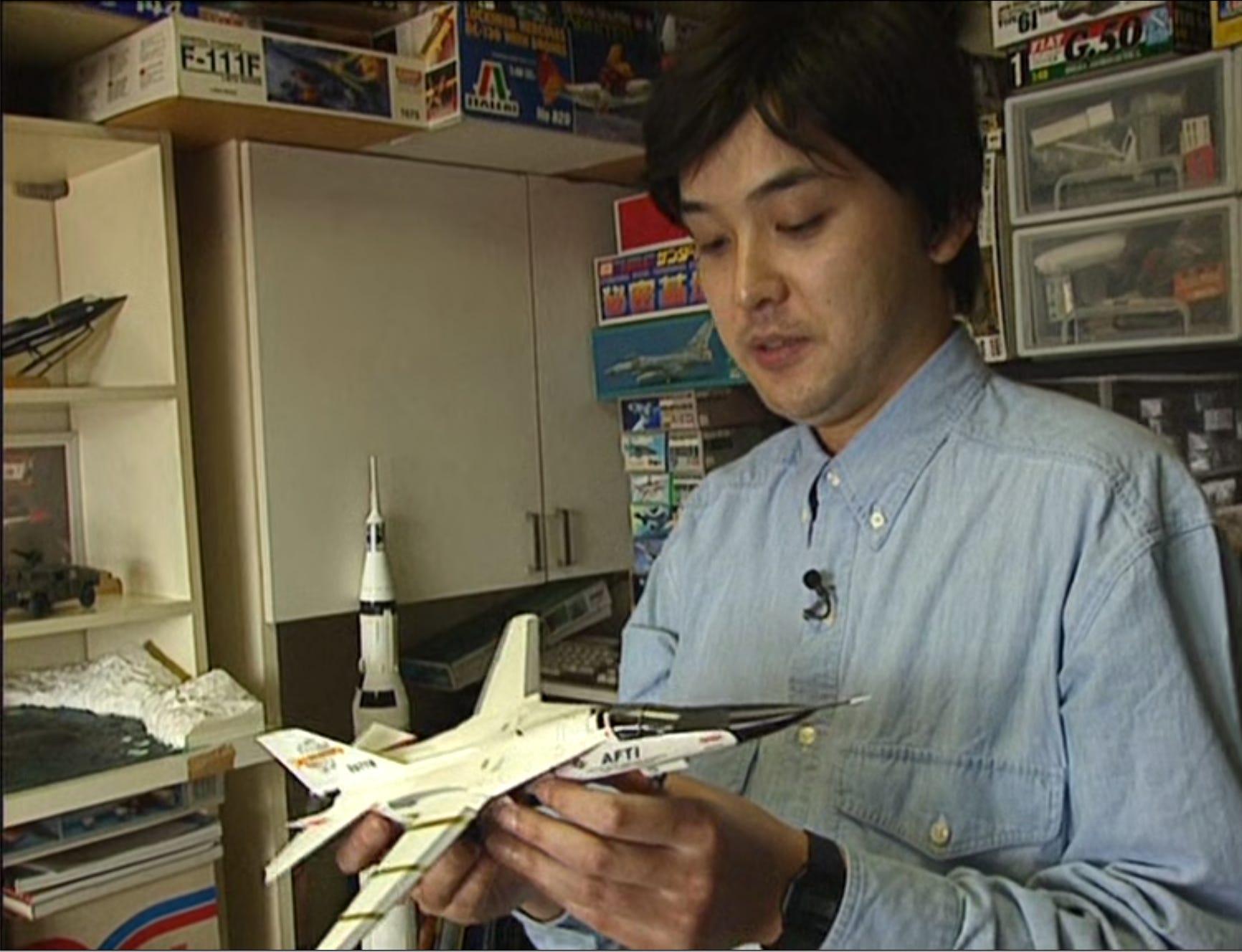
As for another example, there is the French documentary Otaku which covers the titular Japanese phenomenon. The word, literally meaning “you” in an honorific and feminized sense, refers to the epidemic of young men in Japan retreating from responsibility by fixating on a given obsession. While this fetish is more often than not anime, one otaku they talk to, named Hiroki, gave up a career in medicine to become obsessed with building model airplanes. Graduating without a job threw him into a state of ennui, with his only escape being news footage on TV of F-15s and AH-64 Apaches being flown over Iraq during the Gulf War. Swapping one form of rigorous programming for another, Hiroki’s tiny apartment soon became packed with model airplane sets and their booklets which he spent hours every day combing through and constructing. A bubble both fortifying and giddily suffocating. As with Des Esseintes, this private world is posited firmly against the society that acts as its protective membrane. Even in a banal, middle class, modern existence, the ultimate transgression is the man who moves nowhere else but inward.
When asked, Hiroki refused to pick a favorite model, stating that “The most important thing is the act of making them. What’s important is me, as a person.” The secret to this inwardness, as Huysmans writes, “lies in knowing how to proceed, how to concentrate deeply enough to produce the hallucination and succeed in substituting the dream reality for the reality itself.” What these examples serve to point out is that even the most vacant and autistic work nestles ever-nearer to the divine when it operates in this mode. The mode of total attention where everything worldly—class, society, family, tradition; Substack, N+1, geek bars, Lana Del Rey—disappears into nothing along with yourself. All that is left is the relation. Under the pressure of its own intense dreaming, the strange and obstinate thing tears its tissue and splinters off into the ether. It is one hundred-times more beautiful than anything produced under the guise of “just hanging out.”
I’m not criticizing the state of art and culture. I like the confessional, nouveau-banal mode in literature today that Ellmann, Knausgaard, and Mark Kozelek are doing. But even this doesn’t cohere into any kind of discernible movement most can identify (unlike the narcissistic tripe that lies downstream from it, known as auto-fiction). The last coherent music scenes operate exclusively within the mode of vagueness and distortion (think hypnagogic pop and “cloud rap”), deliberately eschewing categorization in a favor of a more constant, digitized form of collaboration. Even fashion resembles a choosy collage of the past driven by archive fever and nostalgia. Point being, most people can attest to the lack of a zeitgeist-pushing creative movement in the 21st century, and most people would be right. This is not necessarily a bad thing but it is worth accepting and asking why.
Creature comforts are at an all time high. This unprecedented kind of security discourages any spontaneity that would otherwise be prompted. The bubbles of our homes stocked with Haagen-Dazs and Roku Originals sit atop the canopy of history that we’re kept warm and ignorant from. Away from the time before any given town had 20 different decent restaurants and when cigarette smoke singed your taste buds so bad you wouldn’t be able to taste how shitty your food was anyway. In circumstances of high boredom and relative destitution young people are driven to make a scene. Create some salvation out of nothing. Of course, no one is willing to go back to this a prior state of nothingness. Any attempt to do so deliberately is posturing and precludes a retreat into safety––there is no risk. The chant for a new now echoes as a rallying cry for the end.
My final plea: abandon risk. Embrace your solitude and the pleasures of home. It is said that America is in its decadent era. A time when the comforts of civilization reach a numbing point, beyond pleasure, emptied of excitement. If this is true, then be like Des Esseintes or, if you are poor, be like Hiroki—both emblematic of and the repudiation for their class-standing. Abandon all consideration for what your work, if any, has to do with the zeitgeist. The absence of a zeitgeist gives you all the freedom you need to ignore the possibility of one. You have to become comfortable in your class before you’re able to transgress it. You can’t look for certitude in that which is explicitly vague. So stop doing cultural alchemy. Stop adding the -core suffix to things to make them feel real. Try to not be a narcissist for at least a little bit.
No posts
Comments
Nothing yet. Say the first thing.
Sign in to join the conversation.