
Text in EN ↓
Texto em PT ↓
Last week we had the opportunity to lead the Architectural Association Visiting School Amazon, hosted at Escola da Floresta in Santarém. Over seven intensive days, architecture students explored a fundamental question that guided the entire workshop:
How can we design a city from the perspective of the forest and the species that inhabit it?
The workshop began with a visit to ZOONAMA, Santarém’s wildlife rescue and rehabilitation centre. Following the visit, each student selected one species and was invited to temporarily abandon the exclusively human point of view, designing instead from the perspective of that animal.
How does a macaw perceive territory? How much space does it need to fly? How does an ocelot move through the forest? How can rescued animals in rehabilitation remain visually, acoustically and chemically connected to wildlife living freely around them? What happens when a road interrupts an ecological corridor? How does a monkey perceive the vertical layers of the forest? How do rivers, sounds, smells and vegetation organise spatial experience?
This shift in perspective revealed a simple but powerful idea: designing for other species inevitably means designing a better city for people as well.
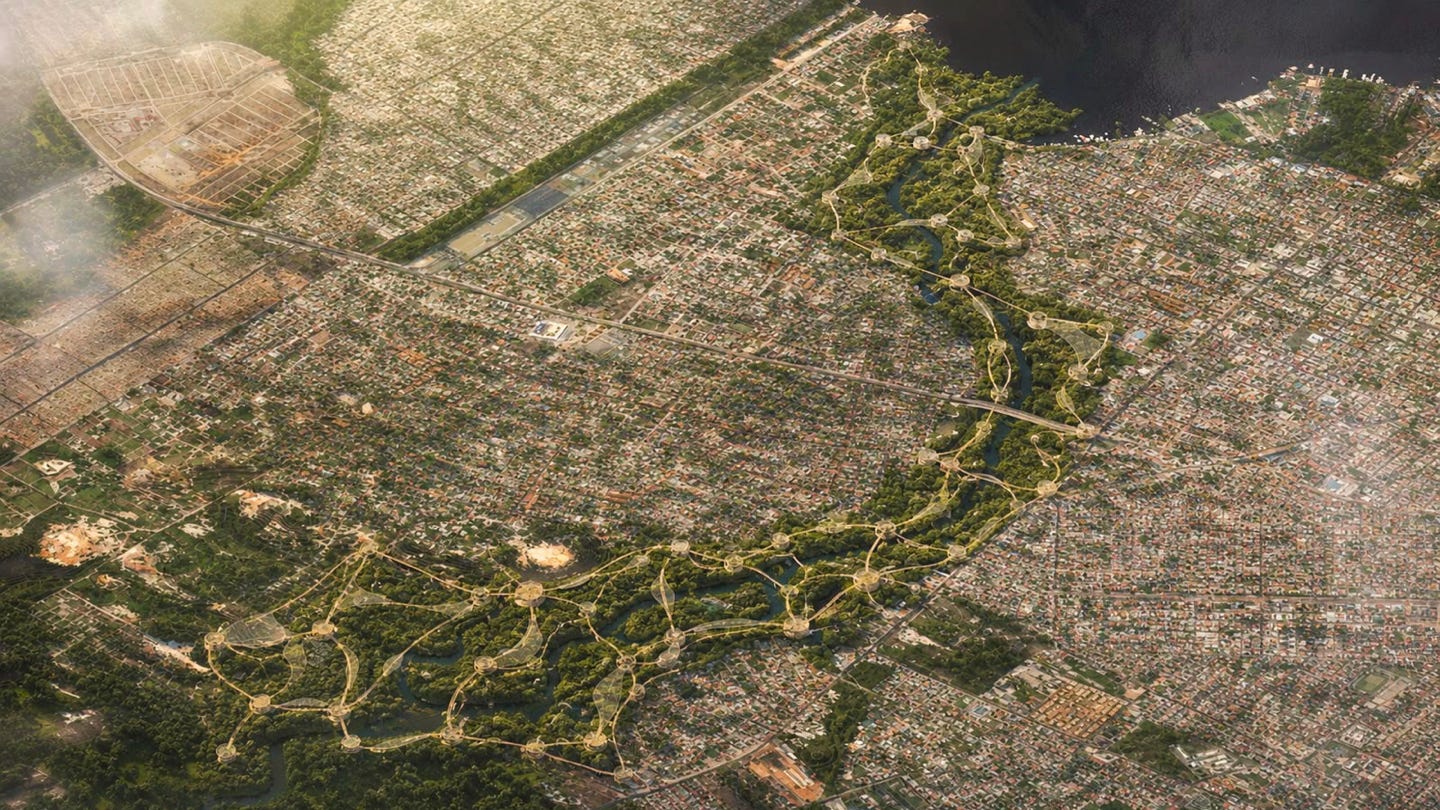
Although located in the heart of the Amazon, Santarém embodies a paradox shared by many contemporary cities. Urban growth has progressively disconnected its inhabitants from the ecological processes that sustain urban life itself.
Public green spaces remain scarce, making it difficult to walk, gather and occupy the city during increasingly hot days.
The sealing of the soil compromises springs and waterways. Forest fragments become isolated islands. Roads interrupt ecological corridors and prevent wildlife from moving naturally through the territory. Water systems lose their natural dynamics, affecting streams, wetlands and biodiversity.
The forest remains around the city, yet gradually disappears from everyday urban life.
From this diagnosis emerged the proposal for Bioparque Santarém.
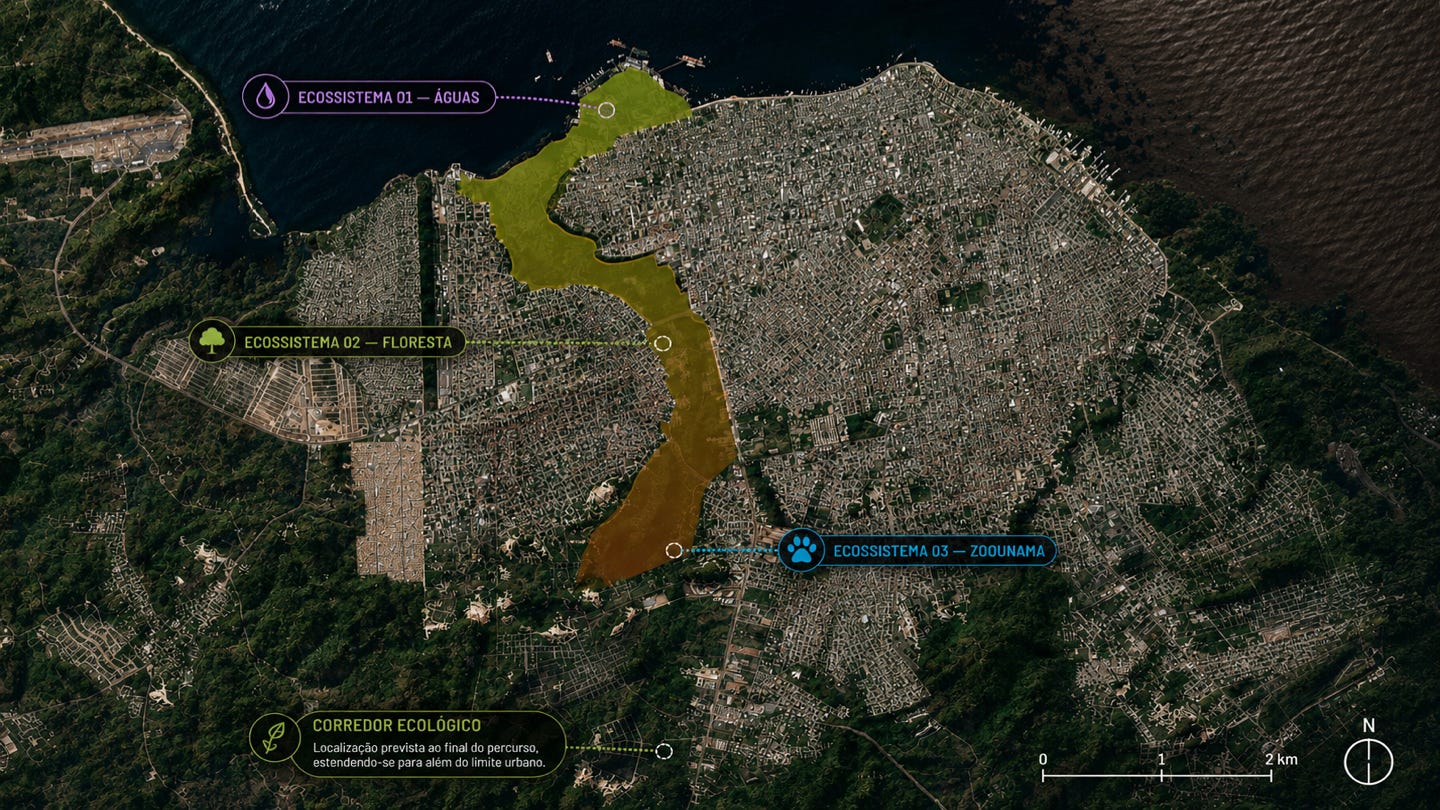
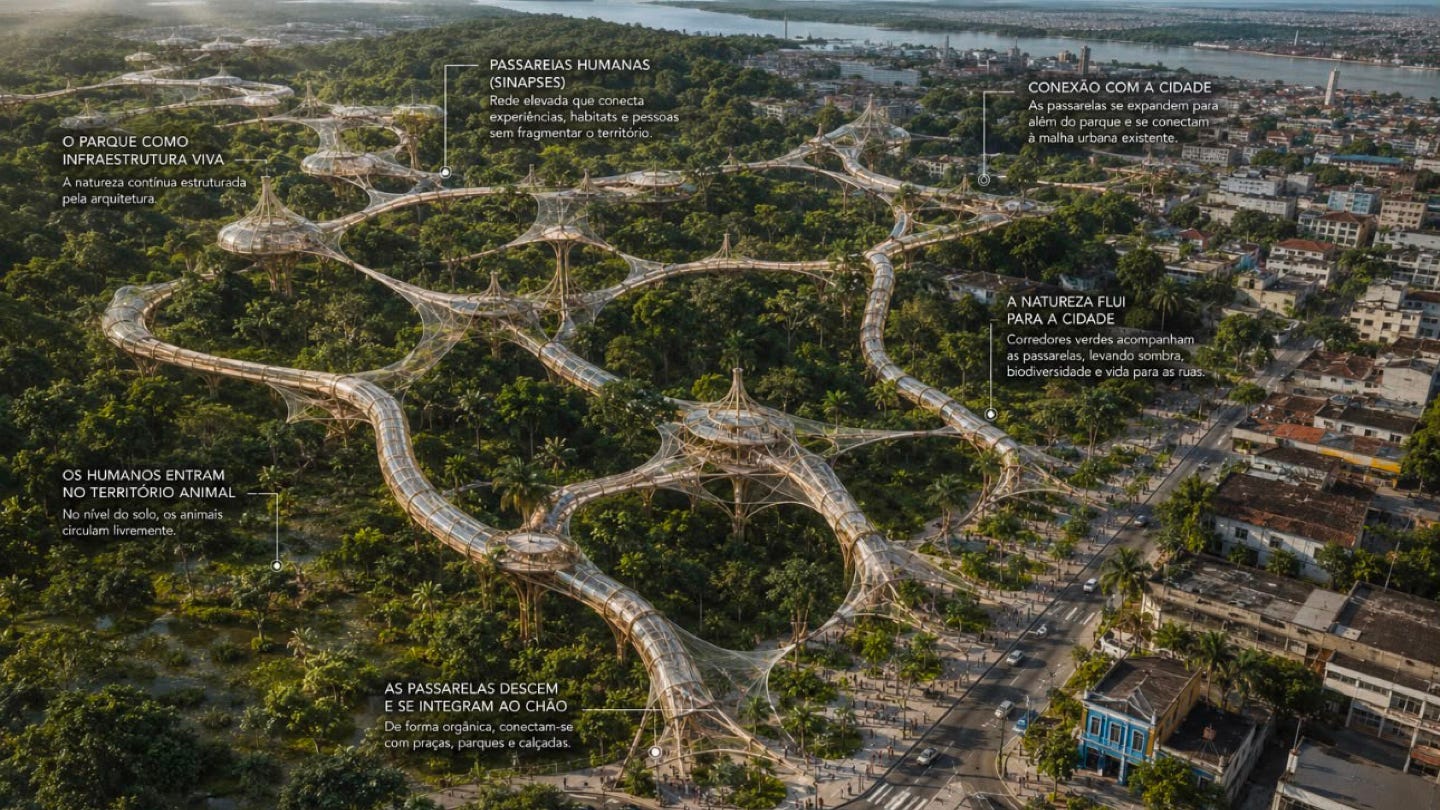
Rather than another urban park, the project proposes a new typology of ecological infrastructure: a linear biopark conceived as a continuous green corridor, connecting neighbourhoods, rivers, forest fragments, public facilities and ZOONAMA.
This network combines pedestrian paths, cycling routes, educational trails and observation points while simultaneously creating continuous habitats and ecological corridors for Amazonian wildlife.
Its ambition is not simply to create recreational space, but to regenerate relationships—between city and forest, between human and more-than-human communities.
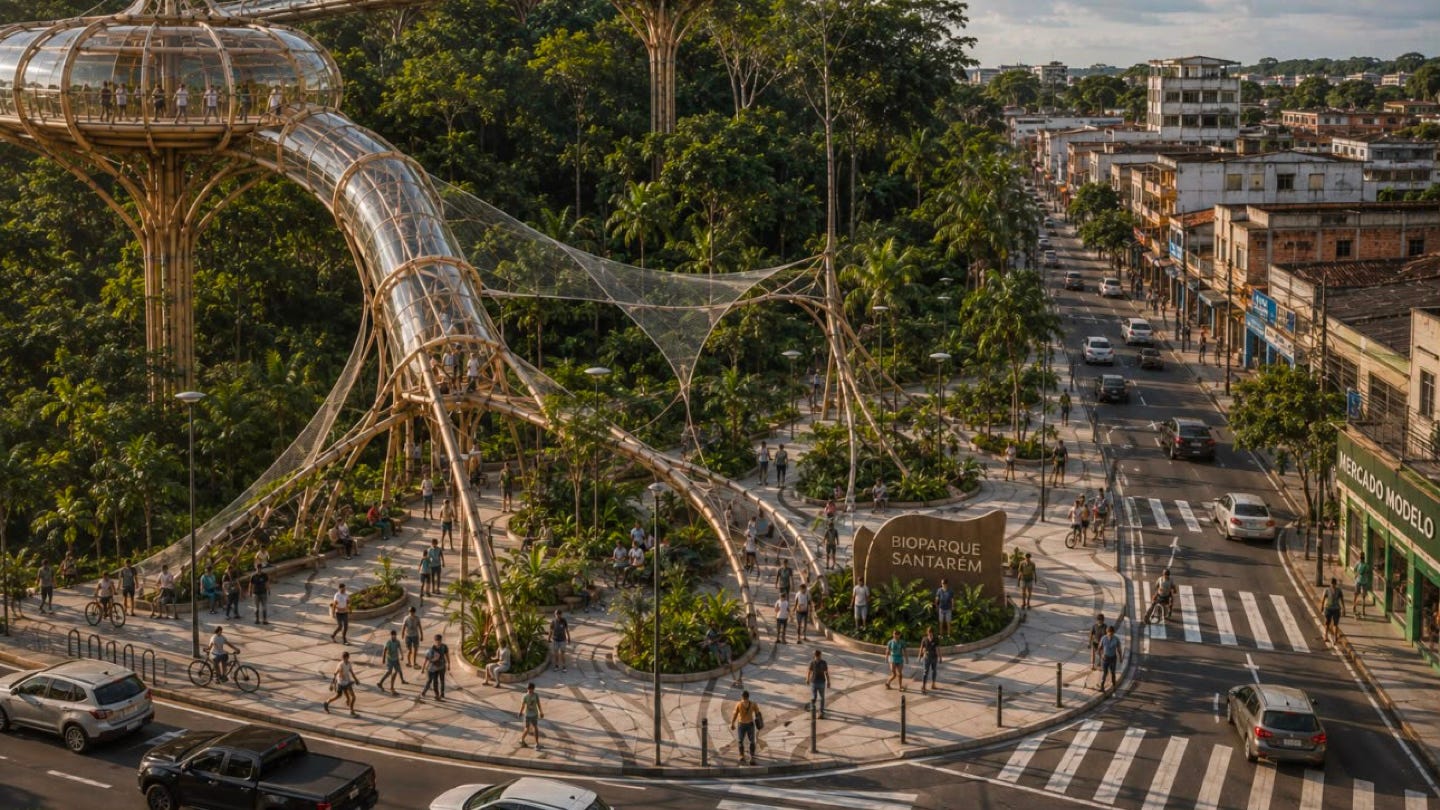
The spatial organisation of the project is inspired by mycelium, the underground fungal network that connects trees, distributes nutrients and orchestrates ecological processes throughout the forest.
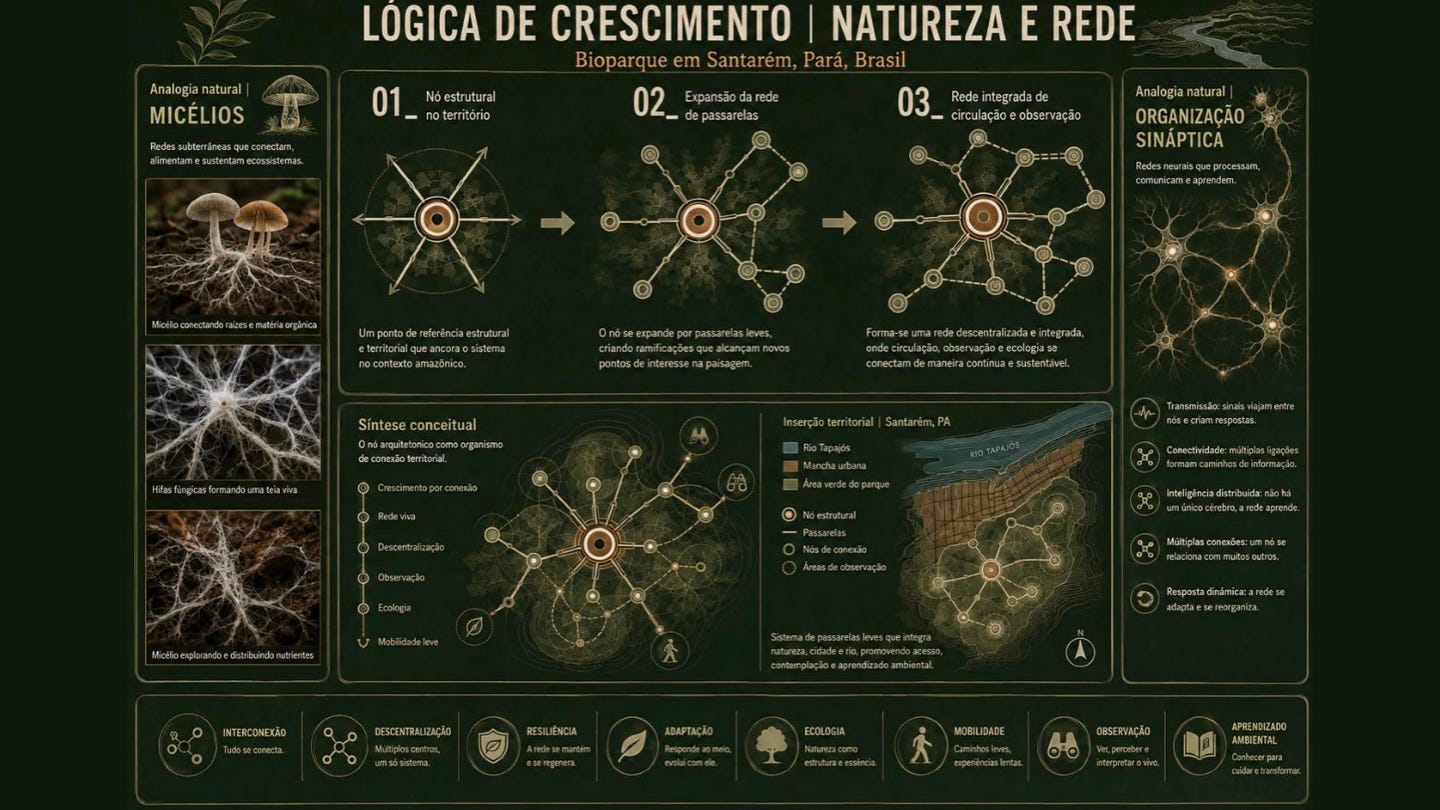
Like mycelium, the Biopark is not conceived as a finished object but as a living system capable of growing through connections, gradually regenerating the web of life.
Each new intervention strengthens the existing network, allowing the park to expand through the city by connecting neighbourhoods, rivers, public spaces and new forest fragments.
Rather than a fixed masterplan, the project proposes an adaptive strategy for urban growth based on ecological regeneration.
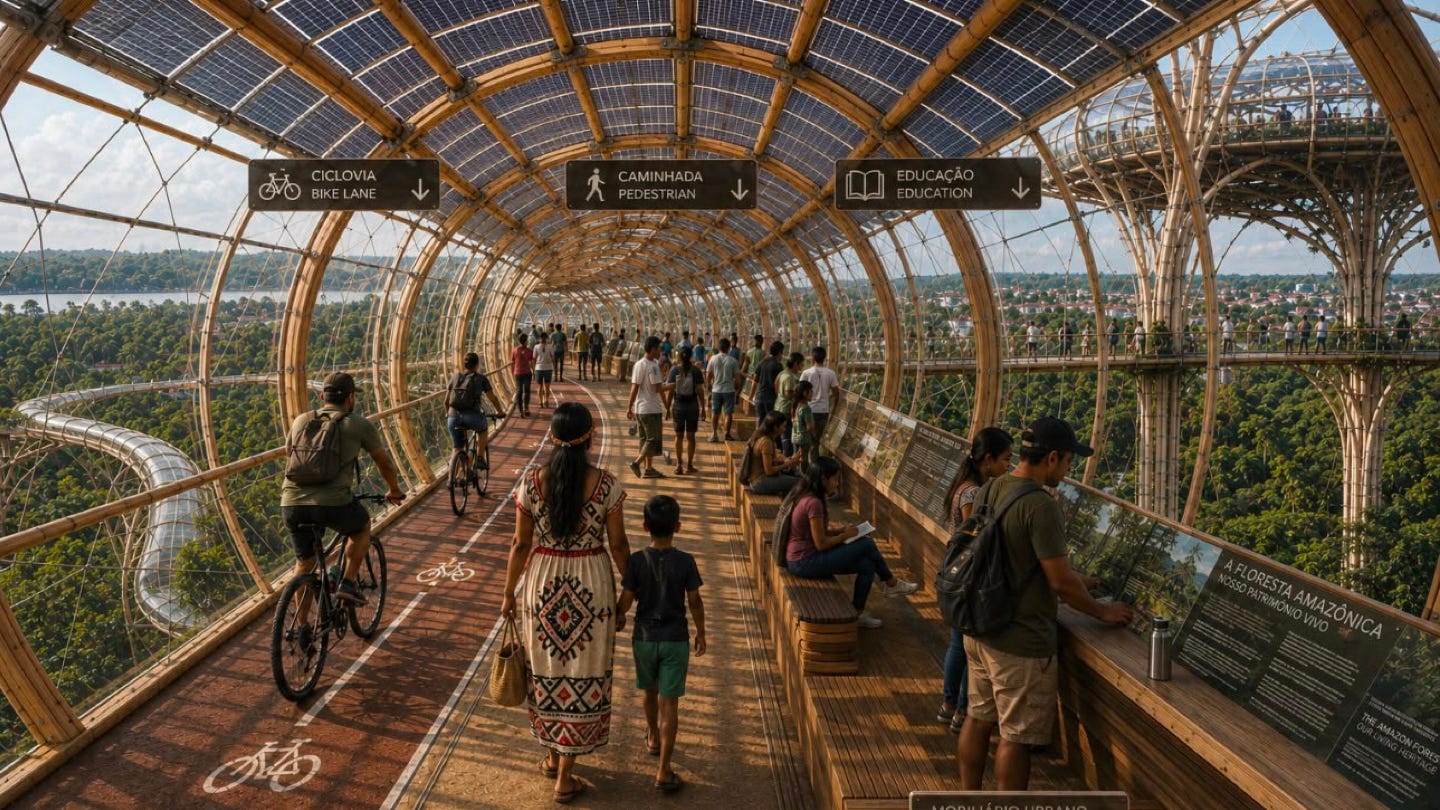
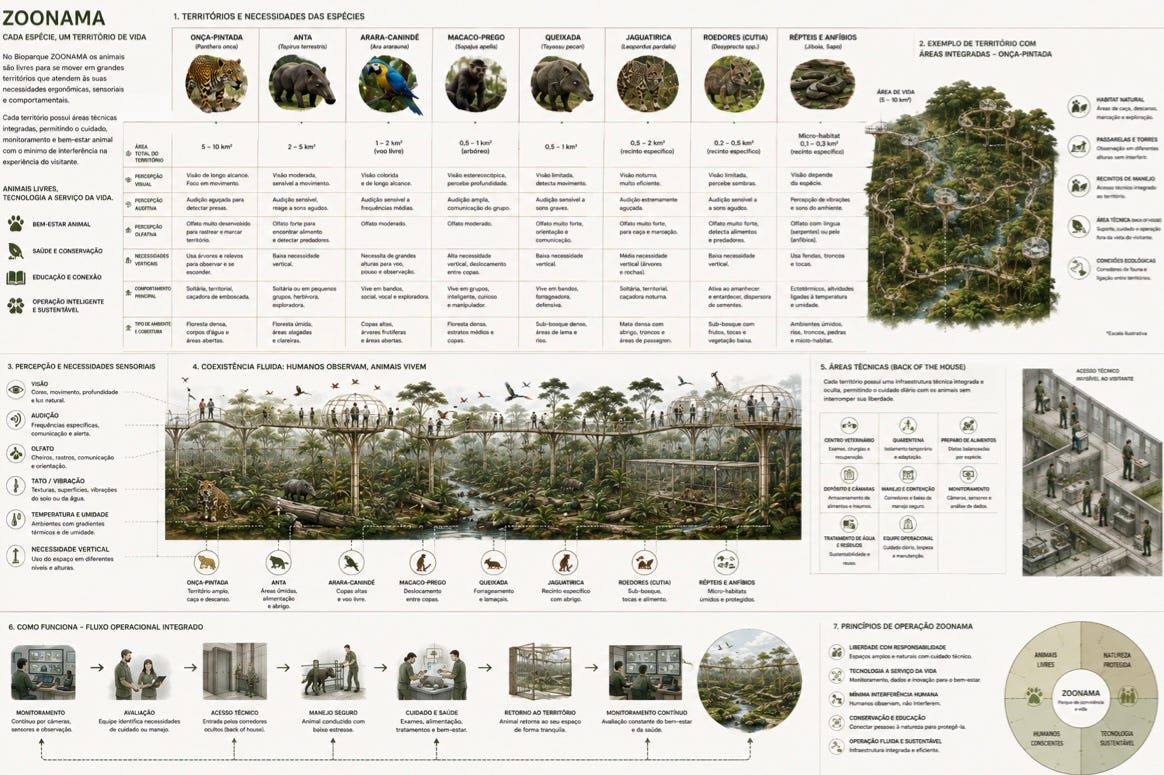
Within this network (and as case study proposal), ZOONAMA remains the operational centre for wildlife rescue and rehabilitation.
Instead of concentrating animals inside isolated enclosures, the Biopark expands their territory through progressively more natural environments, supporting rehabilitation, adaptation and rewilding, with the ultimate goal of returning rescued animals to the wild whenever possible.
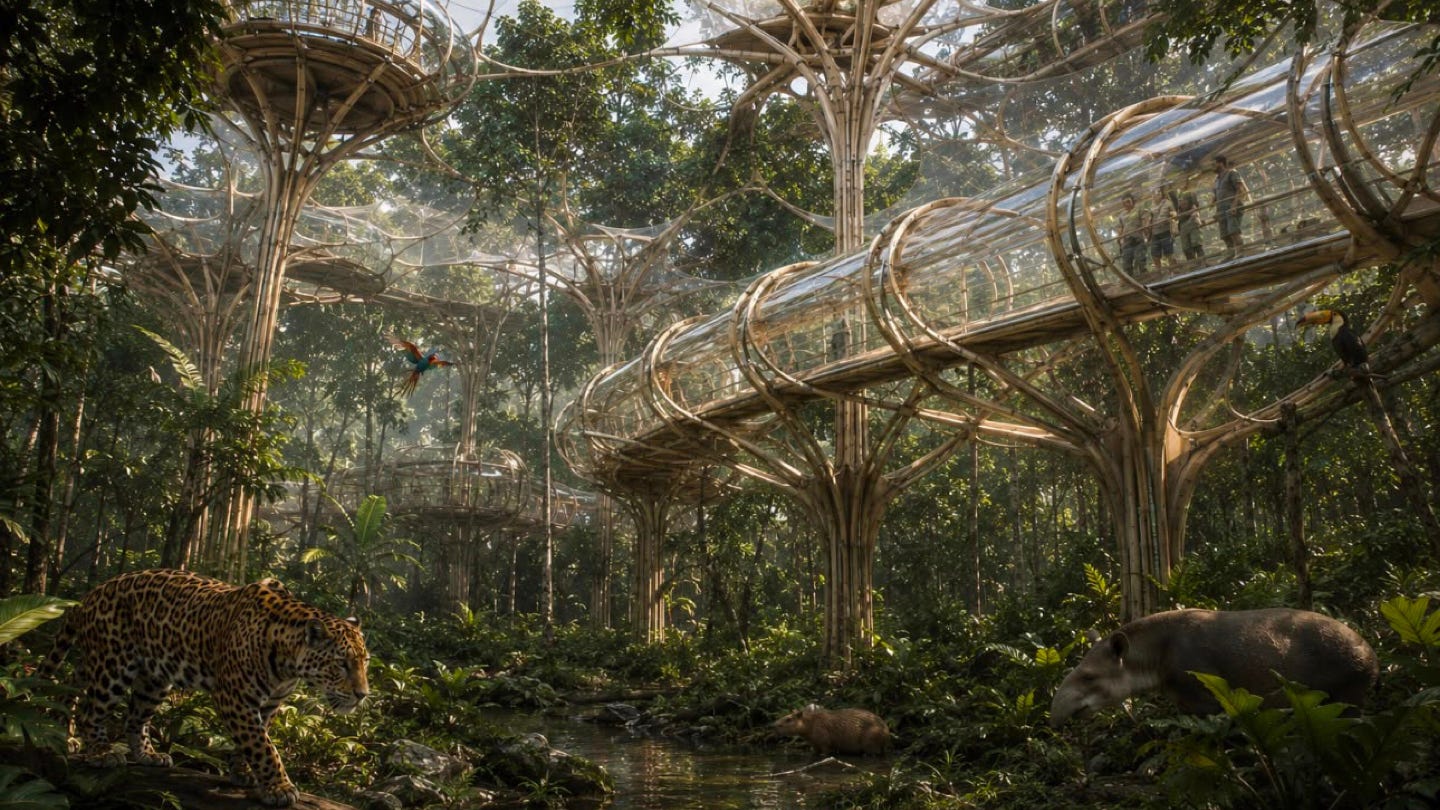
This fundamentally reverses the traditional logic of the zoo.
Rather than restricting animals to maximise human freedom, the project enlarges wildlife territories while carefully designing the movement of the human animal.
Architecture ceases to be an infrastructure of containment and becomes an infrastructure of coexistence.
Long before European colonisation, the region now known as Santarém was home to large Indigenous civilizations whose settlements, agriculture, rivers, forests and wildlife formed a deeply interconnected territorial network.
The Biopark seeks to recover this territorial intelligence as a way of addressing the contemporary challenges of the city.
In a context of rising temperatures, shrinking green spaces, ecological fragmentation and biodiversity loss, investing in green infrastructure also means investing in public health, climate resilience, environmental education, urban mobility, everyday well-being and the long-term value of the city.
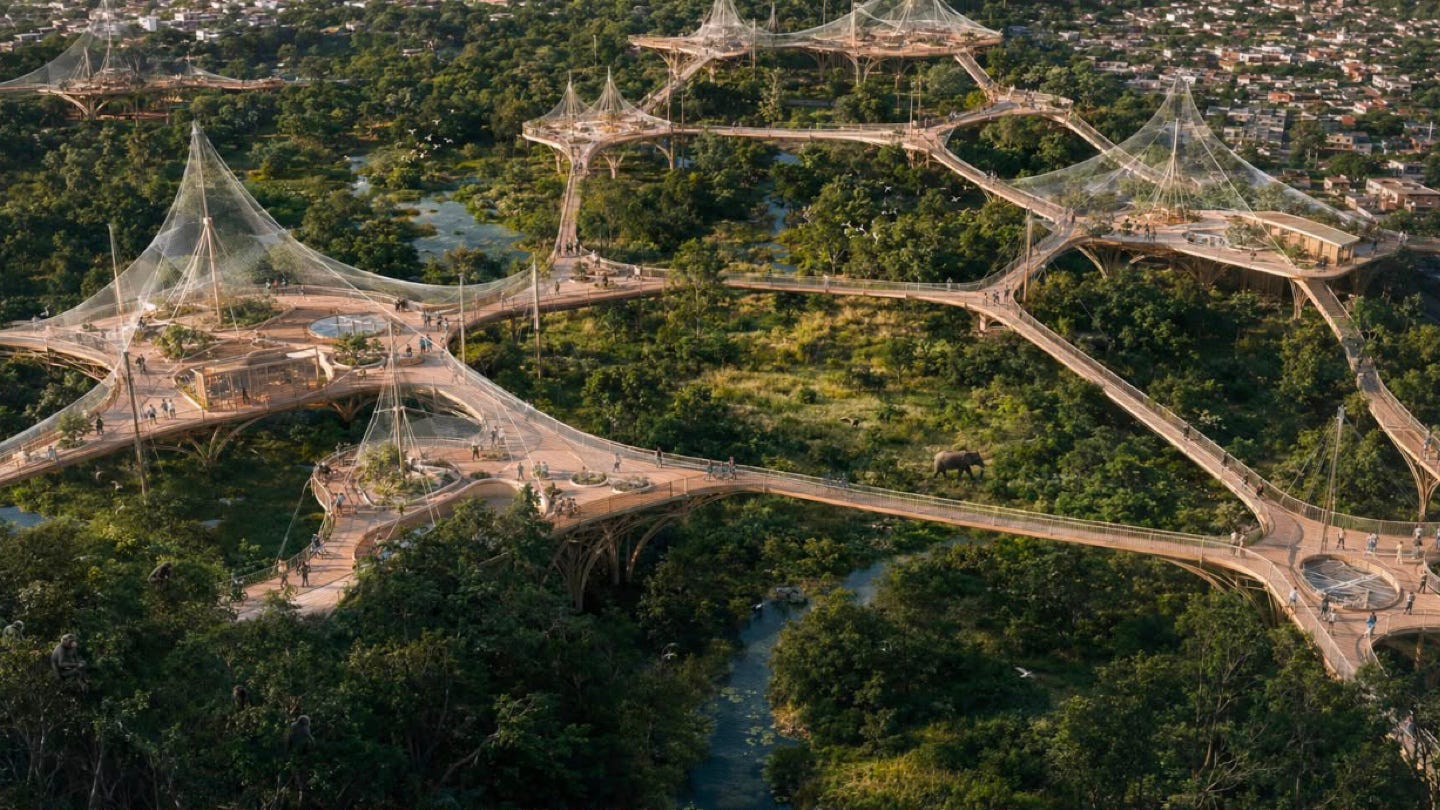
Bioparque Santarém proposes a territory of encounter between human and more-than-human communities. A place where architecture, ecology and urbanism are no longer separate disciplines, but complementary ways of rebuilding our most fundamental relationship with Nature.
Architectural Association Visiting School Amazon
Programme Directors: Marko Brajovic + Nacho Martí
Programme Coordinator: Penelope Casal del Rey
Mask Design Practice: Alice Bartholo
Our heartfelt thanks to this year’s participants for their courage, generosity and collaborative spirit throughout the workshop.
We also extend our sincere gratitude to Escola da Floresta, ZOONAMA, and the Museum of Amazonian Sciences (MuCA) for their warm hospitality, invaluable support and collaboration during this edition of the Architectural Association Visiting School Amazon.
Texto em PT ↓
Na última semana tivemos a oportunidade de conduzir a Architectural Association Visiting School Amazon, realizada na Escola da Floresta, em Santarém. Durante sete dias, estudantes de arquitetura mergulharam em um processo intensivo de investigação orientado por uma pergunta central:
Como projetar uma cidade a partir da perspectiva da floresta e das espécies que a habitam?
O ponto de partida foi a ZOONAMA, centro de resgate, cuidado e reabilitação de animais silvestres de Santarém. Após uma visita ao local, cada estudante escolheu uma espécie e foi convidado a abandonar, por um momento, o olhar exclusivamente humano para projetar a partir da perspectiva desse animal.
Como uma arara percebe o território? Qual a distância necessária para o voo? Como uma jaguatirica atravessa a floresta? Como animais em reabilitação podem manter relações visuais, sonoras e olfativas com animais livres, preservando vínculos com seu ambiente natural? O que acontece quando uma estrada interrompe um corredor ecológico? Como um macaco percebe as diferentes alturas da floresta? Como rios, sons, odores e vegetação organizam sua experiência espacial?
Essa mudança de perspectiva revelou que projetar para outras espécies é, inevitavelmente, projetar uma cidade melhor também para as pessoas.
Apesar de estar localizada no coração da Amazônia, Santarém enfrenta um paradoxo comum a muitas cidades brasileiras: sua expansão urbana afastou gradualmente a população dos processos naturais que sustentam a própria cidade.
Os espaços públicos arborizados ainda são escassos, tornando difícil caminhar, permanecer e viver a cidade durante o dia sob temperaturas cada vez mais elevadas.
A impermeabilização do solo compromete nascentes e cursos d’água. Fragmentos de floresta tornam-se ilhas isoladas. Estradas interrompem corredores ecológicos e dificultam o deslocamento da fauna. A dinâmica natural das águas deixa de acontecer, afetando igarapés, áreas alagáveis e a biodiversidade.
A floresta continua presente ao redor da cidade, mas deixa de fazer parte da experiência cotidiana de quem vive nela.
A partir dessa leitura, desenvolvemos coletivamente a proposta do Bioparque Santarém.
Mais do que um parque, o projeto propõe uma nova tipologia de infraestrutura urbana: um parque linear concebido como um grande corredor verde, conectando bairros, rios, fragmentos de floresta, equipamentos públicos e a ZOONAMA.
Essa rede incorpora caminhos para pedestres, ciclovias, percursos educativos e espaços de contemplação, ao mesmo tempo em que estabelece habitats contínuos e corredores ecológicos para a fauna amazônica.
O objetivo não é apenas criar áreas de lazer, mas construir uma infraestrutura capaz de regenerar as relações entre cidade e floresta, entre gente humana e gente não humana.
A estratégia espacial do projeto inspira-se no micélio, a rede subterrânea dos fungos que conecta árvores, transporta nutrientes e organiza os processos ecológicos da floresta.
Assim como o micélio, o Bioparque não é pensado como um objeto acabado, mas como um sistema vivo capaz de crescer por conexões, regenerando progressivamente a teia da vida.
Cada nova intervenção fortalece a rede existente, permitindo que o parque se expanda pela cidade, conectando bairros, rios, áreas verdes e novos fragmentos de floresta.
Mais do que um projeto, trata-se de uma estratégia de crescimento urbano baseada na regeneração.
Dentro dessa rede (no nosso caso de estudo), a ZOONAMA permanece como núcleo de resgate, cuidado e reabilitação da fauna.
Em vez de concentrar os animais em recintos isolados, o Bioparque amplia seu território através de áreas progressivamente mais naturalizadas, possibilitando processos de reabilitação, adaptação e rewilding, preparando, sempre que possível, seu retorno à vida livre.
Essa proposta inverte a lógica tradicional do zoológico.
Em vez de restringir os animais para ampliar a liberdade da espécie humana, ampliamos o território da fauna e desenhamos cuidadosamente os percursos dos animais humanos.
A arquitetura deixa de ser uma infraestrutura de contenção para tornar-se uma infraestrutura de coexistência.
Muito antes da invasão europeia, a região onde hoje está Santarém fazia parte de uma paisagem amazônica intensamente habitada por grandes civilizações indígenas, onde rios, floresta, agricultura, fauna e assentamentos constituíam uma rede profundamente integrada.
O Bioparque busca recuperar essa inteligência territorial para enfrentar os desafios contemporâneos da cidade.
Em um contexto de aumento das temperaturas, redução das áreas verdes, fragmentação ecológica e perda da biodiversidade, investir em infraestrutura verde significa investir simultaneamente em saúde pública, qualidade de vida, educação ambiental, mobilidade, conforto climático e valorização urbana.
O Bioparque Santarém propõe-se como um território de encontro entre gente humana e gente não humana. Um lugar onde arquitetura, ecologia e urbanismo deixam de ser disciplinas separadas para reconstruir nossa relação mais profunda com aquilo que sempre fomos: Natureza.
Architectural Association Visiting School Amazon
Diretores do Programa: Marko Brajovic + Nacho Martí
Coordenação: Penelope Casal del Rey
Oficina de Design de Máscaras: Alice Bartholo
Nosso agradecimento especial aos participantes desta edição, pela coragem, generosidade e espírito colaborativo que tornaram possível esta intensa semana de investigação e criação coletiva.
Agradecemos também à Escola da Floresta, à ZOONAMA e ao Museu de Ciências da Amazônia (MuCA) pelo acolhimento, apoio e parceria fundamentais para a realização desta edição da Architectural Association Visiting School Amazon.
Comments
Nothing yet. Say the first thing.
Sign in to join the conversation.