
I came across the work of Stephen R Covey through his book The Seven Habits of Highly Effective People in my late 20s (nearly 40 years ago). We used it at work in the nuclear industry and I knew and worked with the UK licence holder so saw it developing across the country. I was lucky enough to meet Covey’s son (also called Stephen) during my time with the Transformational Leadership Council; he was kind enough to endorse the Solutions Focus casebook Solutions Focus Working that Jenny and I put together. I still think Seven Habits has some good fundamentals on how to get things done.
Early in the book Covey sets out his stall, with all seven habits in one overall image (see below). The three levels show a pathway to maturity. We all start being dependent on others (parents, teachers and so on). Then we start to crave independence, the ability to do things for ourselves. Anyone who has parented teens will recognise this phase. It’s all about me, about what I want to do. Of course, there are better and worse ways to go about that, and Covey’s first three habits are about that. Be proactive, begin with the end in mind, and put first things first. In other words, you have to do things rather than simply wait for results to come to you, use goals and forward thinking, and then take action today in small ways. It’s still an excellent start.
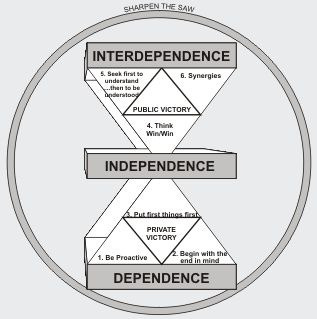
So far so good. But now, we move towards the upper end of the diagram and the idea of interdependence. The second three habits are about working with others to create things together - more about we than me. Think Win/Win, seeking results which are good for all parties (as opposed to win/lose – life is not a zero sum game, no matter what Donald Trump thinks). Seek first to understand… then be understood is about listening first and speaking second; an excellent way to build relationships as well as get people onside. And finally Synergies – creating things together which are better than you (or the others) could have done alone. The seventh habit is Sharpen The Saw, shown as a ring around all the other habits; that’s about keeping learning and developing.
Dependence – Independence – Interdependence seems to me to be a fundamental pathway to maturity. It’s natural to seek one’s own identity at some point. And then comes the realisation that you can’t do it all alone forever, and it is better to co-operate with others. My career, first in management development and later in Solutions Focus and in Host Leadership, has been based on this basic assumption - better to work with people whenever you can.
Nobody in government wanted Brexit. The whole referendum thing was offered by prime minister David Cameron in 2013 in an effort to head off support for the UK Independence Party (the clue is in the name!) under Nigel Farage. Cameron had not expected to win a majority at the next election; many had expected him to form another coalition with the Liberal Democrats, who would have insisted on dropping the whole enterprise. But in 2015, Cameron’s Conservatives surprised everyone by winning small majority. There was no way out.
The referendum campaign was flawed on both sides. Leave, their campaign already split, offered a ludicrous menu of ‘benefits’ many of which were mutually exclusive. Their slogan Take Back Control was conjured up to evoke a past which had never really existed. For the 19th century and the first half of the 20th century Britain had indeed ruled a worldwide empire ‘on which the sun never set’.
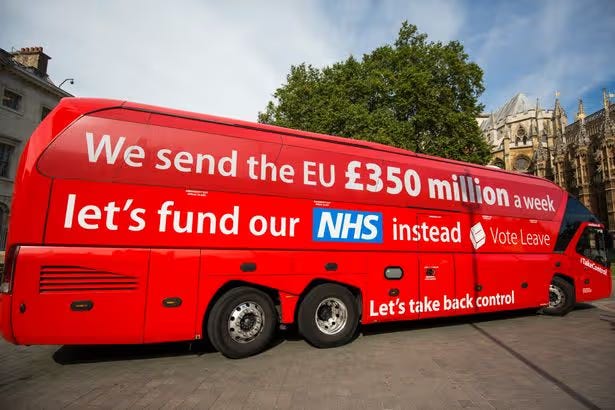
But after the Second World War most of the colonial countries had opted for their own independence (and their own choice of relations with neighbouring states), and others (including the big Anglosphere countries like Australia and Canada) had formed the Commonwealth, a club which promoted good relations but left trade and diplomacy with each state. Since the UK joined the EU, then the European Economic Community (EEC) in 1973, these countries had forged strong relationship with their geographical neighbours (Australia exported to China, Canada to the USA) rather than the distant ‘mother country’.
The Leave campaign painted the EU as ‘them’; foreigners who were controlling ‘us’. This was plainly laughable. The EU WAS ‘us’. As a key member state the UK was party to all decisions. The vast majority of the time we had our way, and occasional setbacks could be used as bargaining the next time around. The UK had an excellent position within the EU, with opt-outs from joining the Euro (Jenny and I were two of the very few people who actively campaigned to join the single currency), social legislation and so on. All this would be at risk if we left.
The Remain campaign was ill-starred from the start. Former Marks and Spencer boss Sir Stuart Rose was put in charge, until he was painted as ‘big business’ by the opposition. Cameron posted dire predictions about what a Leave vote would mean to every house in the land, which was painted as ‘project fear’. The Remain campaign focused on economics; the Leave campaign focused on an imaginary post-empire fantasy of ‘Britain can do it alone’.
I well remember 23 June 2016, the day of the vote. Jenny and I were in Norway, on holiday in Lofoten, the beautiful archipelago north of the Arctic Circle. I was very nervous about the potential outcome, even though Remain were strong favourites to win. The online bookmakers had them at 10-1 ON, implying a more than 90% chance of victory. I think that if it had been tighter, more Remain voters would have come out. Listening to BBC radio through the night, the awful truth dawned. The votes were 52% Leave, 48% Remain. We were out.
The trouble, both immediately and long-term, was that nobody knew what Leave meant. The campaigns had carefully avoided any concrete ideas, so everyone could paint their own fantasies onto it. There were widely different conceptions, from negotiating a minimal Brexit (and becoming a rule-taker from the EU) to a dramatic ‘send them home’ immigrant repatriation, no matter their legal status (as EU freedom of movement would end).
The negotiations took five years and were hampered at every turn by the UK arguing with itself about what it wanted. ANY Brexit could be shown to be bad for the country; the question was how bad, and what (if any) upside could be gained. The question dominated Parliament and the country, wasting five years of political bandwidth. The difficulty was that although Leave had won, there was no majority for any particular form of Leaving. Parliament held votes; the closest was a quite minimal Brexit but even that lost by a few votes.
In the end Boris Johnson won the 2019 general election on a pledge to ‘Get Brexit Done’. (The keen-eyed will notice that this still doesn’t contain an answer to the question of destination. Johnson was offering to simply make it go away.) Brexit negotiator David Frost, former CEO of the Scotch Whisky Association whose former office in Edinburgh is now bizarrely my own place of work) came up with a thin Trade and Co-operation Agreement which was rushed through Parliament in a couple of days between Christmas and New Year 2019. There was little debate – everyone was exhausted.
We are still suffering the dubious ‘benefits’ of this deal today. We used to be able to send books to EU member states cheaply in a couple of days. Now it can take weeks, along with random customs and administrative charges. I am supposed to get a business visa to run a two-day workshop on the continent. (I don’t – it’s easier to be economical with the truth at the border and say I am visiting friends.)
Another small example close to home. We used to have a summer influx of Finns, Lithuanians and so on who came to work at Scottish tourist businesses in the Highlands. They had a glorious four months working in beautiful scenery, got to practice their English and went home back to college in September. No paperwork involved. Now, anyone coming to the UK to work (from within the EU or not) must get an expensive visa and come for a full-time job. But these jobs are not full-time - so they go unfilled. Businesses struggle; many have closed.
There are many bad things about Brexit, and painfully few upsides. The Guardian has today published a summary of how Brexit has made Britain poorer. Nobody is pleased about this; even the supposed winners of the referendum think the problem is that we haven’t left far enough.
The worst thing about Brexit is not economic, it’s not inconvenience at borders, it’s not being an international laughing stock. It is that the Brexit vote legitimised those who thing the answer to everything is ‘independence’. That means that ‘they’ are to blame, and ‘we’ must therefore exclude ‘them’.
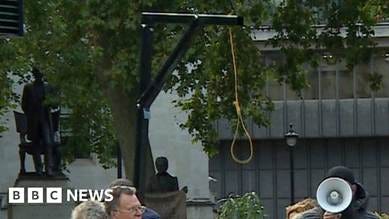
This works in various perfidious ways. Immediately after the vote, those (like me) who wanted to negotiate a co-operative relationship with Europe were harangued as ‘ignoring the will of the people’. Leave supporters threatened Members of Parliament verbally and physically – I recall one particularly unpleasant day when a gallows was erected outside Westminster as a warning to those who might (within the law) strike compromises.
We now find ourselves in a position where right-wing leaders like Nigel Farage (now Reform UK) and Rupert Lowe (Restore UK) blame everything on (usually dark-skinned) immigrants. Today, Farage wants to ban foreign nationals from social housing. Lowe goes further, wanting to deport all fast-tracked migrants (from clearly at-risk places) immediately. They are egged on by trillionaire Elon Musk and US Vice President JD Vance who shout about cultural oblivion (embracing ‘free speech’ but only for themselves). We have seen brown people, with 20 years standing in the community, being literally firebombed out of their houses in Northern Ireland (by mobs enraged that an immigrant is alleged to have violently assaulted someone).
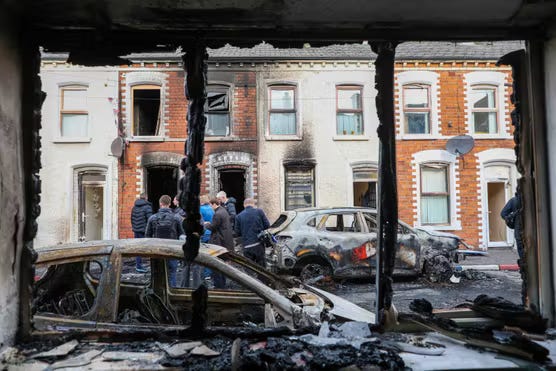
It’s all about how to get rid of ‘them’ so ‘we’ can thrive. Never mind that ‘them’ are staffing the NHS, working in schools and so on. ‘We’ can do better without ‘them’, apparently. Only we can’t. Such an atmosphere stokes resentment and blame, much less use than co-operation and inclusion. ‘They’ are here anyway – surely better to help them contribute?
Of course there are pressures in the world aside of Brexit which are fuelling such sentiments. But before Brexit, these were opinions mainly expressed in the darkness, shunned by reasonable politicians. Brexit made them respectable. Now the genie is out of the bottle, it is hard to see how to put it back. In an interdependent world, independence can only be a step on the way to forging new relationships.
Some of you will know that Jenny and I moved to Scotland after the Brexit vote. Scotland has always had good connections with Europe going all the way back to the ‘auld alliance’ between Scotland and France in the 18th century. We are very in favour of Scottish independence (from the United Kingdom). Isn’t that just the same as the splits painted by the Brexiters?
In a word, no. In Scotland, nationalism is a civic, not an ethnic, matter. Most of us in Scotland welcome refugees and immigrants. We are proud of the New Scots (whether from China, India, Pakistan or even England) who have come to throw their shoulders to the Scottish wheel. What we seek is to make our own political decisions, mostly so we can rejoin the EU. Being a part of a much bigger club is a sensible home in the 21st century. I am very happy to say on occasions when immigration authorities have sought to arrest migrants, they have been thwarted by spontaneous demonstrations.
This is a somewhat depressing note on which to end this season’s series of articles. I found Brexit completely discombobulating and have been trying to figure out why. After ten years, I think this is my most accurate answer yet.
In this series of articles (now well lover 100 pieces) I am exploring how organising both humanely AND effectively is a useful way to proceed, with occasional forays to point up how doing this opposite is disastrous and counter-productive. I look forward to continuing in September.
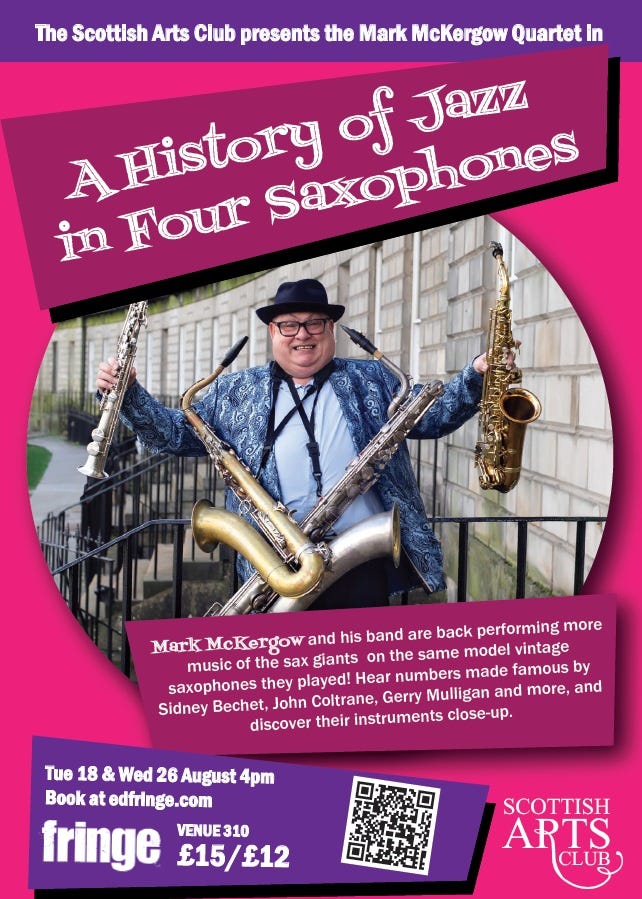
I am once again performing in the world-famous Edinburgh Fringe Festival this summer. I have two different shows, two performances of each.
A History of Jazz in Four Saxophones sees me performing music of the jazz greats (including Sidney Bechet, Charlie Parker, John Coltrane and Gerry Mulligan) on the same models of saxophone they used. It’s a unique show as far as I know, and I have the same excellent band as last year with top players from Edinburgh and Glasgow.
Tuesday 18 August and Wednesday 26 August 2026, 4pm, Scottish Arts Club.
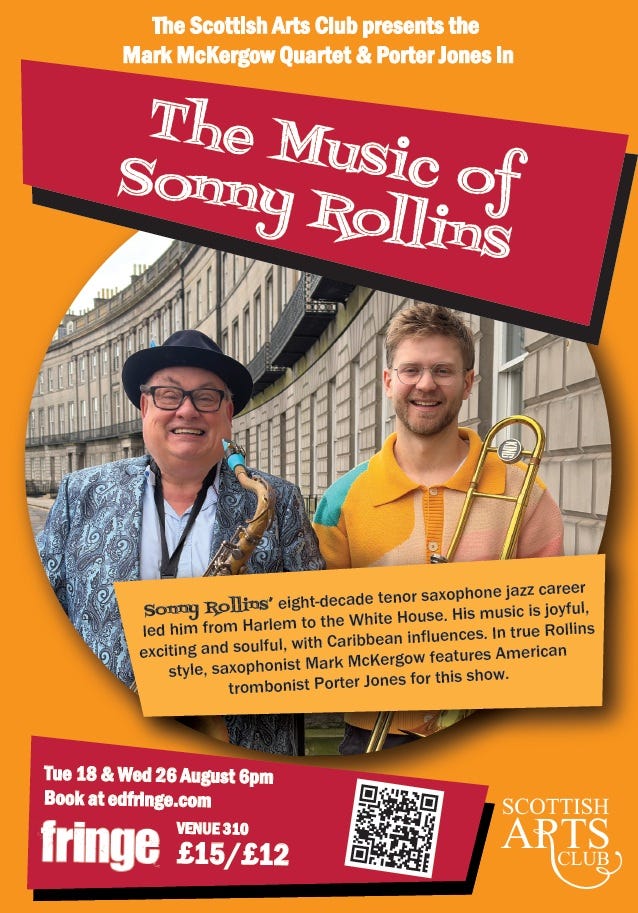
The Music of Sonny Rollins pays tribute to this master of the tenor saxophone. Sonny Rollins’ eight-decade career took him from Harlem to the White House and the world. I will be telling his story and playing some of his best-loved numbers. Rollins loved to play alongside a trombonist and I am thrilled to be joined by American Porter Jones for this show, expanding the band.
Tuesday 18 August and Wednesday 26 August 2026, 6pm, Scottish Arts Club. (Same dates as above, different time!)
This Substack has been running since January 2023. I normally take July and August off, and this year is no exception. I’ll be back on Wednesday 2 September 2026. Have a great summer, wherever you are.
Comments
Nothing yet. Say the first thing.
Sign in to join the conversation.