

I would like to thank the Ménière’s Community on Facebook for allowing me to use some of their ‘memes’ in my articles. I think you will find the comments from Community members helpful as you begin your journey with Ménière’s. I also want to thank the many universities, clinics, hospitals, and vestibular organizations that have shared charts about the disease, its progress, and potential treatments.
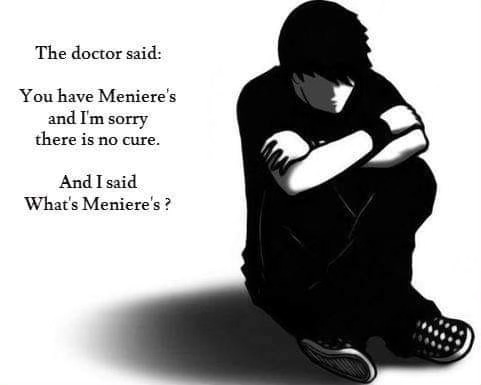
You’ve been diagnosed with Ménière’s Disease. Doctors tell you the disease is progressive and incurable. Not exactly what you were hoping to hear. So, is that it? Is there no help? No hope?
One of the first articles I wrote in this series a few years ago was titled, ‘Laboratory of One: Understanding How Ménière’s Disease Affects ‘You’.’ If you have been diagnosed recently, I recommend you read the article for some helpful information.
What I plan to share with you during the next several ‘Ménière’s Years’ articles may come as a surprise to some people who are new to Ménière’s Disease, but my purpose is to ‘educate’ rather than ‘frighten.’ Yes, Ménière’s is a tough disease to handle. I’m in my 20th year with Ménière’s, plus I helped my mother who had it until she passed away. She died in the ‘Final Stage’ of Ménière’s at the age of 91, so that should tell you something about how we can learn to endure the hardships this disease will bring into our lives.
It is difficult to have hope as you face years of Ménière’s attacks and travel through the various stages of the disease, but it is not impossible. Here’s the first thing I’d like you to know if you are new to the disease:
You may or may not find this of any comfort right now, but you are not alone. Thousands of people are diagnosed with Ménière’s Disease every year in the United States.
“Ménière’s affects roughly 615,000 people in the United States, making it a relatively rare disorder, according to current statistics. About 0.2 percent of the U.S. population has it. And each year about 45,500 new cases are diagnosed. But despite these statistics, there continues to be debate over how common Meniere’s actually is.
Although it can come on at any age, most people with Ménière’s are 40 or older. Onset most often occurs between 40 and 60. And the probability of developing the disorder is fairly equal between both women and men, although some studies do show that women may be more likely to be diagnosed with it.
Ménière’s is called a disease, but it really is a cluster of symptoms for which the underlying cause is unknown and for which there currently is no cure.” American Hearing Research Foundation
I also want to quote one of the doctors I know who has both an impressive education in Neurotology and decades of experience in working with Ménière’s patients. Here’s what he said to me during my initial testing with him:
“The one thing we know about Ménière’s Disease is that we don’t know anything about Ménière’s Disease.”
I found his honesty refreshing. You can learn something from every doctor you’ll meet during your ‘Ménière’s Journey.’ I might add that he did the necessary testing to confirm I had Familial Bi-Lateral Ménière’s Disease. That has been helpful in determining how to navigate the ‘challenging waters’ of this illness.
The answer to that question is somewhat up to you. Your doctors, depending on their specialities and how much they know about Ménière’s, will probably explain the disease and some of what’s ahead for you. They may tell you what may ‘trigger’ your vertigo attacks, the various ‘stages’ of the disease, the ‘Ménière’s ladder,’ neuroplasticity, and the many ‘tools’ they have available to them to help you through the various stages of Ménière’s. However, it’s up to you how you follow their advice. It’s your brain and body. Doctors are there to give you their professional observations and opinions based on the evidence they find. What you do with that information is for you to decide.
Making ‘lifestyle changes’ is a fairly common recommendation to Ménière’s patients. It’s generally non-invasive and you determine what ‘changes’ you make to your life. Your doctors may also recommend ‘rescue’ medications that will help you with the violent vertigo attacks that can accompany Ménière’s. Though I have personally tried to limit the number of medications I use, I have found a couple helpful to me when I feel an attack coming. That’s something for you to consider.
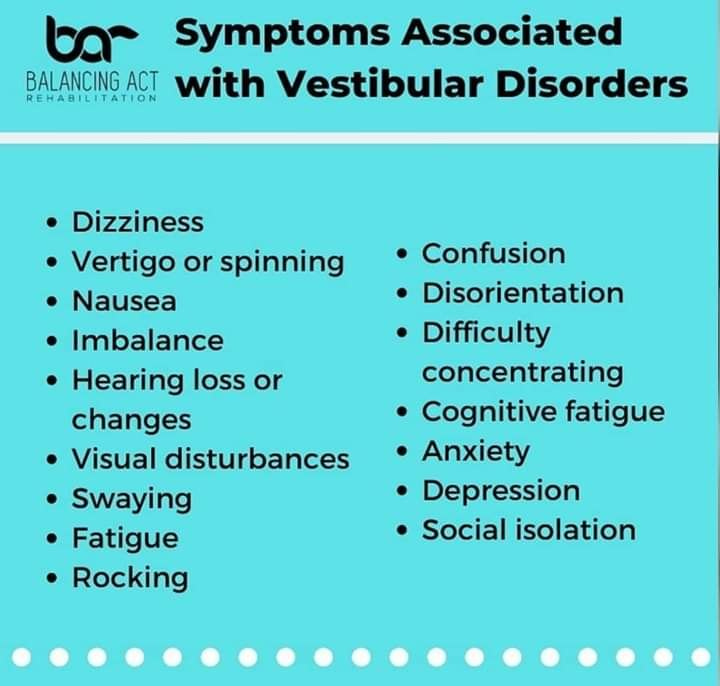
I found the early and middle (intermediate) stages to be particularly difficult at times. I’ve experienced all of the symptoms listed below, as have many other Ménière’s patients I know, so I trust the list:
I believe honesty is the best medicine. I won’t try to mislead you into believing something that isn’t true. I’m an investigative journalist by trade, so I’m not trying to sell you anything. My goal is to discover the truth and help all of us find ways to improve the quality of our lives. I have and will continue to share with you the best research available about Ménière’s — and I will be honest with you about what you may face in the months and years to come.
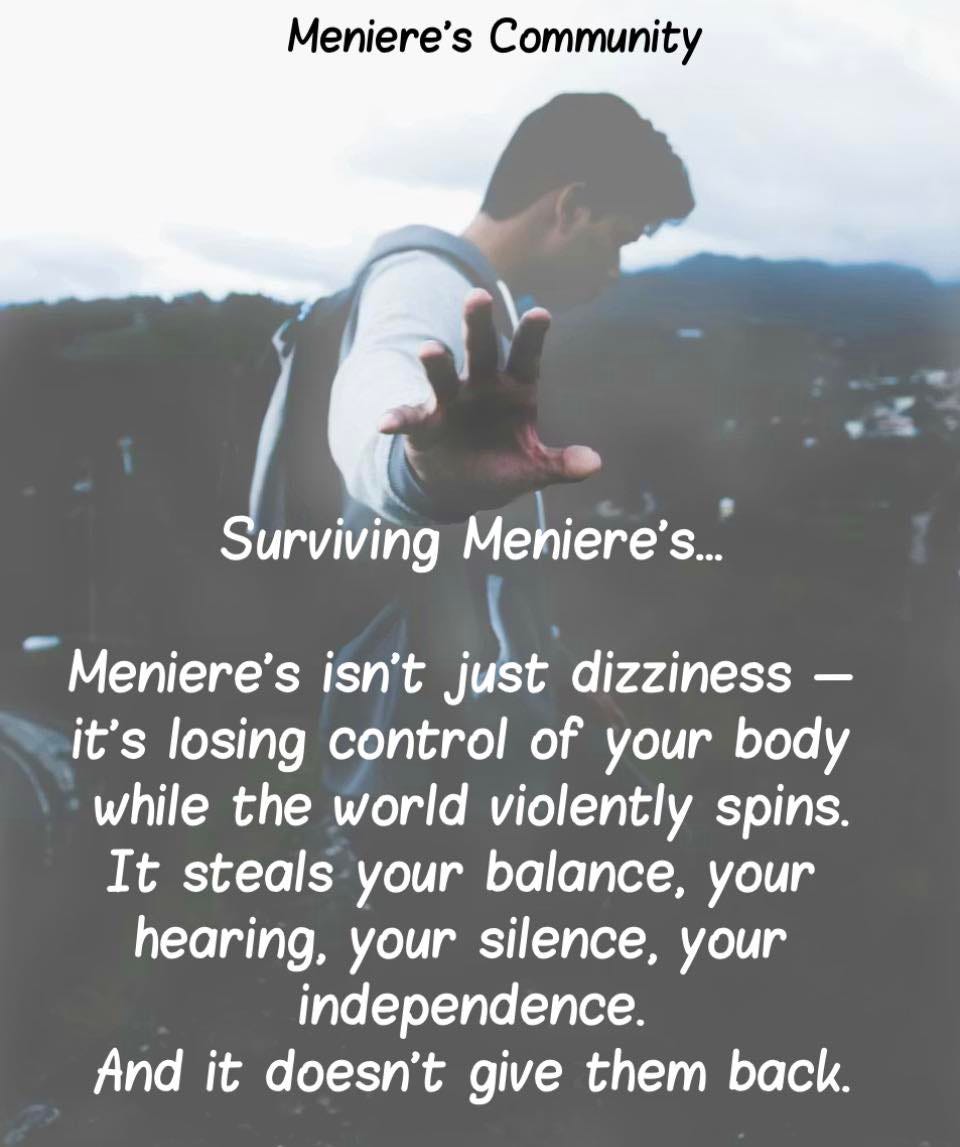
I’ll share about the importance of ‘Community Support’ for Ménière’s Disease in the next Ménière’s Years newsletter.
“… rejoicing in hope, patient in tribulation, continuing steadfastly in prayer.” Romans 12:12
Thank you for reading Mark McGee’s Newsletter. This post is public so feel free to share it.
If you’re a new subscriber to a publication on Substack, you’ll receive all sections by default.
If you’re already a subscriber and the writer has created a new section or sections, you’ll need to subscribe to them in order to receive a new email newsletter or see a post in your app Inbox.
No posts
Comments
Nothing yet. Say the first thing.
Sign in to join the conversation.