

What is the best method of self defense for the elderly? My simple answer is “the one that works.” A more complex answer might be - “the one you can learn to use.”
As for who I mean when I use the term “elderly,” please refer back to the first part of our series.
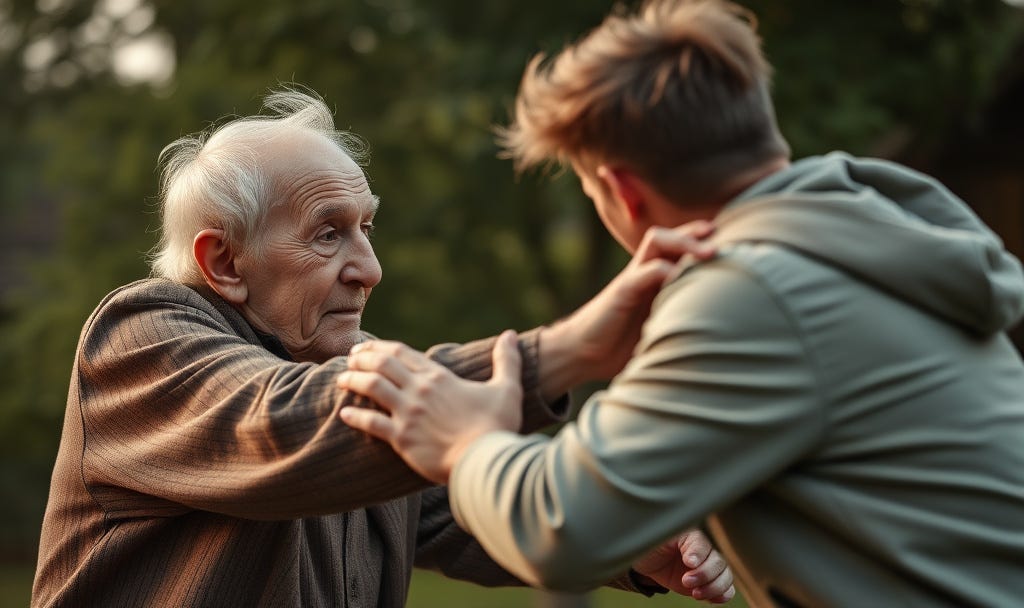
Self defense begins with physical and emotional assessment, then moves to awareness, and a person’s fitness for defense. The next step is to find a teacher.
Finding a teacher is more than just selecting a particular self-defense system to study. It also includes the teacher’s aptitude to teach the elderly and a sensitivity to their special needs. I’ve been teaching self defense for more than 60 years, but readily admit it took awhile before I understood how to teach older people. Becoming an older person myself certainly helped, but a good teacher will study the needs of all the people who attend their classes.
As more and more older people attend a class, the teacher should look for ways to help them with their special needs. The instructor may find that scheduling a specific class for people in their 60s, 70s, and 80s, might be helpful. An older person can continue to train with younger classmates if they like, but some might want to train with people their own age. It’s an individual thing, so having options is a good idea.
Older people are usually gentle people, so some of the self-defense target areas I’m going to mention may sound like “dirty” fighting. Let me be clear as someone who has been a senior citizen for many years .. there is no such thing as “dirty” self defense when an elderly person is attacked. Most attacks on older people are by younger people. That’s what I call “dirty.” Many attacks on older people are vicious and violent. That’s what I call “dirty.” So, anything that an older person can use to defend themselves should not be considered “dirty.”
However, if an older person were to get the upper hand on an attacker and attempt to take revenge on them for the attack, that’s where the “dirty” line is crossed. Once an older person is free to escape an attack, they should escape .. not try to take revenge.
Now, let’s look at some effective martial arts an older person could study to learn how to defend themselves.
T’ai Chi Ch’uan is an excellent self-defense system for older people. Grand Master John Chung Li used to say that Hwa Yu T’ai Chi Ch’uan was “good for health and self defense.” I agree. T’ai Chi is excellent for improving people’s health – people of all ages. It is also good for self defense. T’ai Chi Ch’uan can be extremely effective at defending against attack and defeating an opponent. Hwa Yu, like some other system of T’ai Chi Ch’uan, include short Animal forms that are easy to learn and use in real-life situations.
T’ai Chi can help older people build strength and balance, which are important to health and self defense. T’ai Chi Ch’uan uses basic martial arts principles like evasion, quartering, and countering. All of those are important to an older person’s success in defending themselves against attack. We use the following terms in Hwa Yu T’ai Chi Ch’uan and Yon Ch’uan Martial Arts:
Yield
Clear
Contact
Control
Counter
Though T’ai Chi Ch’uan has the appearance of a slow-moving and gentle exercise, it can also be used quickly to defend against an attacker. GM Li used to say, “slow makes fast.” Moving slowly at first helps build a person’s ability to move quickly and effectively when necessary. T’ai Chi instructors who understand the self-defense aspects of the art will guide students to understand how to use the movements if attacked.
One of the best self-defense techniques in T’ai Chi Ch’uan is “coiling and uncoiling.” It’s a way of moving your wrist and forearm in a way that facilitates a quick escape from someone who grabs you. We teach it to everyone from young children to older adults. The technique is part of the “Contact/Control” feature of T’ai Chi, which can also be used for pulling someone into a throw or pushing someone away from you. Contact is usually made with the “coiling” technique. Control is usually made with the “uncoiling” technique. It’s a way of escaping from an attacker without doing them much harm.
There are times when a person needs to cause harm to an attacker (see Special Note for Seniors above). That means striking a target area that brings the attack to a quick and effective end. Targets in T’ai Chi Ch’uan include an attacker’s eyes, nose, temples, throat, solar plexus, groin, knees, shins, and top of feet. If your teacher knows Chin Na, you can also learn joint locking to set up an attacker for a quick throw. I don’t recommend that older people attempt to place attackers in holds.
Having something in your pocket or purse that you can throw toward the eyes of an attacker can give you an advantage as well. In the brief moment that they blink their eyes because of something coming at them, you can evade and escape, or counter attack.
If an older person happens to use a cane for walking or balance, the cane can be an excellent self-defense weapon. Some T’ai Chi instructors will know how to help you learn to use your cane for that purpose. Other options are to learn how to use near-by objects that you can grab and use to defend yourself. I call that “environmental” defense weapons because they are available in any given environment in which you find yourself. Learning how to wield environmental weapons so that an attacker cannot easily block or evade the weapon is an important part of the lessons. A quick cane handle strike to an attacker’s throat or solar plexus, or a powerful lifting cane strike to an attacker’s groin can give you the time you need to escape to safety.
If you use a walker or rollator (also known as a wheeled walker) to get around, try to keep it between you and the attacker making it more difficult for him to reach you. Yell or scream for help while you do that. The attacker may give up trying to reach you if he fears someone coming to your defense. I recommend that elderly people not walk outside at night if possible. If you must do that, ask other people to walk with you. Attackers usually won’t try attacking a group of people, especially if they see younger people in the group.
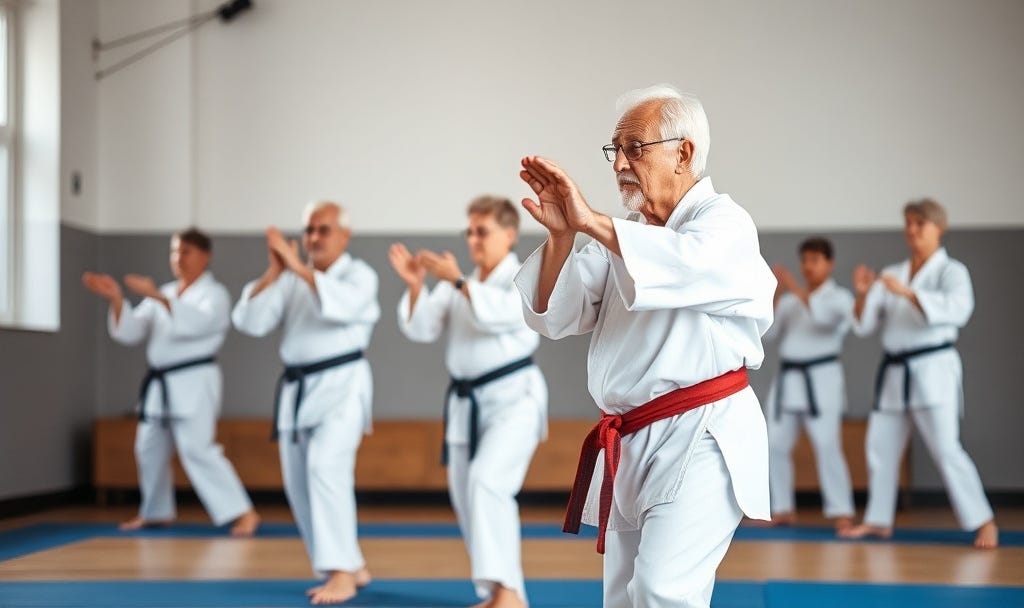
Karate is another excellent system of self defense for older people. I include Kempo, Tang Soo Do, Taekwondo, and Krav Maga in this category. Even if an older person was not a Karate student when they were younger, they can still learn defensive techniques that are effective against an attack. Yon Ch’uan Martial Arts is an excellent example of how to use blocks, kicks, strikes, traps, and throws in defending against an attack. The principles of evasion, quartering, and countering are also applicable in Karate.
Targets in Karate include an attacker’s eyes, nose, temples, throat, solar plexus, groin, knees, shins, and top of feet. If your teacher knows Chin Na or Jujutsu, you can also learn joint locking to set up an attacker for a quick throw.
Having something in your pocket or purse that you can throw toward the eyes of an attacker can give you an advantage as well. In the brief moment that they blink their eyes because of something coming at them, you can evade and escape, or counter attack.
Karate also has many weapons that you can learn to use, but it’s important to remember that an attacker may be able to take the weapon away and use it on you. Learning how to use a short stick (e.g. Yawara, Escrima) in class is also a good way of understanding how to grab something near you (e.g. environmental) and use it as a defensive and/or offensive weapon.
I also want to make mention of yelling or shouting for self defense. Karate teaches students to yell or shout loudly as they strike .. sometimes when they block. Martial artists use the yell to help focus their power into the strike. A side benefit is that students learn how to yell loudly. If an attacker pulls you close to their head, yell loudly into their ear. The sound will disable their thinking for just a moment. If you kick them in their groin with your knee immediately following your shout, that could be enough to escape.
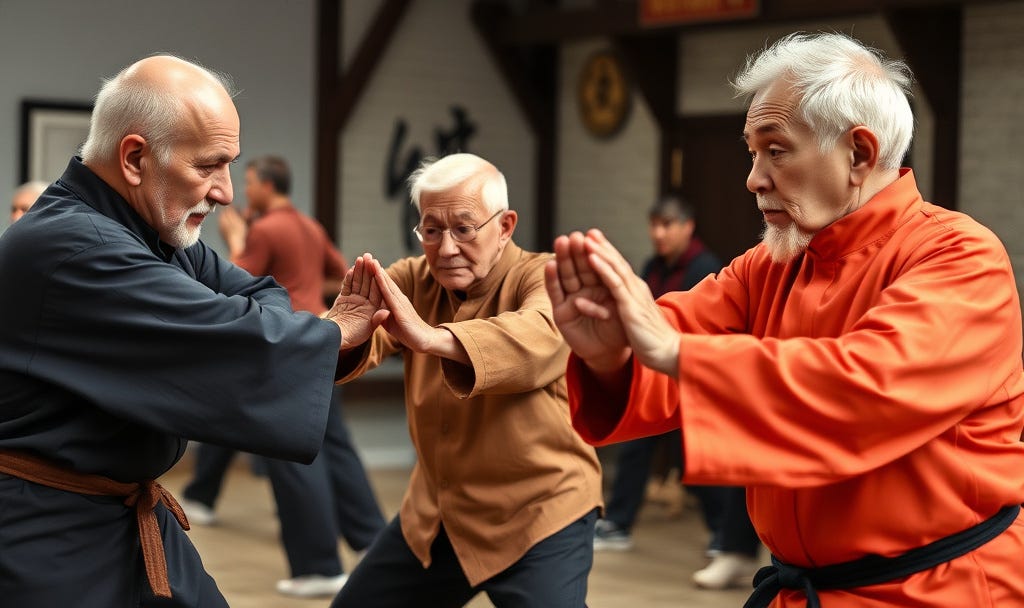
Kung Fu has many similarities to Karate. That’s because some older Karate styles came from Kung Fu. Many of the things written above also apply to Kung Fu. Some styles of Kung Fu are more external in the way power is generated for martial techniques. Some styles of Kung Fu are more internal and in the way power is generated for martial techniques. I’ve studied both and both are effective. However, older people may find internal Kung Fu will work better for them.
Hwa Yu T’ai Chi Ch’uan, 15 Animal Kung Fu, and Yon Ch’uan Martial Arts are examples of internal Kung Fu. Wing Chun is another Kung Fu that some elderly people say they like for self defense.
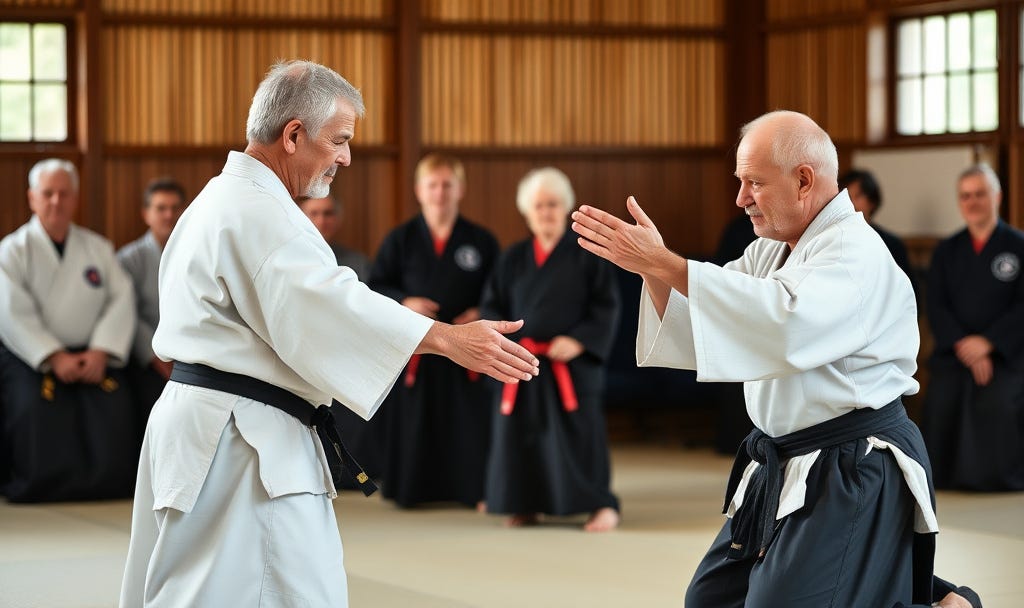
I don’t usually recommend that older people study Judo and Aikido unless they have previous experience with it because of the dangers related to falling. Older people can learn how to off-balance and throw someone, but the rigors of falling and being thrown in class could lead to serious injury. If you have previous experience with Judo or Aikido you will probably do fine as long as the teacher understands how aging affects martial artists.
Experienced Judo and Aikido instructors will be careful in training older people without previous experience in the arts. I have taught older people how to fall for the purpose of not hurting themselves if they slip on ice, trip over their dog, etc. However, the training needs to be done slowly and carefully. Most elderly people I’ve trained were thankful to see how safe falling works, but didn’t want to practice it. That’s okay. The choice needs to be theirs.
Judo and Aikido are both effective in self defense because they use an attacker’s strength and force against them. We teach both in Yon Ch’uan Martial Arts as alternatives to harsher defenses (e.g. kicks, strikes, etc). However, I will say that yielding, clearing, and blending with an attacker so that he is thrown into a wall or other hard object will definitely leave a mark (on them).
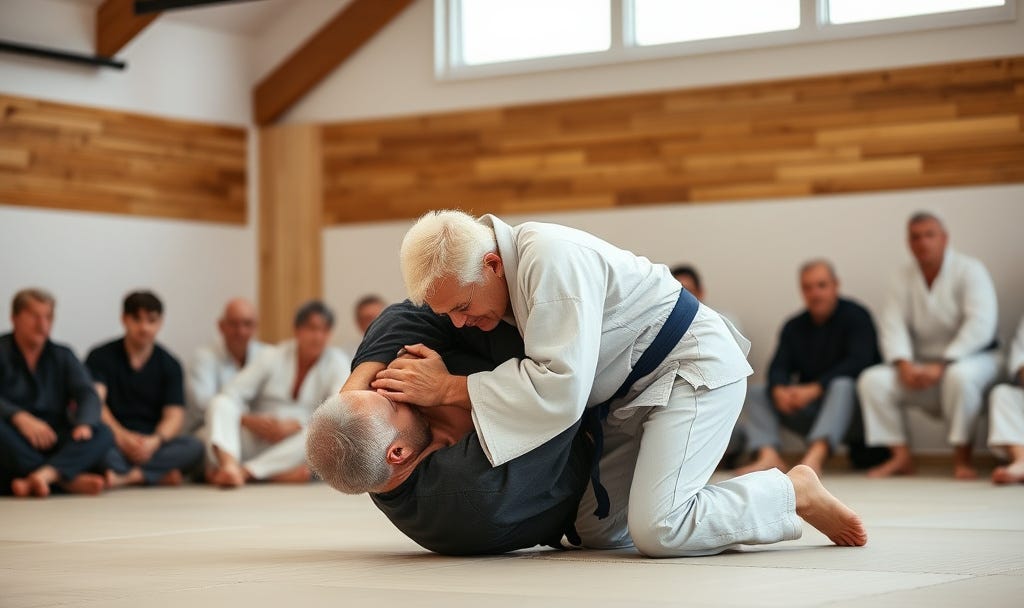
Many attacks on people, including the elderly, go to the ground. Learning some basics of how to survive a ground attack can be beneficial, even life-saving. An important key, as with Judo, is to train with a teacher who has experience working with elderly students. That’s based on any previous experience with Jujutsu, strength, fitness, and flexibility. The last thing an older person wants to do is injure themselves learning how not to be injured. Older people do not heal as quickly as younger people, so keep that in mind as you select a self-defense method.
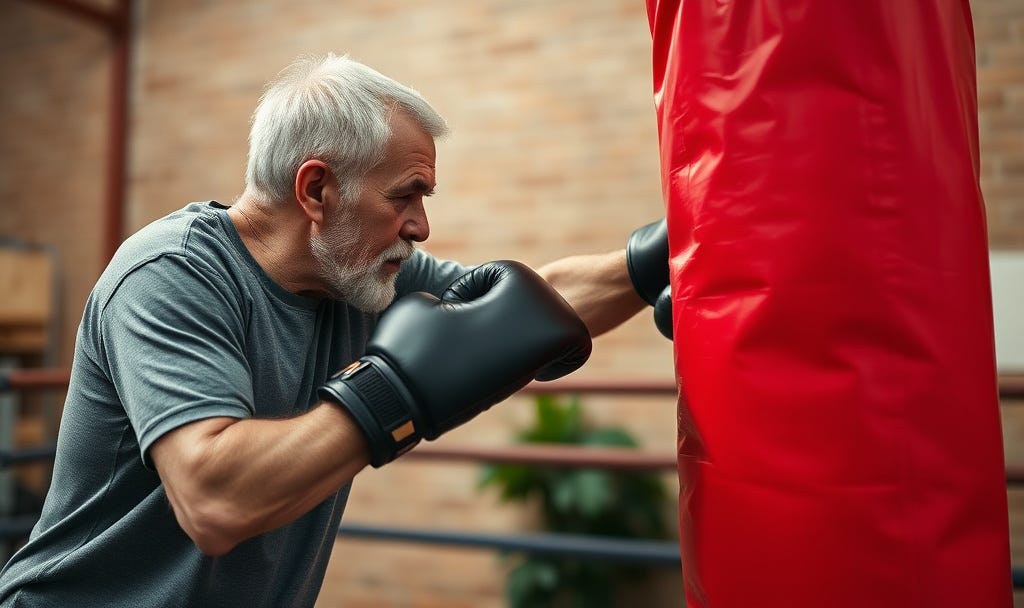
Boxing can be a good fitness exercise for older people, but finding a teacher who understands the physical needs of seniors is important. Previous experience with boxing is also helpful. I saw a convenience store video of an older man (in his 70s) knock out three young men who were trying to rob him as he was leaving the store. The man had been a champion boxer when he was younger, so he knew how to take a strong stance and deliver the knockout blows. However, an older person with no previous boxing experience would need to learn from a good teacher who would honestly evaluate whether boxing was a good fit for them.
Boxing is fighting and fighting is not usually the best option for an older person. However, if your only way out of an attack is to take a strong stance and hit people, hard boxing can be an option.
After more than 60 years training people in martial arts and self defense, my personal recommendation to older people is to begin with T’ai Chi Ch’uan – especially those older than 70, and people with medical conditions or physical limitations. T’ai Chi is good for health and self defense, so it can help you in both areas. Plus, T’ai Chi classes are usually a lot of fun!
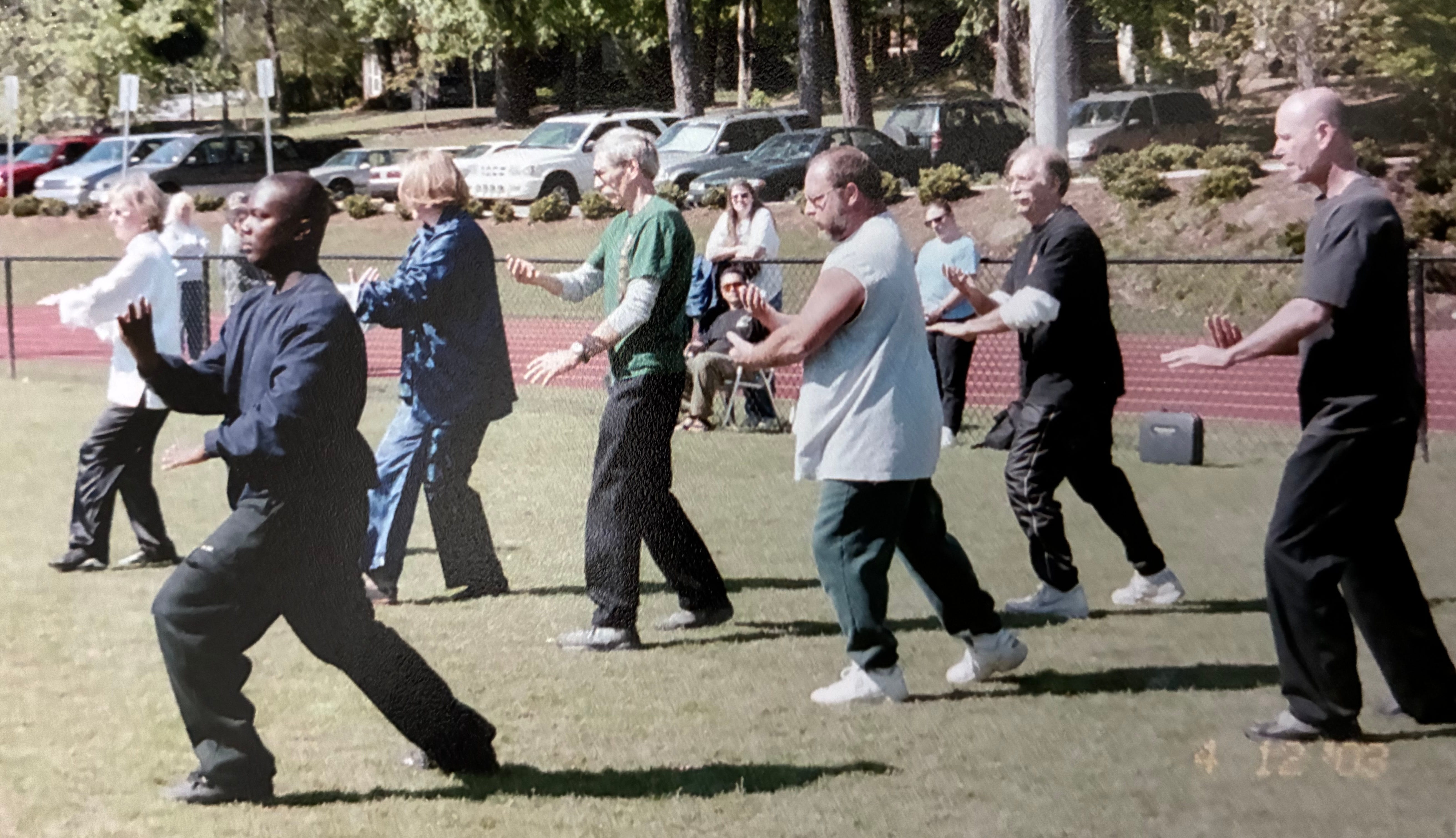
Here are a couple of photos from 2001 and 2002 of members of my T’ai Chi class in Columbus, Georgia. We did many demonstrations of the art to introduce the benefits of the exercise to the community. You can see that people of all ages and physical conditions can enjoy T’ai Chi.
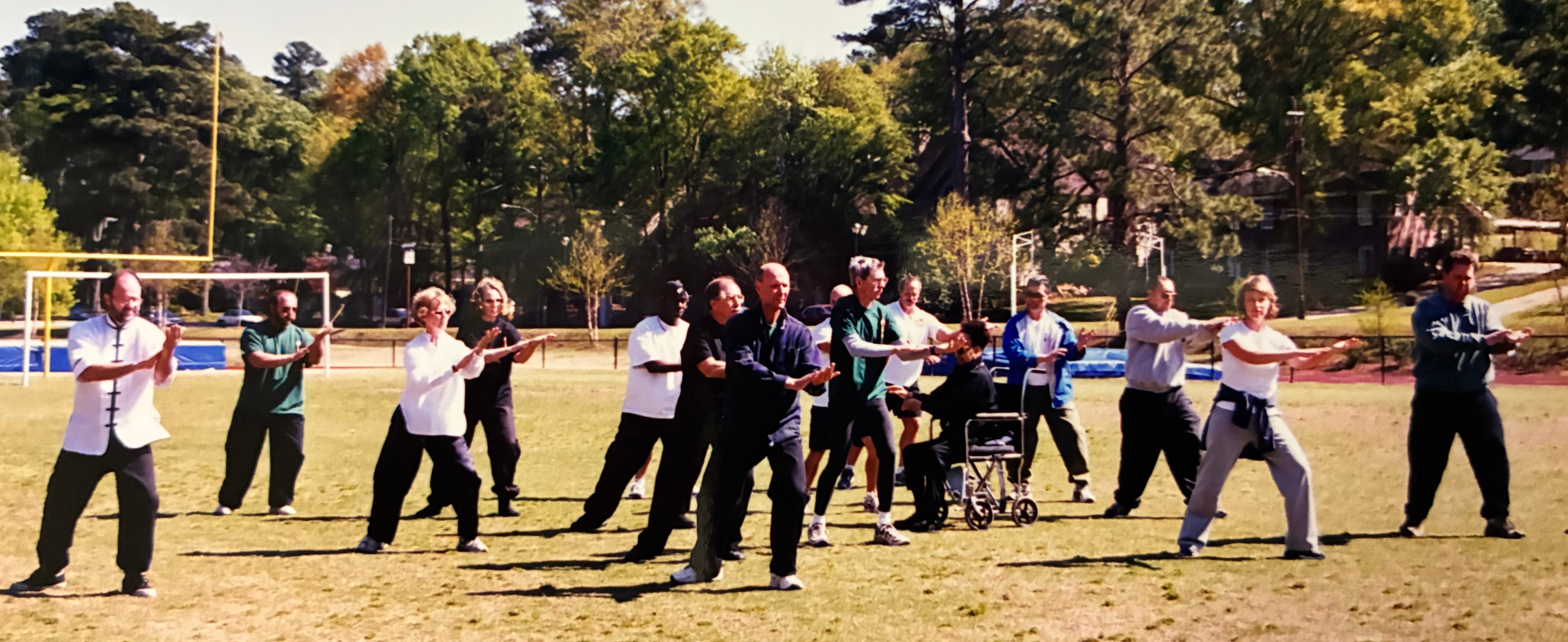
Find a teacher who has many years of experience in both the health and self defense sides of T’ai Chi. Once you have some solid training in T’ai Chi Ch’uan, you may find that you’d like to also learn something else. That other martial art may be taught in the same location as your T’ai Chi class, or your teacher or fellow students may have some good suggestions for you.
I’ll share some special advice for seniors in the next part of our special series, Protecting The Vulnerable.
Sensei McGee is a 9th Degree Black Belt in Yon Ch’uan Martial Arts and a Master Trainer in Hwa Yu T’ai Chi under Grand Master Robert Xavier. Mr. McGee is also a 7th Degree Black Sash in Shaolin Kung Fu and a 3rd Degree Black Belt in Matsumura Seito Shorin Ryu Karate under Grand Master Stephen Van Camp. He also has Black Belts in Tang Soo Do, Taekwondo, and Kempo.
We hope you will subscribe to Women’s Self Defense and invite daughters, mothers, and other women in your life to subscribe as well. Subscribing means that each new newsletter will arrive in your inbox as soon as it’s published. Articles will also be available under the Self Defense section of this Substack website.
If you’re a new subscriber to a publication on Substack, you’ll receive all sections by default.
If you’re already a subscriber and the writer has created a new section or sections, you’ll need to subscribe to them in order to receive a new email newsletter or see a post in your app Inbox.
I am here to help you, so please share your comments, concerns, and questions about self defense. Even though I’m emphasizing “Women’s” self defense, the principles and techniques I’ll share are just as applicable for boys and men.
You can be attacked anywhere, at anytime, by anyone. Be ready.
Thank you for reading Mark McGee’s Newsletter. This post is public so feel free to share it.
No posts
Comments
Nothing yet. Say the first thing.
Sign in to join the conversation.