
Chances are, you heard about all of these viral stories last year:
The married (but not to each other) CEO and HR director caught making out on the Coldplay kiss cam.
The lunatic Karen at a Phillies game screaming profanities at a father and demanding he give her the home run ball he had just caught for his son.
The delusional passenger on a Southwest flight kicked off a plane because she couldn’t stop ranting about imaginary beings taking over the world.
We all hear these stories. We saw them get shared incessantly. We watched them become memes, punchlines, cultural staples in our information diets.
But let me ask you: Did you hear about any of these stories?
One morning a few years back, while waiting for the New York City subway, a man had a seizure and fell onto the tracks in front of an oncoming train. Wesley Autrey, a 50-year-old construction worker and Navy veteran, quickly jumped onto the tracks, pushed the man into a drainage ditch and covered him with his body as the train roared over both of their heads, inches away from killing them. Both survived.
Or this one: Kennis Goodman, a 34-year-old DoorDash driver and Air Force veteran, was picking up his first delivery of the day when a man walked into a South Carolina Walgreens with a knife and started slashing and stabbing customers. Goodman ran straight up to the guy, tackled him, wrestled the knife away from him, and successfully held him there until police arrived.
Or this one: William Rubio, a 37-year-old maintenance worker from Kentucky, spotted a tractor-trailer engulfed in six-foot flames on an Arizona highway. He got out of his car, ran across the median, climbed onto the burning engine block, and punched through the cracked windshield with his bare hands and pulled the unconscious driver free. About 15 seconds after they cleared the cab, it exploded.
The first three stories were seen by hundreds of millions of people within 48 hours. The second three were mostly covered by local newspapers and read by nobody.
Outrage travels instantly, while heroism requires two paragraphs of context and a grainy photo of proof.
But we only see the first.
This is because the algorithms are built to promote what you'll share in the next 10 seconds, not what you’ll still admire in 10 years.
A lot of bytes have been published lamenting social media’s effect on our attention, the way it’s blitzed any semblance or reasonable political discourse, the superficiality and mindlessness of its content.
But quietly, in the background, our culture has slowly witnessed the loss of its collective heroes.
That’s because heroism requires context—there needs to be some understanding of what was sacrificed and the depth of that sacrifice to properly understand the heroism. But the fact of the matter is that our current media formats are no longer suited to delivering rich context. And the stories of real-life heroes have all but disappeared from our news media and our art.
Instead, “heroism” in our culture has been reduced to the lowest-common denominator. News media only surfaces tribal political “heroes.” And popular culture simply regurgitating the same old fantastical superheroes.
Gone are the lived stories of real men and women that historically were always lifted in the culture as a way of aligning everyone around shared values. The few stories that do break through are either quickly politicized for—you guessed it—more reach, or they are quickly reacted to and ridiculed by clout-chasers.
This isn’t to say that there are no heroes out there doing great things? The death of heroism is not the death of heroes themselves. It’s the death of heroes being held up and admired within our culture.
The attention economy robs us of more than our attention. The mechanics of it demand cynicism from its adherents. Trashing something is ten times easier than building something and it gets ten times the reach.
So why not just trash everything, all the time?
My grandfather served in World War II. For forty years, he never spoke about his experiences there. Any time anyone asked him what happened, he simply replied, “I drove a truck in France.”
My grandfather was a life-long firefighter. He could regale you for hours about some of the most intense fires he had battled and the incredible bravery he had seen. But for decades, he shrugged off any questions of the war as if it were nothing.
Then, one night in the late 80s, when he was about five scotches deep, he finally started talking. He was at D-Day. He had piloted one of the landing crafts across the channel. He would land on the beach, watch all of the men — many of whom were his friends — immediately get shot, only to then have to turn around to go load up another 30 infantrymen, bring them across the channel, watch them all immediately get shot, turn around, go get another group, and on and on, for hours.
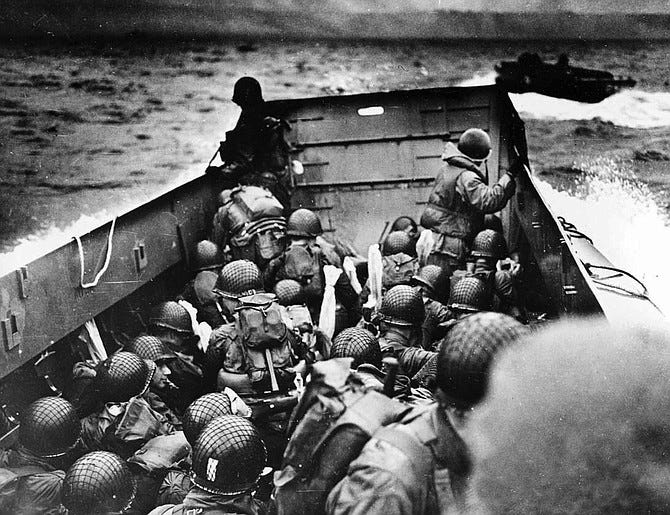
His experiences, among countless others, were later depicted and immortalized in the opening scenes of Steven Spielberg’s Saving Private Ryan. Scenes that still bring me to tears, especially as I think about my grandfather. And all of the incredible men and women of his generation. And the unimaginable sacrifices they made.
Then I wonder… how would that story be told on TikTok today?
Would it?
No posts
Comments
Nothing yet. Say the first thing.
Sign in to join the conversation.