
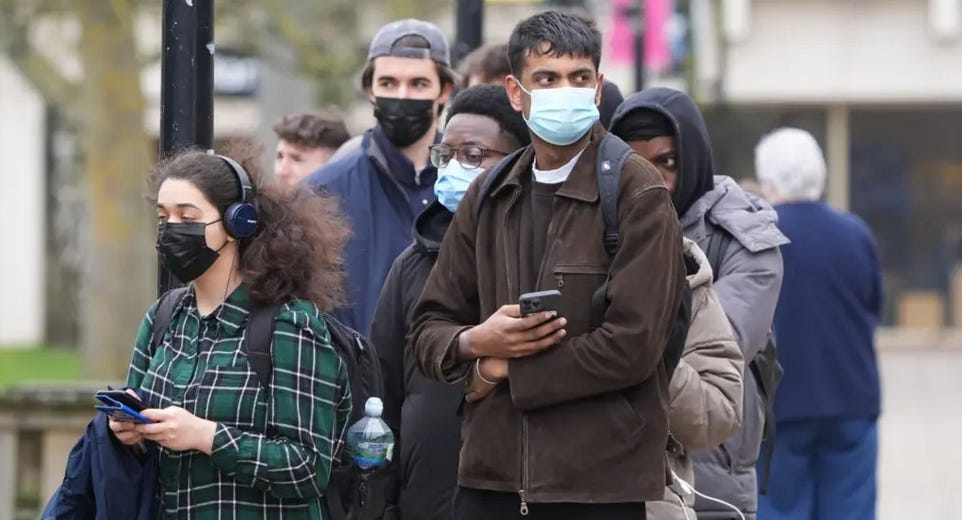
Shuttered lecture theatres and anxious students waiting in line for antibiotics. The reappearance of face masks and expert briefings from the UK Health Security Agency (UKHSA).
As the meningitis outbreak at the University of Kent sparks alarm across southern England, you could be forgiven for thinking we are witnessing a replay of Covid-19. And just when Baroness Heather Hallet, the chair of the UK Covid Inquiry, is about to deliver her long-awaited report on the impact of the pandemic on healthcare systems i the four nations.
Of course, meningitis is a very different pathogen from SARS-CoV-2, the virus of Covid-19 – for starters, the Kent outbreak is due to a bacterium, not a virus, and is typically spread by close contact with respiratory droplets rather than via highly infectious aerosols. And the good news is we have a vaccine against the “B” strain at the centre of the Kent outbreak, something that wasn’t the case during Covid when vaccines had to be manufactured from scratch. Nonetheless the echoes are striking, reminding us that while history doesn’t repeat it often rhymes.
So far, the outbreak that begun in Kent last weekend has killed two students and left 15 gravely ill. Whether viral or bacterial, meningitis presents a particular risk in communal settings such as universities and schools – one of the victims was an 18-year-old Kent schoolgirl, the other a 21-year-old female student. But it can affect people at any age, including adults in the prime of life.
For me, the latest outbreak immediately brought to mind the sudden death of a journalist friend from meningitis a little over thirteen years ago. It was shortly before Christmas 2012 when John, a reporter for Lloyds’ List, first felt the premonitory signs of fatigue and fever at his home in Bath. Thinking he had a mild case of flu, John ignored the symptoms and set off for London accompanied his wife and sons. The plan was to catch the Eurostar to Paris, where they were scheduled to meet up with John’s sister-in-law and her husband before heading to their home in Fontainbleu for the festive season. But John never made it to Fontainbleu. Instead, by the time the Eurostar emerged from the Channel tunnel, he was running a high fever and his wife was sufficiently worried to ask a guard if he could stop the train and let them off.
“Impossible”, came the reply.
The result was that by the time the Eursotar pulled into the Gare du Nord, John was complaining of a stiff neck and muscle and back pains – hallmarks of a severe meningitis infection. And by the time he reached his sister-in-law’s apartment near Bastille, he was having trouble standing up.
They immediately dialled the emergency services but when the medics arrived at the fifth floor apartment John was ice cold. Then, on turning him over, the medics spotted a dark purple rash on his back – another sign of meningitis.
Suspecting John had a systemic infection, the medics called the fire brigade. The next thing his wife knew, pompiers had brought a crane up to the balcony of the apartment and were stretchering John out the louvre windows.
Whisked to the Val-de-Grace hospital in the 14th arrondisement, John was admitted to intensive care as doctors tried to figure out what was wrong with him. Fit, middle-aged men with no underlying medical conditions do not usually collapse going about their daily business, unless they have suffered a heart attack or a brain aneurism. But John’s symptoms did not match those of a heart attack or other common catastrophic conditions and, although it was the flu season, there were no unusually virulent strains circulating that winter.
Fearing that John was at risk of toxic shock, he was placed him on a heart monitor while doctors ran a series of tests to rule out common viral infections. Then, thinking that his immune system may have been compromised, they screened him for HIV and leukaemia but these tests were also negative. It was only when they took a lumbar puncture and saw a mass of tiny, kidney-shaped diplococci in John’s spinal fluid that they realised it was Neisseria meningitidis.
The bacterium lives in the membranes of the nose and throat and usually presents little risk to healthy adults. However, every now and then, for reasons that are unclear, it gets into the bloodstream, causing septicaemia and catastrophic systemic changes. And if it crosses the meninges, the thin membrane that protects the brain, it can trigger paralysis and lasting brain damage.
Fearing the bacteria had already crossed the blood-brain barrier, John was placed in a coma, while doctors fed him intravenous antibiotics. But by now John had sepsis and his kidneys were beginning to fail. The final stage came 48 hours later when John’s immune system went into overdrive, flooding his lungs with fluids that cut the flow of oxygen to his heart. The doctors upped the antibiotics and put him on a respirator to help his breathing but it was to no avail and on Christmas Day John died. He was 53.
To this day, John’s family has no idea how he caught meningitis. At Lloyd’s List, John’s speciality was Italian shipping, a beat that required him to keep tabs on the comings and goings of tankers and cruise liners at various ports in the Meditteranean and the Aegean. Perhaps he’d the caught the bug while interviewing the crew of a ship that had recently returned from Sudan or Senegal – one of the most virulent strains of meningitis is the W135 serogroup, a type associated with periodic epidemics in countries in sub-Saharan Africa and pilgrims returning from the Haj in Mecca. Or perhaps he’d caught a different strain during his regular travels in Europe.
The chances of contracting meningitis are about 1 in 100,000. Close to half of cases are in adults aged 25 and over. The best way to avoid infection is to be vaccinated. The MenACWY vaccine is usually offered to school-age children to protect against four common meningococcal groups and can be given up to age 25. However, the vaccine against the B strain – known as Bexsero - is expensive and is typically only given to infants, though it can also be obtained privately.
Bexsero is now being offered to some students at Kent as part of what the health secretary Wes Streeting is describing as a “targeted” programme (four of the 15 confirmed cases are meningitis B). However, at time of press it was too early to say whether the outbreak, which appears to have begun at a nightclub in Canterbury on March 5, will be contained or if cases will spread to other parts of the UK. With many parents now evacuating their children from Kent, that possibility cannot be ruled out. And who can blame parents for panicking?
In educational settings, once a second linked case has occurred, the chances of a third case occurring are as high as 30 to 50 per cent. Risk factors including kissing and – if some reports are to be believed - sharing vapes. But as John’s case and the death of the schoolgirl and student in Kent illustrate, the truth is no one is immune from meningitis and when outbreaks occur, cases can progress rapidly with devastating consequences.
That is why whenever a pathogen – whether it be meningitis, Ebola, bird flu or SARS – makes the news, I cannot help but think of John and reflect, “there but for the grace of God go I”.
No posts
Comments
Nothing yet. Say the first thing.
Sign in to join the conversation.