
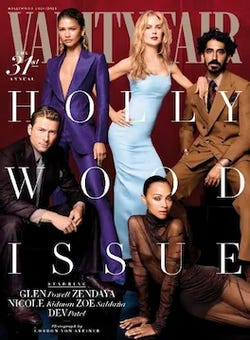
Vanity Fair is an odd name for a glossy and glamorous magazine. It’s a reference joke, but I’m not sure that most people, these days, would get it.
Vanity Fair was invented in the seventeenth century by a religious zealot named John Bunyan. He was in prison at the time for the crime of being too religious, but he had paper and pen so he wrote a long allegorical novel called The Pilgrim’s Progress. It’s about a fellow called Christian who sets out on a journey, but the places he passes are all symbolic. They’re things like “The Valley of the Shadow of Death”, which is shady, or the “Slough of Despond”, where he becomes rather despondent.
One of the places he passes through is a market town where there is a permanent fair going. At the fair they sell vain and trivial things to the worldly. This town is called Vanity Fair.
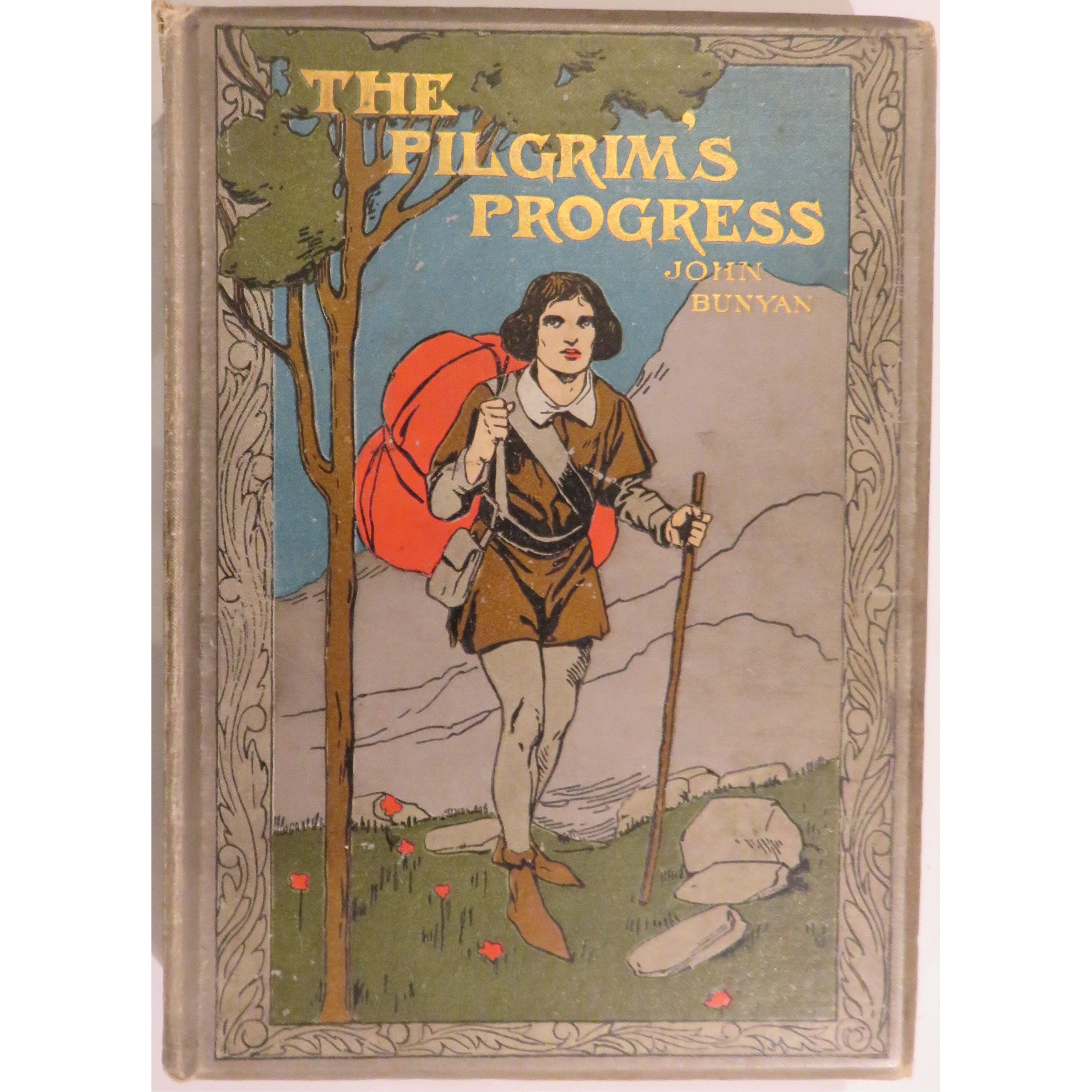
The people who live in Vanity Fair have names like Mr. No-good, Mr. Malice, Mr. Love-lust, Mr. Live-loose, Mr. Heady, Mr. High- mind, Mr. Enmity, Mr. Liar, Mr. Cruelty, Mr. Hate-light, and Mr. Implacable.
The Pilgrim’s Progress was immensely popular as a strict and stern religious book that would inculcate its readers with the love, and fear, of God.
Then, in the 1840s, a writer called William Makepeace Thackeray wrote a satirical novel about English society. It’s generally a funny romp of a book, but he decided to call it Vanity Fair, and that changes the whole tone. The novel now has a message: that England was the new Vanity Fair, filled with luxury and sin. That two-word title sets the whole story in the context of religion and of judgement.
Titles can do that, even in two words.
The book was a hit, and a magazine was named after it. In fact, several different magazines have been named after it over the years. But the famous one is the glossy and glamorous magazine published by Condé Nast from 1913-36, then revived in 1983, because that’s the one that’s still going.
And almost nobody today knows that the name comes from a stern and serious Christian judgement on the vanity of consumer culture.
This all occurred to me because I happened to be musing upon Victorian novel titles and how boring they are. They’re mainly just named after the main character — Jane Eyre, Oliver Twist — or the place where they happen — Middlemarch, Wuthering Heights. Or, sometimes, they do exactly what it says on the tin as in A Tale of Two Cities, which is a tale that takes place in two cities.
The title doesn’t add anything to the book at all.
But in the twentieth century that changed. You started getting titles like For Whom the Bell Tolls, or Clockwork Orange. Novels began to have names that meant something. The title changed the way that you read the book. Ulysses is called Ulysses because James Joyce wanted you to notice that the main character, wandering around Dublin, is doing a modern version of the travels of Ulysses/Odysseus, the great classical hero and commuter.
When Evelyn Waugh called his first novel Decline and Fall he wanted you to think about The Decline and Fall of the Roman Empire, and he wanted you to see some parallels.
Rebecca, by Daphne Du Maurier appears to have a nice normal nineteenth century title, but even that one tells you how to read the book. Because Rebecca never appears in Rebecca. Rebecca is the dead first wife, the shadow of whose death hangs over the poor put-upon second wife.
The twentieth century title grows like an exotic plant into all sorts of strange shapes. You have fragments like To the Lighthouse. You have whole sentences: Do Androids Dream of Electric Sheep? By Grand Central Station I Sat Down and Wept; Flow My Tears, The Policeman Said; Mourning Becomes Electra.
And I was only thinking about all that, because I was listening to Bohemian Rhapsody.
Almost all pop songs have dull titles, or at least titles that Don’t Do Anything. Let It Be is called Let It Be because the repeated line of the chorus is “Let it be”. Shake It Off works the same way. Hotel California, Twist and Shout, Stairway to Heaven — there’s nothing there. No work has been done. Nothing is added to the song.
Even when the title looks elaborate — There’s a Guy Works Down the Chip Shop Swears He’s Elvis, or (my favourite) You’re the Reason Our Kids are Ugly — it turns out that that is indeed the chorus.
There are exceptions, of course. Sympathy for the Devil definitely tells you how to listen to the song.
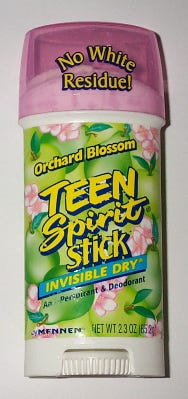
Even among the exceptions to this rule, thought, the new title often doesn’t do very much. Space Oddity is just a joke on 2001: A Space Odyssey. The Beatles’ A Day in the Life is about a day in a life. Perhaps Subterranean Homesick Blues is about somebody who wants to stop living such an underground life, I’m not certain. Smells Like Teen Spirit was simply a misunderstanding. Kurt Cobain thought it was a phrase about rebellion. He didn’t realise that his girlfriend, who had scrawled the phrase on his bedroom wall, was simply insulting him, because Teen Spirit was actually a brand of deodorant.
Which gets me back to my original question: would Bohemian Rhapsody be a different song if it had a different title?
I couldn’t decide, and I was leaning towards the title being meaningless. Then I looked it up, and I discovered that the track was originally called Mongolian Rhapsody.
And I think that that would have been a very different song.
No posts
Comments
Nothing yet. Say the first thing.
Sign in to join the conversation.