
As I said before, and as my theory of the Polar Nexus demonstrates, human history is not a slow, linear climb from primitive cave dwellers to modern industrial society. That conventional narrative is a modern fabrication designed to blind us to our true heritage. History is a grand, repeating, cyclical machine, a vast astrophysical clockwork driven by galactic mechanics, advanced stewardship, and deliberate bio-technological interventions. What mainstream academia dismisses as poetic myth or primitive superstition is, in truth, an encrypted operational logbook and survival manual left behind by previous global epochs.
When we strip away modern institutional dogmas, an extraordinary and undeniable pattern emerges across ancient royal chronicles, temple architectures, declassified intelligence files, and contemporary archaeogenetic breakthroughs. We are not the pinnacle of evolutionary achievement on Earth; we are simply living in the long shadow of an advanced, antediluvian global reality whose infrastructure remains operational, buried deep beneath subglacial sheets and subterranean vaults. The threads of the Naga dynasties of Southeast Asia, the subterranean facilities of ancient Mesopotamia, the subglacial arrays of Antarctica, and the galactic cycles mapped by the Vedic and Mayan sages all converge upon a singular truth. We are approaching the end of an orchestrated cosmic quarantine, and the machine is powering up once again.
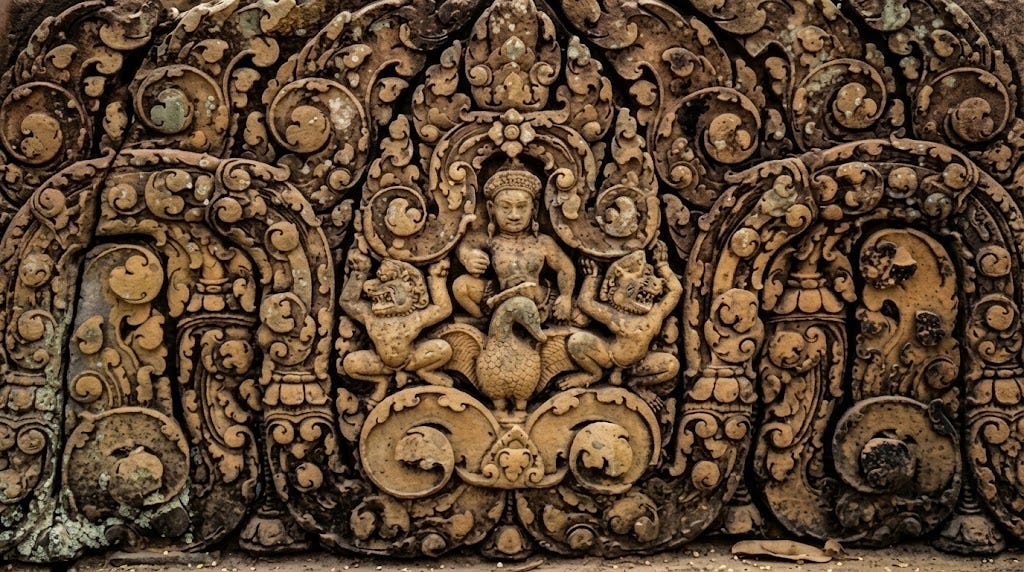
To understand how sovereign power, civil administration, and technological knowledge were established on this planet after the last global cataclysm, we must turn our gaze toward Southeast Asia. In Cambodia's historical traditions, national origin and dynastic sovereignty are anchored in the chronicle of the Naga Queen, known in indigenous memory as Neang Neak or Queen Soma.
According to classical Khmer inscriptions and foundational chronicles, the proto-Cambodian empire of Funan was established in the first century AD through the marital alliance of an Indian merchant-prince named Kaundinya I (Preah Thong) and Queen Soma, the sovereign daughter of a terrestrial Naga monarch. The most meticulous historical testimonies regarding this founding event come directly from Chinese diplomatic logs. In the third century AD, during the Wu Dynasty, imperial envoys Kang Tai and Zhu Ying were dispatched to the southern kingdoms. Their reports, recorded in the Funan Zhuan and later incorporated into the official court annals of the Book of Liang, preserve the event with startling clarity.
Kaundinya was guided by a vivid nocturnal revelation in a temple dream, instructing him to retrieve a divine bow and sail across the southern seas toward Funan. When his vessel approached the coastline, it was intercepted by sovereign naval forces led by Queen Soma, referred to in Chinese records as Liuye, meaning “Willow Leaf.” Kaundinya deployed his bow, unleashing a weapon whose trajectory and power overwhelmed the defensive perimeter. Awed by this demonstration of advanced authority and technology, Soma yielded, struck a truce, and took Kaundinya as her consort.
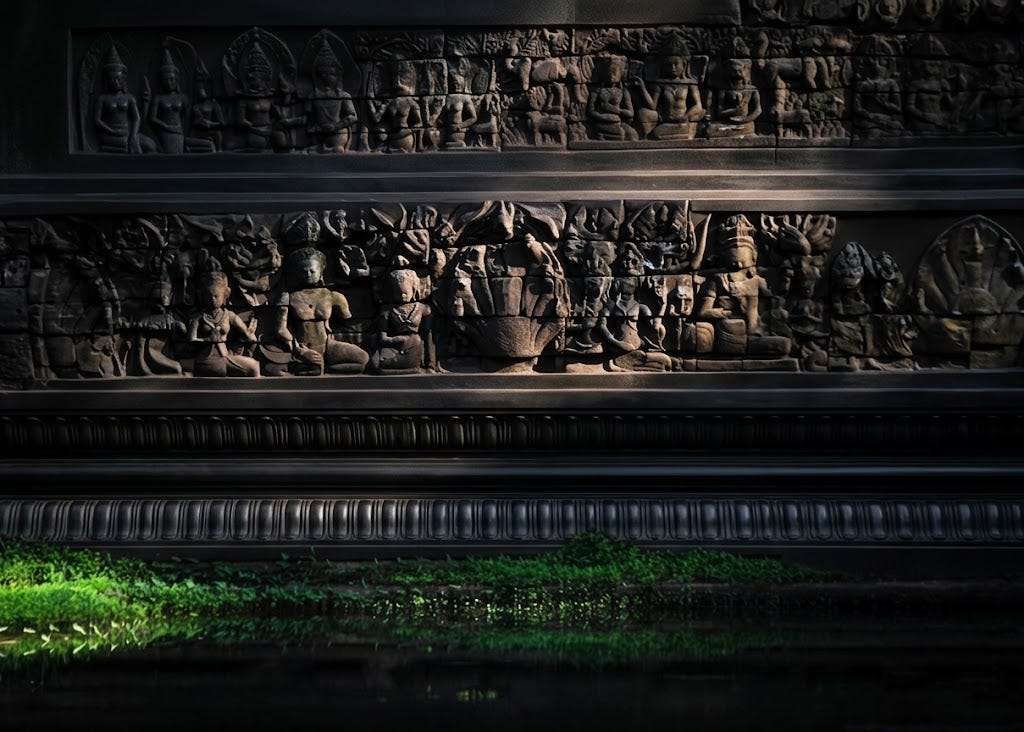
This union was far more than an ordinary marriage; it was a formal bio-political transfer of dynastic sovereignty through the feminine serpentine bloodline. It gave rise to the Somvong Dynasty, which ruled the Mekong Delta and shaped the politics of the region for centuries. Through this serpentine matriarch, the rulers of Funan derived their legitimate right to govern land, control water infrastructure, and commune with higher forces.
For centuries, orthodox historians dismissed the serpentine parentage of Queen Soma as sheer allegorical fantasy. Yet modern bio-archaeology and population genetics have recently delivered a devastating blow to that skepticism. Archaeogenetic analyses conducted on ancient human skeletal remains from the Wat Komnou burial complex at Angkor Borei, one of Funan’s earliest political and commercial hubs, revealed an extraordinary genetic profile. Individuals buried between the first and third centuries AD carried between 40 and 50 percent South Asian (Indian) ancestral DNA.
This archaeogenetic discovery proves that the ancient texts were recording factual history. A massive, real dynastic and genetic fusion took place between indigenous Southeast Asian populations and high-caste migrants at the exact chronological window documented in the Chinese annals and Khmer oral traditions. The Naga bloodline was not an abstract spiritual metaphor; it represented a distinct, physically manifested ruling caste that established the foundational architecture of Southeast Asian civilization.
Comments
Nothing yet. Say the first thing.
Sign in to join the conversation.