
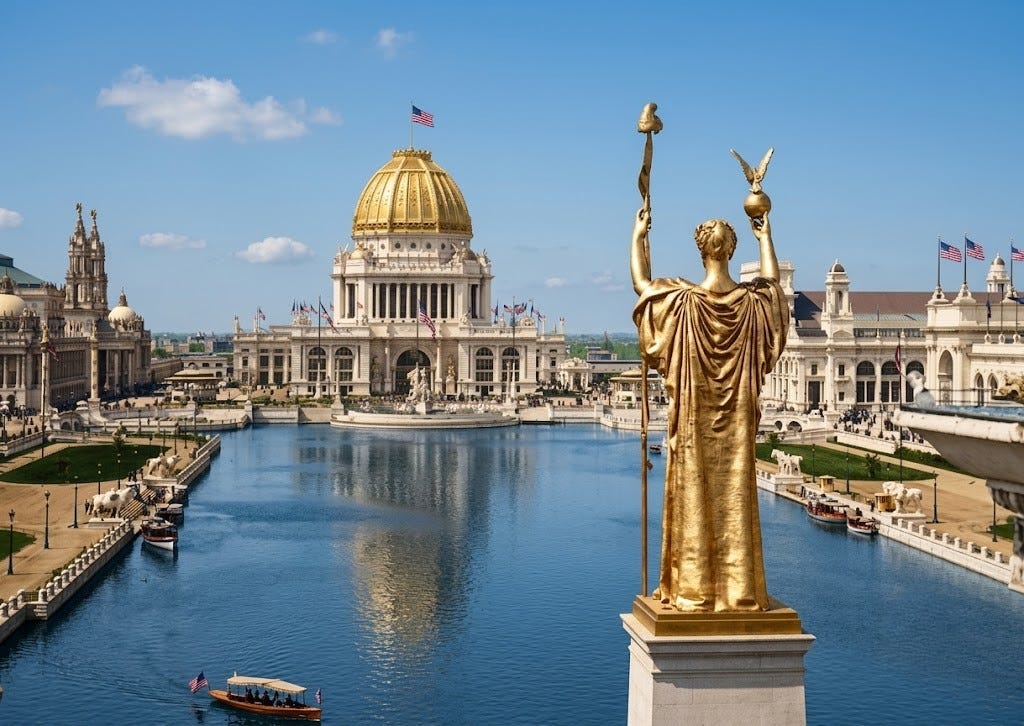
If you open any standard world atlas printed in Europe between the late 16th and early 19th centuries, you will run into a geographical reality that modern history departments would prefer you didn’t think about too hard.
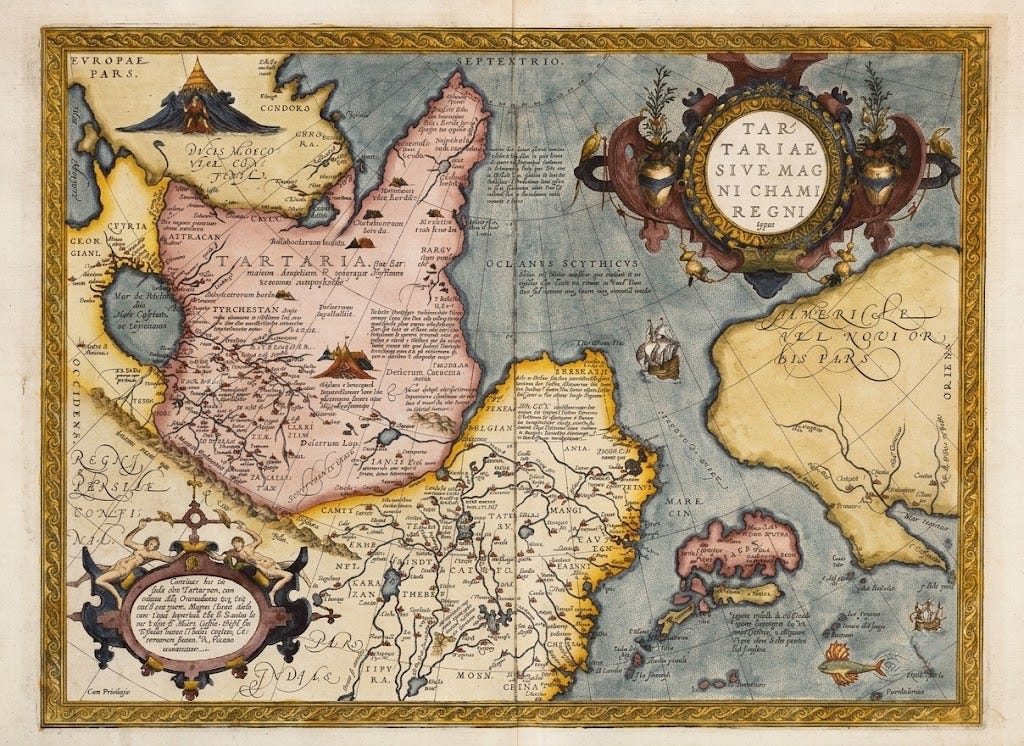
Spanning from the Ural Mountains all the way to the Pacific Ocean, covering millions of square miles of the Asian landmass, lies a vast empire labeled with absolute cartographic certainty: Grand Tartaria (or Tartaria Magna).
It wasn’t a vague tribal region. It appears on the 1570 map by Abraham Ortelius, the royal geographer to King Philip II of Spain. It is carved into the copper plates of Mercator’s 1595 atlas. It sits prominently in the 1771 edition of the Encyclopædia Britannica, which casually describes Tartaria as a massive empire stretching across northern Asia, far larger than European Russia.
And then, right around the mid-19th century, in a window of roughly forty years between 1850 and 1890, Tartaria simply vanished.
Not through a slow, recorded geopolitical decline described in dusty textbooks, but through a total, systemic scrubbing. Its cities were re-labeled, its history was sanitized, its architecture was claimed by overnight “colonial pioneers,” and its memory was systematically dissolved.
Official history tells us that Tartaria was merely a catch-all geographic label used by ignorant European cartographers who didn’t know what was going on in Asia.
That is a remarkably convenient explanation. It asks you to believe that for three hundred years, the finest cartographers, royal geographers, military surveyors, and encyclopedia editors of the Western world all shared the same hallucination. It asks you to accept that mapmakers who could calculate longitude by celestial mechanics suddenly forgot how political boundaries worked whenever they looked east.
They didn’t forget. They were keeping records. And what those records show, when you stop reading the commentary and start looking at the physical evidence, is that the mid-19th century was not the dawn of modern civilization.
It was the final, brutal phase of a global reset.
Let us skip the internet memes for a moment and focus on undeniable physical stone, brick, and iron.
If you walk through the older quarters of virtually any major city on Earth today, whether it is St. Petersburg, Buenos Aires, Shanghai, San Francisco, Melbourne, or Bucharest, you will encounter a very specific, hyper-sophisticated style of architecture. High vaulted ceilings, massive granite blocks, elaborate domed rotundas, symmetrical Greco-Roman columns, and intricate iron spires soaring into the sky.
Official architectural history calls this the Beaux-Arts, Neoclassical, or Colonial Renaissance period.

We are told that during the 1800s, European colonists, arriving in wooden ships or horse-drawn carriages at remote corners of the globe, immediately set to work building colossal, multi-story granite palatial complexes. Consider the official narrative of Melbourne, Australia.
According to mainstream history, the first British settlers arrived in Melbourne in 1835. It was a swampy, remote outpost on the other side of the planet. Yet, according to official records, by the 1850s and 1860s, just twenty years after settlers were sleeping in canvas tents, this tiny population built the Melbourne General Post Office, the Royal Exhibition Building, and the State Library of Victoria.
These are structures featuring massive hand-carved stone columns, multi-ton granite facade blocks, soaring domes, and subterranean basement levels lined with kiln-fired brick networks.
Who quarried the millions of tons of granite? Where were the industrial brick kilns, the paved highways, the heavy steam cranes, and the thousands of master stone-masons required to execute these feats?
Australia had a total population of a few hundred thousand people scattered across a continent, mostly consisting of convicts, farmers, and gold prospectors. Yet, we are expected to believe they possessed the industrial capacity to construct European-style megalithic palaces in their spare time, while living in a country without a developed road network.
The same absurdity repeats across North America.
When American pioneers reached San Francisco, Denver, or Salt Lake City, official history tells us they rolled up in wooden covered wagons, laid out dirt tracks, and then, within a decade or two, erected massive stone capitols, mints, and cathedrals that would make a Roman emperor blush.
The narrative requires you to suspend basic logistical sense. Anyone who has ever managed a modest home renovation knows the friction of material supply chains. We are asked to believe that 19th-century pioneers moved multi-ton stone monoliths over mud tracks with ox carts, built elaborate underground vaulted drainage networks, and topped their buildings with exquisite copper-sheathed domes before they even had paved streets. They didn’t build them. They inherited them.
The rest of this investigation is reserved for our Inner Members.
The World’s Fairs Demolition Program: How the elites built “temporary” plaster cities in Chicago, St. Louis, and San Francisco that covered hundreds of acres, only to burn and dynamite them to the ground months later.
The Orphan Trains and Ancestral Amnesia: The dark human logistics of the 1800s. Where did millions of parentless children come from, and why were they shipped across North America on trains to populate newly “discovered” cities?
The 1611 Controller Script: How the ruling bloodlines sanitized Tartaria from the imperial chronicles to institute the modern debt-and-fossil-fuel matrix.
👉 Upgrade to a Paid Subscription right now to unlock the full text below, access the private discussion thread, and receive Thursday and Sunday’s deep-dive volumes!
Comments
Nothing yet. Say the first thing.
Sign in to join the conversation.