
Software is eating the world—Andreessen’s slogan became a cliché because it kept getting more correct. SaaS industrialized that process: take a messy workflow, turn it into a deterministic machine, sell it as a subscription. For a long time, “software” meant a stable UI wrapped around repeatable logic: click the button, get the expected output. But AI is changing what software is, because it changes how software is made and how it’s used. It pulls us from deterministic execution toward probabilistic reasoning and creativity, from tools you operate toward systems that interpret intent and produce outcomes. And once you see that shift clearly, the “Is SaaS dead?” question stops being a binary and starts looking like a spectrum problem.
Here’s the spectrum that matters: on one end, you have the lean app—a small, sharply defined product that does one job well, can be built rapidly, and earns its keep by saving time in a specific place. On the other end, you have the universal app—a powerful enough interface (or agent) that can do almost everything: write, plan, analyze, generate, automate, integrate. The SaaS era mostly lived in the middle: medium-sized products with expanding feature sets, growing UIs, and pricing that scaled with seats. The AI era stretches the spectrum in both directions at once. It makes lean apps cheaper and faster to create (vibe coding, prompt-to-code, instant scaffolds), and it makes universal apps more plausible because the “interface” becomes a reasoning system rather than a fixed set of screens.
Lean apps thrive because AI collapses the cost of building software. When building is 10x cheaper in time and money, you can afford to build narrowly. You don’t need a huge platform to justify the effort. You can ship a tiny product that solves one annoying pain point—“summarize these support tickets,” “convert these invoices,” “draft these outreach emails,” “clean this dataset”—and you can iterate fast because your development loop is compressed. This creates an explosion of micro-products and niche tools. It’s the long tail going infinite: every workflow gets a button, every team gets a helper, every edge case gets an app. A lot of SaaS will look like this: small, focused, inexpensive, and ruthlessly useful.
Universal apps thrive for a different reason: AI collapses the cost of using software too. In the old world, software demanded translation—you had to learn the app’s language (its UI, its workflows, its settings). In the AI world, the software learns your language. If you can type “run our weekly growth report, pull the anomalies, draft a summary, and open the top two issues as tickets,” you don’t need a dozen separate interfaces. The universal app becomes a control plane: it routes intent into actions across tools, it holds context, it orchestrates workflows, and it hides complexity behind natural language. This is why the UI feels like it’s disappearing. The universal app is not “one app with every feature.” It’s “one intelligence layer that can call any capability.”
Now the key argument: AI doesn’t kill SaaS; it polarizes it. It pulls software toward two stable attractors—lean apps and universal apps—and it squeezes the middle.
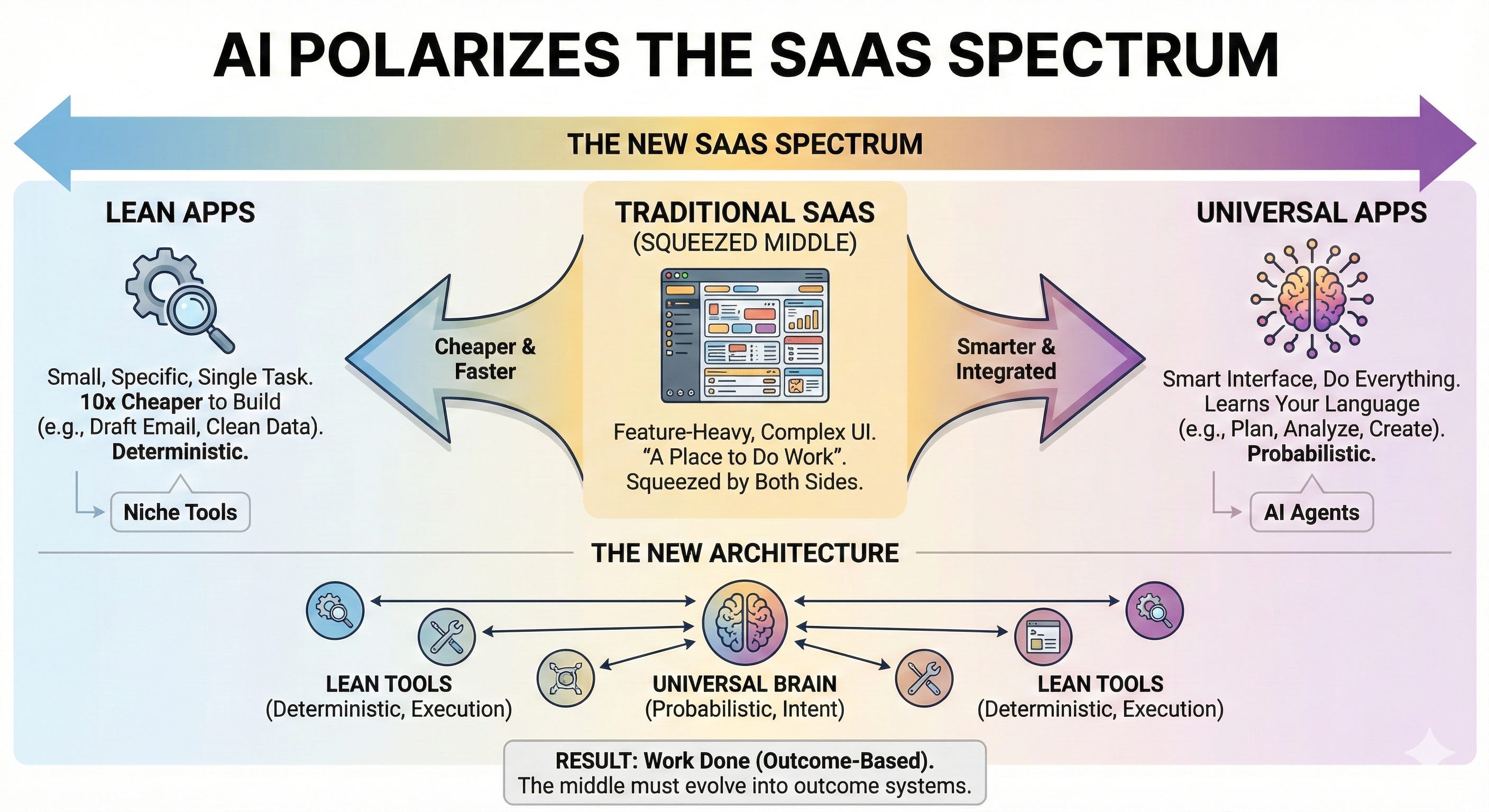
The middle is traditional SaaS as we’ve known it: feature-heavy products whose main value is “a place where humans do the work.” That middle gets attacked from both sides. Lean apps undercut it by being cheaper, faster, and more specific: why pay for a full platform when a tiny tool can solve the exact pain? Universal apps undercut it by absorbing it: why learn five different UIs when one agent can talk to all of them? If your product’s differentiation is mostly “we provide an interface to do the thing,” you’re vulnerable, because both ends of the spectrum can offer a better deal—one through focus, the other through generality.
But this is where people overreact. The middle doesn’t vanish. It transforms. Because the universal app still needs deterministic systems underneath it, and lean apps still need trustworthy rails to be useful in the real world. The future is not “everything becomes one big AI.” The future is “one or a few universal control planes orchestrate a vast ecosystem of lean capabilities.” Think of it like the web itself: the browser is universal, but the sites are specialized. In the AI era, the agent is the browser, and lean apps are the websites—except many of them won’t even be visible as standalone UIs; they’ll be callable tools.
This is why spectrum thinking beats hot takes. The question isn’t “Will SaaS die?” It’s “Where on the spectrum does value concentrate, and what happens to businesses sitting in the unstable middle?” And the answer is: value concentrates in two places. First, in lean, high-ROI tools that are cheap to build and obviously worth paying for because they remove friction in a very specific workflow. Second, in universal orchestration layers that own the entry point, permissions, context, and routing of work—because whoever controls the interface to action controls distribution. Between those, you still have plenty of SaaS, but it must evolve from being a tool people operate to being a system that delivers outcomes reliably.
The deterministic versus probabilistic distinction is what makes this work. Universal apps are probabilistic: they reason, interpret, create, decide. Lean apps tend to be deterministic: they execute a narrow function reliably. When you combine them, you get the best of both worlds: probabilistic intelligence on top, deterministic execution underneath. That’s the architecture of the coming decade. The “brain” handles ambiguity and creativity; the “tools” handle correctness and repeatability. You ask for an outcome; the system delegates to specialized capabilities; the result is work done.
So if you want a clean thesis, it’s this: AI lowers the cost of making software so much that it creates an explosion of lean apps, while simultaneously making universal apps the natural interface to them. SaaS doesn’t die—it gets reorganized along a spectrum. The winners on the lean end are the ones that own a slice of workflow so sharply that paying is a no-brainer. The winners on the universal end are the ones that own the control plane—context, routing, identity, permissions, and trust. And the survivors in the middle are the SaaS companies that stop selling “a place to do work” and start selling “work done,” with agentic layers, integrations, auditability, and outcome-based value.
Software ate the world. AI is now eating the friction of both building and using software. That doesn’t end the SaaS era; it ends the era where SaaS value lived primarily in screens and feature lists. The new era is a spectrum: lean capabilities everywhere, universal intelligence on top, and a constant war over who owns the interface to action. In that world, the question “Is SaaS dead?” is like asking whether books are dead because the internet exists. The format isn’t dying—it’s being rearranged by a new distribution layer.
Comments
Nothing yet. Say the first thing.
Sign in to join the conversation.