
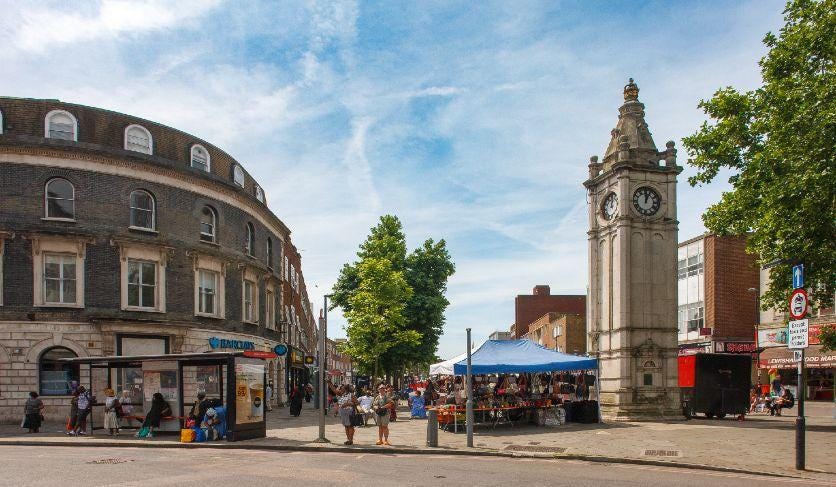
For a few hours over the weekend, Lewisham, where I live, was the centre of the British political universe as council officials announced the result of Thursday’s local elections.
In a stunning turn around, the Green Party gained control of the borough council, winning 39 of 53 seats. At the last election in 2022, Labour won every seat, with 56 percent of the vote. Last Thursday, the Greens won a comfortable majority with 44 percent of the vote against Labour’s 26. It’s a pretty astonishing result when you consider Lewisham has been run by Labour since 1971.
Lewisham is one of five London boroughs where we also elect a mayor with executive powers. That post had been held by Labour since it was created in 2002. But the Green candidate, Liam Shrivastava, also won the mayoralty with 40 percent of the vote against the Labour candidate’s 35.
Across England the story of these elections is of insurgent parties of right and left upending the status quo. Of the 136 councils where elections were held, Labour lost control of 36 leaving them with 28; the Conservatives lost 8, leaving them with 9; the Lib-Dems gained 3, taking them to 15; Reform won control of 14, and the Greens 5, both for the first time. The number of councils with no party in control rose by 22 to 64.
In Scotland, the nationalists consolidated their position, though didn’t manage to win a majority in the Scottish Parliament. Labour and the Tories were the big losers again, with gains for Reform, the Greens and the Lib-Dems. In Wales, Plaid Cymru won enough seats to form a minority government in the Senedd; Labour and the Conservatives both did badly, though Reform did much better than the Greens.
You don’t have to be Sir John Curtice to understand these results as a massive rejection of conventional politics. Millions of Britons are fed up with the state of the country and don’t understand why life is such a struggle. Two years ago electors took out their anger on the Conservatives after 14 years during which nothing improved, following the financial crisis of 2008: they elected a Labour government with a massive majority.
And now they blame Labour for making no discernible progress. To be fair to Labour, they have made progress in some areas, but nobody knows about it because they refuse to talk up their successes. And in any case, such piecemeal improvements take years to create a widespread perception that things are improving.
But Labour’s biggest problem today is not the mess they inherited; it is their leader, Keir Starmer, who is simply not up to the job of Prime Minister. Starmer must urgently be replaced by someone who recognises the nature and magnitude of the challenges facing Britain and understands that tinkering at the edges simply won’t cut it.
I had planned to vote Green last Thursday. Although I can’t see Zack Polanski as a future Prime Minister, it would be disingenuous for me to bang on endlessly about the need for radical economic change and then chicken out when somebody comes along promising exactly that.
Polanski says all the right things about creating a country where everyone can enjoy improved economic security. But I’m not sure he has any idea of the immense obstacles he would have to overcome to deliver on such a promise. His policy proposals, as far as they exist, are too ‘Old Labour’ and he’s gone strangely quiet on the biggest threat to our collective wellbeing: climate change.
But the straw that broke the camel’s back for me was Polanski’s recent equivocation on anti-Semitism. He’s in a position to set an example of how to criticise Israeli government actions in Gaza (and now Iran) without resorting to anti-Semitic tropes, or giving the impression that your party welcomes people who hate Jews.
The overwhelming priority in the three years before the next general election must be to ensure that Nigel Farage’s Reform UK Party is not able to form a government. It’s possible that a new Labour Prime Minister might turn things around sufficiently to prevent that outcome, but given the state of the economy (see below) it’s too much of a risk. As I’ve written before, the best way to keep Farage out of No 10 would be to bring in Proportional Representation (PR).
Only one of the putative candidates to replace Keir Starmer is talking about this: Andy Burnham. Whether, as Prime Minister, he could persuade enough of his MPs to vote for such a change is not certain. But if Labour can’t turn the country around, they at least have a duty to ensure Farage is not permitted to drag Britain down the road to Trumpism, and PR might be the only tool available to them.
As I write, the excruciatingly slow death of Keir Starmer’s government is being played out in real time. The Prime Minister is certainly stubborn, though he is quite unable to persuade many Labour MPs, a growing number of government ministers, or the rest of the country, that he has a viable plan for turning things around.
I agreed with pretty much everything in this morning’s post by The Bear except his conclusion: that Starmer should stay. I don’t dispute that technocracy is an essential part of government, but I would argue that civil servants should be the technocrats. Starmer clearly wanted to govern as one, believing all he had to do was manage the system better than his Tory predecessors.
The fact that he has failed so badly suggests the system is broken to such an extent that its successful management is beyond even the best technocrat. And Starmer is not a very good one, nor has he been able to build an effective team of technocrats around him.
Of course, it is the Prime Minister’s job to manage the technocrats who run the system. But there are three other qualities required of a successful Prime Minister. Vision; the ability to Communicate with the public; and political Nous. And Starmer falls woefully short in respect of all three.
Vision requires more than repeating platitudes about creating a better country for everyone. It has to have a strong moral element, implicit in which is an acceptance that in a democracy, politics is about delivering improvements in the quality of life for the majority who currently struggle.
Communicating that vision requires a relatable story about how we got here, and why, nearly two decades since the financial crisis, none of the seven Prime Ministers to lead Britain have been able to turn the economy around so that more people feel the benefits.
In a nutshell: the financial crisis followed by austerity, compounded by Brexit, all on top of decades of chronic underinvestment in public infrastructure, has left Britain with a moribund economy which, without a radical overhaul, is never going to be able to deliver the goods for the struggling majority. Add to this that Britons want improved public services but refuse to pay more tax; and the fact that Britain is forced to pay more to borrow from the bond markets than other countries, and you begin to get a sense of how massive the challenge is, and how, therefore, only an exceptional leader will have any hope of succeeding.
If you want to better understand why Britain has to pay more to borrow, this excellent recent piece by Clive Lewis explains it well. Now there’s a politician who gets it. As I noted on Saturday, a government led by Andy Burnham, with Ed Miliband in the Treasury and Lewis at Defence, might be just what Britain needs. But I digress.
Starmer has no vision, nor does he have the ability to communicate. Those shortcomings might be survivable if he had any political Nous. But by all reports he doesn’t do politics; he doesn’t build relationships; he doesn’t seek alliances; he presumably thinks these things are unnecessary when in fact they are essential prerequisites to being a successful politician.
Starmer is so unaware of his own shortcomings and so stubborn that he appears determined to cling on. That may have changed between my clicking ‘publish’ and you reading this, but I doubt it.
Whether the likes of Andy Burnham, Angela Rayner, Wes Streeting or Ed Miliband have the qualities listed above, we cannot possibly know until we see one of them tested in the field, as Prime Minister. So yes, it’s a risk. But right now, Britain is heading for a government led by Nigel Farage in three years time. That’s a much bigger risk, and everything possible must be done to avoid it.
Comments
Nothing yet. Say the first thing.
Sign in to join the conversation.