
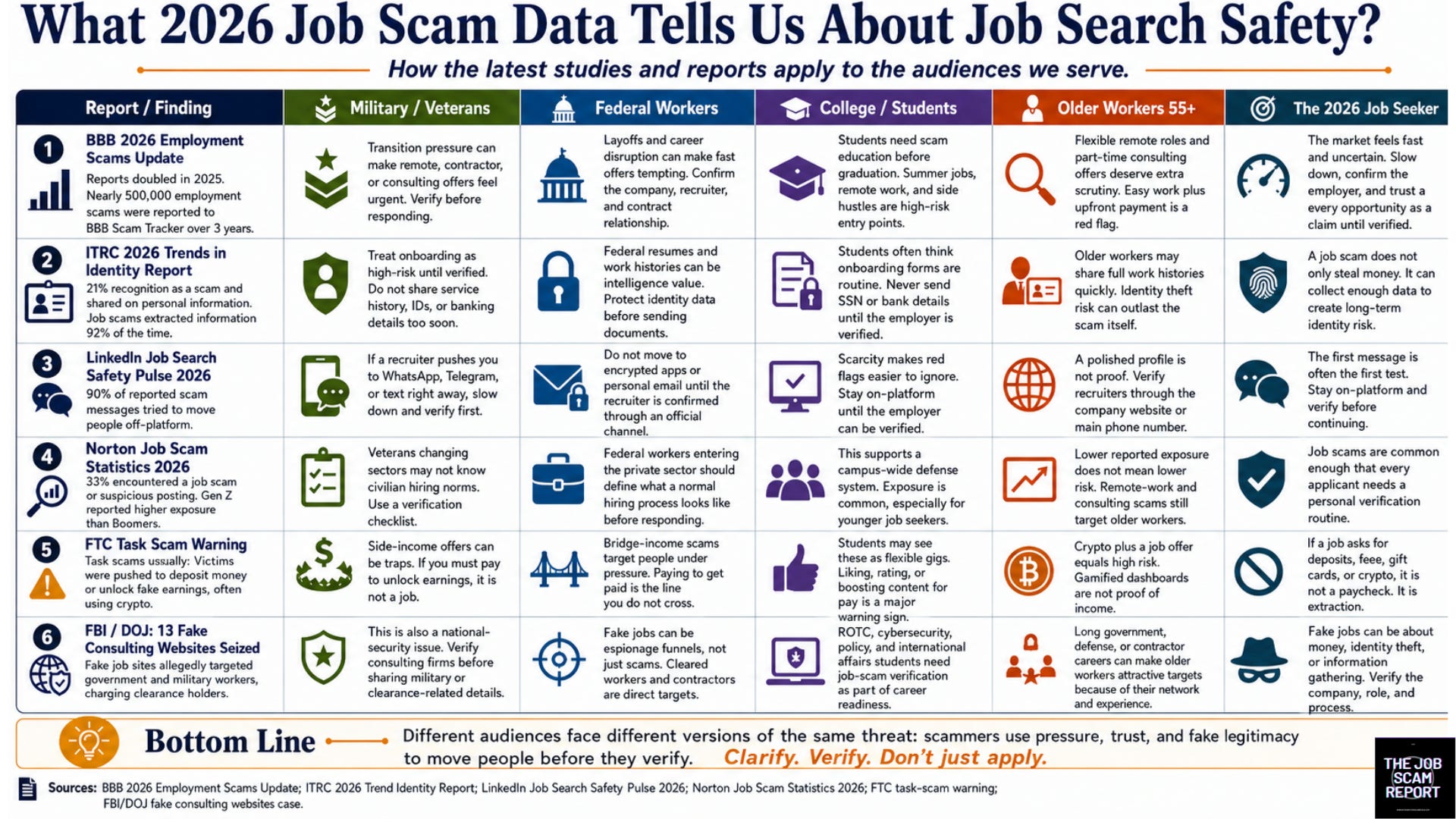
There are six surveys I think every job seeker should understand: surges in job scams pose a threat. You’re not just looking for bear traps. It’s a landmine out there.
Today’s job search should be safe and strategic. It is up to job seekers to research recruiters and companies and understand how job scams work. It’s important to question everything, and third-party verification is critical to the process.
All the groups mentioned in the chart may have the same soft areas, with different events to present each one’s vulnerability. It’s important to understand why education, knowledge, and awareness are critical. Preparedness is not only training for physical danger but also for the emotional toll of a job search.
All but one are group surveys. I thought it was important to include the thousands of workers and job seekers. This one event could affect all other groups I included.
One caveat in all of these surveys is the relatively small number of participants. I think it would provide a better perspective if we knew whether they were currently working or unemployed. The state of mind matters to someone passing up or ignoring a fake recruiter with a fairy-tale offer, or to a job seeker who has been active in the job market for a year or more.
Here are factors I tried to align with the chart:
LinkedIn = behavior, off-platform movement, and red-flag blindness.
Norton = exposure/encounter rates among U.S. adults and demographics.
FTC = financial loss trends and task-scam growth.
BBB = real-world report volume and task-scam mechanics.
FBI/DOJ = scam infrastructure and targeted espionage funnels.
Academic research = while not specifically included in the data, college students are exposed to psychological vulnerabilities, behavioral signals, and emotional manipulation.
U.S. military personnel get limited job training. The separation from active duty can be quite challenging. While they do have required career training, most agree it’s not enough. The transition from soldier to civilian is a born-again-like experience. Their work experience will need to be reframed and now marketed to various employers. Most of the people I’ve ever talked to feel like aliens.
For married military personnel, particularly their spouses, job changes may have been frequent due to frequent relocations. The Better Business Bureau’s 2021 data was the latest I could find showing that job scams were #1 among military veterans and spouses across all scam types.
On January 20, 2026, the House passed H.R. 1663, the Veterans Scam and Fraud Evasion Act (VSAFE Act). The bill would establish a Veterans Scam and Fraud Evasion Officer at the Department of Veterans Affairs to coordinate fraud and scam prevention, reporting, and incident response, and to serve as a central point of contact for veterans seeking scam-prevention resources.
Tens of thousands of federal workers have been laid off since February 2025. While few were able to retire, most struggled to find private-sector jobs. Many still feel the threat of “layoff anxiety.” The federal work environment is unstable, like a ship buffeted by high winds and rough seas.
Bridge income (a job or opportunity for income while looking) seems appealing and a scammer’s delight for unguarded victims. During this turbulence, a fast, vague consulting offer feels like a lifeline, causing workers to skip the verification process. Instead of a generous offer raising red flags, it presents an individual with entertaining possibilities.
Federal workers and military personnel have this one thing in common: both are unfamiliar with today’s hiring process or the job search in the wild. Unlike military or federal work, random recruiters are not vetted, and assuming they are is dangerous.
Universities have two critical events a year that everyone knows about, and scammers understand the behavior of incoming freshmen and new graduates seeking internships and jobs. It’s hard to say whether schools offer students adequate job scam education. Perhaps those of you who are subscribers and educators can share how you educate your students about job scams.
Freshmen (most) are starting from ground zero as they are making life decisions for the first time. While they are told to trust their administrators, they’re also making new friends and forming a de facto family. Many of them will trust the friends almost as much as they do family while at school. When one finds a “too-good-to-be-true” job, they share it with friends. Many are at risk of becoming “money-mules” for fake companies. The school promising to take care of students lacks the resources to provide quality education and, by omission, becomes the very enabler it warns against.
Students lack resources, and fake recruiters and companies use opportunity as bait. Easy opportunity. The promises of getting paid more for less, the creation of urgency and trust, and the students’ immediate needs to survive are unfamiliar territory for them.
While older workers are likely the most resilient group because they have survived past layoffs, the 55+ group has the scars and the stories. Yet when they reach their fifties, they’re seen as a liability by default. Employers aren’t checking for them anymore. They’re punished for growing older, gaining more experience, and becoming more costly.
They endured several economic downturns, including job losses, reduced financial leverage, and changes in employment. Bad actors understand that older workers fear a lack of usefulness, mourn the diminished demand for their services, and are coming to terms with their new retirement status. When they hear from bad actors, they are a fit for a position, it offers them hope. They temporarily trust what someone offers as bait, not as confirmation of their worth.
While this group is the least scammed, they pay a higher price. Not just monetary, but it also costs them their time. Many older workers are working against time, as it takes them longer to find jobs in the same industry they left. After so much time, they pivot to a new industry, where they are new and lose the experience that once gave them leverage.
The 2026 Job Seeker
Today’s job seekers are not only battling a saturated job market but also facing unprecedented landmines. Today’s job search is equivalent to cramming for an exam. Each job seeker has to research jobs, companies, and recruiters to some extent. Most feel the urge to apply to many more jobs, similarly to trying to make up for all of the times you procrastinated studying until the last night before. Out of 100 unvetted jobs without any employer communication or feedback, how many actual jobs were applied to?
Comments
Nothing yet. Say the first thing.
Sign in to join the conversation.