
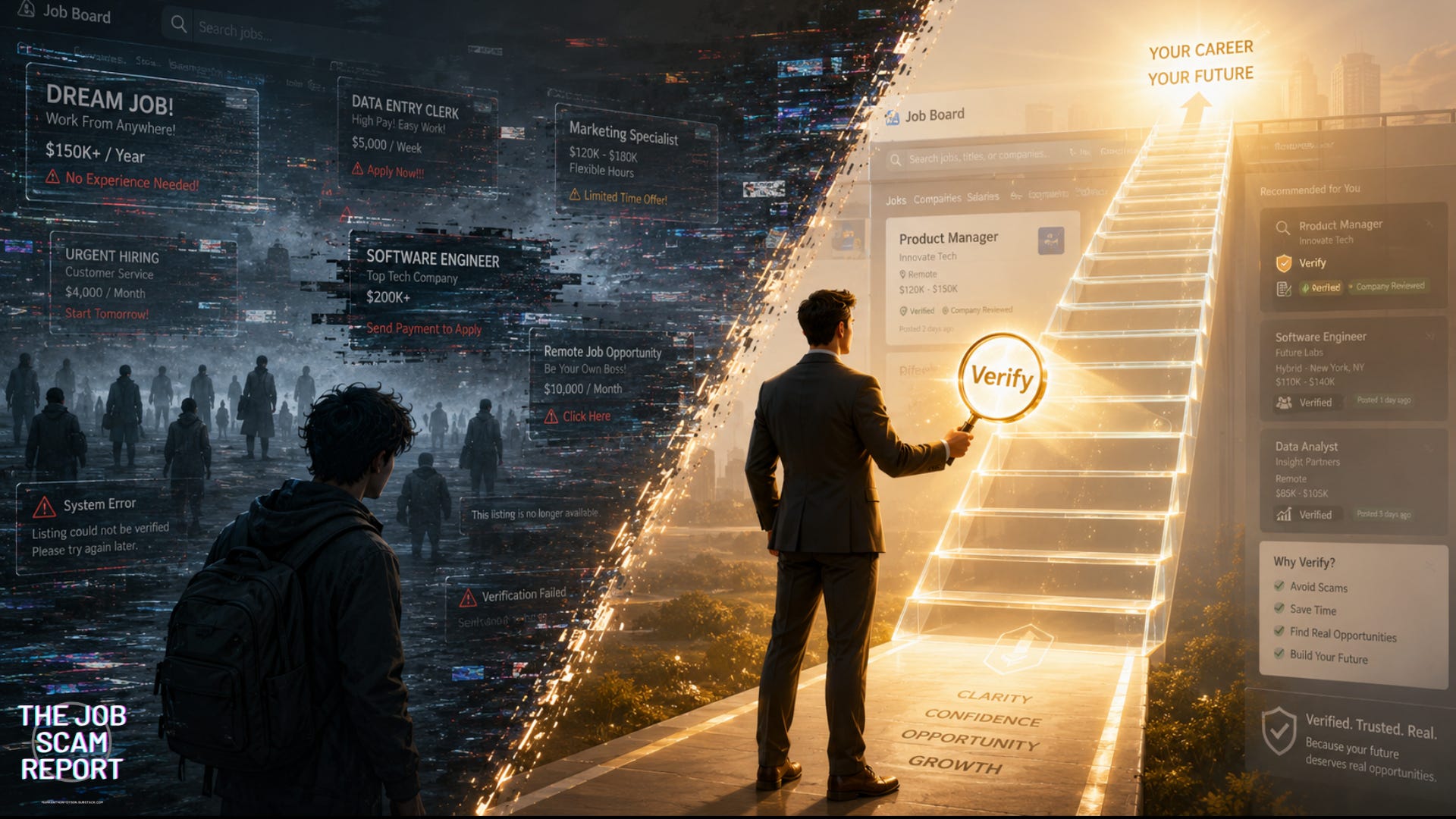
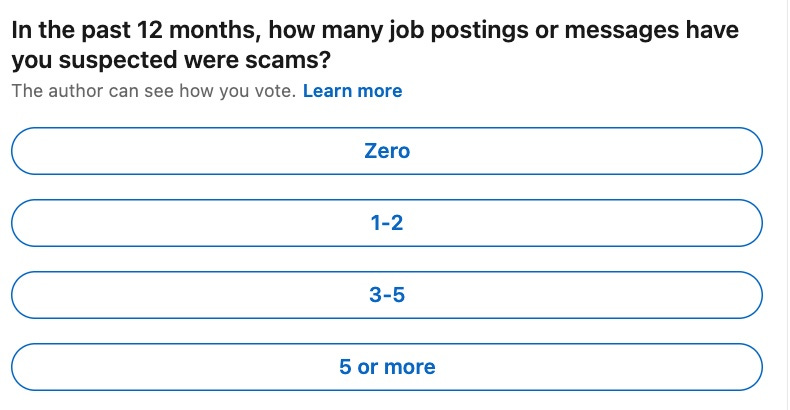
I’m doing a survey on LinkedIn and I would love for you to vote. One question. No wrong answer.
Job scam red flags aren't the sexy transparency story people want to share. But they're the one thing everyone wants to spot before it's too late.
A recent LinkedIn survey backs this up:
Most people know to be careful — 72% say they stop to think about whether a job is legitimate before applying, and recruiters are noticing it too (49% say candidates have reached out just to confirm a role is real). But awareness isn't the same as protection: 32% of Gen Z say they've already been a victim of a job scam.
Awareness is out there. It's just not reaching the people who need it most.
So I want real numbers from real people: in the last 12 months, how many job postings or messages have you suspected were scams?
Vote below — zero, a couple, a handful, or more — and share this with your network. The bigger the sample, the clearer the picture.
Why are some of us spotting red flags every week while others haven't seen one all year?
Let's find out.
Please go and let me know how many job scams you’ve seen in the last year.
If you took last Friday and this Monday off from your job search, it was a good decision.
Sometimes the search itself becomes the stressor. Not because you are doing anything wrong, but because the market feels crowded with uncertainty: job scams, fake recruiters, ghost jobs, vague postings, and hiring processes seem to go nowhere.
Check out the episode with Russ Irby talking about his 18-month job search and 29 final interview rounds. This is where “layoff PTSD” and burnout collide.
Feelings of threat are not always captured by statistics. Sometimes, the subtle signs job seekers share online tell us something important about how unsafe the process feels. And those voices stand out, and the range of emotion tells us even more.
If you look at the last month of articles I’ve published, including the McAfee study on Norton’s site, at least 1 in 3 professionals has seen a job scam posting.
We’ve discussed “ghost jobs” before. Some HR and recruiting professionals call certain roles “evergreen jobs,” especially when they are tied to high-turnover positions or future hiring needs. But job seekers often experience them differently.
A ghost job is not always a scam. The employer may be real. The company may exist. The role, well, may not be actively open, funded, or intended to be filled soon.
I’ve repeated this one thing: Ghost job openings should have a universal symbol indicating the job is evergreen. Too far ahead of its time? I don’t think so. We’ll discuss this again.
Much of this is echoed in the episode below:
Transparency. The distinction provides clarity.
Still, ghost jobs and job scams create the same emotional result: doubt.
Is this real?
Is this worth my time?
Did I just give my data to someone who had no intention of hiring?
You’ve heard me say “verify” repeatedly on this platform. It’s equally important to accurately state your skills. Check the company’s career page. Check whether the role has a posting or closing date.
Search for exact phrases from the job description to see if they have been copied or recycled. Look for current employees or recruiters discussing the role through channels the original contact did not provide.
Multiple unresolved red flags should stop the process.
Verification should be professional, not confrontational. A legitimate recruiter should not object to basic confirmation through official company channels.
Ghost jobs may not always be criminal, but they still affect trust. And when trust is already low, job seekers become more vulnerable to polished, urgent, and personal scams.
Clarify.
Verify.
Don’t just apply.
Vet everything and everyone.
Comments
Nothing yet. Say the first thing.
Sign in to join the conversation.