
This is a follow-up to my 2025 post Prompting My Way Through Cancer.
Last October I gave a presentation at the Essex County Medical Society’s Clinic Day in Windsor, Ontario, and explained how I used AI to navigate colon cancer.
Telling my own doctor I was running my treatment questions through ChatGPT had been nerve-wracking enough. Telling over a hundred doctors at once was terrifying. The invitation came through a doctor friend in my cycling club: he’d read my post about being an AI-assisted patient, and figured a conference hall full of physicians should hear the story from the patient’s side of the exam room.
My final slide made a prediction: what felt groundbreaking a year earlier, and merely ahead of the curve that day, would soon be standard operating procedure.
Just a few months later, I started failing my bike workouts. I knew exactly what that meant, and I badly wished I didn’t.
Round Two
A quick recap if you’re new here. In the summer of 2024, I was diagnosed with iron deficiency anemia after I noticed a sudden decline in my cycling performance. In the spring of 2025, a suspected case of appendicitis turned into emergency surgery, which turned into the removal of part of my colon, which turned out to contain a tumor. I recovered quickly, rode London-Edinburgh-London in August, and wrote about how ChatGPT made me a better patient along the way.
In that first post, I joked about glossing over ChatGPT’s warning in 2024 that anemia in men my age is quite often caused by cancer. I don’t get to make that joke twice. In January of this year, I started failing interval workouts I should have handled comfortably, exactly the way I did in 2024. My power meter knew something was wrong before my bloodwork did. By the time my regularly scheduled blood test rolled around in mid-March, I already suspected the anemia was back, and by extension, the cancer. The test confirmed the first part within a day. An endoscopy and colonoscopy found the rest a few weeks later.
The diagnosis: a recurrence at the site of my original tumor, this time expanding into my small intestine, plus a small deposit on my peritoneum. If you don’t know what a peritoneum is, neither did I. It’s the lining of your abdominal cavity, a fact I learned from an AI roughly thirty seconds after reading my imaging report. So now it’s months of chemotherapy, currently in progress, with surgery to follow once the chemo has done its job.
The good news is that my treatment plan is curative in intent, meaning that we are still working towards a total recovery back to my pre-cancer life.
Last time was a sprint: emergency surgery, recovery, done in a season. This time is more like an ultra-endurance event. That difference, combined with advancements in the AI space, is why it felt overdue to give an update on how I’m using AI this time around. (If you’re mid-diagnosis yourself and just want the playbook, skip ahead to “If You’re the Patient.” The next few sections are how I got there.)
From a Chat Window to a Filing Cabinet
In early 2025, my whole setup was a ChatGPT project folder with an elaborate system prompt asking it to act like a multidisciplinary team of world-class specialists. It worked better than it had any right to. But every new test result meant another upload into a chat interface, and finding anything I’d learned three weeks earlier meant scrolling through old conversations like an archaeologist. (Seriously, chat logs are the worst way to archive information. Fix this, AI companies!)
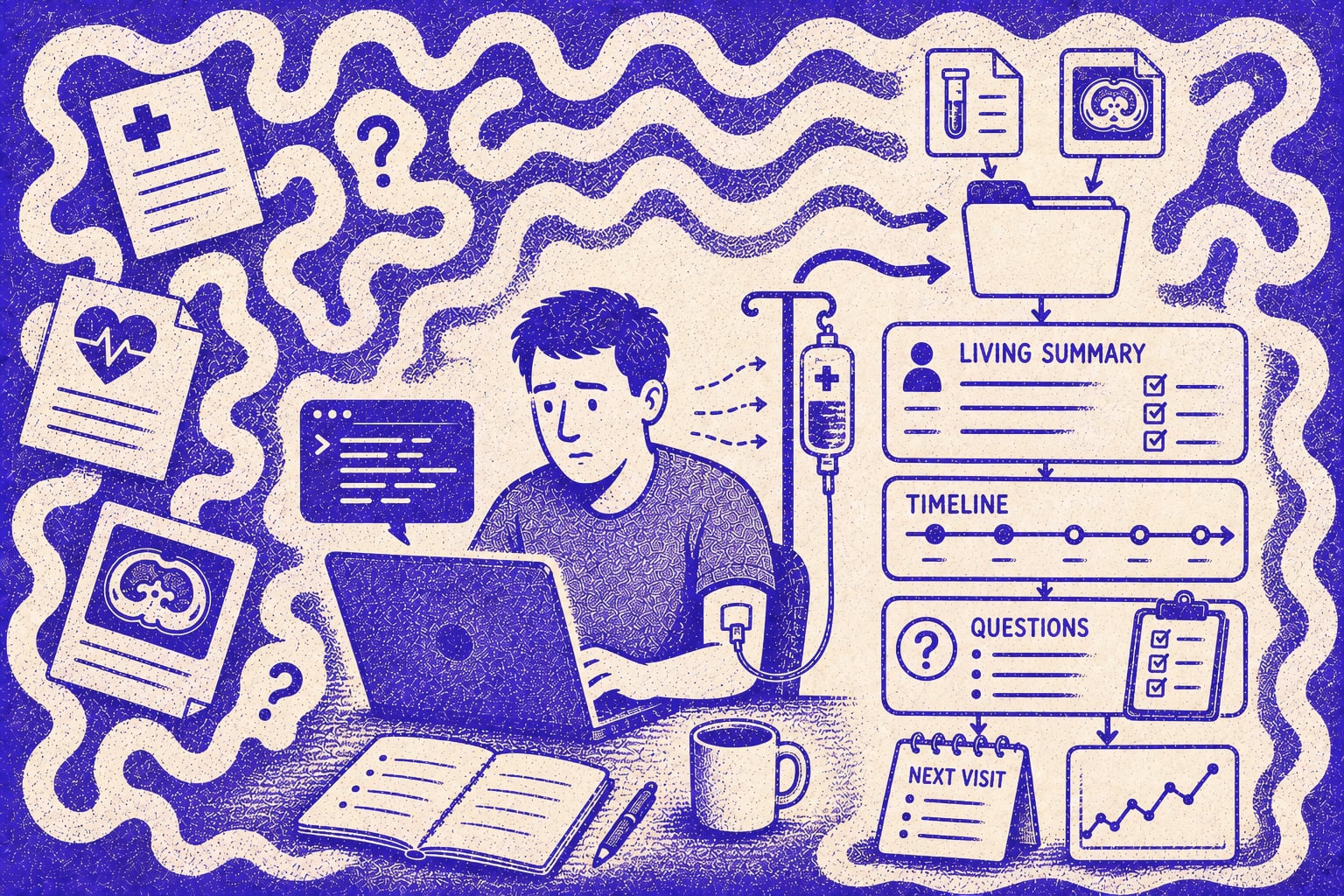
Over the last year, my everyday AI use had drifted from ChatGPT to Claude, and increasingly to Claude Code, the terminal-based agent I use for software work. I also keep every note I write in Obsidian, as plain markdown files on my own machine. When it sank in that this round could run a year or more instead of a summer, the answer was obvious: stop treating my health data like chat history and start treating it like a project.
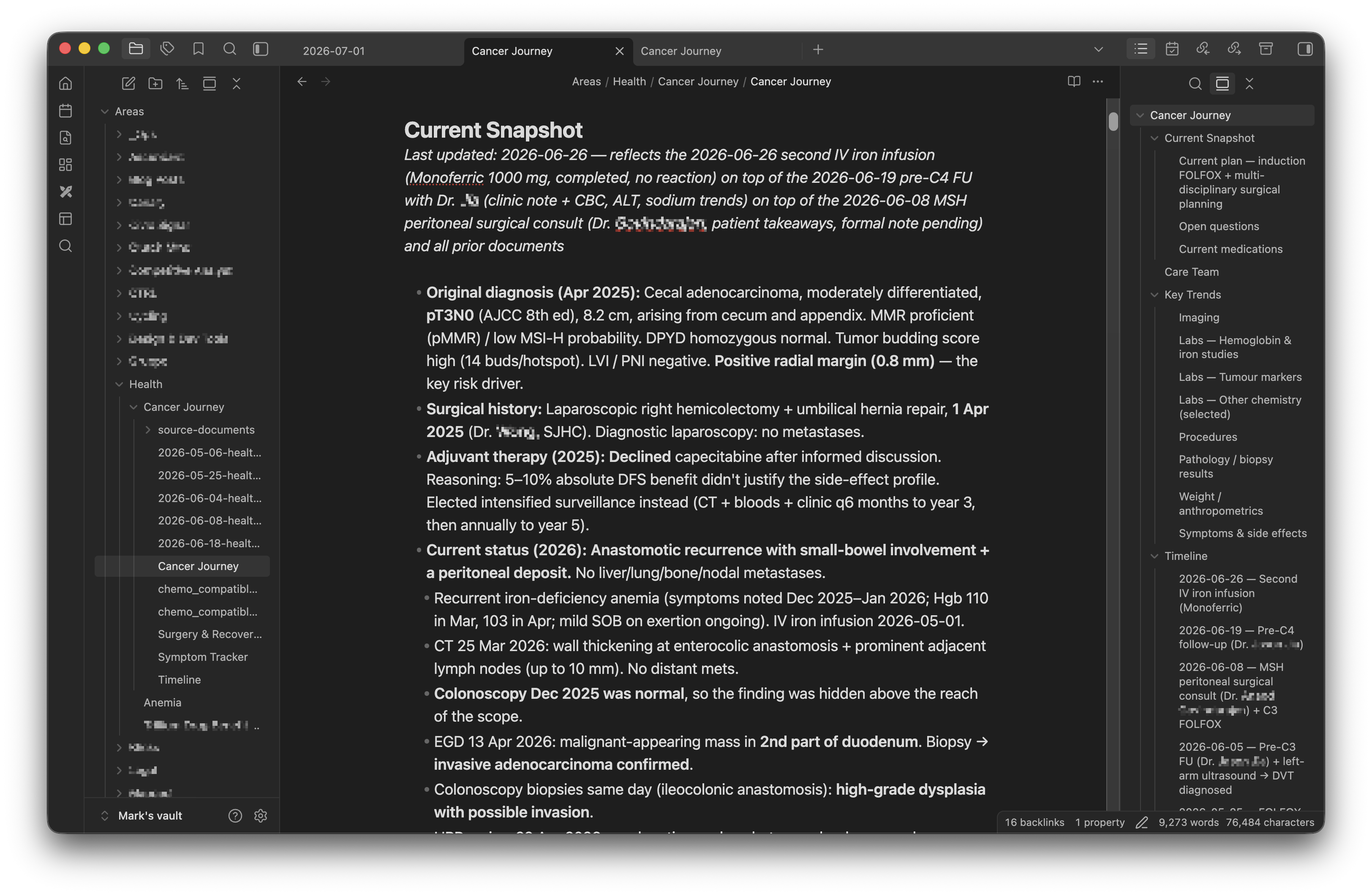
The whole system is one folder called Cancer Journey in my Obsidian vault, which lives on my own hard drive:
- A living summary document. The top is a snapshot of where things stand: diagnosis, current medications, care team, upcoming appointments. Claude updates it whenever a new document arrives. Below that sits a timeline that’s append-only. Dated entries, never rewritten, each one tracing back to a source document. This is the file in the screenshot above.
- A source-documents folder. Every after-visit summary, lab PDF, and imaging report goes in as it arrives.
- Trackers and prep docs that Claude Code builds and maintains: a symptom tracker, appointment prep notes, questions to raise at the next visit.
None of this requires anything fancier than text files in folders, and that’s the point. It’s plain text I own, portable to whatever model is best next year. My care is currently split across two hospitals, and my little folder of markdown files is the only place the complete picture exists. When a new specialist says “catch me up,” I can generate a one-page brief in about a minute.
Process Beats Vibes
The other big upgrade this year wasn’t mine. Dr. Cat Hicks built an open-source skill called Informed Patient that gives Claude a structured process for exactly this situation: a symptom interview, a literature search with actual quality standards (it treats a 40-person pilot study and a decade of randomized trials very differently), and an honest weighing of the evidence for and against each hypothesis, all packaged into prep for a real appointment with a real doctor. Here’s a sample output if you want to see what this all looks like.
Where the 2025 version of me asked one-off questions (“what does pT3N0M0 mean?”), the 2026 version runs this review before and after every single appointment. Before a visit, it means I walk in oriented: when I met the surgical oncologist who’ll eventually operate on me, I already understood the sequencing question we needed to settle, why the answer wasn’t obvious, and what I wanted to ask. Twenty minutes of specialist time went toward decisions instead of orientation. After a visit, the notes and results go back through the same process, so “wait, what did he mean by that?” gets answered the same afternoon instead of becoming a 3 a.m. spiral.
The skill matters because it guards against the ways AI health searches go wrong: anchoring on the first plausible answer, over-trusting a single study, telling you what you want to hear. Structure beats vibes, especially when you’re scared. If I could keep only one upgrade from this past year, it wouldn’t be the fancy markdown system or even the smarter models. It would be this Claude Skill.
The Models Grew Into the Job
Between these two posts, the models crossed a threshold. Each release this year was a jump I could feel in daily use: Claude Opus 4.6 in February, ChatGPT 5.5 in April, Opus 4.8 in May. The improvement I care about doesn’t show up on a benchmark. It shows up in how much I can safely hand them.
The clearest example is triage. The PICC line in my arm (the semi-permanent IV that chemo runs through) has been the biggest complication of this round. It gave me blood clots, which earned me twice-daily blood-thinner injections and a new hobby of interpreting every ache as a possible embolism. When something flares up, Claude reads my full history and helps me sort it into one of three buckets: emergency room now, call the oncology line today, or mention it at the next appointment. It’s overly cautious in an appropriate way. When my arm first swelled around the line, that caution kept me from writing it off as a chemo side effect; when I raised it at my next visit, a same-day ultrasound confirmed the clots. For someone primed to catastrophize every headache, an assistant that right-sizes fear is invaluable. Claude also caught that two of my clinic notes had me on two different blood thinners, the kind of discrepancy a busy clinic can miss and a patient would never think to look for.
What I Told the Doctors
Back to Windsor. My pitch to the room wasn’t “AI will replace you.” It was a walkthrough of the roles AI played for me as a patient: translator of medical jargon, coordinator across specialties, rehab planner, journaling coach on call at 3 a.m. My mental model then and now: treat it like a brilliant intern. Eager, fast, surprisingly knowledgeable, and not yet trustworthy enough to act without review.
I’d braced for skepticism about hallucinations and liability. Instead, several doctors came up afterward to compare notes on how they were using AI in their own practices. Nobody asked whether patients should be doing this. They asked how to coach patients to do it well, without the garbage-in, garbage-out failure mode. The question is no longer whether patients will use AI; it’s whether they’ll use it dangerously or use it well. A room full of physicians treating that as settled is about as close to standard operating procedure as it gets.
What AI Still Can’t Do
Now the other side of the ledger, because I certainly don’t want to come across as some AGI-pilled, “ditch your doctor today” quack.
AI didn’t catch my recurrence. Bloodwork, scans, and several procedures did, aided by a stubborn patient who knew his own baseline. AI didn’t decide my treatment. The chemo-first strategy came from a talented multi-disciplinary oncology team that has seen hundreds of cases like mine. If they disagreed with what AI had told me to expect for treatment ahead of time, I would obviously have gone with my doctor’s recommendations. Amy Deng, an AI researcher who ran a remarkable AI-assisted investigation of her own illness, reached the same conclusion I have: an informed patient running a careful process with a frontier model can get more out of it than out of a typical primary-care visit for an ambiguous problem, but nothing she tried outperformed her top specialist. The models raise the floor. Humans still lift the ceiling.
If You’re the Patient, Start Here
This section is the reason I wrote this post. Obligatory reminder that I’m still not a doctor: this is what worked for me, not medical advice. You don’t need my setup on day one, and you don’t need to be technical.
The basic version, today: create a project in Claude or ChatGPT. Feed it everything: every lab result, every after-visit summary, every update in your own words. Use a strong paid model with extended thinking turned on. The twenty dollars a month is some of the best money you’ll spend on your health.
The upgraded version, when it becomes a long haul: move your records into plain files you own. Mine boils down to three pieces: a snapshot file that gets rewritten as things change, a dated timeline that never gets rewritten, and a folder of source documents. A coding agent like Claude Code maintains it. That’s the whole trick.
Before and after every appointment: run a structured process like the Informed Patient skill instead of freestyle chatting. It’s the single habit I’d recommend above everything else here. Structure protects you from your own hopes.
On privacy: for me, the upside beats the risk, and I feed it everything. Your calculus may differ. Strip names and ID numbers if it worries you, and know that consumer AI tools aren’t covered by health privacy laws by default.
On local models: I’ve spent the past month experimenting with self-hosted LLMs, which would solve the privacy question neatly. They’ve come a long way, and they handle a surprising amount of my other work. But they are not ready for this. Stick with a major frontier model for anything medical, and check back in a year.
Always: your care team gets the final word. The intern drafts; the attending signs.
No Neat Bow This Time
The first post ended with me recovered, lucky, and back on my bike. This one ends in the middle: more chemo ahead, surgery after that, outcome unknown (but optimistic). I won’t pretend that doesn’t scare me.
Here’s what I keep coming back to, though. I can’t control my pathology. I can control how prepared I walk into every appointment, and whether my scattered records tell a coherent story. That part is mine, and a year of better models and better process has made it easier than it has ever been. Nobody is coming to organize your cancer for you. Grab the tools and do it yourself.
P.S. – Another Note for the Builders
Last year I wrote that however hyped AI is, it’s still being underestimated. Twelve months later I’m more sure, with one twist: the models improved faster than the products around them. Everything I described here, I had to assemble myself from a coding agent, a folder of markdown, and someone else’s open-source skill. A patient who can’t do that is still stuck with a chat window. If you’re building in health AI, that gap is your roadmap, and patients like me are easy to find. My inbox is open.
Comments
Nothing yet. Say the first thing.
Sign in to join the conversation.