
Hi everyone,
Mark to Market is a newsletter on the intersection of real estate, finance and technology, and specifically how they work together to shape the world around us.
This week, we allow Hamid Moghadam, Founder, Chairman and CEO of Prologis (ticker: PLD, market cap: $100B) to guide us through what many have called “an uncertain financial picture.”
Hamid Moghadam is the CEO of Prologis. He’s undoubtedly the GOAT REIT CEO. Jamie Dimon of real estate investment trusts and that is undebatable. We challenge anybody to try. This is a man whose time last year was worth $24,000 per hour, nestled just above Apple’s Tim Cook on the list of top-paid US CEOs. Though he doesn’t act like it, because for some reason only the lord himself knows, he gave me 30 minutes recently.
There have been plenty of articles on Hamid Moghadam’s retirement. Most are very nice. Whether they’re written by the litigators over at Costar or the extension of the U.S. President’s family itself in the form of one Jared Kushner’s Commercial Observer. Ours is nice too, but it's not a parade, we will make you think. Because Hamid is my buddy, and we can push our friends. Through that unique relationship I was able to push him on some major questions related to the currently murky macroeconomic picture. We will put his responses in the context of that cloudiness so that you, like me, can enjoy being guided through the fog by an absolute veteran.
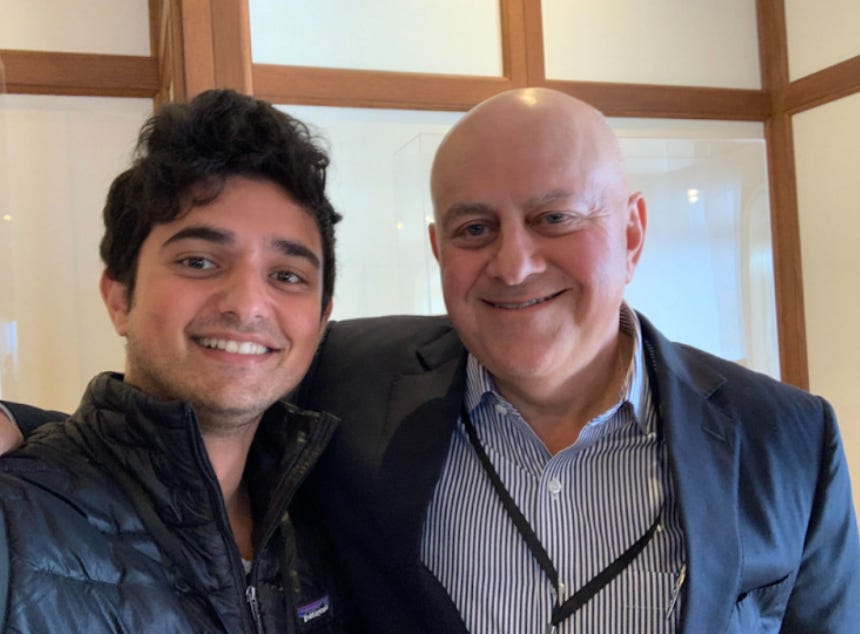
But before the meat of it let me tell you why I love this guy so much. Rounding out the interview with my last question, I got cut off…
“Close your eyes and imagine you're 25 again” - me.
“I don’t have to close my eyes, I still feel like I’m 25,” - Hamid.
Pretty sharp wit for a 68 year old. To Hamid Moghadam. The Iranian-American pioneer. The godfather of all things delivered via Amazon, and the one, the only, jokester I know who will take a sprinkle of his extremely valuable time to make us all chuckle.
For most of the rest of the article, we’re going to let Hamid do the talking, because he’s the expert. So we will do this in our favorite, classic, Q&A style. But his answers won’t mean anything unless you have macro-economic context. So we will provide that in bold before each question.
Then a question in italics.
And finally
“Hamid’s answer in block quotes.”
Here Goes.
The economic shocks of COVID, which extended an already long ZIRP era, followed by see-sawing political objectives and now, higher for longer interest rates, have created an uncertain market in which its tough to do business.
Q1 - The Crystal Ball, One More Time
Given what you've seen over the past 10 years and all the shifting economic forces and regulation changes, what time periods does it remind you of, and how has it been different? How do you see this playing out?"
“Economically speaking, it's actually been a pretty benign 10 years, if you really look at it, and these are the cycles that create opportunities. If it were a steady state, 3% per year growth economy and you could rely on 2% inflation, then it would be pretty difficult to compete. Because it’s hard to gain an advantage in terms of ability to out-think someone through a complex situation.”
He continued to concede that the younger generation of real estate investors has indeed felt an unprecedented downturn:
“People who got into the business after 2010 didn’t see a downturn until 2022/23 and, in fact, for most of the last four years of that period, post-COVID, you had zero cost of capital. So not only was there not a downturn, but they were pouring jet fuel on the economy [through] monetary and fiscal policy. So we went from a very, very loose capital environment, zero interest rates, essentially where credit was readily available and then immediately went into a situation at the end of 2022 early ‘23 when the Fed started raising interest rates, and that was a real headwind to the economy.”
Companies with owned real estate are now suddenly trading at higher equity multiples (or valuations) than those that are asset light. We asked Hamid to consider this.
Q2 - On Valuation Logic
“Today, Walmart trades at a higher PE than Amazon. By about 30%. That feels like a signal — but of what?”
“Your real estate in the case of retail, is at a higher multiple than the underlying retail business, because Amazon's growth rate was considered to be really advantaged by by COVID and Walmart was disadvantaged by the same thing. [Now you have an environment where its the opposite].”
Despite the newfound shine Wall Street has taken to the asset class in terms of valuation, the traditional drivers of value are no longer necessarily there.
Q3 - On Traditional Real Estate Value Drivers
“You were ahead of the curve betting on infill logistics before it was obvious. But now, the long-term demand picture is cloudier — not economically, but demographically. In a world where population decline is no longer just possible, but increasingly probable, how should real estate investors rethink long-term value?”
“I think population is one factor that leads to real estate returns long term, but affluence is another one. We [have higher demands from affluent customers]. Today, two day delivery is the standard. Tomorrow, one day delivery will be standard. The day after tomorrow, it will be a two hour delivery, and you're already seeing it in some places. The only way you can [meet that demand] is to position more and more inventory closer and closer to the customers.”
“Which brings me to the other factor, the supply constraint. Supply in these affluent markets is actually going down. Existing industrial stock is being converted, because the warehouse is “the cheapest house on the block” to convert to a [higher and better use]. In the Bay Area, for example, 25 million square feet of industrial space has been taken out of circulation in the last decade.”
There is a lot of hooplah around the promise of artificial intelligence, and equally as much push back or fear.
Q4 - On Automation and the Cost of Goods vs. the Cost of Capital
“There’s a lot of optimism around automation — that it will drive down the cost of goods across the board. But if that plays out, do you believe the cost of capital adjusts in proportion, or are we in for a mismatch between input deflation and capital scarcity?”
“Demand will keep the cost of capital high. May not go up, but you will have a very real cost of capital. The government being the number one driver of that demand and spender of capital through the deficits [we’ve accrued] and that we're going to be running.”
“We've also had this experience in the last 20 years with technology changing the amount of capital needed for business. Take Google, for example. Only $19M of capital went into Google, and it's now a $2.5T company, because they became profitable. Those are return on technology companies as opposed to return on hard asset companies like our business. We can't do that. In our business you have to deploy capital and get an ROI. That's how you grow your business.”
There’s a minor contradiction here between this statement and his prior one about supply constraints. How is Prologis going to continue to deploy capital to grow their business if their value driver is now diminishing supply? But as we know, the company has also been expanding heavily into data centers under the tutelage of their new CEO who will take the helm in January 2026. Hamid’s main point was on survival.
“We’ve already had a lot of experience with these fast-growing google’s of the world not being huge consumers of capital in relation to the size of the business. If anything, things are tipping in favor of capital intensive businesses per your valuation question”
Hamid then separately discussed the factors that will affect cost of labor, which is the primary input in the logistics business
“I think the cost of labor in real terms will increase too because of immigration policy. Automation is not necessarily cheaper. A lot of our customers in the logistics business, for example, are implementing automation not because they want to or think it's more economical, but because they have to. They just can't get the labor. Automation, at least today, is not flexible enough to really meet a general purpose need, [and that will be exacerbated because there are less immigrants coming in that would do those jobs]”
Lastly, I asked him if he might put himself in my shoes, or that of many of our readers once more. To help us navigate a noisy world.
Q5 - On Noise, Clarity, and Meaning
“Close your eyes and imagine you're 25 again. You're ambitious, sharp, and trying to make something real — but you're doing it in a world filled with noise. What was the noise when you were 25? How is it different from today?
“There is noise. There's always noise. Let me tell you what the noise was around the time I was coming out of school. The noise was that oil production is going to be curtailed because of the Iran/Iraq War, and Iran being anti-West. They feared Iran or one of its allies is going to close the Persian Gulf and interrupt the flow of oil. So oil prices went from x to 4x”
“That was a big deal because the economy at that time was very oil intensive. If you look at barrels of oil per unit of GDP, I think the number has fallen to 30% of what it was in the ‘80s, and the economy has grown by factor three or four during that period.”
“Today, the primary industry is probably computer science, or maybe with GPT today, now something new, so the subject of economic significance changes.”
While the news headlines may change; Hamid urged that smart decision-making remains the primary task of any investor or successful individual.
“The other difference is that the noise is now constant, and mobile, because we have the first generations that grew up with iPhones. My son is an example”
“I think the implications of that are information scarcity vs. abundance. The challenge in those days was getting the right information. Today, you can get the information really easily, but there's so much of it that you have to be able to synthesize it better. What's important, what's not important? Where do I pay attention? Which information do I ignore? Where is it repetitive? That’s the new challenge.”
With that, he wishes us luck and rides off into the sunset. Thank you, Hamid. Cannot say it enough. Thank you so very much, for the time, for my first job in institutional real estate, and for the laughs along the way. Until next time.
Thanks for reading this special Q&A edition of Mark to Market. This section was made possible by the editorial, and at times emotional support of Andy S. Burt. If you enjoy our work, please share with others.
No posts
Comments
Nothing yet. Say the first thing.
Sign in to join the conversation.