
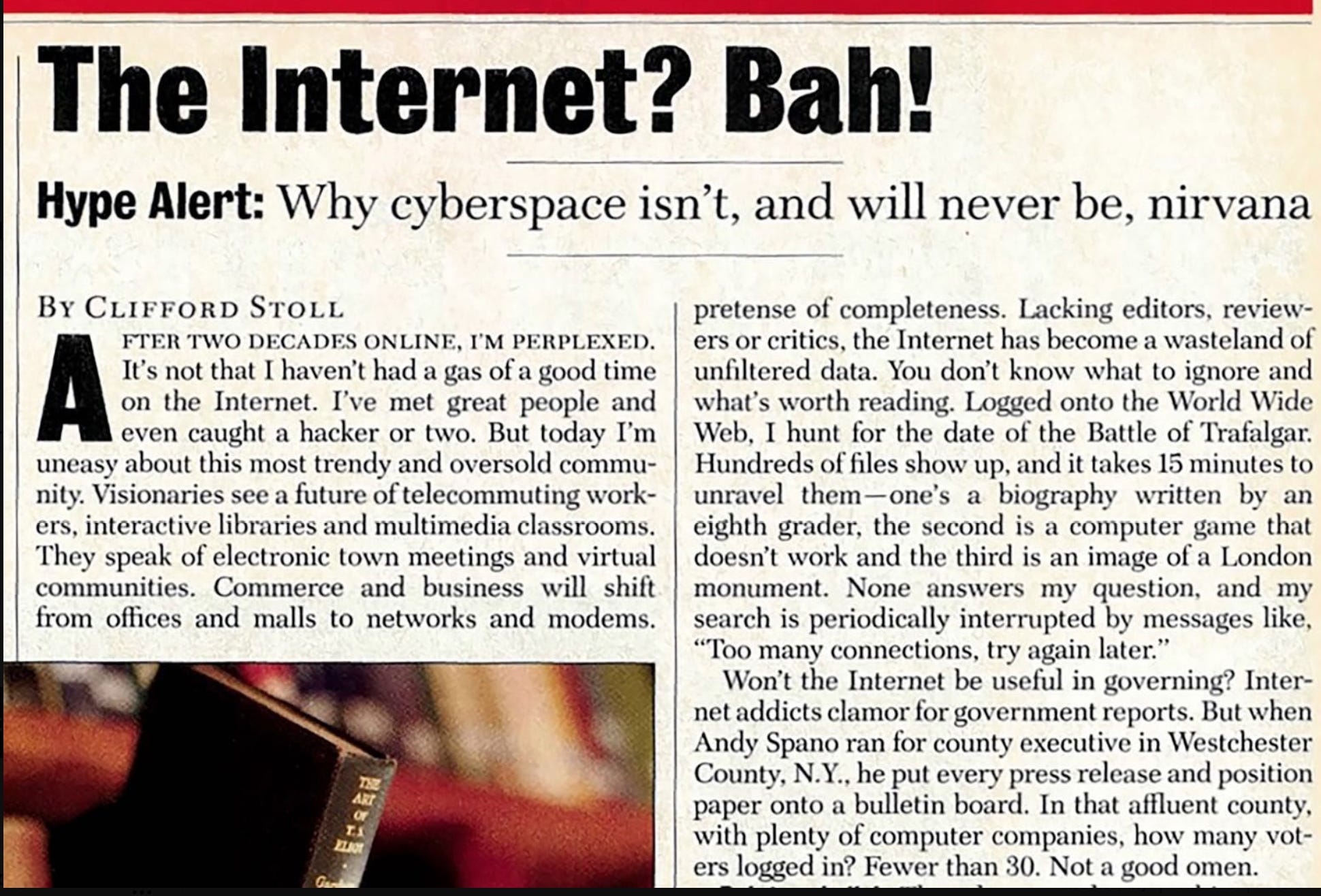
In 1995, a Newsweek columnist wrote an article explaining why the internet would fail and why it was basically a scam.
He argued it could never replace newspapers, face-to-face meetings, or real human connections. They laughed at those who believed in the internet and thought it would change the world.
He was completely wrong.
The thing is, the masses are wrong most of the time.
I think about that article every time someone tells me blockchain or crypto is a scam and has no real value.
Before the internet, if you wanted to reach an audience, you needed a record label, a newspaper, a TV network, or a publisher.
These intermediaries controlled the infrastructure. They decided what got published, who became famous, what ideas spread, and often how people thought about the world. They controlled distribution, attention, and access.
Of course, they also took the majority of the money.
Then the internet arrived.
The infrastructure became open. Anyone could publish, distribute, and build an audience.
The gatekeepers became OPTIONAL.
The music industry lost 40% of its revenue in a decade. Newspapers collapsed. Television networks spent years in denial before streaming rewired the entire industry.
Only companies that adapted survived.
Now look at your bank.
Most people think blockchain is about coins, tokens, or speculation.
That is like looking at the internet in 1995 and thinking it was just about email.
The real innovation is the infrastructure.
A blockchain is a shared record that no single company, bank, or government controls. Transactions are verified by a network rather than a central institution. Settlement happens in minutes or seconds, not days.
There is no middleman deciding whether your transaction should go through. No institution acting as the only gateway. No gatekeeper extracting fees simply because they control the rails.
Smart contracts take this one step further.
They are programs that automatically execute when predefined conditions are met.
A loan can be released automatically when collateral is verified. An artist can receive royalties every time their work is sold without a label taking most of the revenue. A business agreement between parties in different countries can settle automatically without layers of intermediaries processing the transaction.
The important point is not that these processes become digital; they were already digital. The important point is that they become open, programmable, and accessible to anyone with an internet connection.
Just as the internet removed gatekeepers from information, blockchain removes gatekeepers from value transfer, ownership, and financial coordination.
In 1994, the internet existed, but it was not yet mainstream. Venture capital was beginning to flow in. The early builders were called delusional and scammers by the people running the gatekeeping institutions.
That is exactly where we are with blockchain in 2026.
Bitcoin is now held by sovereign wealth funds. BlackRock manages the largest Bitcoin ETF in history. JPMorgan, which called Bitcoin a scam in 2017, is now launching its own Bitcoin products. Morgan Stanley introduced a spot Bitcoin ETF. The same institutions that spent years dismissing this technology are now competing to distribute it.
The early internet looked like chat rooms, basic websites, and email. Most people thought it was a toy. They focused on what was happening on the surface and completely missed what was happening underneath.
The underlying infrastructure was quietly becoming the foundation of the modern economy.
Blockchain today looks like wallets, memecoins, and speculation to most people. Once again, people are focused on the surface.
Underneath, a new financial infrastructure is being built, one where value can move as easily as information moves across the internet.
Just as most people underestimated what the internet would become, I believe most people are underestimating what blockchain will become.
The technology that many still dismiss today will end up becoming the foundation of the next financial system.
This is how you know the disruption is real. Gatekeepers do not spend years fighting something that does not matter. They fight things that threaten their position.
Governments around the world are rushing to develop Central Bank Digital Currencies (CBDCs), while banks that spent years calling crypto a scam are now building blockchain products and offering them to clients. BlackRock manages the largest Bitcoin ETF in history. JPMorgan is building blockchain infrastructure. Morgan Stanley and other major financial institutions are expanding their crypto offerings.
The same institutions that laughed at this technology are now trying to participate in it.
The pattern is always the same: First, they ignore it. Then they laugh at it. Then they fight it. Eventually, they join it.
The internet created enormous opportunities for the people who understood the shift early. Artists no longer needed record labels to reach audiences, writers no longer needed newspapers to distribute their work, and entrepreneurs could build businesses without asking gatekeepers for permission.
The same shift is happening in finance.
For the first time in history, people can own, store, and move value on a global network without relying entirely on banks and financial intermediaries. This is not some future vision or theoretical concept. In countries where governments destroyed currencies through inflation, corruption, or economic mismanagement, millions of people have already turned to Bitcoin and stablecoins to protect their savings and conduct everyday transactions.
That is why I do not spend much time worrying about market cycles. Prices go up and down, narratives change, and speculation comes and goes. The real story is the infrastructure being built underneath, and that infrastructure becomes stronger every year.
His name was Clifford Stoll. In 1995, he wrote an article explaining why the internet would never live up to the hype. His arguments sounded reasonable at the time. He believed people would continue relying on newspapers, bookstores, and traditional ways of doing business.
He was wrong.
Not because he was unintelligent, but because he judged a new technology by the standards of the old system it was replacing.
That is the exact mistake many people make with blockchain today.
They see volatility, speculation, and memecoins and assume that is the entire story. They focus on what is happening on the surface, just as people in the 1990s focused on chat rooms and email while missing the infrastructure being built underneath.
History shows the same pattern again and again. Most people focus on what exists today. Builders focus on what becomes possible tomorrow.
The gatekeepers laughed at the internet, and many of those same institutions are now adapting to blockchain because they have no choice. The infrastructure being built today will quietly become the foundation for entirely new financial systems, just as the internet became the foundation of the modern digital economy.
The masses are often wrong in the moment. The future belongs to the people who recognize the shift before it becomes obvious to everyone else.
No posts
Comments
Nothing yet. Say the first thing.
Sign in to join the conversation.