
What is the universe trying to tell me? I’m sitting on a wraparound deck outside the Shotpouch Cabin with a tall picture window facing a purling coastal creek and writing of my love for forest birds when I hear two soft thuds. Leaping up, I rush around the corner. Two warblers lie on their sides like plucked buttercups. Each has a jaunty black cap. Stilled.
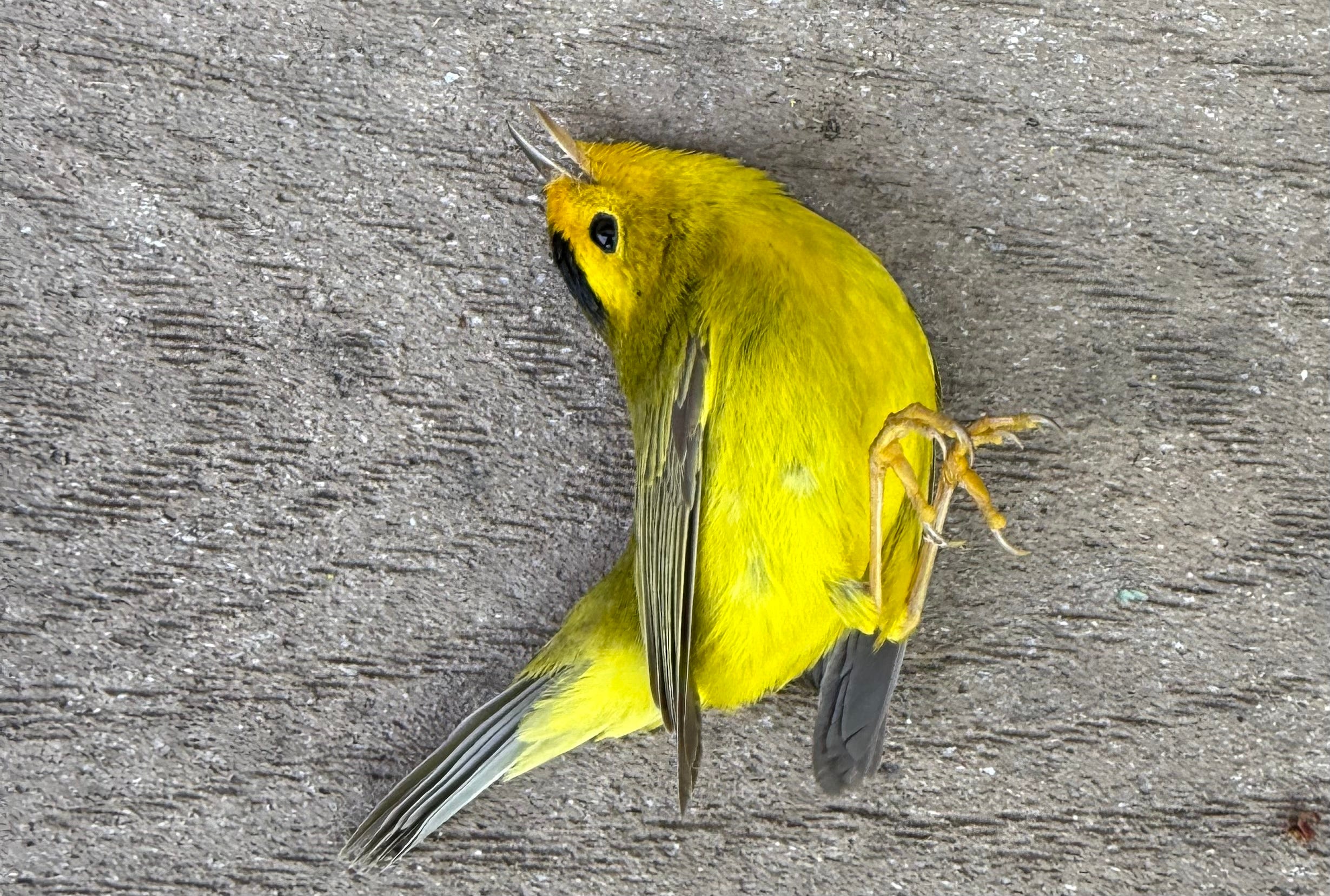
They are male Wilson’s Warblers, arrived only a few weeks before from a perilous flight north from Mexico to their nesting home here in Oregon among red alders, willows, bigleaf maples, and red elderberries by this creek in this spot. The neotropical migratory songbirds had flown the gauntlet of prowling outdoor cats, blinding lights at night driving them toward city high rises, erratic and powerful storms of climate change, and always fewer places of safety, less food along the way.
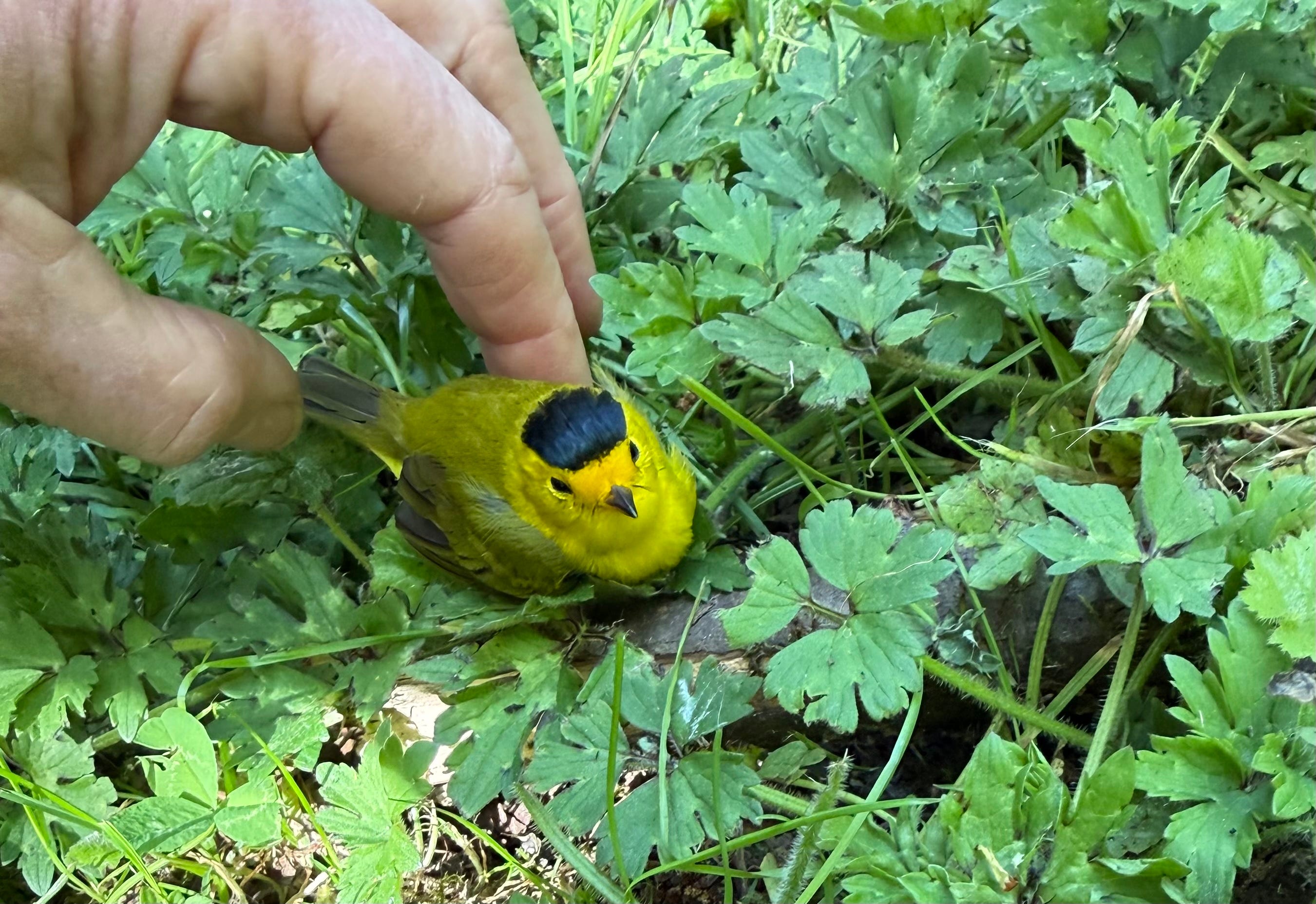
No no no. They cannot be dead. Please please please. I stoop down to the first. His black polished eyes are open, thin bill parted as if readying to riff his chattering bright song. I place him in my right palm. Feathers silky. Chest rises and falls. Fifteen feet over is the second one—he, too, is alive. Both fit in my open hand. They feel weightless as a breeze, warm as a clutch of eggs under a hen. Twin heartbeats.
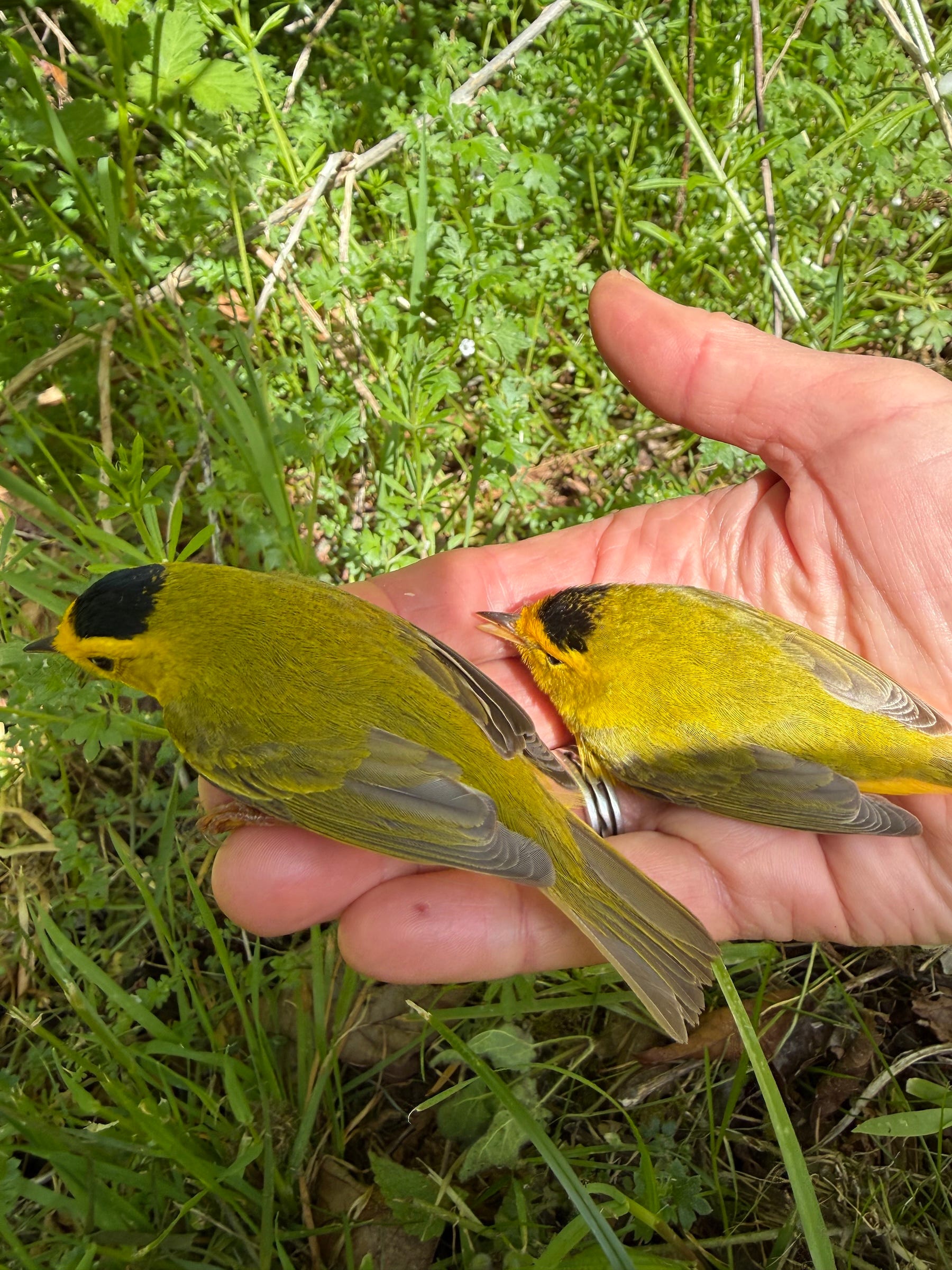
I carry them down by the healing creek. There, I wait. I sit among grass and creeping buttercup plants. I hold the birds. One is more alert than the other,
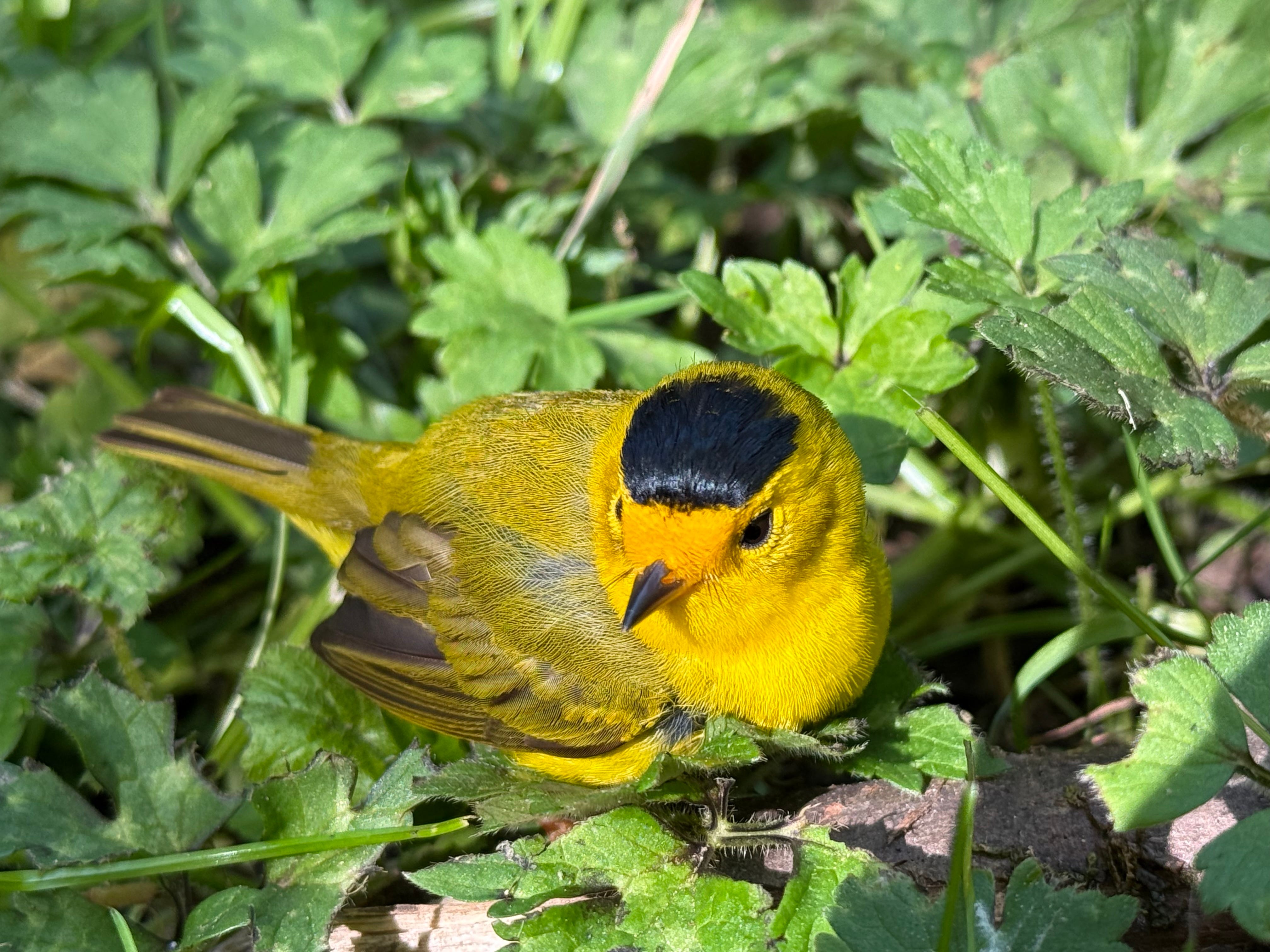
Come on little ones. Come on little ones. I’m crooning softly. Their eyes open, close, open. Gliding my left forefinger over their silky intricate feathers, I notice the olive-yellow hues on their backs, sleek gray flight and tail feathers, and the brilliant yellows of their face below black head feathers. Now they are both upright.
Since my arrival the day before, I’d scanned thickets seeking their lemony shapes—so hidden, even as their emphatic verses seemed to tease me as if to say…look..look..over here..here!
I place them on the ground. Keep stroking their feathers. Tell the sweet ones how sorry I am. How unfair. How wrong to fly so long and far only to strike a window reflecting creek, woods, and sky.
There are small decals on the various panes of the high window—placed there to alert birds. The intention to protect birds was there. This is what many bird stores offer. Sadly ,it’s not enough. Perhaps it is meant to be that I should be here at this moment. I’ve written about bird collisions before and solutions that work. I once collided into a glass door so hard I fell backwards and held my bleeding nose, and wrote about that too. I have empathy. It would be my way of giving back.
I know I’m a big scary person. Come on little ones... The weaker one closes his eyes, but he’s moving his head. Blinks. Time feels suspended. I love you even though I don’t know you. I will protect you.
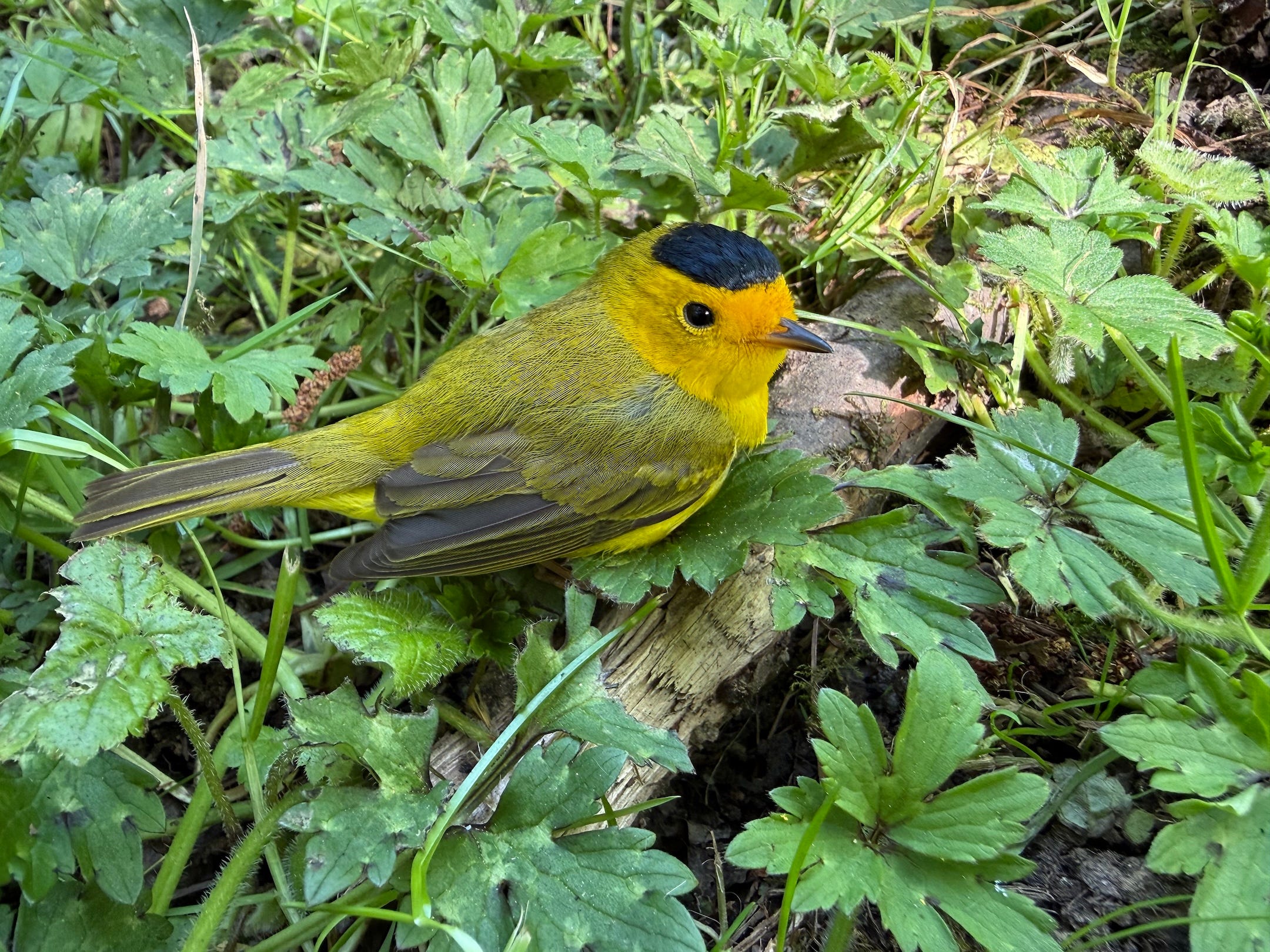
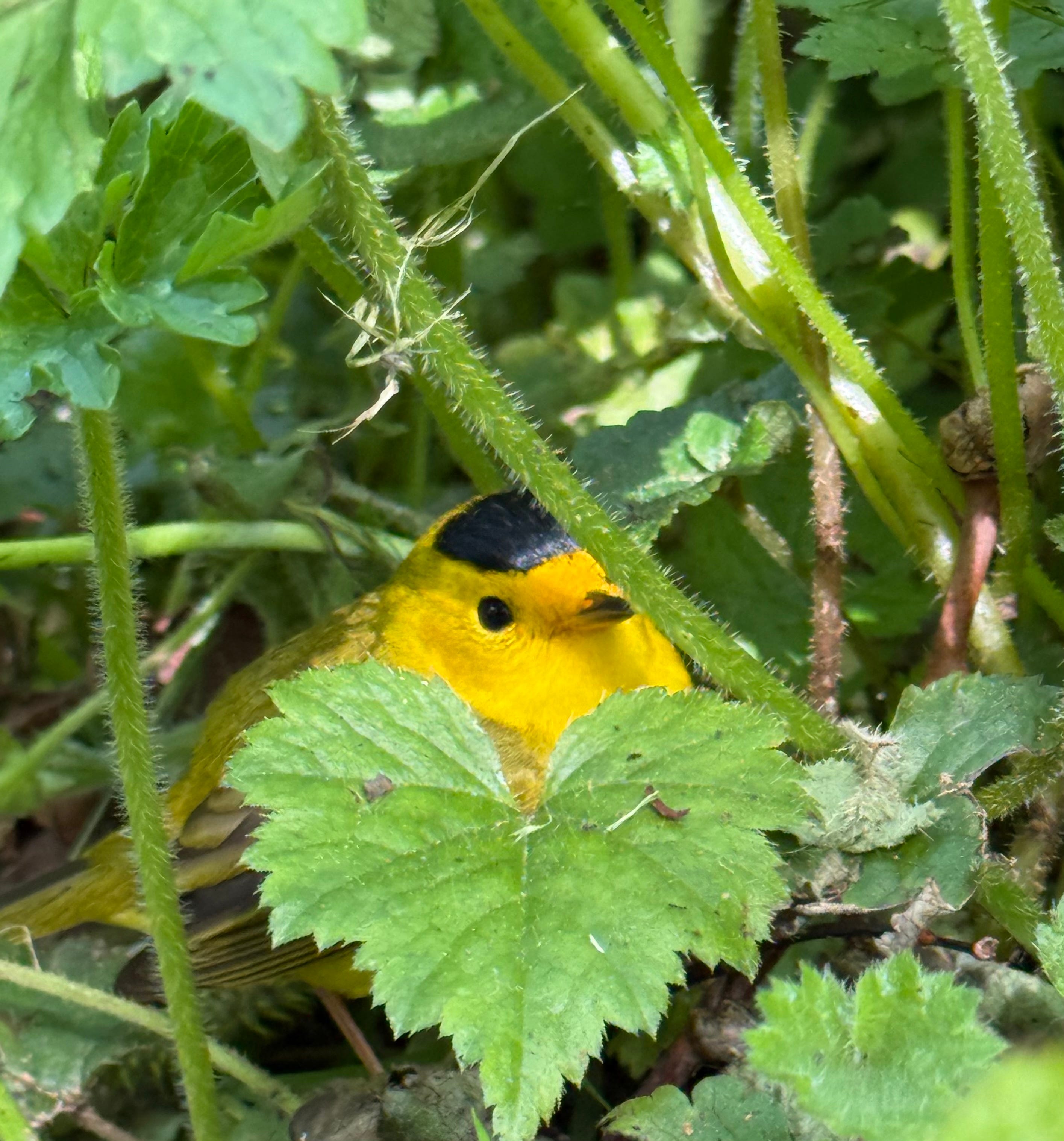
I keep murmuring to the warblers. At last, their eyes remain open. Life shines. They peer right and left. One flutters off like the ruffle of a prayer flag and vanishes into willows overhanging the creek. The other takes a few tentative hops to rest beneath a leaf umbrella. I stay. Finally, he, too spreads his wings.
A couple of years ago, my friend Sandra and I were speaking in that same way and tone...Stay with us.. as we supported our friend Jamie when he slumped and lost consciousness from anaphylactic shock—even after his wife Margie had administered one and then a second EpiPen shot after a bee sting. While she was on the phone directing the ambulance to the house, we kept talking to Jamie. There’s no thought. It’s just what we do—something deep within us, right? Later, when Jamie was home from the hospital and feeling remarkably fine, he told us that he heard us the entire time. Our voices made a difference.
The next morning, I wake in the predawn. Open the sliding door to the chorus of Varied Thrush, White-throated Sparrow, Robin, and Pacific Wren—a euphonious celebration of a rewilding preserve of lush, verdant forest that still retains some towering Douglas-firs and western redcedars—a rarity in the coast range after a century of logging. And at last I hear Wilson’s Warblers—che-che-che-chwe-chwe! Their blossoming notes sharpen every fuzzy edge and clarify my purpose. They could be different birds. There’s no way to know if the concussed warblers I’d held in my hand had survived the night. I could only hope.
The wonderful people of the Spring Creek Project of Oregon State University and the Shotpouch Foundation will act and soon. The windows will be safe for birds. I wish I could be there to help. All who come there to create art, prose, poetry, music, and reverence will still feel immersed in the outer world. The views will still be magnificent.
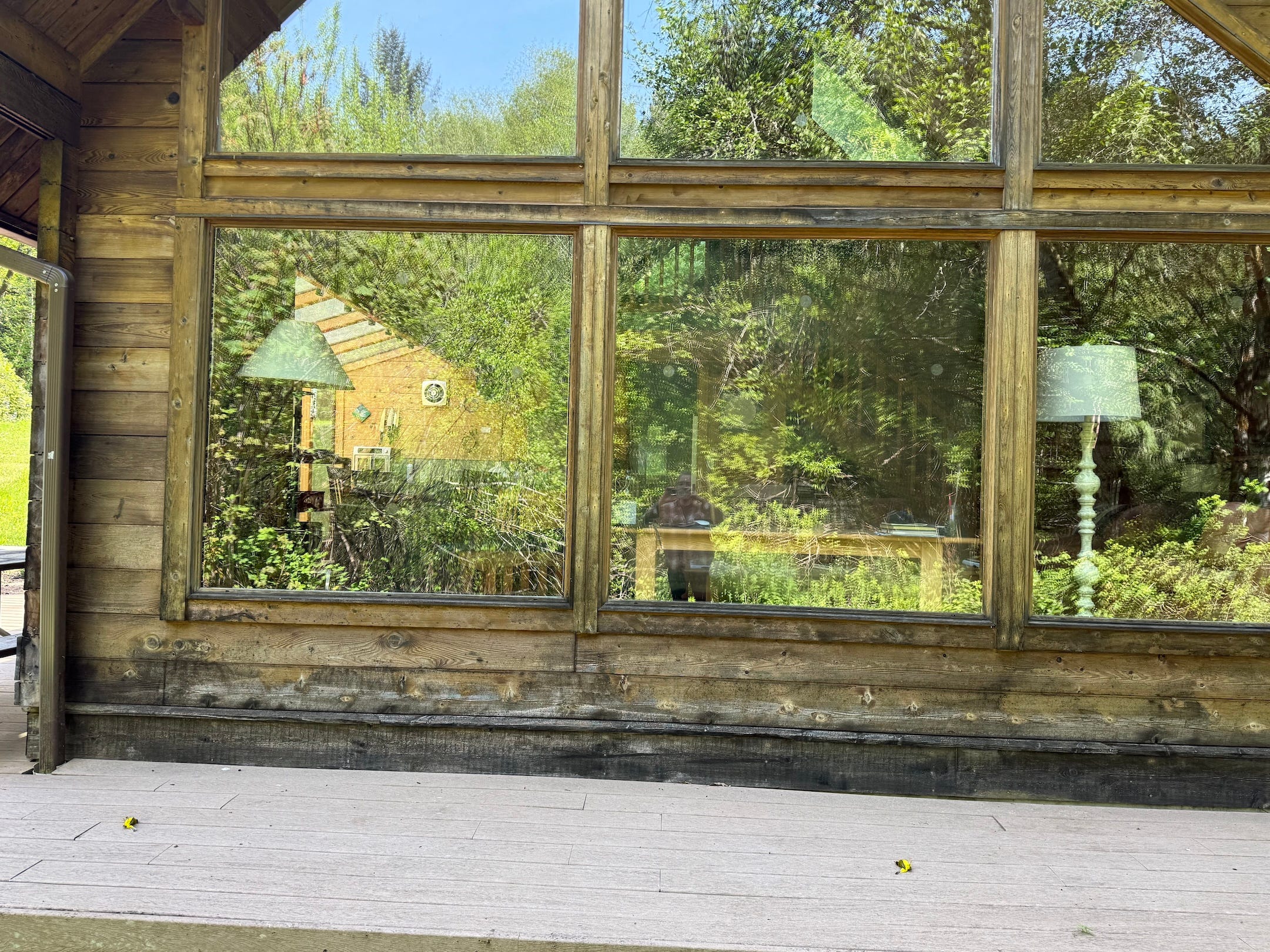
In the above photo of the reflective window panes, you can see the two warblers on the deck if you look closely. Now for the solution from my friend Dawn Harris (who works for the US Fish & Wildlife Service and has put on this same window film at the office in Newport).
Go to the website called Feather Friendly. Look for the sheets/roll of the dots (as opposed to strips of the dots), which makes for a much easier installation,—with the help of two to three people. The dot pattern is visible only on the outside of the windows. From the inside, the darker color of dots makes them imperceptible.
Dawn also recommends a simple and cheap solution that works well —to hang parachute cords from the outside (See directions here). That’s what we do for windows in our one-story home.
We are all learning. We are all culpable for inadvertent harms. We can change. I’m pleased that the new public library in my home community of Bend, Oregon, features bird-safe, multi-story windows facing north and west and all windows will be monitored for collisions to take further action if needed.
What is the universe trying to tell me? In dire global times, tangible actions matter. They lift our spirits. For the love of birds—will you take another look at your windows wherever you live? Are they reflective? Can birds see through one window to another and think there is an open pathway? There’s no better time than now to act—in spring and early summer when birds are migrating, courting, and nesting.
To find out more, visit the American Bird Conservancy website—and support this important nonprofit, too. I’d love it if you would share your bird-safe window solutions, too. Send photos.
Bonus— Here are Seven Actions to Take to Help Birds from Cornell Lab of Ornithology
No posts
Comments
Nothing yet. Say the first thing.
Sign in to join the conversation.