
Author: Ariel Lawhon
Genre: Historical Fiction
Rating: ⭐⭐⭐⭐⭐ (5/5)
Release Day: September 8, 2026
Recommended Reading:
Hamnet by Maggie O’Farrell — A beautifully written historical novel that blends meticulous research with deep emotional resonance, making it a perfect companion for readers who love history brought vividly to life.
The Frozen River by Ariel Lawhon — Another masterfully researched novel from Lawhon, featuring a remarkable woman whose courage and intelligence shape the course of history.
Daughter of the Pirate Queen by Tricia Levenseller — A fast-paced YA fantasy filled with daring adventures and swashbuckling spirit for readers who simply can’t get enough pirate stories.
I’m always going to remember pirate stories with a fond smile. When I was a teenager, the Pirates of the Caribbean franchise was the first series I ever became truly obsessed with. I always knew that real pirates were nothing like them and certainly didn’t have magical curses, but the films created a world that balanced fantasy with historical inspiration.
The movies were also where I first fell in love with Elizabeth Swann’s story. She was a governor’s daughter, a proper lady who, despite her upbringing, possessed an adventurous spirit stronger than the comforts of her privileged life. I remember admiring her because she longed for something that, in her world, seemed unthinkable for women of her station.
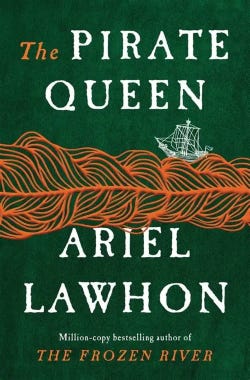
Ariel Lawhon’s upcoming novel, The Pirate Queen, also features a woman who loved freedom and the sea more than comfort. The difference is that Grace O’Malley was real.
Historical fiction is beautiful because it allows us to feel as though we have come to know someone who lived centuries ago. Lawhon makes O’Malley so vivid and relatable that, by the novel’s end, I felt as though I had truly met her.
How accurate was it, though?
Grace O’Malley was born in sixteenth-century Ireland, at a time when power was rarely handed to women. The daughter of a Gaelic chieftain, she grew up surrounded by ships, trade, and the constant negotiations that determined who controlled the western coast. According to one of the most enduring stories about her childhood, she cut off her long hair so she could accompany her father to sea—a tale that may be impossible to verify, but one that captures the determination that came to define her life.
As she grew older, O’Malley proved herself to be more than a sailor. She became a leader, merchant, strategist, and, when circumstances demanded it, a pirate. She commanded ships, defended her family’s interests, and navigated the shifting alliances between Gaelic clans and the expanding English Crown. To her supporters she was a protector; to her enemies she was an outlaw. Like many historical figures, she was impossible to fit neatly into a single category.
Perhaps the most remarkable chapter of her life came in 1593, when she sailed to meet Queen Elizabeth I. The two women—each commanding power in a world dominated by men—met not on a battlefield but across a table, negotiating for the future of O’Malley’s family. It is one of history’s most extraordinary encounters and reminds us that Grace O’Malley was never merely a legend of the sea. She was also a skilled political leader who understood when diplomacy could accomplish what swords could not.
Lawhon weaves these historical moments effortlessly into her novel. It opens with a young Grace cutting her hair after her father tells her that, without it, she can join him at sea. It ends with Grace’s audience with Elizabeth I. The meeting is one of the novel’s finest scenes. Lawhon allows both women to retain their strength and dignity, showing that each was remarkable in her own way. In a world where leadership was reserved for men, Grace and Elizabeth recognize something familiar in one another. They may not always agree, but they understand what it means to wield authority in a world determined to question it.
The Pirate Queen is a remarkable work of historical fiction, demonstrating how magical the genre can be when it is approached with love and respect. Lawhon takes the legendary pirate Grace O’Malley and crafts a sweeping saga that follows her extraordinary life from childhood to her final breath.
As the daughter of chieftain and pirate Eoin O’Malley, young Grace develops an independent spirit that is not encouraged in girls of her time. She is expected to marry well and strengthen her family’s alliances with another clan. When her father takes her aboard his ship as a child, he hopes the harsh realities of life at sea will convince her that such a future is not meant for her.
It has precisely the opposite effect.
Pirate stories are often filled with bold protagonists whose greatest love is the sea itself. They long for freedom above all else. Grace possesses that same untamed spirit, one that, like the ocean, refuses to be contained. As she grows older, she becomes an exceptional leader aboard the Niamh. Before long, her crew comes to admire and respect her, setting aside the old superstition that a woman aboard a ship brings bad luck.
What makes Grace such a compelling heroine is that her courage is never portrayed as effortless. She must continually prove herself in a world determined to underestimate her. Every victory she earns feels deserved, making her journey not only adventurous but deeply inspiring.
The Pirate Queen is one of the most poignant reads I’ve encountered this year. It is a sprawling saga that follows its subject through different phases of her life: as an adventurous child, an unhappily married woman, a captain respected by her crew, and a leader who can stand in the same room as Elizabeth I.
Of course, the author has added some details, or exaggerated others, for the sake of crafting a powerful story. I have a book called Ireland’s Pirate Queen next to me now. Having spent so much time with a fictional version of Grace, I remembered that I purchased Anne Chambers’ biography more than a decade ago. The Pirate Queen did not simply grip me with its drama; it spoke to the young girl inside me who admired Elizabeth Swann, collected pirate figurines, and once believed that being a pirate might be an adventure worthy of the danger.
Historical fiction, when done well, has this effect. We become so captivated by an author’s story that we soon want to investigate the truth. We want to learn about the real legends who inspired the making of this heroine (or villain, depending on how you see her). A good story may contain imagined elements, but I never consider it a lie, especially when it inspires us to seek out the truth.
Lawhon also gives Grace the flaws that make her feel human. For one, she struggles to trust men. In the novel, this distrust begins with her own father, when he lies to her by saying that all she needs to do to join him aboard the Niamh is cut off her red braid. This happens when she is only five years old, and even at that age she possesses remarkable insight.
Five-year-old Grace tells her mother, “Fathers shouldn’t lie.” Her mother’s response is poignant:
“Neither should husbands. But they do. Do you understand? Men. Lie. Sometimes with words. Sometimes without them.”
“Do women lie?”
“Usually when our lives depend on it.”
Grace carries those words with her throughout her life. Her father deceives her into a marriage at sixteen, leaving her at the mercy of a cruel husband who inflicts both physical and emotional wounds. She learns, just as her mother predicted, that survival sometimes requires deception. Even one of her own sons eventually betrays her.
Many men also come to resent Grace’s natural leadership. They cannot accept that a woman has amassed such power and notoriety. Unable to match her accomplishments, they resort to disrespect and slander, attempting to diminish what they cannot understand.
One passage that stayed with me reads:
Grace has ten grandchildren already. … She hopes her daughter is getting a girl. It is important, she thinks, that every woman make a version of herself to pass on the part of her that a son will never understand.
Grace’s attitude toward women and daughters reminded me very much of Abigail Adams in A Founding Mother. Adams believed in educating all of her children—not only her sons—so that each could carve out a meaningful place in the world. Both novels portray women whose beliefs challenged the societies in which they lived. Abigail imagined broader possibilities for her daughters than the world was willing to offer, while Grace refused to accept the limitations placed upon her altogether, ultimately becoming the captain of her father’s ship. Though their lives unfolded in different worlds, both women believed that daughters deserved far more than the futures society had prescribed for them.
Near the novel’s conclusion, we witness the meeting between Grace O’Malley and Queen Elizabeth I. The pirate queen and the English queen stand together in the same room, making every courtier aware of their presence and power. It is easy for the men around them to insult Grace for daring to lead and for “not knowing her place.” Elizabeth, however, will have none of it. She understands better than anyone how difficult it is for a woman not only to attain power but to hold onto it. She has spent her entire reign navigating that same reality.
Another passage captures the kind of leader Grace strives to be:
“…that, from this day forward, the gates of Howth Castle will never be closed to those seeking your kindness. That you not deny the hospitality required of you as a Lord of Ireland. That you always keep an empty chair and an extra plate at your table for those who might appear at your doorstep hungry or tired.”
These words, spoken by Grace to Sir Christopher St. Lawrence, Lord Howth, reveal a great deal about her character. She is not afraid to draw her dagger when circumstances demand it, but whenever kindness is possible, she chooses it instead. Having endured so much cruelty herself, she understands the value of compassion.
Loyalty born of respect is far superior to the kind of service motivated by fear. It is easy to force obedience through terror, but earning genuine devotion requires patience, sacrifice, and integrity. The leader who chooses compassion leaves behind a far richer legacy than the one who rules through intimidation. Grace understood this. She sought to be honest, fair, and worthy of the loyalty she inspired.
Grace O’Malley’s story has endured for centuries because it is about far more than piracy. It is about a woman who refused to accept the boundaries others drew around her, who led with courage, intelligence, and, whenever possible, compassion. Ariel Lawhon honors that legacy with a novel that is both sweeping in scope and deeply human.
The Pirate Queen is a reminder that historical fiction, at its best, does more than recreate the past—it allows remarkable people to live again. It invites us to look beyond the legends and discover the human beings who inspired them. This is a novel that will undoubtedly find a place on many readers’ shelves when it is released in September.
Comments
Nothing yet. Say the first thing.
Sign in to join the conversation.