
It’s a love story, baby, just say yes.
I was one of the teenagers who, on hearing Taylor Swift’s song “Love Story” the week of its release, was absolutely gripped by it. I remember that, years later, there were plenty of cynics and keyboard warriors arguing that “it’s not really a Shakespeare story” and “she can’t write songs!” Yet it was one of those songs that, regardless of how vocal the critics became, couldn’t be avoided. A pop remix soon emerged.
PSA: I’m a Swiftie. I saw “Love Story” live during the Fearless Tour. Our hands touched as she made her way down to the round acoustic stage to sing “Fifteen.” And when she sang “Fearless,” I remember her modifying the lyrics to, “This moment, Idaho, capture it, remember it!”
I will die on the Taylor Swift hill.
And I believe that “Love Story” touches on something deeply human that we like to pretend we’ve outgrown—but never truly do.
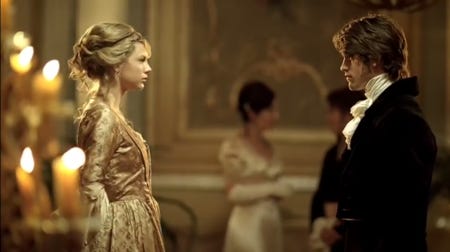
“Love Story” was released in September 2008, and Swift has said that she wrote it as a modern take on Romeo and Juliet, changing Shakespeare’s tragic ending into a marriage proposal. The drama surrounding Swift only helped elevate her to the status of a musical classic, although some people still refuse to acknowledge this, regardless of the Eras Tour. The following year, Kanye West’s infamous VMA interruption became one of the defining moments of pop culture, when he interrupted Swift’s acceptance speech to insist that Beyoncé had one of the best videos of all time.
I think that “Love Story” made its way into even more people’s hearts after that—though the video in question was, in fact, for “You Belong With Me.”
Before all of that drama, there were thousands and thousands of girls and women—and some men who’d never admit it—who might find themselves humming that song under their breath while it played on the radio at a traffic light.
Before Kanye stepped in to help, the song was already moving forward on its own, and I believe it’s because of its title: Love Story.
The song’s hook is right there in its title. So many people want a love story, and they turn to artists like Taylor Swift, who are unafraid to put that desire into words. The world shouldn’t revolve around the person you’re currently crushing on, and if a crush dictates your decisions for more than a passing season, you probably need to go talk to somebody.
But love is a powerful force nonetheless, and Taylor Swift wasn’t the first person to use it to connect with an audience. Love stories have existed forever—in music, novels, poetry, and Shakespeare’s tragic plays.
Why are we so embarrassed to admit that we want our own love stories? And why have tales of happy endings, breathtaking romance, and “I do” become classics regardless of the age in which they were written?
As I type this article, I am finishing my eighty-first novel of the year. It is O, Juliet by Robin Maxwell. I have reviewed it here.
You would be correct in assuming that O, Juliet’s origins in the Shakespearean tale are what caused me to muse on Taylor Swift. However, though the song and novel are both rooted in Shakespeare’s play, they are very different.
I won’t deny it: Taylor Swift took creative liberties—as she is allowed to do—in order to create a song that resonated with everyone, even those who haven’t read Shakespeare. Confession? I haven’t read the full Romeo and Juliet either. I am one of those people.
Since I am unfamiliar with Shakespeare’s full tale, I will concede that Robin Maxwell might have taken liberties of her own in her novel, but here’s the thing: I love this novel.
It is a book about love. There’s nothing rational about it. Romeo and Juliet are obsessed with one another, even though, if they were to think practically for a moment, they would realize that there is far more risk in their being together. I don’t believe theirs is the sort of love that would create a long-term happy marriage, but for this moment—for this beautiful, fleeting season of their lives—they are light to one another.
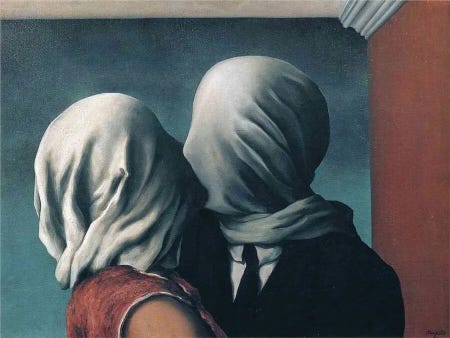
There is no one more lovely to Romeo than Juliet. There is no man more brave and noble to her than Romeo. I haven’t felt this kind of infatuation for a person I was dating in years. Years.
I couldn’t begin to explain why. Could it be age? Experience? Cynicism? I haven’t experienced it since I was a teenager. For this reason, I like reading books that remind me of what it feels like.
Maybe that’s part of what I am looking for when I read a love story. I’m not looking for a romance that resembles my own life, or even one that I would want for myself. Sometimes I simply want to remember what it feels like to look at another person and believe, however briefly, that there is nobody in the world quite like them.
Maybe, one day, I’ll meet a person like that.
This year, I have read many books that center on the topic of love. It’s a topic that, like water, is fluid. It morphs according to the circumstances. In dark conditions, it can still prevail; trust might be shattered, but love refuses to die. And love has been like that throughout the ages. Just look at Helen of Troy.
Some of my favorite books about love are remarkably different from one another. In The Black Tulip by Alexandre Dumas, the protagonist finds himself imprisoned amid political intrigue and falls deeply in love—both with the jailer’s daughter and with the tulip he is determined to grow, despite the fact that he is in a cell.
Girl with a Pearl Earring by Tracy Chevalier is a quieter novel about a young maid named Griet, who is on the threshold of womanhood while working in the home of the painter Vermeer and experiences infatuation for the first time—with him, of course. Apparently, life was not already complicated enough.
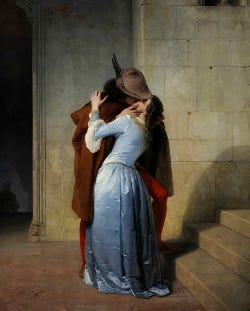
Dear George, Dear Mary by Mary Calvi tells a fictional but compelling account of George Washington and Mary Philipse, the wealthy young woman he is said to have courted before he became the George Washington we know. Their romance is wrapped up in an inconvenient fact: falling in love does not necessarily mean that two people are destined for one another.
Perhaps this is why I keep looking for love in books. It rarely appears in the same form twice. Sometimes it is passionate and foolish. Sometimes it is quiet and impossible. Sometimes it grows in a prison cell alongside a tulip.
Circumstances and centuries change, as do people. But love remains. We keep writing about it—and reading about it.
There is a part of me that suspects the girl who first heard Love Story would be rather surprised by the woman writing this article now.
She was so easily swept up in romance. She could hear a song about Romeo and Juliet and believe, without much resistance, that of course the story should end with a wedding. She wanted the beautiful dress, the dramatic declaration, and the impossible obstacle that was somehow overcome at the very last moment.
She wanted the yes.
I am older now. I have lived enough life to know that love is messier than that. I know that sometimes the person you love is not the person you should be with. I know that wanting something badly does not make it good for you, and that some endings are necessary even when they break your heart.
Yet that girl still exists somewhere inside of me.
I still love the grand declaration. I still want to read about two people who look at each other and think, of all the people in the world, it had to be you. Maybe I don’t believe in love stories in quite the way I once did. But I don’t think I have stopped wanting them.
Growing older isn’t about becoming too wise for the things that once enchanted us. It’s about learning which enchantments are still worth keeping.
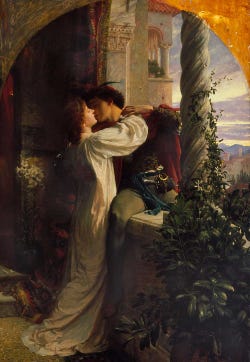
We should stop being embarrassed by our love stories. We know, intellectually, that real life is rarely a Taylor Swift song. People disappoint us. People leave. Sometimes love is not enough, and sometimes the person we thought was the love of our lives turns out to have been only a chapter.
But that doesn’t make the stories meaningless.
We tell them because love is one of the few forces powerful enough to make ordinary people behave extraordinarily. It makes Romeo climb a balcony. It makes a girl wait for a letter. It makes a painter immortalize a face. It makes us write songs that millions of people will sing in their cars years after they were first released.
Maybe we don’t read love stories because we believe they will tell us exactly how our own lives will unfold. Maybe we read them because they remind us that, at some point, someone looked at another human being and thought: There you are. I have found you.
And perhaps that is enough.
It is a love story, after all.
Baby, just say yes.
Comments
Nothing yet. Say the first thing.
Sign in to join the conversation.