
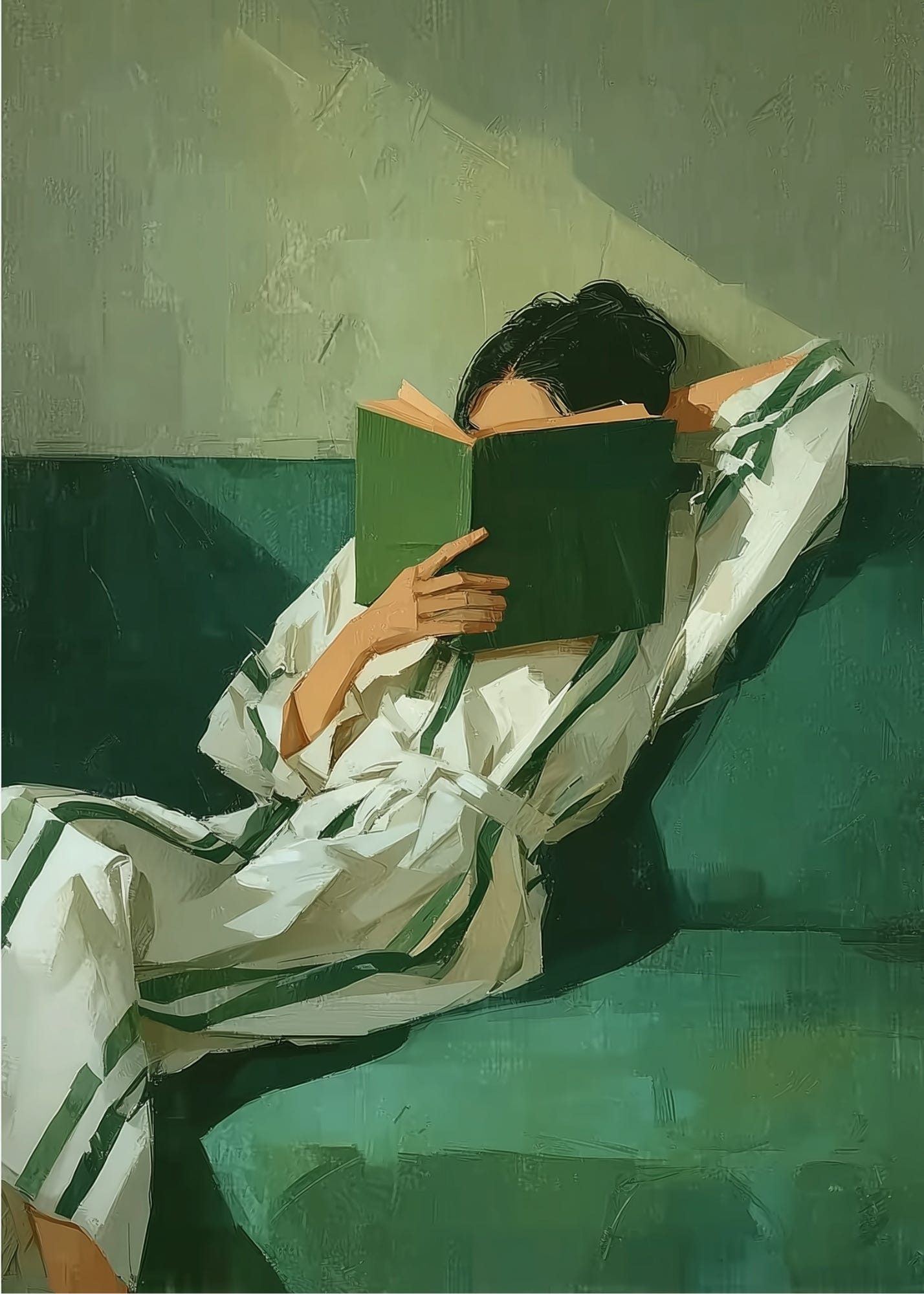
In the autumn of 1866, Gustave Flaubert wrote to George Sand about the purpose of literature. Sand believed the novel should console, that art owed the reader something warm and hopeful, a hand extended across the darkness. Flaubert disagreed. Art owed the reader nothing, he argued, except the truth, however cold that truth might be. They wrote to each other for years, these two positions never quite reconciling, and what emerged from the exchange was not a side with more authority than the other but two writers who deepened their own convictions because in each other they found a sounding board.
This example came to mind because I have been thinking, for a while now, about the demonization of AI in writing communities, and if a difference conversation is possible. The pushback is understandable and, in many respects, necessary. As AI-generated content floods the internet, the resistance has to come from somewhere, and it should come from writers, from the people who have dedicated their professional lives to the craft and who understand what is at stake when originality of thought, of language, of intellectual labour, gets threatened. I support that resistance. And yet I keep coming back to a different question: in which ways could AI be used in the writing process without replacing our thinking, but perhaps extending it? What is it that the modern writer is missing, in terms of the capacity to hold ideas, test them, and bring them to the page, that has nothing to do with AI at all?
Thanks for reading 🧘♀️ Zen and the Novel! This post is public so feel free to share it.
I’ve been thinking about those letters, and about what they were actually doing. We tend to remember the great epistolary exchanges of literary history as correspondence, but I think there was more to it that an exchange of brilliant minds. Flaubert wasn’t writing to Sand to report on his thinking. I’d like to think that it was while writing those letter that some of his best thinking came into focus. Virginia Woolf, writing to Roger Fry about the novel she was trying to write, which turned out to be To the lighthouse, was doing the same thing. And it was thanks to this correspondence that she experimented with replacing the traditional chronological structure of novel writing, to embrace a more visual, emotional composition.
The correspondence was the place where an idea could be tested before it hardened into a position, where friction was not a threat but a requirement. Flaubert needed someone who would push back. And in George Sand, he had one. Most writers have never had that.
The epistolary tradition wasn’t exactly democratic. It required time, and proximity to literary or artistic culture, and the kind of social network that most writers, then and now, have simply not had access to. Woolf had her Bloomsbury circle. Anais Nin had Henry Miller, Sylvia Plath had Ted Hughes.
The rest of us have a notebook and a closed door or a writing workshop group at best.
In the last few years we have assisted to a true democratization of writing and publishing. Learning how to write is no longer prerogative of who can afford expensive courses or MFA. Online classes are widely available and the opportunities to publish our writing have multiplied, Substack is an example of that. However more writing doesn’t mean better writing.
The function those exchanges of the past served is one still very much needed by writers. Writers still need to find out what they think before they can say it clearly, and this kind of thinking, the resistant, pre-draft kind often happens in conversation, in the exchange of one idea meeting another, in the experience of trying to articulate something not yet formed to someone who will not simply agree with you. Without that, you arrive at the blank page still carrying doubts around what you’re trying to say and you wonder why your writing falls flat.
Where exactly does one find that kind of exchange in a daily life that is, at its best, hectic and at its worst chaotic? Even in the online writing communities I inhabit, genuine intellectual exchange is rare. There are exceptions, but what I mostly see are courses, workshops, carefully packaged knowledge moving in one direction from seller to buyer. The internet has unleashed enormous creative potential and we are, all of us, so anxious to capitalize on it, to make it a business, to sell the next thing. There is very little room left for the idle correspondence in which ideas have always tended to flourish. That kind of conversation is disappearing, and I think writers feel the loss of it even when they can't name it.
What if most of what gets called writer’s block is not a failure of creativity, discipline or imagination, but rather the experience of being asked to commit to an idea that hasn’t fully formed? In a room with no one to test it against?
There is another dimension to this that we seem reluctant to talk about. Two decades of social media have done something to the way people hold attention. The ideas are there, but the capacity to stay inside a thought long enough to develop it has been worn down by the relentless scroll. Perhaps a conversation, even a conversation with an AI, could provide enough external structure to keep the thinking moving, to give the idea somewhere to go before it dissolves.
At this point some readers will reasonably note that we have more spaces for intellectual exchange now than at any point in history: podcasts, panels, interviews, online writing communities, virtual salons that meet on Tuesday evenings across time zones. This is true, and I don’t want to dismiss it. But these are, almost without exception, spaces for ideas that have already been formed. The podcast guest arrives with a position. The panelist knows what she believes. What made the epistolary exchanges of the past generative was precisely that they were private, low-stakes, and specifically designed for being wrong. Sand wasn’t performing for an audience when she challenged Flaubert’s coldness. She was thinking. He was thinking back.
AI doesn’t replace the podcast but it might be able to restore that correspondence.
I recognize this is not a comfortable thing to say in a writing community, where AI has become something close to a moral question and where the lines are drawn with considerable feeling. I understand that feeling, and in many ways I share it.
I am not interested in AI as a creative tool. I am not interested in prose generated by a machine, or in fiction shaped by an algorithm, or in any process that moves the writer away from the difficulty of making something true from the inside out: the sitting with it and the not-knowing and the slow, unglamorous arrival at what you actually mean. That difficulty is where the writing lives.
In addition to this there is another aspect to consider. AI lacks the stake in the outcome that made Sand’s letters to Flaubert worth receiving, the quality of someone who had thought long and hard about literature and was willing to tell him, with warmth and without apology, that his coldness was a kind of cowardice. An AI will not do that. Left to its own tendencies, it will reflect your thinking back to you more often than it will challenge it. Which is why AI-generated prose tends to move in circles, returning to the same points without accumulating depth, producing the shape of an argument without the substance of one. If you hand over your writer’s block to an AI and ask it to write the piece for you, what comes back will need more than revision. It will need a human voice.
And yet. The value of the epistolary exchange was not only in the encounter of often opposing views, but also in the articulation, in the act of making a half-formed idea legible to someone outside your own head, of translating instinct into argument, of having to say the thing out loud in order to find out whether it held. That act of translation is where much of the thinking actually happens, and it can happen even when the correspondent is imperfect. Using AI to think before you write, to find out what you believe by the experience of defending it, to have somewhere to be wrong before you commit to anything in public, does something close to what Flaubert's letters to Sand did. Using AI to write outsources the thing that makes writing worth doing. These are different activities, and the conversation we are currently having about AI in writing treats them as though they were the same, which is why the conversation keeps going in circles.
The writers who used epistolary exchange well understood that the thinking before the writing is itself a practice, and that arriving at the page with an untested idea means skipping a step, one that eventually shows up in the work. What they had was access to an interlocutor. A particular kind of intellectual companionship, patient and willing to push back, that most writers across history have had to do without.
For the first time, that no longer has to be true. Not because AI is wise or because it replaces what a brilliant correspondent offers, but because the function, the friction, the private rehearsal space, the conversation that happens before the essay, no longer depends on knowing the right people, or living in the right city, or having the kind of life that accommodates years of literary friendship.
I am aware of how dangerous that statement can be. If the argument is that people, especially young people, should seek those intellectual connections in real life, I am in complete agreement. But where to find them? What is the social milieu where ideas can be shared, discussed and tested? I like to think that universities are still one of the last bastions for that kind of exchange, places where intellectual companionship is built into the structure of daily life and where you are still expected, at least in theory, to test your thinking against someone else’s before you commit to it. But not everyone has access to a university, and not every university still works that way. For the writer outside those walls, the question of where to find genuine intellectual companionship is not rhetorical. It is a daily, practical problem. AI does not solve that problem, but it might help.
The way most people use AI today is flawed. When we distrust our own instincts, it’s easier to assume the machine knows more than we do.
In spite of the considerable push back, AI, like any technological advancement, is most probably here to stay. The danger is not the tool itself but the seduction of it, the ease with which we are tempted to delegate not just tasks but thinking itself. To use AI well, we first need to restore some faith in what we already know. And that is not a technological problem. It is an educational one.
To trust that this is possible requires a kind of faith in the human intellect that the current climate makes difficult. It is easier to fear the tool than to believe we can use it without losing ourselves to it. But that belief is not naive. It is, I would argue, the necessary condition for using any powerful tool well.
This is why, when people in my circle ask whether education still matters in the AI era, whether it is worth pursuing at all when a machine can produce so much so quickly, I find myself thinking about my son and his English exams. We spent a few days together revisiting books I had loved and he was encountering for the first time: To Kill a Mockingbird, A Streetcar Named Desire, several poems that had been sitting in anthologies and he probably would have never had a chance to know had it not been for his school demands. To watch him work through the moral weight of Atticus Finch, or sit with the fragility of Blanche DuBois, was to understand something that no AI model can shortcut.
You cannot confidently argue with a machine, or with anyone, about things you do not know. You cannot hold a position under pressure if you have never learned what a position feels like from the inside.
Education is not less important in the AI era. It is more important, because it is what makes genuine conversation possible, including conversation with a machine. The letter, in the end, is only as good as the mind that writes it.
The gap between good writing and bad writing will not close because of AI. If anything, it will widen, and what will separate them is the same thing that has always separated them: the quality of the thinking behind the words. An interlocutor can offer support to test and shape that thinking.
Nothing can replace real life conversations with real, engaged people. But we live in hectic times, our lives are full with so many commitments. For those of us whose college years are well behind us, a new interlocutor might have arrived in an unexpected form, always available and ready to listen to us.
It is up to us now to be empowered to use it in a way that doesn’t relinquish our entire competence and knowledge. AI cannot think or write instead of us and we should never ask that, but it could help enhance or set in motion our thinking process.
The way the exchange is managed and how much we get out of it, it’s completely within our power.
Comments
Nothing yet. Say the first thing.
Sign in to join the conversation.