
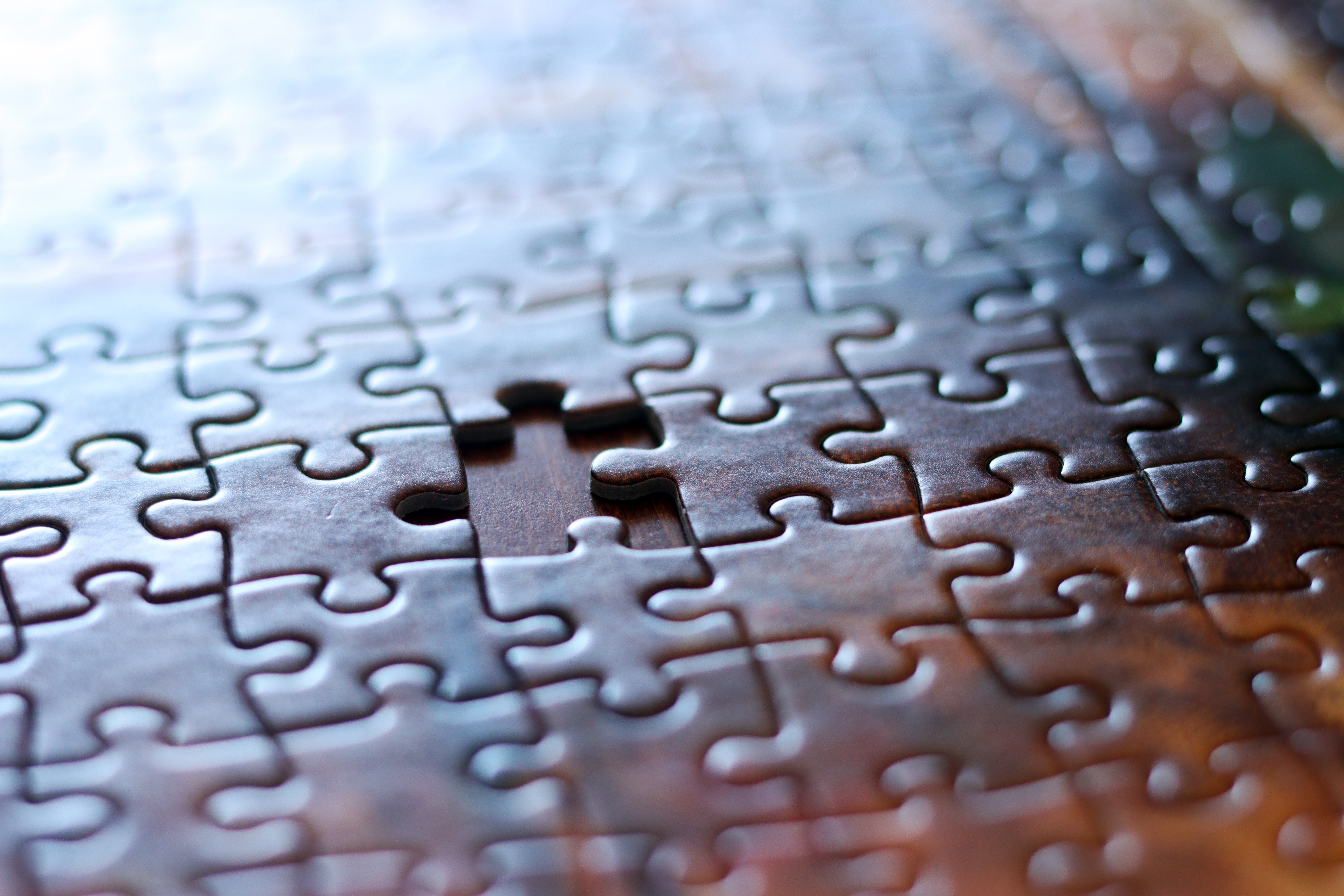
The introduction to the version of Georges Perec’s Thoughts of Sorts that I’ve been reading is written by Margaret Drabble, one of my favorite authors. In her introduction, Drabble frames the book with the claim, “Georges Perec was a writer obsessed with classification. He loved lists and inventories and catalogues and the ‘ineffable joys of enumeration’. But his own work is hard to classify, and attempts to pigeon-hole it fail to capture the multiplicity of his achievements.” Each of Perec’s writing attempts, she says, was a way of building toward a never-to-be completed puzzle “which the act of writing created and continues to create.”
_______________________________
I found that Drabble had herself written a book about puzzles and the way that certain jigsaw puzzles are difficult (she cites a particularly difficult one that she found in Stratford-on-Avon which was an image of Shakespeare’s face) and yet beg to be completed—to be fit together into a pattern or an image. The Pattern in the Carpet is a collection of chapters that fit together—we assume—but the connection between them isn’t obvious. How do the pieces fit together? Is there an image? Maybe a pattern? A key to solving it?
Drabble talks about the ethics of using the image on the box to guide the reconstruction of a jigsaw puzzle (she and her aunt thought it was OK); about the history of jigsaw puzzles (which began in the 18th century as tools for teaching geography: they were originally maps that puzzlers had to put back together); about writers who prefer crossword puzzles (Drabble doesn’t like their connection to language and words); and about her own history as a writer, reader, and member of a family. It blends history, a discussion of books, and memoir. Is there a picture completed by it? Like the Shakespeare jigsaw puzzle, it is difficult to put together.
Yet that’s a reason to read it.
In The Structure of Scientific Revolutions, Thomas Kuhn compares scientific progress (which only happens when there’s a paradigm in place, Kuhn argues) to solving a crossword puzzle. Each block has a letter that belongs in it; that letter is determined by its place in a longer word, which is itself an answer to a clue and fits with the answer to another clue, which itself intersects with other answers to other clues. Cheating is dishonorable, though not really policed. One could look up the answers on the web or in an encyclopedia, but the purpose of the crossword puzzle would be undermined thereby. And, of course, some of the clues require creativity and lateral thinking: their answers are sometimes homonymic, or subtle.
Philosophical puzzles, though, sometimes don’t have clear answers: when do a number of bits of sand make up a pile of sand? What came first, the chicken or the egg? Can something come from nothing? If space and time are infinitely divisible, how is movement from one place to another in a finite time possible? What is it like to be a bat?
Logical positivists, who ruled the Anglo-American roost in 19th and 20th century philosophy departments, thought such puzzles gave philosophy a bad name. Genuine problems had solutions; these puzzles looked like problems, but they weren’t: they were abuses of language, or confusions, the positivists claimed. The truth or falsity of any given answer to these pseudo-questions has no empirical content—and if one cannot say in advance what kind of empirical evidence would settle the question, then there’s not really a question there.
But the history of puzzles is a long one: mosaics, labyrinths, riddles, crossword puzzles, jigsaw puzzles. So maybe philosophers of the mid-twentieth century thought that philosophy was serious, and not to be undertaken for fun, but the idea of puzzles and the fun they provide seems to be, if anything, a common feature of human life. However, when the first crossword puzzles began to appear in the early twentieth century, they were thought to be too unserious for newspapers—until the Second World War, when they were judged to be useful diversions.
Diversions? Maybe that’s what a puzzle is—a diversion, a time-killer, a secular routine. In his short piece Borges and I, the author tells us that he once tried to free himself from Borges with games about infinity and time, but that eventually all such things belonged to Borges or to oblivion. “I do not know which of us has written this page,” the story concludes.
A puzzle indeed! The “I” and the public persona—how do they fit together? Maybe, as Borges suggests, they can’t. But here again is the puzzle—not solvable, but not something we can just dismiss.
Is a memoir a search for the pattern? For a way to fit everything together? If we take the jigsaw puzzle to be a metaphor for that search, then it seems that the pieces should all fit together, but contrary to some of the book’s reviewers, I don’t think there’s a pattern here. And I think that’s the point.
Comments
Nothing yet. Say the first thing.
Sign in to join the conversation.