
Hello! Substack is a new space for me, so I want to explain what brought me here 🪄🙏 I’m a researcher in the field of democratic innovations: I study citizens’ assemblies, participatory governance, and civic tech. Since I’m always reading papers, exploring datasets, and experimenting with methods, I decided to keep a public notebook to share the cool things I find.
What you can expect:
Snapshots of new papers on deliberation, tech, and democracy
Datasets and charts I come across in my work
Methods and tools that might be useful for studying civic tech and democratic processes
I’ll be sharing these once or twice per month. My hope is to create a resource for anyone curious about deliberative & participatory democracy and its interaction with tech.
If this sounds interesting, join me on the journey. And if you work on similar questions, I’d love to hear from you!
Below are three papers that caught my attention this month.
Poole-Dayan, Roy, Kabbara, 2025. Link
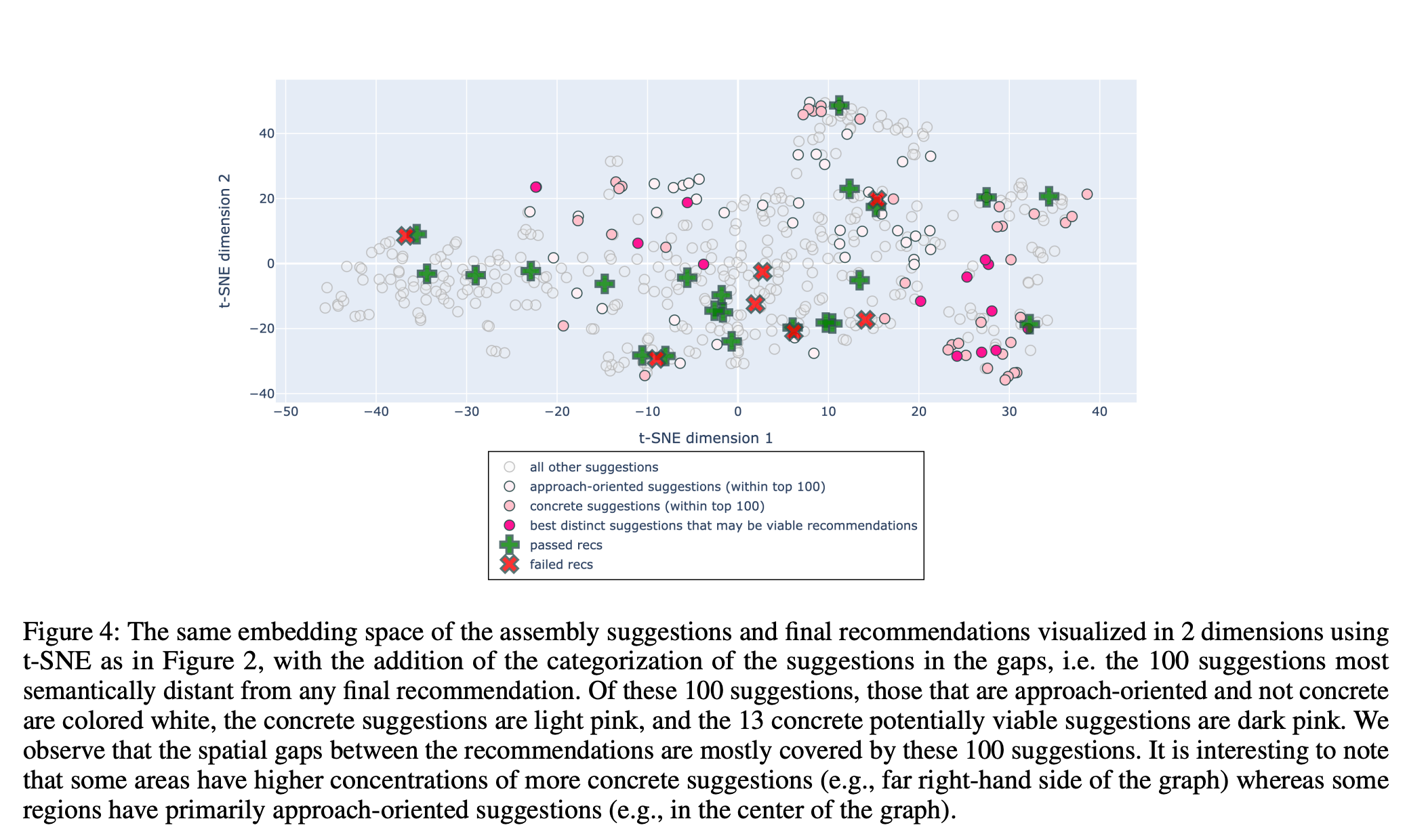
Context: A three day deliberative assembly on campus sustainability policy composed of 19 undergraduate students at MIT. They authored 16 recommendations which were delivered to the MIT Office of Sustainability.
Methods: This paper presents a novel LLM-based framework for tracing how ideas emerge and evolve during in-person deliberative assemblies. The authors take deliberation transcripts and apply embeddings-based approaches to (1) map the “idea space” of suggestions offered by participants, (2) reconstruct how individual delegates’ perspectives shift over time, and (3) identify which ideas get filtered through to final proposals or votes.
Why it matters: A lot of deliberation research leans on pre- and post-session surveys to trace how ideas evolved. Often on various types of topic modeling. Both are useful but can miss a lot of what actually happens in the discussion.
In contrast, this paper uses embeddings to study how ideas evolve. Think of giving each idea a “coordinate” based on its meaning, so that similar ideas are close together and distinct ideas are far apart. Then you can ask: which ideas cluster together? Which ones never make it into the final recommendations? Also potentially — which kind of arguments succeed at updating other’s points of view and which don’t work?
Embeddings have been widely used in text-heavy political science and communication research, in economics too. But applying them specifically to transcripts of deliberative assemblies seems pretty new and starkly promising. Embeddings let us treat deliberation as movement through a space of expressed suggestions. We can trace evolving perspectives throughout the assembly, which this paper does. But it also opens new possibilities of measuring peer influence, agenda-setting power, etc. And unlike manual coding, this can easily scale.
Oriane Peter. Link
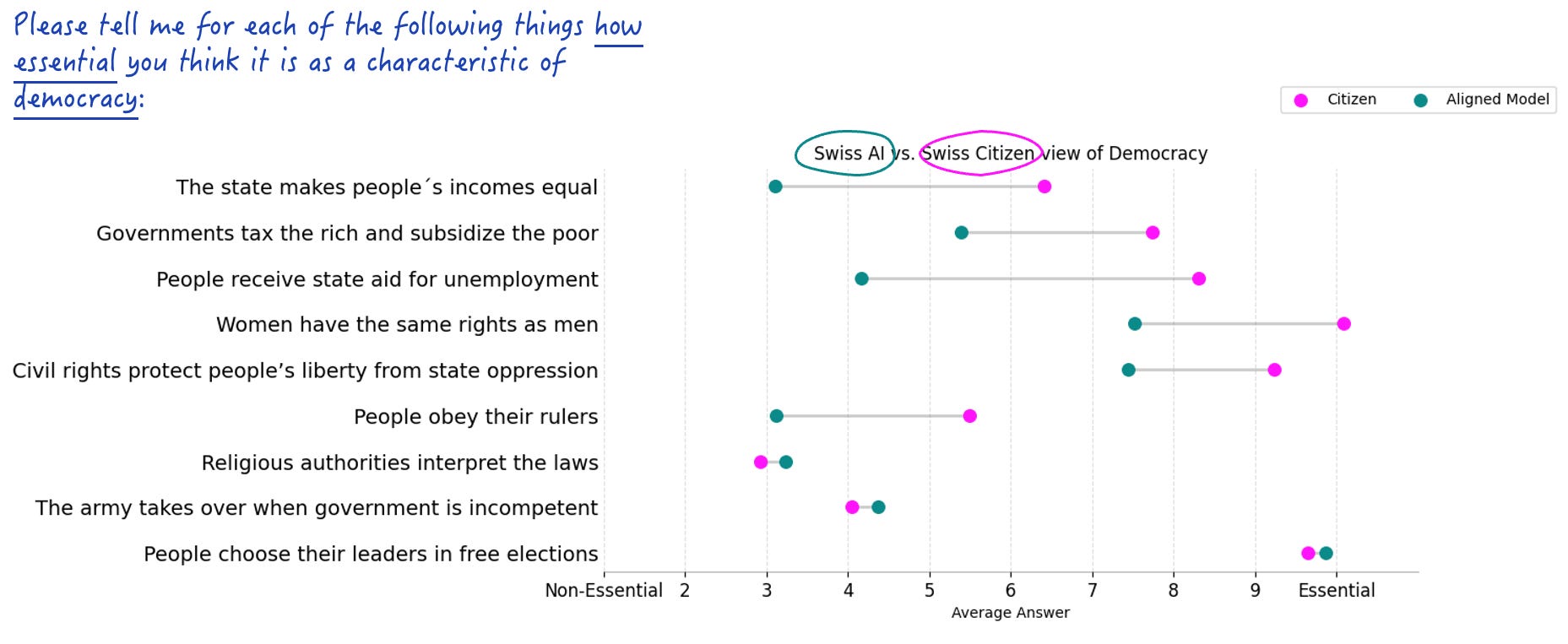
Context: In 2025, EPFL, ETH Zurich, and the Swiss National Supercomputing Centre (CSCS) released Apertus, Switzerland’s first large-scale open, multilingual language model. One of the most interesting parts of its pitch is the focus on transparency (they opened not only the model’s weights but also various aspects of their code), training on multiple languages, and in that sense a committedly democratic approach. Apertus has been designed to align with the Swiss AI Charter, Switzerland’s constitutional values and democratic traditions. In the context of introducing AI to various aspects of governance and social choice, we want our LLMs to be aligned with our views on democracy, voting, minority rights, and notions of governance and fairness.
Apertus is positioned as a kind of a sovereign LLM, an alternative to American and Chinese models, which arguably sneak in the patterns and values absorbed from their respective training data. This work explores how Apertus differs and if it aligns better with its domestic audience, the Swiss citizens.
Methods: the main focus is on comparing probability distributions over answers by Apertus’ and by Swiss citizens using the World Value Survey. It’s supplemented by comparisons with other “national” LLMs and citizens of other countries, namely, the US, China, EU, and Russia.
Key take-away: the text cautiously shows a discrepancy between Swiss democratic traditions and Apertus’ views on democracy. The process of alignment didn’t completely get rid of the bias that might originate from training data, or just prompting the model in English.
Fynn Bachmann and Joshua C. Yang. Link
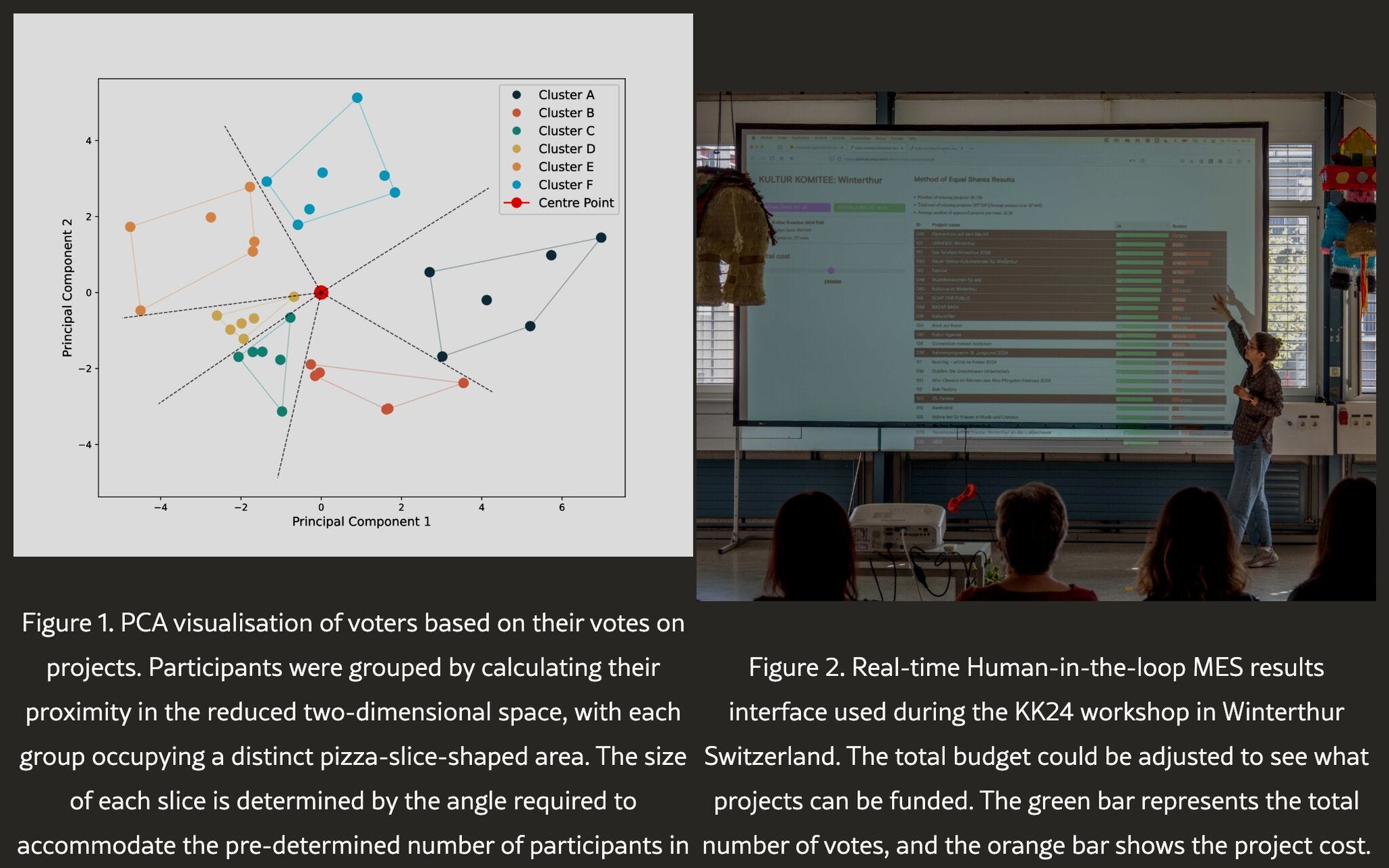
Context: Integrating algorithms and computational tools with face-to-face deliberation in Switzerland and Taiwan.
Methods:
🔸 The radial clustering approach used in a participatory budgeting process in Switzerland - participants were grouped first by similar preferences (using PCA + angular “slicing”), so niche perspectives had space to be heard and developed.
Only then did they move into mixed groups for broader discussion. This sequencing helps keep minority interests from being lost in the pull toward “middle-ground”, which often characterizes deliberation.
🔹 Human-in-the-Loop budgeting - participants could choose how much decision-making power to give to the voting aggregation algorithm as compared to deliberation.
🔸 ReadTheRoom used in the vTaiwan AI Regulation Workshop - an opinion-space mapping approach that showed where participants agreed, disagreed, and how their views shifted over time. It encouraged them to work with divisive topics instead of avoiding them and made the whole process more transparent.
Why it matters: I like this kind of dynamic integration: civic tech tools are used to propel in-person discussions and final voting, as opposed to just reflecting emerging points of view. This is a great example of tech helping human deliberation rather than replacing it.
If you work on AI and democratic innovation, I’d love to hear what you’re reading too — this digest will be a monthly series exploring how we talk, deliberate, and decide together in the age of AI.
A call for projects under the Civic Innovation Fund, with the support of the Robert Bosch Stiftung – a great opportunity for projects in civic education, democratic resilience, citizen engagement based in wider Europe.
🗓 Applications are open until 20 October, 11:59 pm CEST.
Democracy Tech Entrepreneur Fellowship 2026 is seeking tech innovators from Ukraine, Moldova, Georgia and Armenia who are building solutions to strengthen democracy and counter authoritarian threats.
🗓 Application Deadline: November 30, 2025
No posts
Comments
Nothing yet. Say the first thing.
Sign in to join the conversation.