
Questions before conclusions.
Patterns before personalities.
Evidence before certainty.
Counterexamples are welcome.
The goal is understanding, not winning.
Patterns raise questions. They do not end them.
If the pattern disappears when the question changes, it probably belonged to the question.
If the pattern survives when the question changes, it deserves another investigation.
Observation is not agreement. Recurrence is not proof. But both deserve investigation.
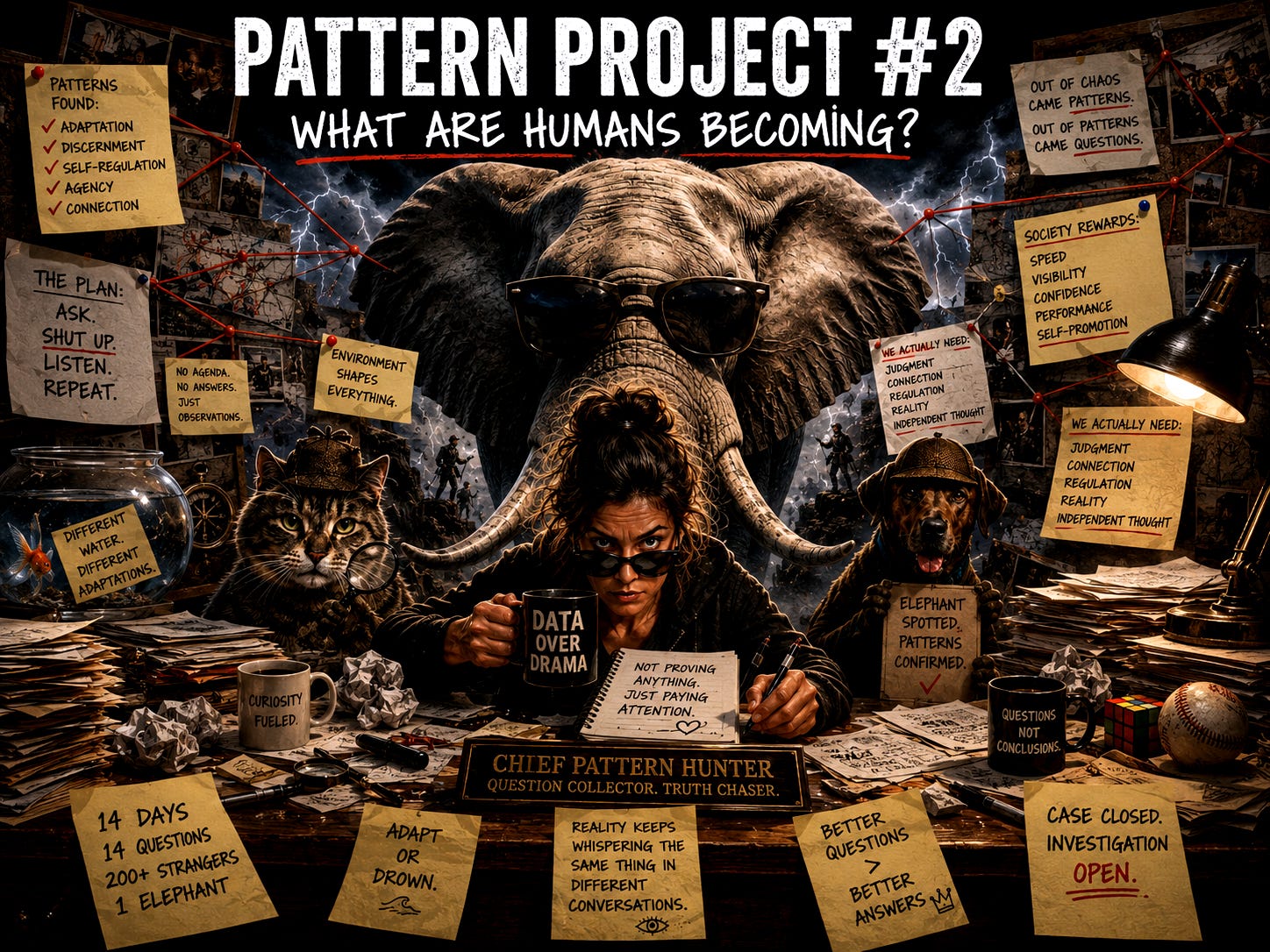
The biggest surprise was not what people believed. It was what refused to change after the question did.
The plan was to, ask one question a day, do not tell anyone where I see this going, do not jump into the comments, and just shut the fuck up.
I was not trying to prove anything, and neither was I trying to convince any one of anything.
I wanted to see what would happen if a bunch of strangers all stared at the same elephant from different directions without realizing they were looking at the same fucking elephant.
The reason I kept changing the question was because I wanted to know if different questions would produce the same underlying observations. Not an easy thing to fake.
Most surveys ask the same question. I was curious to know what would happen if I asked a lot of different ones instead.
Some answered in one sentence, some even changed my mind, others wrote mini essays, while some made jokes, and one managed to answer with “100% AI Generated (too soon?)”.
Something else I noticed was that nobody acted like they had the entire answer. Most offered observations instead of certainty. For a corner of the internet, that is SUS as fuck.
By Day 14, I had a ton of observations, a brain that looked like a shaken up snow globe, and one realization.
I thought everyone would describe different kinds of humans: optimists, pessimists, introverts, extroverts, those who adapt, those who do not, and the typical OG labels, you know because we absolutely love putting labels on everything.
Instead, not a lot of you did that. Everyone kept describing capacities. Not to be confused with personalities.
Seems like a tiny distinction but I do not believe it is. Try asking someone what makes a good carpenter. You would have expected them to say, “a patient person” or “a creative person.” But instead these were the answers I got, “measuring, adjusting, paying attention, solving problems.”
Over and over, y’all answered with things we do, not things that we are. Everyone used different words, but many kept pointing toward the same ideas. Discernment, judgment, pattern recognition, filtering information, managing emotions, paying attention, independent thinking, community, reality.
It was similar to y’all describing the same mountain from different trails. That is when I realized we were talking about environments.
Whenever someone described what humans are becoming, they always explained why: “we have too much information”, “the algorithms reward outrage”, “we’re overloaded”, “we are constantly adapting”, “people are surviving”, “everything feels noisy.”
Even those who completely disagreed with each other politically or philosophically shared something. Most of us assumed that we change because the world around us changes.
Surprising to me was that I never asked. Nobody was told to explain why humans change. Yet we kept going anyway.
If hundreds of us independently start explaining the why behind human behavior without anyone asking us to, that’s a pattern we should be investigating.
I do not know exactly why it happened. I just know it kept happening.
Almost like the comments kept telling the same story in different ways. The environment changed, pressure changed, humans adapted.
So let’s say you are raising fish. Stay with me… You put one fish in a calm pond. You put another in a rushing river. You put another in the ocean. You do not expect them to behave exactly the same. The water changed, the environment changed, the pressures changed, the adaptations followed.
Many also repeatedly separated what modern society rewards from what makes us flourish. When we described success, we talked about confidence, visibility, self promotion, personal branding, performance, and being able to keep up with consistent change.
When y’all described what we actually need, the conversation shifted. Judgment. Empathy. Community. Emotional regulation. Independent thinking. Reality. Connection. Suggesting many of us feel like we are living inside a system that rewards one set of behaviors while requiring another set to remain healthy.
Whether any of those beliefs are objectively true isn't something this project can answer. What it can tell us is how this group makes sense of the world they are living in.
This was an investigation into how we make sense of the world we’re living in, and apparently, a lot of y’all feel like you are sprinting through a funhouse carrying groceries.
Nobody seemed interested in blaming human nature. If anything, the comments sounded more like: “we’re responding”, “we’re adapting”, “we’re surviving”, “we’re trying.”
The word adapting kept coming up throughout this project. Sometimes in ways we do not even notice until years later.
The longer I sat with these comments, I became fascinated by the structure underneath the observations.
Imagine dumping a thousand puzzle pieces onto a table. At first, all you see is chaos. Then someone flips over a corner piece. Someone else finds a patch of blue sky. Another finds part of a tree. Nobody has the whole picture.
You realize we are not finding random pieces anymore. We are finding pieces that keep fitting together. That’s exactly what this project felt like.
Nobody coordinated their answers. Nobody saw tomorrow’s question. Nobody knew what anyone else would say. Yet similar ideas kept surfacing from different directions.
That does not make the observations true or prove the pattern, but it does make the recurrence worth investigating.
This project did not answer the question I originally asked.
What Are Humans Becoming?
I’m not convinced that is what we explored. We explored something much more interesting. What kind of environment do we believe is shaping humans today?
Different questions, different people, similar patterns.
Two very different questions. One focuses on us. The other focuses on the conditions surrounding us. And after fourteen days, my notes were filled far more with descriptions of the water than descriptions of the fish.
If there is one thing I’m taking away from this investigation, it is this: The topic almost never matters.
Looking back, that is why the biggest surprise was not what people believed. It was how little the underlying pattern changed after the question did.
If changing the topic doesn't dramatically change the underlying observations, then maybe the topic isn’t carrying the conversation. Maybe something deeper is.
We talked about children, personality, historians, strength, weakness, emotions, and adaptation. And yet reality kept handing back the same receipt.
Y’all consistently explained human behavior through changing environments, changing pressures, and changing adaptations.
I never asked, "What kind of environment produces these behaviors?" But it was the question many of you answered anyway.
Whether it's a coincidence or not, it earned another question instead of a conclusion.
That’s the whole point of The Pattern Project. To collect patterns, because patterns raise questions, questions lead to investigations, and investigations lead to better questions.
And if the first two case studies have taught me anything… It’s that reality has a strange habit of whispering the same idea through completely different conversations.
The case may be closed. The investigation is not.
Investigation: What Are Humans Becoming?
Case Study: #2
Duration: 14 days
Daily Questions: 14
Method: 14 different questions, answered independently and reviewed for recurring observations across responses.
Most Repeated Patterns
Adaptation: Y’all repeatedly described humans responding to changing conditions.
Discernment: Judgment, filtering, reality testing, and signal detection appeared across different questions.
Self regulation: Emotional steadiness, attention, persistence, and managing pressure repeatedly surfaced.
Agency: Independent thought, responsibility, and trusting one’s judgment remained central.
Connection: Empathy, community, intimacy, and belonging were frequently described as necessary but increasingly difficult.
Unexpected Pattern
Participants repeatedly explained behavior through environmental pressure even though the questions did not explicitly ask about environments.
Important Distinction
What society appears to reward: performance, visibility, confidence, self promotion, speed.
What participants believe humans need: judgment, connection, regulation, reality, independent thought.
This Does Not Prove
These responses do not represent all humanity or establish objective social change. They document recurring perceptions within this investigation.
Question Created by the Pattern
What kinds of environments produce these adaptations, and which adaptations help us flourish rather than merely survive?
Status
The questions are complete. The investigation remains open.
No posts
Comments
Nothing yet. Say the first thing.
Sign in to join the conversation.