
If you’ve read my previous article about pluripotent stem cells, you may remember that life begins with cells that possess remarkable developmental potential.
Early pluripotent stem cells are characterized by a highly dynamic and accessible chromatin landscape, meaning that many regions of their DNA are physically accessible to the proteins responsible for regulating gene expression.
Their genomes remain relatively open and plastic, allowing them to activate a wide range of gene expression programs, which in turn enables them to give rise to virtually any cell type in the body.
As development proceeds and cells become increasingly specialized, this chromatin landscape gradually changes. Some genomic regions become more compact and less accessible, while others remain open to support the gene expression patterns required for each specific cell type.
By adulthood, every cell in your body contains essentially the same DNA sequence. So what ultimately determines cellular identity is not which genes are present, but which genes are activated, when they are activated and to what extent they are expressed.
In other words, it all comes down to gene regulation. And epigenetic mechanisms are an important part of that regulatory system.
However, epigenetics is not synonymous with gene regulation.
Genes can be regulated through many different mechanisms, including signaling pathways, transcription factors, regulatory DNA elements and chromatin organization.
Epigenetic mechanisms represent one important layer of this much larger regulatory network.
Gene regulation itself does not occur in isolation.
Some gene expression programs are remarkably stable and help maintain cellular identity over decades. They ensure that a neuron remains a neuron and that a liver cell continues to function as a liver cell.
But gene regulation is not static. Cells must continuously respond to signals from their environment.
Hormones, nutrients, growth factors, inflammatory molecules, mechanical forces and neuronal signals can all influence gene expression. This is one of the mechanisms through which your body responds to what you eat, how you live, what you are exposed to and the environment you place yourself in.
Some of these changes may occur within minutes or hours.
However, not every cell can respond to every signal.
For a signal to alter gene expression, a cell must first be able to detect it.
This requires the appropriate receptors, signaling molecules, transcription factors and accessible regulatory DNA elements.
If any part of this machinery is missing, the signal may have little or no effect.
As a result, the same extracellular signal can trigger entirely different responses in different cell types. For example, estrogen can only affect cells that express estrogen receptors.
But even that is not the whole story.
Virtually every cell in the body contains the genes encoding estrogen receptors. Yet many cells do not express them.
Why?
In some cell types, the relevant genomic regions are inaccessible because the chromatin is tightly packed. These cells do not express the receptor because they were never meant to respond to estrogen in the first place.
Epigenetic mechanisms such as DNA methylation and histone modifications help maintain this closed chromatin state, preventing the transcriptional machinery from accessing these genes.
As a result, the cell cannot produce the receptor and therefore cannot respond to estrogen. The same signal, in this case estrogen, can thus produce entirely different outcomes depending on the epigenetic landscape of the receiving cell.
How does a neuron keep liver genes switched off while remaining responsive to hormonal signals? How does a muscle cell adapt to exercise while preserving its identity? And how does a stem cell gradually lose developmental potential as tissues become specialized?
To answer these questions, we first need to understand how DNA is organized inside the nucleus.
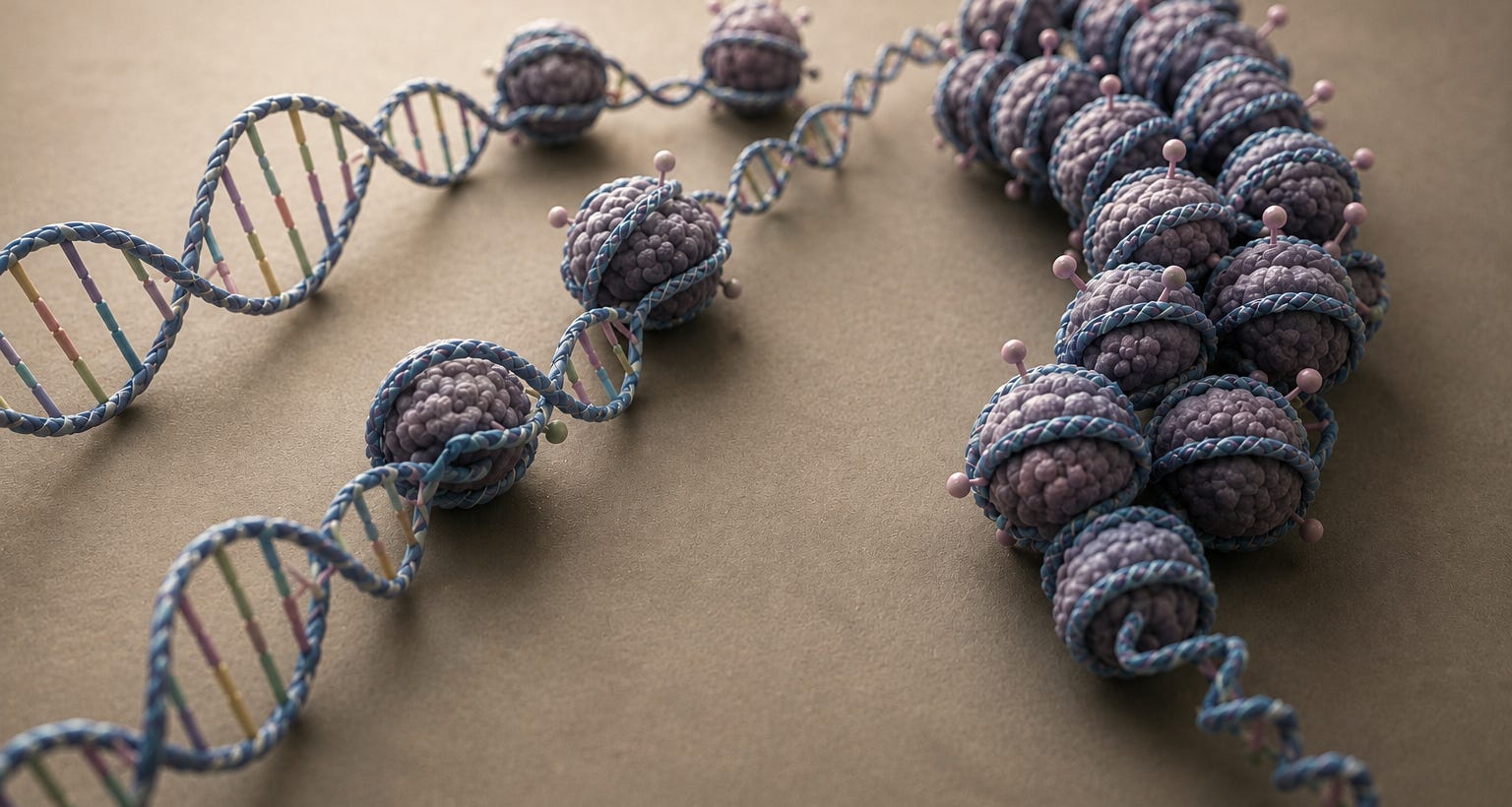
DNA is not floating freely within the cell. Instead, it is wrapped around proteins called histones, forming structures known as nucleosomes.
These nucleosomes represent the fundamental building blocks of chromatin.
Both the DNA itself and the histone proteins can be chemically modified in various ways.
These modifications influence how chromatin is folded and organized in three-dimensional space.
Together, DNA modifications, histone modifications, and higher-order chromatin organization help determine whether a genomic region remains accessible or becomes inaccessible.
This is critically important because regulatory proteins must physically access DNA in order to bind their target sequences and regulate gene expression.
When chromatin is relatively open, transcription factors and other regulatory proteins can reach their binding sites and activate or repress genes.
When chromatin is densely packed, these proteins may no longer be able to access the DNA, making gene activation much more difficult or even impossible.
In this way, chromatin structure serves as an important layer of gene regulation.
An important point is that epigenetic modifications are not always the initial cause of gene activation or gene silencing.
In many cases, they are established after a gene has already become active.
The relationship between gene regulation and epigenetic modifications is often complex. In some situations, epigenetic modifications may contribute to the initiation of gene expression changes. In others, they appear to be recruited after transcription factors have already activated or repressed a gene.
For example, an extracellular signal may activate a receptor, triggering a signaling pathway that ultimately recruits transcription factors to a specific gene. As transcription continues, chromatin-modifying enzymes may be recruited to the same genomic region, gradually establishing a chromatin landscape that becomes increasingly favorable for continued gene expression.
In this way, epigenetic modifications can reinforce and stabilize an already active transcriptional state.
The same principle applies to gene repression.
Over time, active and inactive genes can accumulate distinct chromatin features that help maintain their respective states.
This introduces an important property into gene regulation: memory.
Once established, some chromatin modifications may persist long after the original activating signal has disappeared.
As a result, gene expression states can persist long after the original activating signal has disappeared. A gene does not necessarily switch off immediately when the activating signal is removed, because components of the chromatin landscape that supported transcription may still remain.
How long this memory persists depends on the specific modification involved, the cell type and the molecular mechanisms that maintain or erase these specific epigenetic marks.
Some epigenetic modifications can also survive cell division. This allows daughter cells to inherit aspects of the gene expression programs present in the parent cell and helps maintain cellular identity throughout life.
A smaller subset of epigenetic information may occasionally escape the extensive reprogramming events that normally occur during germ cell formation and early embryonic development. As a result, certain epigenetic states can sometimes influence subsequent generations.
However, most epigenetic modifications are erased and reset during these developmental stages, which is why true transgenerational epigenetic inheritance appears to be the exception rather than the rule in mammals. But this is another, yet very exciting, discussion.
Anyway, this is where our journey into epigenetics begins. I will do my best to deliver Part 2 as soon as possible.
No posts
Comments
Nothing yet. Say the first thing.
Sign in to join the conversation.