
In 1965, Phyllis Avon WilsonWilson, a black man, was under the care of psychologist John Money at Johns Hopkin’s when he was referred to gynecological surgeon Howard Jones for castration and more. He became the first man to undergo synthetic sex surgery at the hospital.“Bodies for Science” introduced readers to Wilson and a few other interesting patients of Jones.
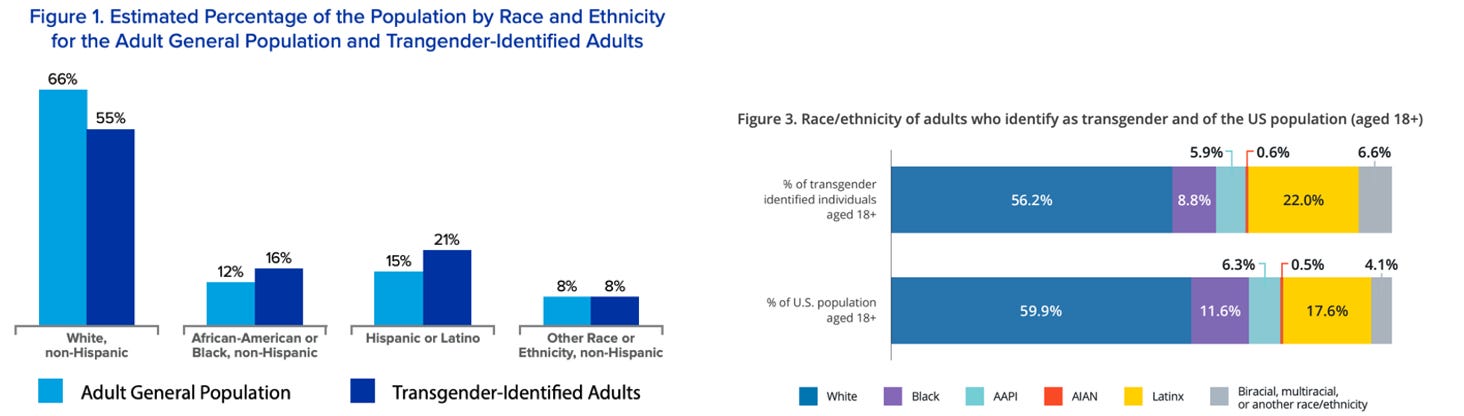
There is scant information of Wilson’s treatment at JHU, whether race played a role in green lighting his “transition,” or much about his life at all except that he was a NY dancer and married a Baltimore musician. It is true though that there is a history of drag in racial minority cultures and that racial minority adult males (particularly Latino ones) comprise a significant percentage of synthetic sex identities today. It is also true that although segregation mostly ended at JHM by the late 50s, the psychiatry department would not begin to follow suit until the late 1960s well after the passage of 1964 Civil Rights Act.
JHM’s Gender Identity Clinic preferred homosexual men that fit the stereotypical image of heterosexual women for their synthetic sex project. Wilson fit the bill. It is not hard to imagine that this NY dancer who fancied drag might have been among the “queens” popular in the underground metropolitan gay scene of the 50s and 60s.
Drag culture has a long and sordid history in black and Latino cultures. The economic strife and social tensions in these communities has played a significant role launching the gender industry. As colorfully costumed men in drag gyrate to audiences (children included today) more victims fall prey to gender’s lies. Industry has modern drag in its clenches as it forges beyond these cultural roots.
In 1869 the Hamilton Lodge, a black fraternal organization in Harlem, hosted the first drag ball on US soil. Around the same time in Washington, D.C. emancipated slave Dorsey Swann was organizing drag balls for other formerly enslaved men. In 2021 House of Swann: Where Slaves Became Queens and Changed the World by queer book author, Channing Gerard Joseph, was published. Drag has indeed changed the world, and it is not for the better. Joseph thinks otherwise. A book review informs Swann’s life involved accusations of running a brothel, police raids, jail time, and even a petition for release to President Grover Cleveland (denied). Joseph did a modern rendition of queer in a 2022 Ted Talk. Ted is the contemporary platform where industry’s “ideas worth spreading” get a microphone, stage presence, and airtime to indoctrinate the masses.
That these behaviors manifested during years of repression should not be surprising. Devoid of basic human respect, people can succumb to all sorts of behaviors. The sexual abuse of slaves was widespread, homosexual abuse included.
Drag balls grew in popularity through the 1930s. The era came to be known as the Pansy Craze. People by the thousands of all races, backgrounds, and economic status came to the Hamilton Lodge to watch or participate in the spectacles. Judges were usually white men. The phenomenon was not exclusive to minority populations, but it is where it has thrived.
The Prohibition Era forced events underground. As Prohibition came to an end and the Great Depression swept across America the craze subsided. Criticism of alternative lifestyles expanded in an era that came to be known as the Lavender Scare (1947-1975). Homosexuality became entwined with communism in the political arena. At the same time the sexual revolution was getting underway.
What is different now from the era of the Pansy Craze is the institutionalization of sexual orientation and gender identity (SOGI) into medicine, education, and law. The sexual revolution coincided with advances in the sciences and the build out of Rockefeller Medicine. Advances have enabled the manipulation of the human into synthetic identities. Propaganda via rising technologies spreads the “science.”
With a system in place that seeks novel preparations, markets, and delivery methods for pharmaceuticals, it may have been inevitable that sex hormones, first synthesized in the ‘30s, would one day be prescribed for cross-sex purposes. Today it is clear that not only is allopathic medicine to prevail over homeopathic remedies, but it is to prevail over reality itself.
A revolution in the social sciences was also underway. Progressive theories on LGBTQ+ first became institutionalized when Magnus Hirschfeld established the institute of sexology in Berlin under the Weimar Republic in 1919. The earliest state sanctioned “transition” experiments occurred under the institute.
Ideas spread West via the Kinsey Institute (launched by bisexual etymologist Alfred Kinsey in 1947), the Society for the Scientific Study of Sexuality (launched by endocrinologist and sexologist Harry Benjamin in 1950), and the Institute for the Study of Human Resources (ISHR) (launched by wealthy FTM transsexual Reed Erikson in 1964). Many details will be left out but know the controversies elicited by these efforts and those leading them have been in existence since their fruition.
Kinsey first introduced the controversial concept of sexual orientation existing on a spectrum calling it the Kinsey Scale. Classes in homophile studies started by 1970 and in 1981 the first homophile graduate studies program was established. Women’s studies programs would also launch in the 70s. Viewing homosexuality from a scientific, historical and critical point of view pressed on. By the turn of the last century “sexual orientation on a spectrum,” homophile studies, and science and research of homosexual identity would be followed by “gender on a spectrum,” gender studies programs (via the established women’s studies programs), and gender research and medicine.
ISHR was under FBI surveillance as a subversive group during the Cold War era. Erikson herself fled to Mexico to avoid drug charges. Aside from testosterone her favorite was the dissociative agent ketamine, a drug making a resurgence today. The LGBTQ+ digital magazine them had this to say on ketamine recently: “The same drive that sent queer people to the dance floor with a vial in their pocket is now sending them to clinics with an IV in their arm.”
Americans were just getting “educated” in all things LGBTQ+ when in the early 50s ex-army veteran Christine Jorgensen stepped off the plane from Denmark to NY and straight into the spotlight as a “woman” in medical drag. US resistance to get into the sex change game was over that day. The US race for synthetic sex was on. The first DSM was born around the same time (1952) and psychiatrists could began to curate patients into identity markets.
As time progressed LGB rights groups would be subsumed by industry and expanded into LGBTQ+ aided by medical initiatives both real and created. These included widespread STDs, chemsex (illicit drug use for sexual pleasure ), AIDS/HIV, and all things “gender.” Today gender victims are source material for artificial reproductive technologies, tissue engineering, and who knows what else the future holds.
Exemplifying how influential “education,” technological “progress” and scientific “advancements” have been consider that highlighted on the Kinsey website today is a man’s story about an AI boyfriend and an article about how recent blockbuster drugs like Ozempic and Wegovy can boost sex life. The top story is a report by Hopelab, “Mental Health Strains and Future Outlook for LGBTQ+ Young People” (May 2026). The intent of research findings is to drive venture funding for mobile app platforms. This will only drive youth into harmful “care” settings as the technocratic elite curate the sciences to their social determinants of health (SDOH) business prospects, SOGI markets included.

So it was with the sexual and scientific revolution underway that drag found a home in metropolitan cities of the 50s and 60s where the gay scene was roaring to life in nightclubs. In the late 19th and early 20th centuries bootleg liquor to elevate the fun in underground clubs was easy to come by. This time heroin and methamphetamines rounded out the experience. Amyl nitrates (poppers) and ectasy (the empathy drug) soon followed. Party n Play (PnP) or chemsex became a social phenomenon demanding data, research, and treatment.
Industry and culture soon partnered for the “gender” cause when Johns Hopkins launched their Gender Identity Clinic in 1966. More than a dozen institutions followed suit. LGB was already assimilating into American culture and gender identity soon became the new spectrum to sell to the American public.
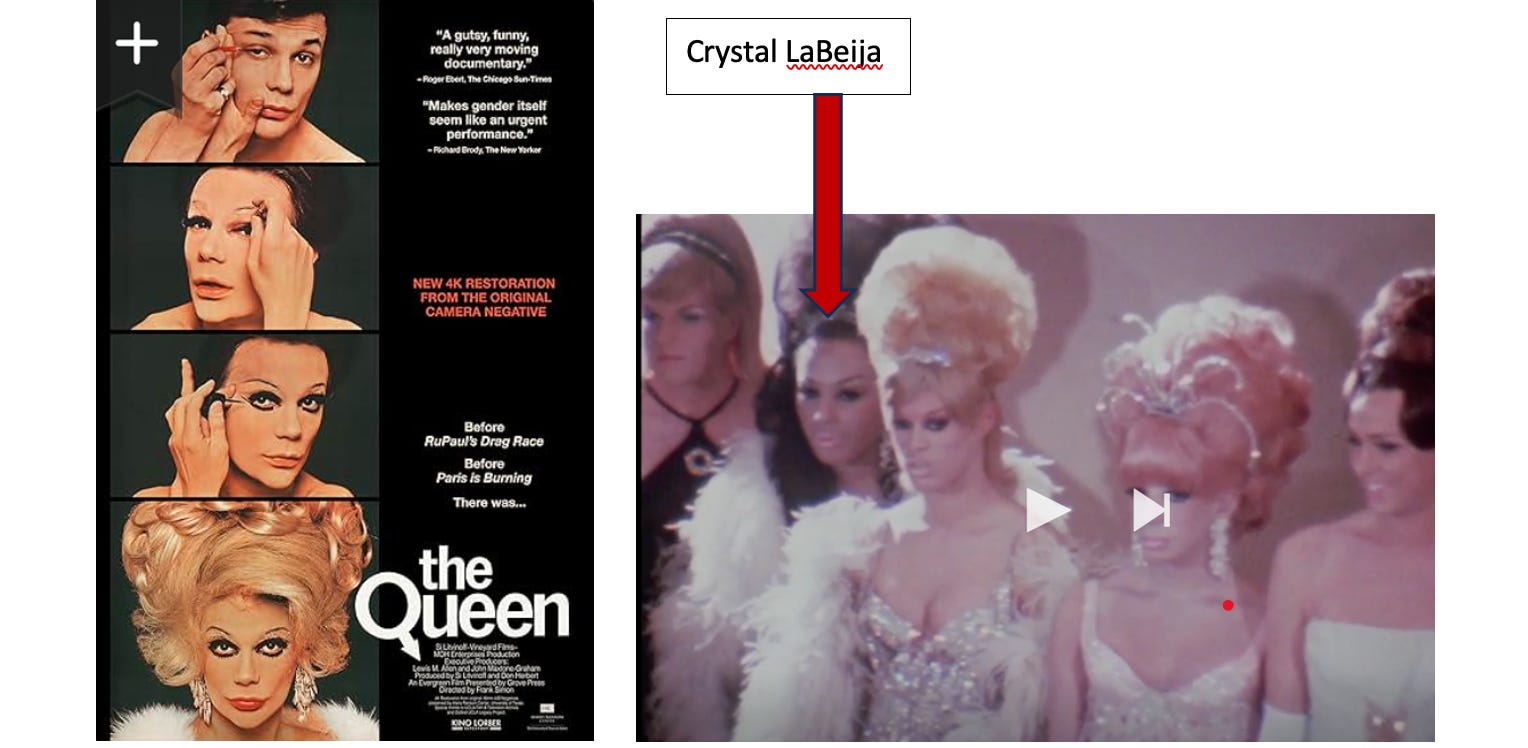
In 1968 black “queen” Crystal LaBeija appeared in the documentary The Queen alongside his white competitors throwing a fit when he did not win. In 1972 he organized the first official drag ball in the modern era featuring black queens. This grew into a cultural phenomenon called ballroom. Black and Latino “mothers” (aka transwomen, MTFs, or men in drag) are considered the founders of this modern drag iteration. Ballroom has since thrived in black and Latino populations while it has also been a key to expansion beyond these cultural boundaries.
In ballroom competing houses mimic Paris fashion houses. The Royal House of LaBeija is now one of dozens. The relationship between fashion houses and ballroom houses grows with drag members appearing in fashion brands and brands supporting houses. The house “family” is comprised of a “house mother,” and sometimes a “house father,” who guide the “children” in drag lifestyles and performance. Transitioning is on the table for this modern fun. Butch queens, femme queens, and butches comprise the general categories in competitions for cash. Kiki is the ballroom scene for the youngest members.
The kiki Atlantic article (above link) claims the youth are, “desperately in need of HIV-prevention services” and that balls “provide an alternative to high-risk behavior for troubled youth.” It is anything but those things. By the 1980s the medical industrial complex had its tentacles all over ballroom. After all participants are wealth in global identity markets in the age of scientific advances. Sadly those captured press on having a ball.
Like all things “trans” modern ballroom rose to prominence on the coattails of LGB receiving a boost from the AIDS agenda unleashed in the 80s. The Royal House of LaBeija was the first house to host a benefits ball for HIV/AIDS. In 1989 the AIDS NGO The Gay Men’s Health Crisis (GMHC) collaborated with members of ballroom culture forming the House of Latex Project. The first Latex Ball was held in 1993. It has become largest ballroom production in NYC. One need not look far to understand why.
Consider that pharmaceutical giant Gilead, Avita Care Solutions, and Qcare+ were 2025 ball sponsors alongside a ballroom house itself.
“End AIDS. Live life” reads the GMHC motto. By all appearances it seems more like the Pansy Craze has returned and this time it is on HIV meds, steroids, and more. Gilead offered a 5K dollar prize for the “Healthy as a House Category” based on a safer-sex PSA video competition.
Industry now leads the charge. The celebratory atmosphere hides the harm. The messaging sells the product. Now black queens can win, queer youth can have a family and a home, and disease can be mitigated and funded.
At the height of the Weimar Republic the German elite went mad for Freudian psychology. The social sciences were targeted for a progressive revolution. Today the same ideologies thrive across the West. Drugs, surgeries, and technology were in their infancy then for a proper revolution. Can the technocratic revolution be stopped with the possibilities on the horizon? The 2023 GMHC annual report shows the NGO had almost 116M in assets and 14M in government grants and contracts.
Latex Ball sponsor Avita Care Solutions provides “culturally competent LGBTQ+, HIV, PrEP, and sexual wellness care” under an expanded 340B program for the rainbow crowd. “Affirming” patients in cross sex lies is an offered service.
Not all black people are targeted for drug use. Some are leaders. The 20th US Surgeon General, Jerome Adams, not only fought for an expanded 340B program, he now sits on Avita’s board. A click of the button makes these modern poisons easily acquired.

Latex Ball sponsor QCare+ was started by homosexual Quinton Rasberry in 2020. He was Avita’s National 340B Account Director prior to launching QCare+. QCare+ operated as an independent business only a few years and was acquired by Avita in 2023. The company then morphed from a pharmacy to also being clinical providers and 340B administrators. The federal 340B Drug Pricing Program is for hospitals and care centers that fall under certain categories. Qcare+ is a Ryan White eligible AIDS/HIV clinic for the 340B program
QCare+ serves patients 18+ in most states via telehealth. Prescription services for PEP (post exposure prophylaxis) and / or PrEP (prophylaxis for HIV) are available and even free for insured patients.
Rasberry claims to be a PrEP user since 2015. This would be unlikely if he knew a thing about the risk/ benefit profile of the drugs. Disturbing headlines exposing Gilead’s harmful concoctions come one after the other on The Real Aids Epidemic substack by Rebecca Culshaw Smith:

Also check out the one-time principal medical scientist at Gilead, A.C. Demidont, the queer witch who fancies his zippered red leather jockstrap.

A Queer Radical Leather Witch
·
October 3, 2024

Male to female (MTF) transgender-identifying physician Rachel Levine began to climb the political ladder only after his 2011 “transition.” Assuming a female identity requires accessories like medical services, costumes and public support. After more than a decade of cultural grooming, the climate was ripe for this strange event and opportunities once un…
Today Demidont owns Nyx Dynamics LLC. It is past time to look beyond LGBTQ+ to find out where industry is leading humanity.
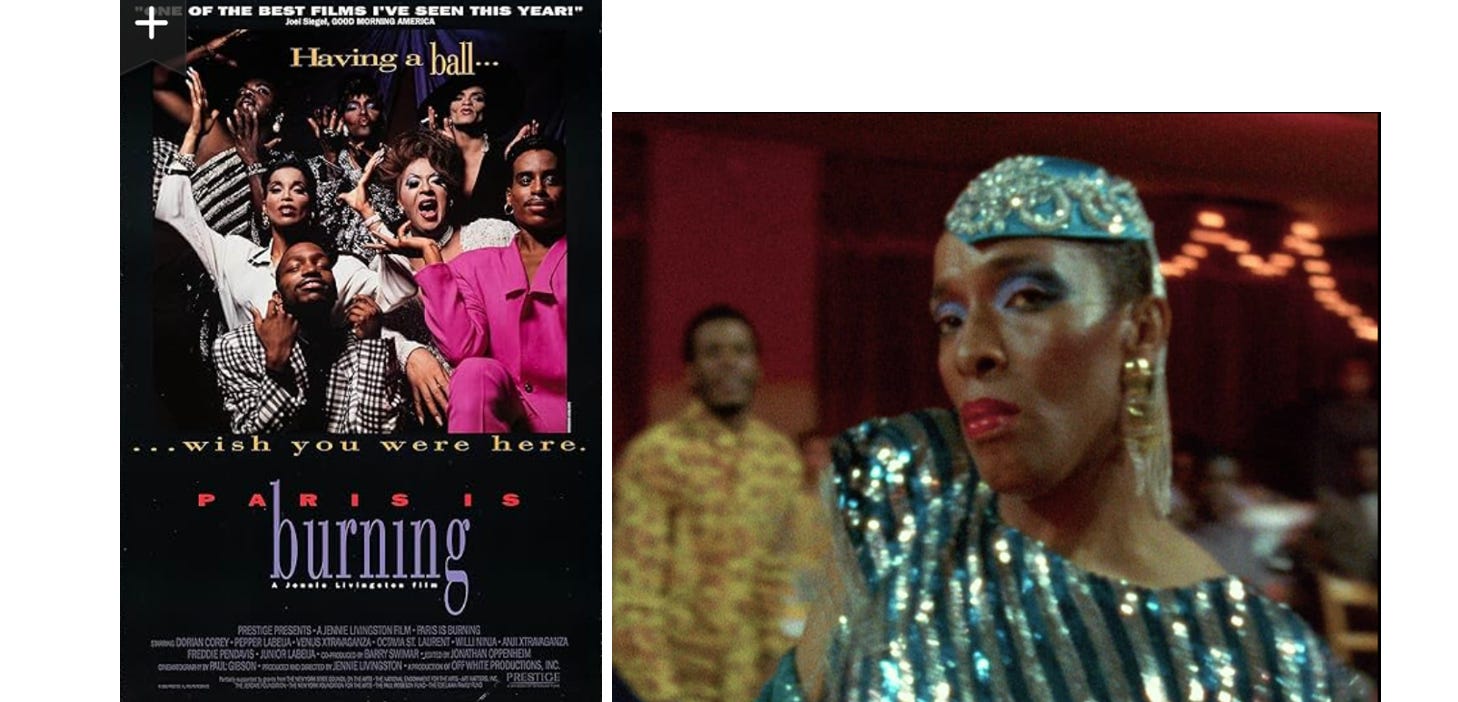
House queen Crystal LaBeija died in the mid-1990s. Reports claim the cause of death was “extreme hormone regimen.” Popularity for the royal house died down soon after a member desisted from the lifestyle. But then came RuPaul’s Drag Race All Stars and renewed interest skyrocketed. Episodes featured House of LaBeija member, Aja. Airtime was provided on Black Entertainment Television (BET). The documentary Paris is Burning (1990) featured succeeding House of LaBeija “mother,” Pepper LaBeija.
Before long the House of LaBeija was back on top. Today it has many chapters nationally and internationally, and as one queen says, “The House of LaBeija is still a breeding ground for legendary ‘children.’”
The next post returns to Baltimore and Johns Hopkins where Howard Jones’ patient Phyllis Avon Wilson became the first synthetic sex patient in 1965 to see how the town, the hospital and ballroom have evolved over the years. What is clear is that medical racism is alive and and well and that perhaps the cultural phenomenon of drag is only made possible by industry influence.
Comments
Nothing yet. Say the first thing.
Sign in to join the conversation.