
It has been a very weird month for me. I had been feeling depressed for some while, so I thought that doing a short personal retreat at Pendle Hill, a Quaker study and retreat center, would help matters. But somehow it instead triggered a mental and spiritual crisis that eventually escalated into extreme suicidality that led me to decide to admit myself into a psych hospital. Yet after just two days, once the suicidal feelings subsided, I realized that the hospital had the potential to make me much worse, so for the first time, I signed the 72 hour notice form in order to leave earlier, formally “against medical advice.” After coming home, I remained prone to disorientation for a few days, which was a bit concerning since some aspects of it were new to me and may have pointed towards an increased likelihood of psychosis. Currently, I feel more recovered and have extra supports for the time being.
How do I explain everything? I suppose I shall elaborate a bit on each item in that paragraph:
short personal retreat: I’d been to Pendle Hill once before when I was a student at Haverford College, and it was a nice place, so I thought it would be an excellent setting to have a bit of respite. I initially was going to focus on creative projects, but then I decided to focus on spiritual reading, in particular Carl Jung’s Red Book, which is recommended reading for a class I’m taking this spring, as well as various Pendle Hill Pamphlets, which are about all sorts of Quaker topics. I also chose to digitally detox, not using any screens, and to minimize talking. All this felt amazing until I was reading the introduction of a book I found in the library by a Jungian analyst, which was about four female ancestors of Jesus (well, technically of Joseph, who in the biblical story is not Jesus’s father by birth). I don’t recall exactly what happened in my mind or what the thought sequence was, but somehow what I was reading triggered intense panic about my gender possibly not actually being nonbinary — an anxiety that I struggled intensely with in my sophomore and junior years of college and which I had not felt with such intensity for years.
mental and spiritual crisis: When that happened, I was terrified. It felt like all my personal growth since that time of intense tumult in college was all going to collapse. Immediately I recognized that the Pendle Hill campus was very similar to Haverford’s campus in that both were arboretums and the room I was staying in looked like an old college dorm room. I knew that the environment I was in could shape both my cognitive processes and the actions I might take, so to avoid eloping or other actions that I did as a stressed-out college student, I quickly returned to the containment of my room. There, I realized that although Jung’s concepts relating to gender (for example, the idea that a man has an inner feminine — anima — and a woman has an inner masculine — animus) were radical in his time, they are outdated now and are not entirely inclusive of queer, trans, and nonbinary people. That realization immediately calmed me down, which was a good sign and suggested that that may have been what triggered me (in combination with being depressed and in an environment that looked like my college campus).
The next day began alright, as my emotional stability returned. But then, in the afternoon, while perusing the bookstore, I read a pamphlet about Peace Pilgrim, a 20th century American woman who walked on seven pilgrimages for peace, never asking for food or shelter and only taking what others freely gave, her only possessions being the clothes she wore and anything in her pockets, which did not include any money. Reading the pamphlet made me think, why couldn’t I abandon my life as it is and do something like this? It was at that moment that I realized that my breakdown the previous day wasn’t about gender at all, and I then broke down even more severely, my whole body shaking as I cried. Luckily the bookstore person found me someone to talk to, who happened to already know me from when I attended Quaker meeting as a Haverford student. I decided it was necessary to break my silence (which already had been broken a couple of times because of people trying to chat with me) so that I could receive support, and I talked with that person for some while until my bodymind settled down somewhat.
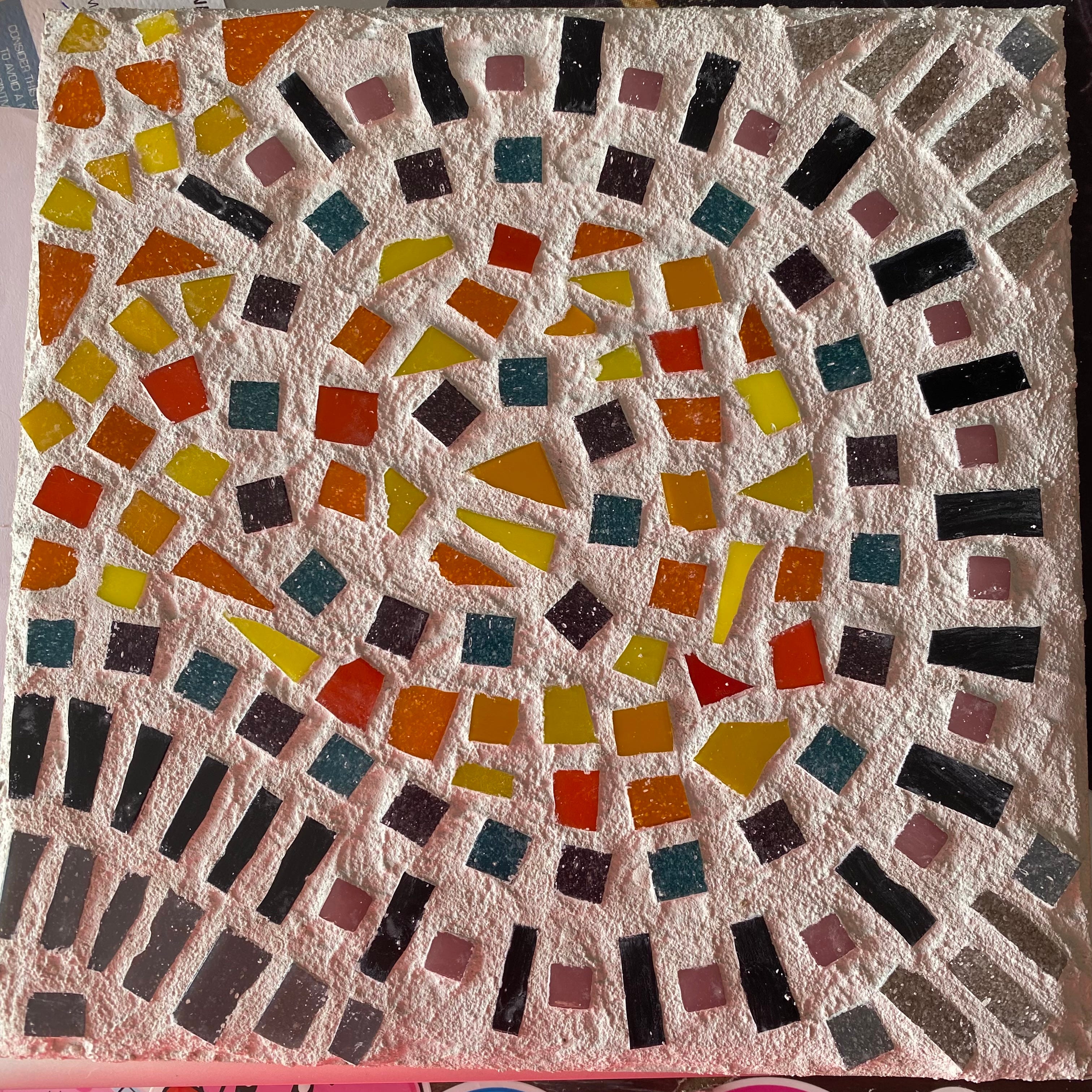
I went home the next morning, which was what I had planned anyway. On my last night at Pendle Hill, I broke my digital detox rule in order to attempt calling my therapist, psychiatrist, and spiritual director, but none of them could be reached. (I had been a bit stubborn about that rule — if I had been more flexible, I could have un-cancelled a session with my therapist that would normally have been the morning after the gender-related breakdown.) In the days after that, I met with each one of them to try to process what happened. I tried to do relaxing activities, such as making this mosaic at an arts studio:
going to the crisis center: But then, something happened that caused me to rapidly get worse. My gender anxieties got inflamed, while at the same time another part of me became terrified of losing myself to my vicious brain. The distorted reasoning in my mind was: “I’d rather die than lose the vibrance of my nonbinary self.” So I was more suicidal than ever before, and thoughts that I had never thought before began to fill my brain. I met with my psychiatrist for a second time that week, and she asked me if I preferred to go to the hospital or to stay at home. She values my agency and so avoids pushing me towards a particular choice, but I almost wanted her to decide for me. Psych hospitals can be awful and often don’t really do much for healing; they are more of just a physically safe place to wait out an acute crisis. But when my psychiatrist suggested that we could wait two days and then reevaluate, I realized that I could very much kill myself within two days. So I chose the hospital.
My mother was very stressed out at my decision, so much so that she felt physically unwell and we needed to wait for her to recover a bit before she could take me to the crisis center. She wanted me to reconsider my decision, but I told her that this voluntary hospitalization was meant to avoid possible involuntary hospitalization due to a suicide attempt, which would be a whole lot worse (and has never happened to me). Once we got to the crisis center, I was evaluated and hospitalization was recommended, and I signed the voluntary hospitalization form. Then, unexpectedly, I was sent to the ER for medical clearance. I thought that going to a crisis center rather than an ER would allow me to avoid the sensory overwhelm and chaos of the ER. When I got to the ER, I was told to put on scrubs, and in the process of getting dressed, I ended up on the floor and couldn’t get up because I was shutting down from the overwhelm. A staff member found me and yelled at me to get up, not believing me that I actually couldn’t stand up. Then a group of people swarmed around me and grabbed me to get me to sit in a chair, which almost caused me a meltdown. They also took away all my belongings without telling me, which felt very rude.
psych hospital: All this time, I expected that I would be able to go to Malvern Behavioral Health, a hospital in Philly that has an LGBTQ ward and which I was at the last three times I was hospitalized. But they rejected me, apparently not because they were full (they likely weren’t, based on my experience there), but rather because they thought that my behaviors were too “high risk.” The social worker who was looking for a place for me could not explain to me what they meant by that. My guess is that either I was too chaotic in my mania last time I was there, or a particular detail relating to my suicidal ideation this time, which I do not wish to mention here, was considered particularly dangerous, even though I do not consider it so and others had been hospitalized there for quite violent stuff. Either way, it’s awfully unfortunate given that part of my issues were gender-related.
I suppose that in part because of “high risk” label, I ended up at a place where there was a lot of psychotic people. Some of these people had compulsions to ramble very loudly to other people or to themselves. I initially did not feel averse to interacting with such people, instead feeling quite curious about their circumstances. But then I realized that their behavior was definitely getting on my nerves. There were other people who presented in a more socially acceptable way, but who at times would express unusual or strong beliefs, sometimes spiritually related. These people started to make me disoriented. By the end of my second day at the hospital, I had an intense moment when suddenly everything and nothing was true at once. I felt like a sponge soaking up everyone else’s craziness. I am so empathetic that other people’s delusions seemed like they could rub onto me. Because of the disorientation, I realized that the hospital could worsen my condition. So that night, I signed the 72 hour notice to voluntarily leave, which is available for those who voluntarily admit themselves to the hospital (called a 201 in Pennsylvania) and do not have a backup 302 (involuntary hospitalization). Since I was no longer suicidal — that subsided just with a little thinking-through in my head — I felt that the hospital had done its job for me.
It turned out to be very much the right decision for me, not just because of the spirituality-related distortions, but also because the large amount of idle time in the hospital, especially over the weekend, caused my brain to ruminate about gender very intensely. The anxieties fit an OCD pattern: I would have an intrusive thought that I was not nonbinary, and then I would be compelled to defend my identity against myself, which would only make me feel more vulnerable because why would a stable identity need to be defended? But that is just how OCD obsessions work: your brain fixates on the bits of uncertainty that are just inherent to everything in life, which makes the uncertainty feel larger and larger. Because my object of obsession is gender, an entirely internal experience, it can very much feel like I have no concrete ground to restabilize myself upon. The only solution is to embrace the uncertainty without panicking, distract my brain away from my ruminations, or just wait for my brain to somehow get bored of its obsessions. None of which was going to happen while I was stuck restless in a hospital where no one gendered me correctly and even the one nonbinary person who was there for a few hours on my first day didn’t understand the nature of my gender-based OCD (they thought my problem was about others being mean to me about being nonbinary).
returning home: Leaving “against medical advice” felt really scary, as I had never done it before and the “experts” wanted me to stay longer. One nurse said that it was not a good sign that I was continuing to ruminate, even though I did not believe that staying longer would help with that. The hospital psychiatrist claimed that my own psychiatrist wanted me to stay longer, but it later turned out that the two had not talked about my decision to leave at all. Other patients, however, seemed to readily understand my reasons for leaving early. No one wanted to stay any longer than they needed to.
Once I got home, I occupied myself with anything that could distract my mind from the gender obsession. The OCD had gotten so bad that I started to imagine reclaiming my birth name (when it was never in doubt that I like my chosen name better), and my brain even started to simply repeat the word “gender” over and over, which felt utterly ridiculous and torturous. After a few days, the obsession began to fade, although it still feels near to me, as if I could slip any day. Sometimes, within a few minutes, I go from feeling intense gender dysphoria regarding some of my female sexual characteristics, to disidentifying with they/them pronouns, to suddenly everything being back to normal as I lie down under my weighted blanket (which, by covering my chest, might have reinforced my nonbinary identity). It’s utterly disorienting, and often I end up worrying about worrying, the fear of going crazy taking me to the edge. And all the time, I have to be open to anything about my gender identity changing (otherwise my OCD yells at me), while also holding onto the reality that most likely nothing has changed much, especially because my identity is already broad and fluid.
Disorientation persisted for a few days in other ways as well. A week ago, just out of curiosity, I read an article online about the second miracles that a few Catholic saints are said to have performed (and which are part of why they were made saints). I began to believe in the miracles, which caused my brain to wander into what if I could be a Catholic?, which then made me actually feel like I could be a Catholic, and then I looked at myself in the mirror with hair disheveled, and my brain went, that’s Dorothy. No idea where that name came from (though etymologically it means “gift of God,” so my brain could have unconsciously made the religious connection), but basically I ended up in a mental space where I was a Catholic named Dorothy, when normally I do not consider myself a Christian and my name has never been remotely similar to Dorothy. It felt very strange and I got distressed. But then the melatonin I took started working on me, and I was able to calm down enough to sleep. The next day, I had another moment of disorientation in which I felt that I was nineteen years old (I am twenty-four). Which makes some sense, as that is the age at which I developed bipolar and struggled with the gender stuff the first time, but the feeling of being displaced in time was significant.
So, I don’t know if all this means that overall I’m getting closer to having a true psychotic episode — previously I have only had brief versions of psychosis during mania and possibly small “blips” of perception in the everyday, none of which involved delusions. Disorientation seems to be theme of everything that has happened in my recent crisis: regarding the connection between the gender breakdown and the Peace Pilgrim breakdown, I articulated to my psychiatrist, “I felt like I could be this white woman.” And given that there are spiritual themes and triggers as well, my academic studies might feel difficult in the next few weeks as the semester starts. It was suggested to me that I replace the course Psychology of Death and Dying with something less potentially triggering, but oddly I don’t think that course would be as triggering as some other courses that were suggested as substitutes, that were more focused on transcendental spirituality. Death is a reality, so it feels grounding even if it’s heavy. Transcendental spirituality is more activating to me because it goes beyond what is sensibly real. Plus, I already have to engage quite frequently in discussions of death and grief in my work as a peer supporter (most often relating to suicidality, but also the loss of loved ones or the grief involved in becoming disabled), so that course would provide me a space to process what happens in that work.
But most importantly, I feel more recovered this week, and my classes so far have felt okay. Indeed, it sometimes feels to me as if the crisis was just a gust of wind that blew over and then quickly passed. Surely there is more that I must emotionally process about what happened, but to me my quick recovery is a sign that I have grown stronger and more resilient and am better able to use psychological tools to cope with my freakishly intense mind. And probably I need to be more careful next time I consider doing anything like a spiritual retreat or intensive. They can be activating for many people, not just those with existing mental health diagnoses, and it might just be that I’m not yet ready to go “all-in” with such things.
I will be performing The Legend of Yuliang again next month, on Sunday, February 15th! It will go in place of regular church service that morning at Johnson Memorial United Methodist Church in Philadelphia (where I’m the staff pianist). It will be from 10am-11am, which is early for a show, but I do hope that some of you wake up early and attend. This show premiered in the Philly Fringe Festival last September. The pastor at the church wanted to attend but couldn’t, so she invited me to present it just ahead of the Lunar New Year. Here’s a description of the show with a few photos from the Fringe run: https://philosopherartistawakener.com/ritual/
There will very likely be another performance of this show later this year as well, currently in the planning process. I’ll let you all know when information for that is posted!
I have started doing martial arts! (The studio calls it karate, but I’m pretty sure it is actually closer to taekwondo because we use Korean words and focus more on kicks.) I’ve been looking for a physical activity that I feel motivated enough to do regularly and that does not overwhelm me as an autistic person, and it seems so far that this fits me well. I learn skills quickly and enthusiastically, even faster than some of the kids at times who have done it a bit longer, and I even feel more motivated to work on my push-ups and sit-ups for the purpose of getting better at the martial art. There’s a bit of a cultural adjustment that I haven’t gotten used to yet, as there are many rituals in which you pay respects to those who are higher in rank to you. For example, you must respond to whomever is actively instructing you with either “yes sir” or “yes ma’am,” words which do not roll off my tongue very easily as someone who never really understood the point of gendered honorifics and has a preference for non-hierarchical language. The instructor is very kind and understanding of my needs as a neurodivergent person, and he does at least sometimes try to gender me correctly, which has manifested as erratically calling me “girl,” “sir,” and “ma’am” at different times, which honestly feels a bit charming to me.
How does place evoke different states of being for you? Do different places destabilize or strengthen you, or take you back to your past?
When have you gone against “expert” advice in making a significant decision? How did the decision play out?
Share your responses to these prompts in the comments if you’d like!
Comments
Nothing yet. Say the first thing.
Sign in to join the conversation.