
I think people misunderstand that famous anti-Nazi First They Came poem, the one based on the writings of the conservative Lutheran pastor Martin Niemöller. You know the one: first they came for the communists, and I did not speak out, because I was not a communist. Then they came for the Jews, the social democrats, the trade unionists. When they came for me, there was no one left to speak up.
I think that poem might be the single most influential piece of writing produced by the 20th century, at least in terms of its impact on world politics. If I’m talking to people about antifascist organizing and I say “you know, the poem,” people know which poem I’m talking about. When I went to Minneapolis and talked with non-political grandmothers standing outside in the coldest weather I’d ever felt in my life, they referenced that poem.
That poem is the clearest, most concise description of the necessity for solidarity between people in the face of fascism that I have ever read. And the fact that people have read it, and internalized its lesson, might well be why the people of the United States are working so hard against fascism right now.
In case you haven’t read it, maybe the oldest version of the poem, translated from German, reads:
When the Nazis came for the communists,
I kept quiet; I wasn't a communist.When they came for the trade unionists, I kept quiet;
I wasn't a trade unionist.When they locked up the social democrats, I kept quiet;
I wasn't a social democrat.When they locked up the Jews, I kept quiet;
I wasn't a Jew.When they came for me, there was no one left to protest.
I like this original formulation a little bit better than the other ones I’ve seen, because it doesn’t say “first they came…” it just says “they came.” We have a problem on the Left where we all try to play Oppression Olympics, where we all compete to be the Most Oppressed and therefore have The Most Valid Voice. (“Oppression Olympics” is a framing developed by the feminist Elizabeth Martínez in conversation with Angela Davis in 1993. It’s not some new-fangled attempt to dismiss identity politics, but instead a reminder to focus our attention to the fact that our various and disparate identities ought to be a source of solidarity, not competition).
Now, famously and importantly, the Nazis arrested and killed people for both identity (like ethnicity, religion, disability, and sexuality) and ideology (anarchists and communists and social democrats, the three groups that make up the traditional Left).
The modern fascists are no different. Their first targets (there I go saying “first”) were immigrants and trans people, convenient scapegoats for all of society’s problems, though of course they seek to remove all marginalized people from public life.
But in the past few months, the rhetoric and prosecutions of people for ideology have ramped up. There’s a new Red Scare in this country.
And lately, my social media has people arguing about who gets to claim to be its target. Is it the anarchists, constantly named as boogiemen (and boogiewomen and boogiethems) by Trump and his allies? We are certainly contenders—the Prairieland conspiracy case revolves around an anarchist book club. The indictment of the DAMN 15 defendants in Minnesota alleges over and over again that the defendants identified themselves publicly as anarchists.
Is it the Social Democrats? The State Department’s new report about the enemy within claims that the Democratic Socialists of America (the DSA, who are winning election after election) are puppets of Cuba.
Is it the Communists? Trump just gave a speech condemning the DSA as Communists, that they’re not really socialists. He knows socialists, you see, and these aren’t them. They’re Communists, in his words. And the American millionaire communist Fergie Chambers was just arrested in Spain for potential extradition to the US, accused of financing Hamas.
Or is Trump’s target simply the Democratic party, including the same establishment Democrats I like to complain about myself, the ones who whole-heartedly embrace capitalism and offer military support to the genocide in Gaza?
The answer is yes. It’s all of those things. The new Red Scare isn’t aimed against one of those groups, it’s aimed at all of them. At all of us.
And we should act like it.
What constitutes “the Left” is somewhat amorphous, and the terminology shifts by time and geography. But to paint with a big brush, you can understand us like this:
The broadest word available (besides “the Left”) is that we can all be called socialists. Socialists are opposed to capitalism. That is to say, we’re opposed to a specific political system that allows people to build wealth through their wealth rather than through their labor. By allowing private individuals to own massive factories that employ hundreds or thousands of laborers, we create a society in which wealth flows upwards (and importantly, each workplace is run as a tyranny).
Historically, there are three broad factions within socialism. Sometimes those factions have aligned with one another, other times they’ve warred. And confusingly, one of these factions is usually called “the socialists.”
Those factions are the anarchists, the democratic socialists (“socialists” in the US), and the state communists (usually called “Communists” with a capital-C, to distinguish them from “communism” which is a description not of the process of revolution but of a post-revolutionary society). These groups differ somewhat in goals but strongly in methods.
Imagine them in a triangle, not a line. Here, I made you a little chart:
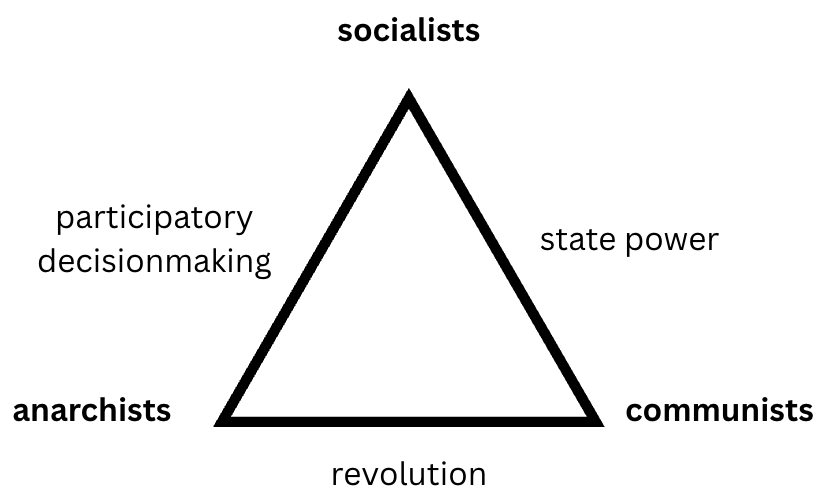
Both the anarchists and the Communists are “revolutionary” ideologies that believe that rather than using the existing capitalist state’s apparatus, a new system must be built and the old system overthrown or rendered obsolete. Democratic socialists, in contrast, believe in using existing democratic systems to achieve these goals.
Both the anarchists and the democratic socialists are, in the broadest sense, “democratic” and believe in participatory decisionmaking. Both groups believe that power must stay invested in the people themselves. In contrast, Communists believe in creating a centrally planned state run by an individual or a small group of individuals.
Both the Communists and the democratic socialists believe in using state power, by having a specific defined institution that governs the region and claims a monopoly on the legitimate use of force. Anarchists, in contrast, believe that power should only be federated between local groups… so large decisions can be still be made, and organizing still happen on a large scale, but without a strong coercive power.
There are many more groups besides these. Many Marxists and communists would not be called Communists. There are also more modern ideas like Democratic Confederalism that adopt ideas from every corner of the triangle and from indigenous Kurdish practices. Zapatismo also sits outside (or perhaps inside) this triangle as well.
Although the balance between these three historical groups was different country by country and decade by decade, in general, the anarchist movement was the strongest revolutionary force on the Left until the Bolsheviks (the original Communists with a capital-C) took power during the Russian Revolution by using the anarchists as shock troops against the Social Democrats and then turning around to betray and kill the useful idiot anarchists. Once there was a Communist country and the USSR controlled how it was represented internationally, they financed the Communist Left across the world. During the cold war, the Social Democrats largely aligned themselves with the capitalist nations (or at least they did in Scandinavia).
It was only once the Bolsheviks took power that we started seeing the red flag be uniquely a Communist symbol, and indeed that the word communist started to mean Communist. It’s also when (near as I can tell… I’ve been reading about this for years but I have years more reading left to do) the three broad categories of the Left really started having it out for one another.
The first Red Scare in America, from 1917 to 1920, came for the entire Left, especially the Russian immigrant Left, which was predominately anarchist. The first Red Scare was kind of like the first World War… it was a huge deal at the time, but it’s overshadowed by the one that came next.
The second Red Scare lasted longer, throughout the 1940s and 1950s, and it left deeper scars. It ostensibly focused on Communists as a more distinct group, because the USSR was running the ComIntern, the Communist International, which directed the activities of Communist groups all over the world. But of course the Red Scare didn’t stay confined to America’s direct and literal political enemy, and socialists and anarchists and generally just anyone who wasn’t excited about American capitalism was caught up by it. The anarchist Charlie Chaplin, the most famous comedian in the world in his time, was warned when he left the country in 1952 that he might not be allowed to return. He stayed gone for twenty years. Alan Lomax, the Leftist-but-not-Communist-Party folk music recorder, the source of practically every piece of Americana we still have, fled in 1950 for eight years. (I don’t mean to cherrypick these two, they’re just people I’ve studied for my work so I know more about them.)
And of course, last week, in 2026 the State Department announced new visa restrictions against the “far left.”
That’s the context I can offer you about Red Scares. I’ve tried to write that objectively, but it’s worth knowing that my bias is that I am an anarchist, and that I believe the world would have been a better place if anarchists had chosen to trust social democrats more and Communists less.
I don’t believe that “anarchists” or “antifa” (which is traditionally a non-ideological and unorganized coalition of primarily anarchists and communists and Communists but has included anyone willing to take direct action against fascism) are really the intended target of this new Red Scare. I don’t think Communists are either. The DSA might come close, because they have electoral power. I believe, ironically, that the new Red Scare is aimed at dismantling the electoral power of the Democratic Party.
They arrest mostly anarchists, because we’re over-represented in people taking direct action against fascism. They can arrest us to say “see? there are terrorists here!”
But they’ve been upfront since the beginning that they’re mostly interested in targeting the people who “finance” antifascism. This strikes every actual antifascist as entirely laughable—we’re financed by a combination of working-class and criminal class jobs, from tech jobs to making pizza to seasonal labor to hospital workers to novelists to sex work to petty thievery.
(I will die on the hill of that “working class” means you work for a living instead of making your money through capital ownership, whether you’re paid well or terribly. Most arguments otherwise are made to divide the working class and to convince the middle class that they have more in common with our mutual oppressors.)
They’re targeting “our” financing because they want to target large, liberal institutions. They want to dismantle the center’s power. They want to never have another election again. They are targeting the Democrats by calling them us.
This isn’t to say they aren’t coming for us. They are. We’re collateral damage, and we are not safe.
For most of the past ten years or so of my life, my main contribution to “the movement” has been speaking and writing, has been things that are entirely legal. Most of my organizing is around preparedness and mutual aid. I’m more law-abiding than most of the non-anarchists I know, because I’ve had enough interactions with police in my life already. I’ve been “safe” from repression for awhile now, because the work I do is firmly under the protection of the first amendment.
That work is no longer safe.
I’m using myself only as an example, not because I’m specifically worried about me more than I am about others. I’m worried about the Prairieland folks who will spend most of their lives in prison unless we make it clear that getting them out is a bare minimum for any new administration. I’m worried about the DAMN 15 in Minnesota, whose charges amount to “being anarchists or working alongside anarchists and organizing a blockade protest at which no police or ICE agents were hurt.”
I’m worried about the pro-Palestine organizers who are getting charged with material support for Foreign Terrorist Organizations by speaking out against genocide and fundraising for its victims.
And I don’t really want to spend my time arguing about who deserves the glory of being the victims of the new Red Scare. I’m as sectarian as they come when it comes to hating authoritarian communism and hating the establishment democrats (who are rushing to throw the DSA under the bus and be the Good Opposition), but… they’re coming for all of us.
When that poem, the famous poem, first started doing the rounds in the 1950s, some people learned that its author had once been a conservative, an anti-semite, and even supported the Nazis for awhile before he spent eight years in Nazi prison camps, and so they wanted to stop spreading it. But to me, that makes the poem even more important. It’s not asking you to speak up for people you like. It’s asking us to fight for people we can’t even stand.
Because our choice is either we have a society in which we are allowed to be different from one another, or we don’t. And in the latter kind of society, a lot of us will be dead.
So we’d better speak up for any of us. We’d better speak up for people we don’t even like.
Because we’ve read the poem, and we’ve seen history.
No posts
Comments
Nothing yet. Say the first thing.
Sign in to join the conversation.