
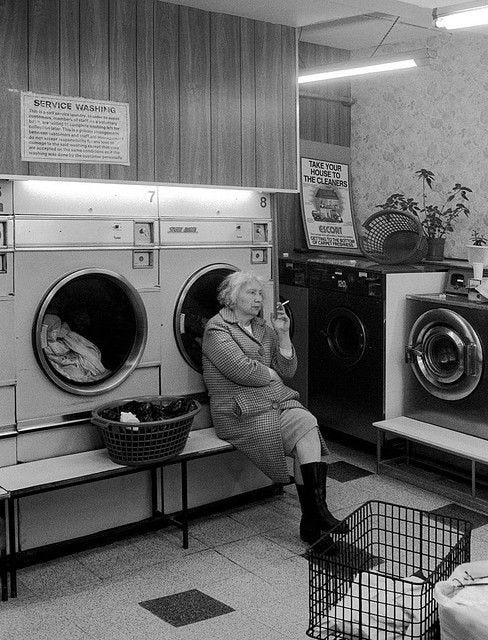
In the pantheon of tastemakers, few critics take a certain, hideous chore into consideration. This chore is a part of our daily lives; it’s boring and unending. How it could be overlooked when it is a major factor in how we consume (and savor) our media diet is shocking. It deserves its own rating system.
I’m talking about folding laundry. A chore so depressingly boring that it defies logic. By my math, I’ve folded as many as 10,000 loads in my lifetime — a figure so staggering I wish I didn’t have a calculator. By Malcom Gladwell’s count, I’m a “world class expert”; by my count, I’m wasting my life.
But, television, and other hands-free media, make it possible to survive it. And certain “texts” — as snooty critics like to call them — make folding laundry an absolute dream. And, dare I say, even meaningful.
Like most humans, I regularly ask friends for viewing recommendations. This might confuse my Netflix algorithm, as if I care, but I’ll literally watch any show that comes from a friend over “recommended for you” on the world’s most idiotic streaming platform.
That’s why I dove happily into Pernille, a 2025 Norwegian series, when a dear friend offered it up. It wasn’t a full-throated endorsement, which didn’t deter me. I could tell there was something about it that captivated her even if it wasn’t “great.” For me, that’s a perfect candidate for two to three loads.
Pernille is the name of a middle aged woman who lives somewhere in Norway. She’s grappling with a lot: she has two teenage-type daughters (bitches!), and an anguished teenage nephew who lives with her because his mother (Pernille’s sister) was killed in a car accident (I think) and his father is in some kind of recovery program. Pernille has an ex-husband who is a babyman, and even though they’re divorced and live apart he still manages to make Pernille do all his fathering work to his own kids.
By day, she works for a social services agency, interviewing families in crisis. And also by day she is continuously solving the problems of all of the people in her life and in a constant state of interruption and sacrifice, all the while deeply grieving the loss of her sister and wondering what it would be like to be in a relationship herself. Also she has knee surgery.
This is where I insert that I have only watched two episodes. But so far, I’ve found the series quite touching. It’s rare that I find stories about the trials of motherhood interesting. They’re usually overwrought — a frazzled mother freaking out about the loss of her independence / body / mojo, blah blah blah. Or downright depressing — a frazzled mother freaking about her kidnapped / killed / cult-inducted child, blah blah blah. But this series is quiet. Pernille is a woman getting by like most women; she’s all things to all people and nothing to herself. She’s shouldering the searing indignities of motherhood like the rest of us. Looking for glimmers of peace where she can find them. Hoping for better. If that’s not aspiring laundry mentality, I don’t know what is.
The acting is pretty bad and the editing is awful. The cast behaves as if it’s freezing outside when it’s clearly shot during summer. The direction is uneven, as if everyone is in a different version of the same scene. I initially wrote this criticism off to my ignorance of Norwegian drama, but I’m afraid this show is cringey, even in its best moments (like when Pernille’s aging father comes out and two lines later she teases him about hooking up with men in the woods).
But Pernille is unAmericanly superior by nature. Like the driest crispbread, it demands that you search for its flavor, and makes you appreciate the weird cucumbers and dried fish that might be served on top. The deep-seated agony about my tv-watching chore were given new resonance in her story; motherhood is complex, and rarely devolves into histrionics. It doesn’t rely on martyrdom to establish its value; the burden is yours whether you complain or not.
On the laundry scale, I give it 🧺🧺🧺🧺 out of five. I took off 🧺 because the English dubbing is horrendous; it’s the only way to watch while attending to the distracting work of sorting piles. Subtitles are a no-no. I commend evil Netflix for streaming it in the U.S. (five seasons available!), and also applaud them for changing the name to Pernille (and not Pørni, as it’s called in Norway). Egads.
Speaking of porny, Emereld Fenell’s 2026 adaptation of Wuthering Heights is an objectively terrible movie. When I saw the trailer last year, I laughed out loud. Barbie as Catherine Earnshaw? “Never!” the English major in me cried out.
But in light of a recent folding session, I’ve subjectively recalibrated my thinking
Emily Brontë did not write Wuthering Heights about Margot Robbie and Jacob Elordi — she probably wouldn’t even recognize this version — but Emereld Fennell did. Laundry folders rejoice.
No matter that the plot is unrecognizable and the two leads are a decade too old, this movie is about longing, loss, and lust — the escapist trinity. Heathcliff (Jacob Elordi) is brought into the abusive Earnshaw household as a boy. Young Catherine and Heathcliff are inseparable, and protective, and jealous. As they grow up, they realize why: they’ve got the hots for each other. Older Catherine (Robbie), rebukes Heathcliff’s advances and finds wealthy Edgar Linton (Shazad Latif) who has an inexplicable thing for wallpaper and shiny fabric. They marry. More jealousy, rebukes, and upon Heathcliff’s monied return, many very steamy montages featuring Cathy and Heathcliff. Then Cathy dies. The end.
This version of Wuthering Heights shows how easy it is to create a high-budget Hallmark movie out of an English masterpiece. In addition, it shows how satisfying the crap version of the story can be. Whilst in the process of matching socks, turning t-shirts right side out, and confusing various pairs of Carhart pants, I was totally transported. Did the laundry even get done? Who can really say?
The story has always been about rapture. In Brontë’s version, that constituted the star-crossed lover framework; the torturous pining, pathetic loneliness, and a single, stolen kiss. The modern version lets the beast out of the story. There is no restraint, there is no tension: it’s all payoff.
Robbie and Elordi are perfectly cast. Not burdened by the complicated characters in the 1847 version, they could just be themselves — the beauty and the brute. They handled that task just fine, and said all their lines, as far as I could tell. Their real responsibility was to handle the seriously carnal action in the film, enough to make a Victorian squirm. What they lack as actors they make up for as committed technicians.
As a folding companion, it sets a high bar. Importantly, it requires little focus: I could handle other chores, texts, and errands without missing a beat. I could even mute the movie in the event that someone in my family interrupted me (10 or 11 times) to ask where something was. The $80 million it cost to make the movie adequately covered my individual laundry task, reducing my personal burden. For that reason I give Wuthering Heights 🧺🧺🧺🧺🧺 out of five. If I had seen it at a theater, however, I would have walked out and asked for my money back. Because it’s truly awful.
Thanks for reading! Got a laundry folding rec? TV? Movie? Podcast? Do tell! xox
No posts
Comments
Nothing yet. Say the first thing.
Sign in to join the conversation.