
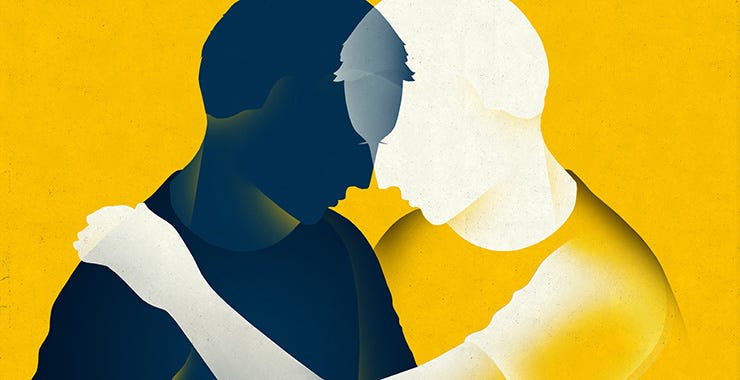
Of all the many leadership skills that researchers point to as mission-critical, empathy continues to rank highest. Studies suggest that employees with empathetic leaders report dramatically higher rates of innovation and engagement than those without. Be that as it may, as prevalent as the importance of empathy may be for effective leadership, our narrow understanding of empathy prevents most leaders from fully realizing its impact.
There is a version of empathy most of us carry without examination, one that goes something like this: we should treat people the way we want to be treated. That feels about right, right? It feels generous. It feels considerate. But upon closer inspection, it’s more of a projection than anything else—a service to an imagination of a slightly different version of ourselves. But according to empathy scholars like Michael Ventura, the true power of empathy lies in the reduction of the self, not in centering. It’s more so the ability to reduce oneself and deliberately work to make room for someone else’s perspective.
This distinction matters more than it seems. When we consider empathy as self-aware perspective-taking, we realize that the lens through which we see the world is not the only presentation of reality. For what seems like a soft accommodation, empathy turns out to be a business input, so we invited Kathryn Petralia—the co-founder of Kabbage, the fintech she scaled to roughly 600 employees before its acquisition by American Express—onto the latest episode of the FROM THE CULTURE podcast to examine what empathy actually looks like when it is load-bearing inside an organization.
According to the literature, our challenge with empathy is not merely due to our inward-facing framing but also because empathy is many-fold. In fact, there are three forms of empathy. There's somatic empathy, the automatic wince when someone slams their hand in a door. There's affective empathy, the Golden Rule—do unto others as you would have done unto you, our pervasive understanding of empathy. And then there's cognitive empathy, the Golden Rule with a twist: do unto others as they would have done unto them. The difference is everything. Affective empathy encourages us to act in ways we would want for ourselves. Cognitive empathy requires that we deny ourselves of what we’d want in order to give what others need. It's a harder, less flattering form of empathy, because it begins with subtracting ourselves from the equation and understanding what people need based on how they translate the world.
Petralia's proclivity for practicing cognitive empathy traces back to being a much older sibling, she says—eleven- and twelve-years senior her brother and sister. She was raised in a household that simply assumed you would notice when people around you were in need and, more importantly, do something about it. Her instructions to notice and show up in the machinery of a company built almost entirely on traditional data. Kabbage didn't start as a mission to rescue the underserved small-business owner; it started, unromantically, with an API. What changed Petralia's understanding of the work were the letters—actual paper letters—from customers saying the product not only helped them keep their business but also grow it. The data was the means. The intimacy was what mattered most.
This is the tension most data-rich organizations tend to get wrong, and it’s the one Petralia presses on: the difference between information and intimacy. We have never had more information about the people we work with and sell to—where they went to school, who they know, what they clicked. And yet our ability to actually understand them has barely budged, because we keep mistaking the 0s and 1s for the person. Distinguishing between the two makes all the difference.
This is evidenced in how Petralia built the hiring process at Kabbage. By 2020, the company had around 600 employees, and she had personally interviewed every one of them—likely 1,500 conversations once you count the ones that didn’t end in an offer. Not to assess whether they could write code. She can’t even write code, she’ll tell you cheerfully, so what would be the point of that? Instead, she interviewed candidates to find out whether they were self-aware, whether they cared about the people around them, and whether they were—to paraphrase—jerks.
To make these determinations, Petralia used a series of unorthodox questions: What's the one word you'd put on your tombstone? Name three positive and three negative qualities someone else would ascribe to you. That last one is a trap with a purpose. The candidate who answers "I just take on too much, I can't say no" has just told you, without realizing it, that they cannot see themselves clearly—and a person who can't see themselves clearly cannot see anyone else.
That’s the unglamorous prerequisite the whole thing rests on: you cannot take someone else’s perspective until you have a reliable read on your own. Without it, what feels like empathy is just projection wearing a nicer coat. And, according to Petralia, at Kabbage, that just won’t do.
What I find most clarifying about Petralia’s example is how thoroughly it dissolves the old “soft skills” framing. Empathy isn’t the warm garnish on top of the real work of running a company; in her telling, it is the operating decision underneath the data architecture, the hiring bar, and the culture that grew from both. When we asked about the loneliness of leadership—the “it’s lonely at the top” cliché—she rejected the premise outright. It was never lonely, she said, because she relied on her team, surfacing problems in front of the whole leadership group rather than carrying them in private. The flat, title-light organization she built wasn’t an aesthetic preference. It was the structural expression of a belief that understanding is distributed, not hoarded.
It’s empathy that helps us see each other, so we might be able to work better together. It connects us and enables us to organize around shared ideas and engage effectively in shared labor. But the hardest part about this “soft skill” we call empathy is that it requires us to get small, something we don’t teach very much in MBA classrooms. Yet, it’s one of the biggest lessons of all.
Check out our full conversation with Kathryn Petralia on the latest episode of FROM THE CULTURE here.

No posts
Comments
Nothing yet. Say the first thing.
Sign in to join the conversation.