
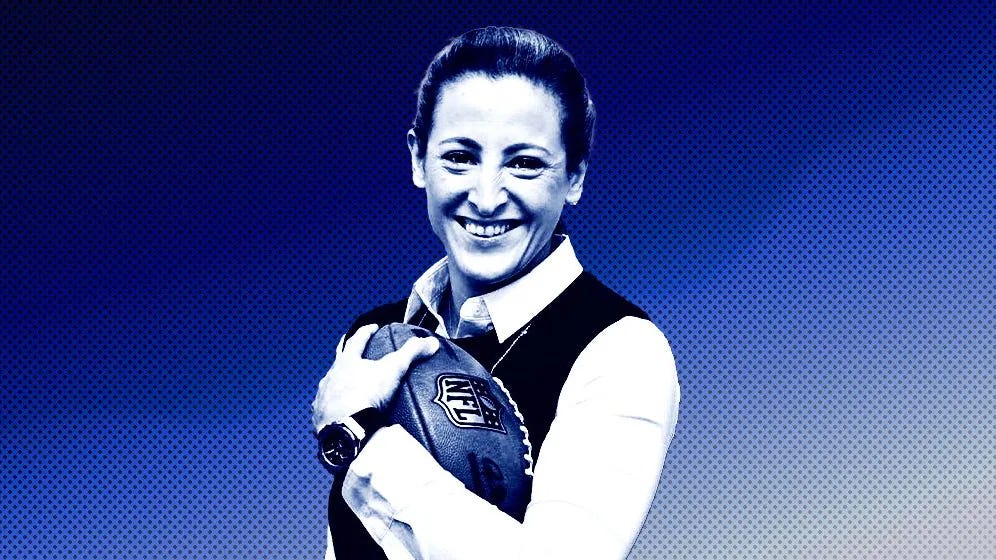
There is a moment most of us can trace our lives back to—when someone looked at us and named something we couldn’t yet see in ourselves. For me, it was a woman named Tylitha Stewart, who caught me in a recording studio talking about applying to a business school I was sure was the ceiling of my ambition, and stopped me cold. “Do you know who you are?” she asked and proceeded to tell me. A University of Michigan-trained engineer, that’s who you are. You are the founder of a music company, she said, and a person with no business selling himself short. She spoke life into me, and I applied to a school I never would have dared to on my own. I teach there now. None of it would have happened without that intervention. Sam Rapoport has a name for what Tylitha did; Rapoport calls it the shoulder tap, and she has built a career out of it.
Rapoport is the former Senior Director, Football Development, NFL Football Operations for the NFL. Over the past decade, she has done something that sounds impossible said plainly: she has reshaped who gets to coach, scout, and lead in one of the most male-dominated institutions on earth. Through the NFL Women’s Forum and related programs, she has moved the league from zero full-time female coaches to a pipeline that has placed dozens of women on sidelines and in scouting departments.
We invited Rapoport onto the latest episode of the FROM THE CULTURE podcast, and I’ll be candid: it was a conversation that changed me. I walked away and wrote a single phrase in my notebook, circled and underlined: more f**k it energy. Or, in more Forbes-friendly language, I’ll call it “eff-it energy.” This energy describes one’s fortitude to pursue what they really want.
To understand where that energy comes from, you have to understand where she comes from. Rapoport grew up gay in early-1980s Canada with, as she describes it, zero representation—no visible adults who looked like the life she quietly wanted. She didn’t come out until she was 29, and for the years before that, she set 40 as a kind of grim finish line, the age by which she assumed the performance would become unsustainable. That is a devastating way to grow up. But it produced, almost as a byproduct, a peculiar freedom: “you have nothing to lose and shoot your shot,” she said, describing the logic of someone who has already glimpsed the bottom. The pain didn’t just heal; it was recycled into fuel, and that fuel became her “eff-it energy.”
You can see that fuel in how her signature program was born. A decade ago, standing on the sidelines at MetLife Stadium, she looked around, asked where all the women were, and found almost none. So, she cornered Commissioner Roger Goodell on the field and told him, “I have a dream” to change the league, and he told her to call him on Monday. The NFL Women’s Forum was born a few months later.
What strikes me most is not the audacity of the ask but that she made it before she felt ready. She admits the plan she first handed Goodell was “such garbage” in hindsight. She handed it in anyway, citing a line she loves from Saturday Night Live’s Lorne Michaels: the show doesn’t go on because it’s ready, it goes on because it’s 11:30. Publish, iterate, publish, iterate. Perfectionism, she argues, is one of the quiet forces that holds women back—by the time it feels flawless, it’s too late.
Here is where Rapoport’s approach shifts from personal disposition to a transferable strategy, and it’s pertinent to every leader. She learned a framework from Dr. Adina Sterling, then at Stanford, that applies to any change you’re trying to drive—DEI, AI adoption, anything. In any organization, roughly 20% are adopters who are bought in and know how to implement the change; about 70% believe in it but have no idea how to execute it; and 10% are detractors who think the whole thing is nonsense.
The instinct most change-makers follow is to spend their energy converting the hostile 10%. Sterling’s insight and Rapoport’s practice are the opposite: pour your finite energy into the 70%, hand them the answers to the test, and move them into the 20%—the detractors’ ground shifts under them anyway. So rather than argue with the resistant, she found a believer: Ron Rivera, the former head coach of the Carolina Panthers and the Washington Commanders, whose wife had also coached basketball and whose daughter had coached softball. She emailed him cold in 2017, asked him not to hire women but to interview them instead, and he flew himself out on his own dime. In 2018, Rivera hired Jennifer King, the first Black woman to coach full-time in the NFL. One adopter became a demonstration; the demonstration moved the middle.
Listening to Rapoport’s account, I could see the evidence-based theory at work. What she was describing was Everett Rogers’ diffusion of innovation work, which suggests that most adoption within a population follows a classic bell-curve distribution. This is the phenomenon in which the majority of the population—the middle of the curve—tips once the early adopters (roughly 16%, as Sterling’s assertion suggests) show them it’s safe. Rapoport had essentially reverse-engineered a sociology textbook through intuition and realized its impact.
But the mechanism at the center of it all—the thing that actually moves a person from the 70 to the 20—is the aforementioned shoulder tap. Rapoport is emphatic that it only works when it’s specific. Not “good job, you’re smart,” which she dismisses as generic noise. The tap has to name what you actually see. She described telling women who insisted they couldn’t scout because they didn’t know the X’s and O’s: here are the three intangibles I see in you, and here is exactly how they translate to evaluating a player. “Then you see their eyes wide open,” she said, “and then they go for it.”
She borrowed a construction from her own therapist that she now uses on her kids and the women she mentors: “you’re the type of person who”—and then you name the thing. It’s active rather than evaluative; it describes an identity and quietly invites the person to live up to it. The vast majority of the women she works with, she says, question themselves from the jump. The tap doesn’t manufacture their ability. It gives them permission to believe in what was already there.
None of this, Rapoport is quick to note, would work in the wrong cultural environment. She credits Goodell’s steadiness about doing what he believes is right even when the noise is deafening. While remaining clear-eyed that the league is nowhere near done, pointing to stalled progress on Black head coaches and general managers as unfinished work, Goodell was convicted. This is the foundation that lets the work continue. You have to find yourself planted in ground that’s congruent with whom you’re trying to become, or the environment will stunt your growth. The most generous shoulder tap in the world can’t take root in soil that rejects it.
What lingers for me is the through-line from Tylitha’s intervention to Sam’s shot: being seen is what inspires people to move. They’re willing to run through a wall, not for you, per se, but for themselves, because they’ve finally glimpsed their own potential and want to live inside it. That’s the catalyst that converts into “eff it energy.” The brain, as I tell my students, doesn’t reliably distinguish between what’s true and what it’s told; give someone a vivid enough picture of who they are, and they’ll start operating as if it’s already so—if they choose to believe it.
That is the quiet physics beneath Rapoport’s entire enterprise. She survived a childhood that made her believe her life should end at 40; her wife threw her a prom for her 40th instead. The pain became fuel, the fuel became a program, and the program became a standing invitation to shoot your shot. All it takes to start is a hand on a shoulder and the specificity to mean it. But you have to be willing to say, “eff-it” to make it happen.
Check out our full conversation with Sam Rapoport on the latest episode of FROM THE CULTURE here.
No posts
Comments
Nothing yet. Say the first thing.
Sign in to join the conversation.