
Today felt, strangely, like a return to the past. For once, the major stories dominating the news were not about soldiers being killed, missiles being fired, terror attacks, hostages, or another front in an ongoing war. They were about a strike over a labor dispute. For those caught up in it, the strike caused real hardship and made for a very difficult day. But there was something notable about the fact that this was what everyone was talking about, after nearly three years in which the news has been dominated by mourning and grief.
A surprise strike began at Ben Gurion Airport at around 11 a.m. today, when ground workers walked off the job. Check-in counters stopped accepting passengers, while arriving aircraft were left with luggage that could not be unloaded. By 2 p.m., the airport was officially closed to both incoming and outgoing flights.
Several flights already en route to Israel were forced to turn around, including an Air France flight from Paris that reversed course in midair and returned to France. The disruption came on one of the busiest travel days of the year at Ben Gurion, with more than 100,000 passengers scheduled to pass through the airport.
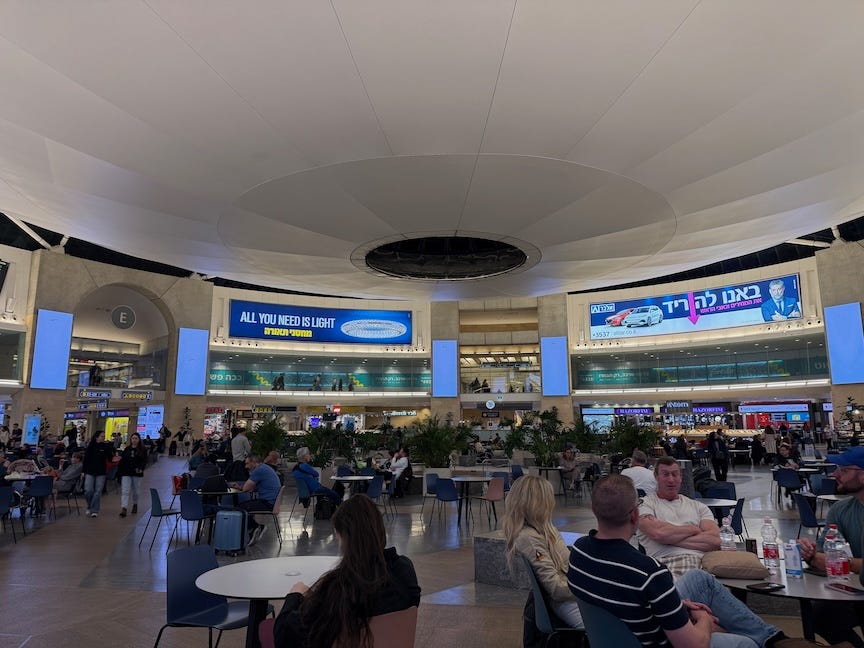
How did we get here? Although only 49 airlines are currently operating at Ben Gurion Airport, compared with more than 100 before October 7, 2023, the overall volume of activity has not declined. Israeli carriers, including El Al, Israir, and Arkia, have stepped into the vacuum left by foreign airlines, as has Blue Bird, a Greek airline owned by the Israeli Kavei Hofsha Group. Together, they have added routes to destinations they did not serve before the war. At the same time, while foreign tourism remains a fraction of what it once was, Israelis are traveling abroad in growing numbers—especially since the war ended, many are flying more frequently.
There are some interesting factors behind the strike. Airport employees called the walk out because they claimed to be overworked and that the airport needs additional staff. That may well be true. But the shortage of workers at Ben Gurion is also part of a much broader problem in Israel today: there simply are not enough people to fill many available jobs.
Restaurants routinely close early because they cannot find enough staff, and the same problem can be seen across other parts of the economy. Airport work, moreover, is demanding, with long and often irregular hours, making it particularly difficult to recruit and retain employees.
We know that the Workers’ Union has been demanding additional staff. However, there is also a political dimension that makes the situation more complicated. The union is closely associated with Likud, and its chairman is a significant Likud power broker who helps mobilize votes in the party’s primaries. Yesterday, Transportation Minister Miri Regev, on her way to a week-long vacation in Morocco, posed for photographs with the union chairman and publicly praised him.
The timing is certainly striking. Just one day after the union chairman met with and was praised by Miri Regev and the prime minister, the union decided that it had no alternative but to strike. The resulting shutdown disrupted the travel plans of tens of thousands of passengers and made Israel seem even less attractive as a destination for foreigners.
Tonight, Prime Minister Netanyahu announced that the head of the airport workers’ union would be expelled from the Likud for orchestrating the surprise walkout that brought Ben Gurion Airport to a standstill.
SUPREME COURT STOPS GOVERNMENT’S CLOSURE OF BELOVED ARMY RADIO
The Supreme Court ruled tonight that the government’s decision to shut down Army Radio must be overturned. The decision, made late last December, was supposed to take effect on March 1, but was halted by a Supreme Court injunction. A hearing was subsequently held, giving the government an opportunity to defend its decision. Today, the court unanimously found that the move was based on “extraneous considerations,” specifically the decision-makers’ dissatisfaction with the station’s broadcasts and political views. The court did find that the government has the authority to close the station, but ruled that it must do so through a proper process and on the basis of legitimate considerations.
TRUMP DECLARES ECONOMIC WAR ON IRAN, BUT CAN HE MAKE IT STICK?
President Trump announced today what he called “D-Day” against Iran, promising economic warfare and isolation on an unprecedented scale. What does that mean? According to Trump, the United States will impose severe economic consequences on any country whose banks, businesses, or other institutions continue to provide Iran with an economic lifeline.
That will be a tall order. Iran continues to trade with China, Turkey, India, and a number of other countries, and forcing all of them to choose between doing business with Iran and maintaining their economic relationships with the United States will not be easy. If Trump can make the threat stick, however, it will place enormous additional pressure on an Iranian economy already under siege.
Can the Iranian government withstand that pressure? For a while, certainly. In the long run, probably not. But economic warfare of this sort takes time to produce political results. Is President Trump prepared to wait that long? That I doubt.
Meckano
Michpal, the payroll software company that went public last September, is buying 70% of Meckano for NIS 66 million. The shares are coming from Gil Cohen, Meckano’s founder, owner and chief executive, who started the company about twelve years ago. The deal values Meckano at NIS 100 million. Michpal and Cohen also agreed on an option mechanism under which either side can force the sale of the remaining 30%.
Meckano makes digital time clocks that run on computers, tablets and phones, with fingerprint recognition and NFC tap-in as the verification methods. Around that it has built a task management product that tracks hours and profitability, software that syncs attendance data to payroll, and a system for employees to file expense reimbursements. It is the same territory Michpal already occupies: attendance, hiring and payslip production accounted for 69% of Michpal’s revenue in 2025.
The numbers explain the appetite. That segment brought Michpal NIS 136 million last year at an operating profit of NIS 58 million, a 42% margin. Meckano earned NIS 15 million in 2025 at roughly 52%, better than the buyer’s own, and consolidating it alone lifts the segment 11% this year. Meckano closed 2025 with a positive balance of NIS 16.4 million and liabilities of about NIS 1 million.
Michpal says Meckano has spent the past two years rebuilding its technology, largely around AI tools, and expects that work to finish in 2027, which should give the combined company room for new products. The purchase price can still move: the agreement carries adjustment mechanisms that could pay Cohen more depending on how Meckano finishes 2026. Michpal listed in September at a valuation of NIS 1.07 billion, short of the NIS 1.2 billion its parent, Formula, had been aiming for. This deal is the first sign of what it intends to do with the listing.
∞–––∞–––∞–––∞–––∞–––∞–––∞–––∞–––∞–––∞–––∞–––∞–––∞
TODAY IN JEWISH HISTORY
Switzerland Bans Shechita (Jewish Ritual Slaughter)
On August 20, 1893, Switzerland held a landmark national referendum that resulted in the constitutional prohibition of shechita, the traditional Jewish method of kosher slaughter. The measure, which required livestock to be stunned before slaughter, effectively prohibited the practice of shechita within Switzerland.
While the campaign was ostensibly championed by early animal welfare societies, it was also deeply intertwined with the antisemitic politics of the era. Fueled by rising xenophobia and public anxiety over an influx of Jewish immigrants fleeing persecution in Eastern Europe, the campaign used concerns over animal cruelty to target and marginalize the country’s Jewish community. The referendum passed with 60.1 percent of the vote.
The 1893 vote fundamentally altered Jewish life in Switzerland, creating significant religious and logistical challenges that persist today. Because the law banned the act of kosher slaughter rather than the consumption of kosher meat itself, Switzerland’s Jewish community was forced to rely on imported meat from neighboring countries to maintain its religious observance.
Despite various political debates, legal challenges, and changing attitudes toward religious freedom over the ensuing century, the original prohibition remains in force. Today, it stands as an important historical precedent for similar bans elsewhere in Europe and highlights the enduring tension between animal welfare legislation and minority religious rights.
Comments
Nothing yet. Say the first thing.
Sign in to join the conversation.