
Over the last 24 hours, there have been some further explanations of Prime Minister Netanyahu’s statement that Israel rejects the 15-point plan for Gaza. Most importantly, the head of the Peace Board said that Israel is, in fact, currently following the plan and has halted its attacks in Gaza.
The statement by the head of the Peace Board directly contradicts claims by several government ministers that Israel has made no change in its military conduct in Gaza. The facts indicate otherwise. Israel has carried out no attacks in Gaza for several days, apart from a single strike in response to what was described as an immediate threat.
Netanyahu’s wording is very carefully calibrated. He said that Israel will not withdraw unless Hamas disarms. The current plan, however, calls for Hamas to disarm in specific areas, followed by an Israeli withdrawal from those same areas. In other words, Netanyahu spoke of disarmament as a condition for withdrawal without specifying whether he meant the complete disarmament of Hamas throughout Gaza or disarmament only in the areas from which Israel would withdraw.
The distinction leaves Netanyahu considerable room to maneuver. He can tell his political base that Israel will not withdraw until Hamas is disarmed, while still leaving open the possibility of implementing a phased plan in which Hamas disarms in particular areas and Israeli forces withdraw in response. In practice, you can drive a Mack truck through the gap between those two formulations.
Today’s Radio Show
0:00
-22:22
ELECTION CAMPAIGN UPDATE
It has been a relatively quiet news day here in Israel, with no significant developments in the confrontation between the United States and Iran, at least as of this evening. So I thought I would take the opportunity to look at where things currently stand in the Israeli election campaign.
It is worth noting that since the Likud government’s attempt at judicial reform, support for the current coalition has fallen from the 64 seats it won in the last election to roughly 52 seats in almost every poll. The opposition has changed over that period, with different parties and different political groupings.
However, the Likud and its coalition partners, including the ultra-Orthodox parties, have never managed to regain anything close to their previous level of support they enjoyed when the coalition was formed.
The exact numbers vary from poll to poll, from week to week, and depending on which constellation of parties are included, the coalition generally receives somewhere between 48 and 52 seats. Even at the upper end of that range, the coalition remains well short of the 61 seats needed for a governing majority.
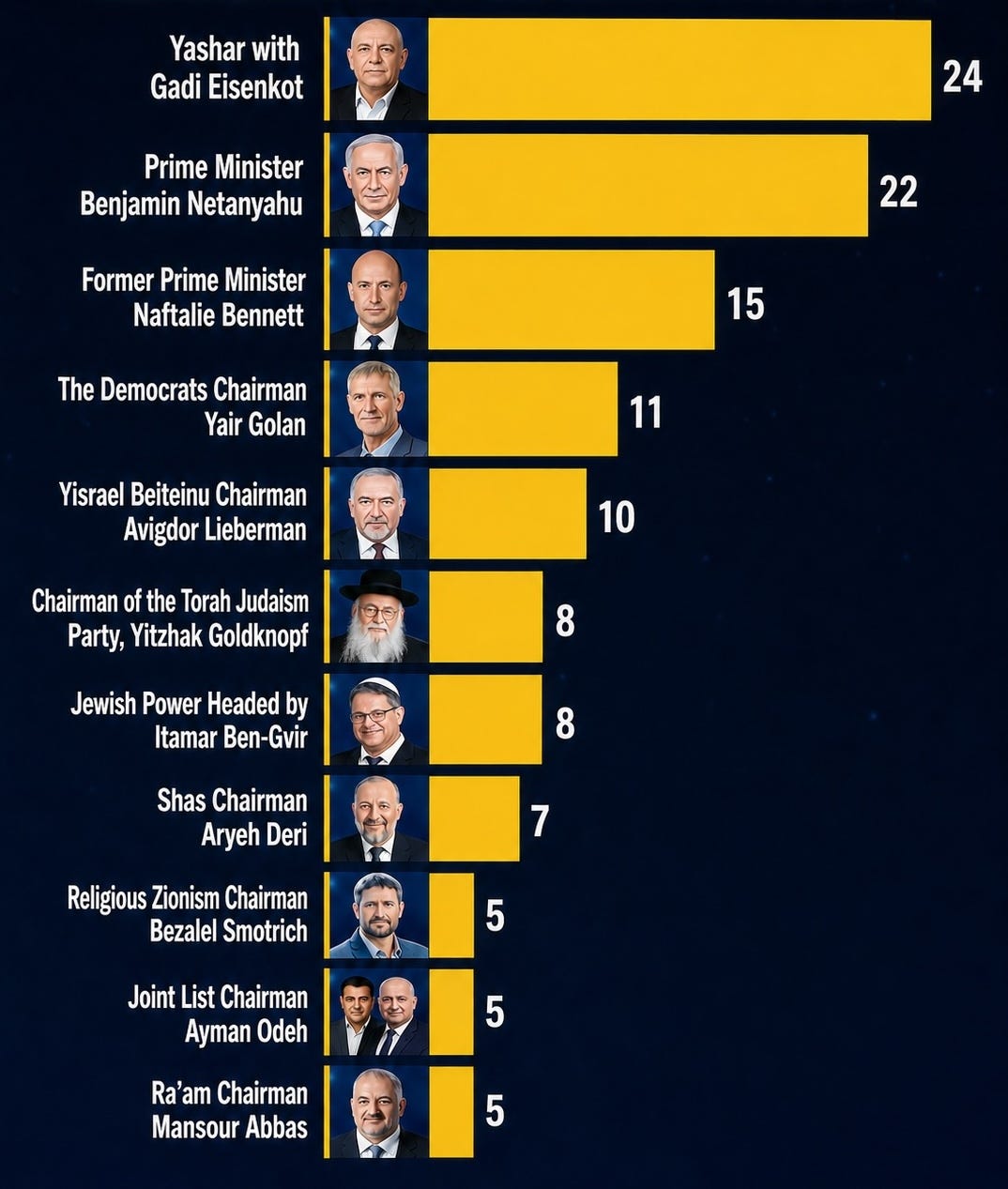
The basic electoral picture, give or take a few seats, is that the current coalition has around 50 seats and the opposition around 60. In some polls, the division might be 52 to 58, but the basic balance remains the same. The remaining seats belong to the Arab parties.
The big question is whether the opposition will be willing to form a government with the support of the Arab parties. Opposition leaders have said they will not do so unless those parties change their positions. One of them, Ra’am, was already part of Naftali Bennett’s coalition. Since then, its leader, Mansour Abbas, has recognized Israel as a Jewish state and expressed support for universal service—if not necessarily in the military, then through national service. Such a position could make it increasingly difficult for opposition leaders to rule out Ra’am as a potential coalition partner.
In addition, the former deputy head of the police, Yoav Segalovitz, who later served successfully in the Knesset and played an important role in reducing crime in the Arab sector during the “change” government, is reportedly likely to join Ra’am. His presence would make it harder still for opposition leaders to rule out Ra’am as a potential coalition partner.
The precise composition of such a coalition remains unclear. Most of the parties, (all currently polling well below the electoral threshold necessary to enter the Knesset), generally envision bringing together the current opposition with the Likud, but without Netanyahu, whom they hold responsible for October 7.
The exception is the newly formed party of Yuli Edelstein and Gilad Erdan. They have made clear that they would be prepared to join a coalition led by Netanyahu, but only if he agrees to pass a genuine ultra-Orthodox draft law. Which brings us back to the beginning.
Netanyahu has rarely shown any willingness to break with the ultra-Orthodox parties. Almost never. He did so once, but quickly brought down that government and returned to his natural coalition with the ultra-Orthodox.
Listening to the politicians launching these new, barely formed parties, particularly Hili Tropper, I find myself wondering what exactly distinguishes them from the established opposition parties. Tropper has just formed a party of his own that, depending on the poll, sometimes crosses the electoral threshold and sometimes does not. But for the life of me, I cannot understand how his positions differ substantially from those of Bennett or Eisenkot, or why he cannot simply join one of those two parties.
There seem to be too many politicians convinced that they personally are the ones who will save the country—or, at the very least, save us.
At the moment, Eisenkot leads the opposition by a significant margin. As I have written before, he remains the one opposition figure against whom the right has struggled to find an effective line of attack. Various attempts have been made, many based on false or unsupported claims, including attacks involving his children—despite the fact that his younger son was killed fighting in Gaza. None has gained much traction.
For now, the focus appears to have shifted to portraying Eisenkot as someone who would form a government with other opposition figures already under sustained attack from the right, particularly the Democrats and their leader, Yair Golan.
So far, that approach has not gained much traction either. Netanyahu, however, has long been extraordinarily effective at turning particular opposition parties and politicians into objects of fear for his voters. We will see what he manages this time. With Eisenkot leading the opposition, the task may be considerably more difficult.
We are now one month away from the deadline for finalizing the Knesset candidate lists. By then, parties will have to decide whether they are running and submit their full slate of candidates.
The Likud will hold its primaries next week, and we have no idea how they will turn out. Netanyahu is entitled to place eight candidates on the party list; so far, he has reportedly found one. The Democrats already have a complete slate. For everyone else, we are still waiting to see what their lists will look like when the deadline arrives a month from now.
The election itself is now only two and a half months away. The latest Channel 12 News poll, released tonight (see below), captures the electoral picture clearly: the current coalition at 50 seats, the Jewish opposition at 60, and the Arab parties at 10.
SCIENCE NEWS
WHY DNA REPAIRS SOME MISTAKES AND NOT OTHERS
Thousands of chemical reactions damage the DNA in every cell of your body every day, and the repair systems fix most of it. Not all. What survives unrepaired becomes a mutation, and mutations are what drive both cancer and evolution. The question a team at the Weizmann Institute of Science in Rehovot set out to answer is why the repair crew fixes some damage and misses other damage in what appears to be the same situation.
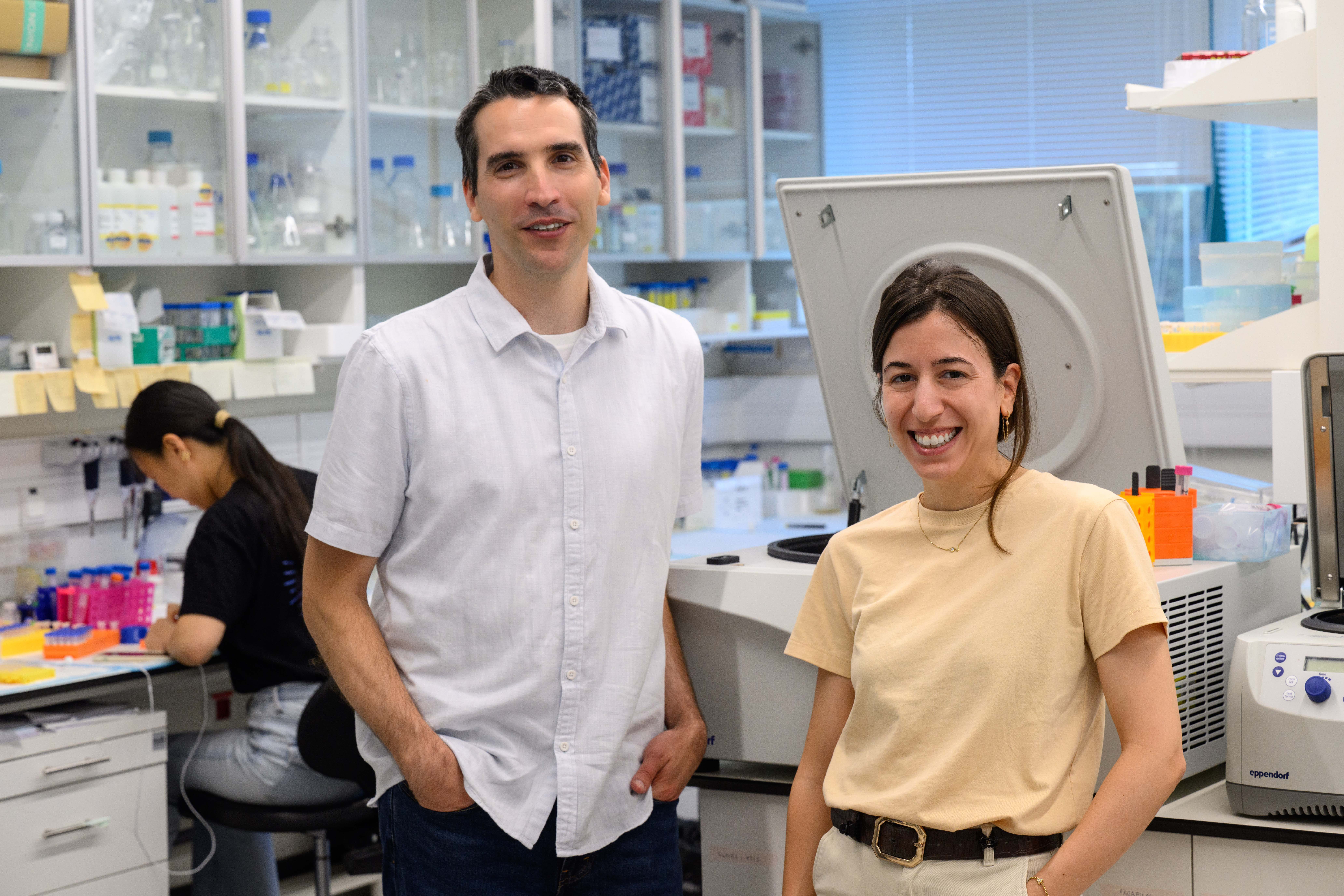
Working in the laboratory of Ariel Afek, the researchers built a chip carrying
Comments
Nothing yet. Say the first thing.
Sign in to join the conversation.