
On Friday morning, 28 August, the Moon will move deep into Earth’s shadow. In the Americas this happens during the evening and night of Thursday, 27 August; across Europe and Africa it will unfold before dawn on Friday.
At maximum, 96.3% of the Moon’s visible disc will be inside the umbra, the darkest part of Earth’s shadow. It is officially a partial lunar eclipse, not a total one, but only a narrow section of the Moon will remain outside that deep shadow. The rest may turn copper, dark red or something closer to dirty brown, depending on the state of Earth’s atmosphere.
Around 3.34 billion people will be able to see at least some of the partial phase. That makes this a genuinely international event, but it also creates a photographic problem: there will be an extraordinary number of technically competent pictures of a reddish Moon floating in a black sky.
The Moon will be impressive. An impressive subject does not automatically make an interesting photograph.
The worldwide timings, cross-checked against NASA’s eclipse data, are:
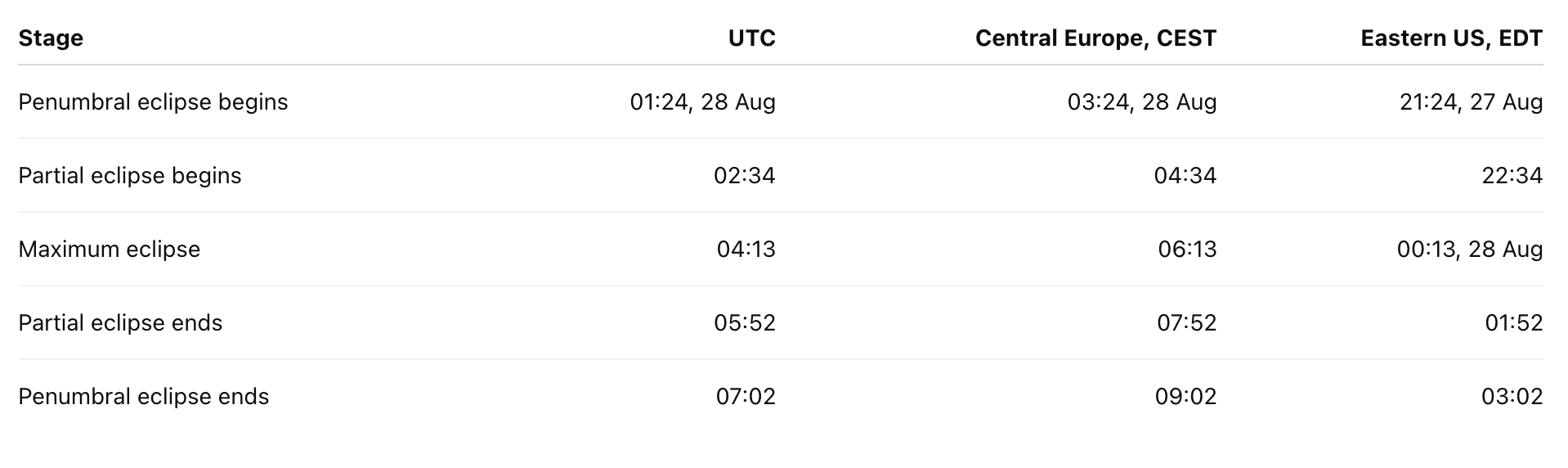
These times describe the eclipse globally. They do not guarantee that the Moon will be above your horizon. In central and eastern Europe, it will be setting as the eclipse deepens, and in some places it will disappear before the worldwide maximum. Check the Moon’s altitude, direction and setting time for your precise location rather than relying only on the table.
The low Moon is a complication, but it is also the opportunity. Instead of photographing an astronomical specimen, you can photograph the eclipse in relation to a church, a bridge, a roofline, a tree or the landscape where you live.
Below the line, I will take you through the complete practical plan: choosing the position, deciding which lens to use, focusing accurately, managing an enormous change in brightness and making a sequence without allowing the camera to take over the photograph.
This lesson is for paid subscribers. If you are a free subscriber, you can use one of your metered reads to continue, or activate the seven-day free trial and read the full lesson without charge.
Comments
Nothing yet. Say the first thing.
Sign in to join the conversation.