
The renewed interest in UFOs/UAPs (Unidentified Flying Objects / Unidentified Aerial Phenomena) was, until recently, relegated to the margins of conspiracy theory and cultural speculation. UAPs have recently re-entered mainstream attention through declassified military footage, formal government reporting, and congressional hearings, which collectively acknowledge the existence of phenomena that remain unresolved within current explanatory frameworks. In my view, this shift is less about confirming extraordinary hypotheses, rather it marks a cultural transition: an increasing willingness within parts of defense and scientific communities to catalog and study anomalies without immediate reduction to known categories.
The recent resurgence of interest in UAPs has also had the side effect of reopening discussion around Fermi’s paradox, which can be summarized with his question “Where are they?” That is, if an extraterrestrial civilization exist and are millions of years more technological advanced than us, why did they not cross stellar distances and say “hello!”
Traditionally, the paradox has been framed within a relatively narrow set of assumptions: that advanced civilizations would expand in detectable, energy-intensive ways, and that technological signatures would be unambiguous across interstellar distances. However, renewed debate increasingly questions these premises. The “silence” of the universe becomes less paradoxical and more reflective of our own cognitive biases based on anthropocentric extrapolation in astrobiology and search for extraterrestrial intelligence (SETI) theories. Several key assumptions underlying the traditional framing of Fermi’s paradox have been explicitly questioned or relaxed in more recent discourse.
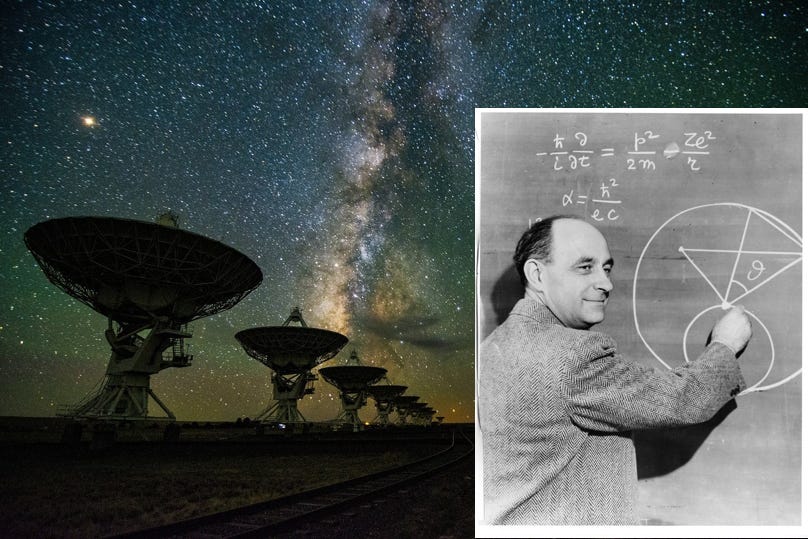
For example, one major revision concerns the assumption of “expansionist intelligence”—the idea that technological civilizations inevitably pursue large-scale, energy-intensive colonization (e.g., galaxy-spanning expansion). It was an idea based on a (more or less unconscious) form of social Darwinism: that every species needs to expand and rapaciously exploit natural resources. It is about territorial expansion for settlement, “living space”—Lebensraum. It is all in our genes, according to a common belief among 20th-century evolutionary biologists. Our own civilization, however, is now learning the lessons of what this really means, and some doubts are emerging as to whether this could be a universal law applicable to all life throughout the universe.
This is an aspect of the “uniformity-of-motivation bias,” which implicitly projects human-like incentives (growth, exploration, resource acquisition) onto non-human intelligence. This is now criticized as anthropocentric; different evolutionary pressures or cognitive architectures could produce radically different value systems, including indifference to expansion or communication.
Another, but tightly related to the above, is the “visibility assumption,” namely that advanced technology would produce obvious, high-energy “technosignatures” of “megacivilizations”. However, a modern perspective emphasizes that mature civilizations might become increasingly energy-efficient and may not require ever-growing resource consumption, such as swallowing entire stars (Dyson spheres) or subjugating entire galaxies, as is often naively imagined in science-fiction scenarios like Star Wars.

Others point out that, at least according to the laws of known physics, interstellar travel is effectively impossible in any practical sense. The central constraint is the relativistic speed limit: no massive object can reach or exceed the speed of light, which turns even the nearest stars into journeys measured in decades to millennia under conventional propulsion. Compounding this is the tyranny of the rocket equation, which makes high velocities exponentially expensive in fuel, quickly leading to prohibitive mass requirements for any craft attempting relativistic speeds. Even if advanced propulsion systems were devised, issues of energy density, interstellar dust impacts at relativistic velocities, and long-term life support introduce additional layers of difficulty. As a result, within a strictly physicalist and engineering-constrained perspective, interstellar travel is often treated as a near-impossibility—not because space travel violates physics, but because physics appears to conspire to make it prohibitively costly, slow, and fragile on the scale of human or even civilizational timescales.
Well, my answer is: what do we know? Across the history of science, many phenomena were long considered impossible because they appeared to violate—or sit outside—the known “laws of nature” as they were understood at the time. Heavier-than-air flight is a classic example: prior to the Wright brothers, many argued that sustained flight was impossible because it seemed incompatible with the known behavior of lift and weight. Similarly, the notion of continents moving across the Earth’s surface—plate tectonics—was also initially rejected, as there was no accepted mechanism that could plausibly account for such large-scale motion. In each case, the “impossibility” was not a violation of nature itself, but a reflection of our incomplete understanding.
On a more social level, another kind of theory I found unconvincing is that of Stephen Hawking who repeatedly expressed caution about humanity actively broadcasting its presence to the cosmos, particularly in the context of messages or signals aimed at potential extraterrestrial intelligences. Hawking often drew an analogy with historical encounters on Earth: when technologically asymmetrical civilizations met, the less technological advanced was enslaved or eventually even annihilated. From this perspective, he suggested that it might be safer for humanity to listen rather than actively advertise its presence.
I don’t worry much about that. There might be a somewhat different law of natural selection that Darwinists rarely consider: the selection of more conscious, and more peaceful, species. The point is that we are reaching a stage in our evolutionary process where we will soon have to decide whether to become a peaceful species or ultimately end in self-annihilation. It is unlikely that human civilization will be able to progress, materially and psychologically, if it does not learn to keep its animalistic, belligerent instincts under control. This may also turn out to be a process of natural selection that has taken place many times on other planetary systems. An alien civilization cannot advance to the technological level required for interstellar travel unless it learns to transcend war and violent self-assertive instincts of survival and selfish aggrandizement. War cannot survive a higher consciousness.

However, what has not been considered enough—and is itself shaped by a different bias—is the notion of the evolution of consciousness within a scientific framework. This is especially visible within the transhumanist movement, which often conceives the next step in human evolution primarily in terms of enhanced intelligence, computational power, longevity, or technological integration. Yet these developments, significant as they may be, do not necessarily imply a corresponding evolution of consciousness itself.
A civilization may become more knowledgeable without becoming wiser, more powerful without becoming more self-aware, and more technologically sophisticated without overcoming the psychological and ethical limitations inherited from its evolutionary past. However, a truly advanced civilization would possess greater wisdom: a deeper awareness of the consequences of its actions, a more integrated understanding of its place within Nature, and a greater capacity to balance individual interests with the well-being of the whole.
Such a civilization would not merely accumulate knowledge; it would cultivate self-knowledge. It would recognize that the greatest challenges to its survival do not arise from external enemies but from the unresolved tensions within its own psyche, such as aggression, fear, greed, and the relentless drive for domination.
In this sense, progress would not be measured primarily by the ability to manipulate matter and energy, but by the capacity to achieve greater levels of consciousness, cooperation, and inner freedom. A civilization that has mastered the stars but not itself may ultimately remain a primitive hominid equipped with a few additional technological gadgets. An advanced civilization would be one that has learned to transcend destructive impulses and has discovered a more harmonious relationship between intelligence, consciousness, Nature, and life itself.
What could Australopithecus, our three-million-year-old hominid ancestor, possibly have imagined about the civilization that would one day emerge from its descendants? It would probably have imagined our future as an improved version of its own world: more refined stone tools, more efficient hunting methods, and perhaps greater mastery of the immediate environment, but not the radically transformed civilization that would eventually emerge.

This is the line of reasoning of the transhumanist ideal, it isn’t a further step in evolution. Rather, it is an amplification and aggrandizement of our present cognitive and sensory capacities, enhancing them quantitatively rather than qualitatively. Transhumanism extends the reach of the mind while leaving us spiritually illiterate. It represents a primitive and naive conception of what evolution is.
Thus, limiting our analysis of the evolution of extraterrestrial civilizations to a purely technological perspective is naive and reflects our ignorance of the deeper dimensions of our own evolution. An alien civilization may have progressed primarily through the development of higher states of consciousness and a more advanced spiritual self-awareness, eventually transcending the limits that currently define the human experience of mind and matter.
Perhaps such civilizations are already here, yet remain invisible to us because they operate on levels of reality that lie beyond our ordinary modes of perception. They may inhabit an immaterial astral realm, or some “subtle physical” plane, where space and time acquire an entirely different meaning. From such a perspective, interstellar travel itself may be a misconception born of our materialist assumptions, for a sufficiently advanced consciousness might no longer be constrained by the limitations that govern physical movement through space. What do we know?
But if this is the case, why would they not try to contact us?
Perhaps because they perceive us in much the same way that we perceive other forms of life that are far less cognitively developed than ourselves. There may simply be no meaningful dialogue possible at our current level of understanding. A civilization that is millions of years ahead of us—not only technologically, but also cognitively and spiritually—might recognize that premature intervention could disrupt our natural evolutionary trajectory. Just as we observe wildlife in a national park without constantly interfering, they might choose to observe us from a distance, allowing our civilization to develop through its own experiences, struggles, and discoveries. Perhaps they understand something that we often fail to grasp ourselves: that genuine evolution cannot be imposed from the outside. Certain lessons must be learned from within, through our own journey of growth and transformation.
This is my way of resolving Fermi’s paradox. I have no idea whether all those reports of UAPs represent genuine encounters with non-human intelligence, misidentified natural phenomena, advanced human technology, or something else entirely. However, the renewed discussion surrounding UAPs invites us to reconsider some of the assumptions embedded in our search for extraterrestrial life and which is based on an exclusively materialist perspective of evolution. If we understand evolution not only in Darwinian terms, but also as the emergence of consciousness through and within matter, an entirely different understanding of the problem emerges.
Perhaps the silence of the universe is not due to the absence of advanced civilizations, but to our limited understanding of what an advanced civilization would actually look like. If technological evolution is accompanied by the evolution of an inner consciousness, then a sufficiently mature civilization may not necessarily expand through the cosmos in the way we imagine—with physical conquest, resource extraction, and visible technological dominance. Its advancement may instead involve forms of existence, communication, and interaction that transcend our current conceptual frameworks.
Civilizations may reach a threshold where survival depends not on mastering external nature, but on mastering themselves. Indeed, everything suggests that humanity itself is now undergoing such a transition: a stage in evolution where the greatest challenge is no longer the conquest of the external world, but the transformation of our own consciousness and behavior. And this transformation will not be achieved by landing on the Moon or colonizing Mars, but by developing inner wisdom and a new level of awareness—an evolution that we always seem to find an excuse to postpone.
There are no paywalls, and “Letters for a Post-Material Future” is kept alive through the support of its readers. If you find value in my effort to develop a critical intuition that moves beyond a narrowly materialistic analytic framework and would like to support my work, you can make a contribution by buying me one or more coffees or by supporting me through one of my books.
Comments
Nothing yet. Say the first thing.
Sign in to join the conversation.