
I used to think “helping yourself” meant doing something on your own. Of course, if you’d asked me for a definition, I might have told you something different. Inside though, I was interpreting it to mean being self-reliant and self-motivated.
Now think back to the last time you did something out of your comfort zone. Something that challenged you to level up in a way that made you nervous and proud at the same time.
Did you have help?
Or did you force yourself to go it alone?
I ask because I recently decided to change my interpretation of “helping yourself,” and especially my automatic impulse to go it alone. Maybe you will too. Let me explain.
The parking lot was dark, but I could see my way to the little white Japanese kei truck because the restaurant was still open. Diners came in and out, moving from table to table with their drinks. I could hear their laughter as I walked quickly across the lot. I had slipped away without saying goodbye to any of my friends because I was anxious to move the truck.
Akira had left earlier, so it was up to me. There was no time for him to come back and help me. I needed to drive the truck myself, or I wouldn’t get it back in time. Worse, I wouldn’t make it to the next meeting point, and then we’d have to continue on separately. So I got in, closed the door, and started the engine.
The truck bucked a few times as I got used to working the clutch. I hadn’t been behind the wheel for eight years and had only driven a manual once in a parking lot, never out on the road. Somehow, it made sense this time, and I found the transition from first to second gear not so bad. Even though my hands gripped the steering wheel tightly, my shoulders relaxed a bit.
I could do this.
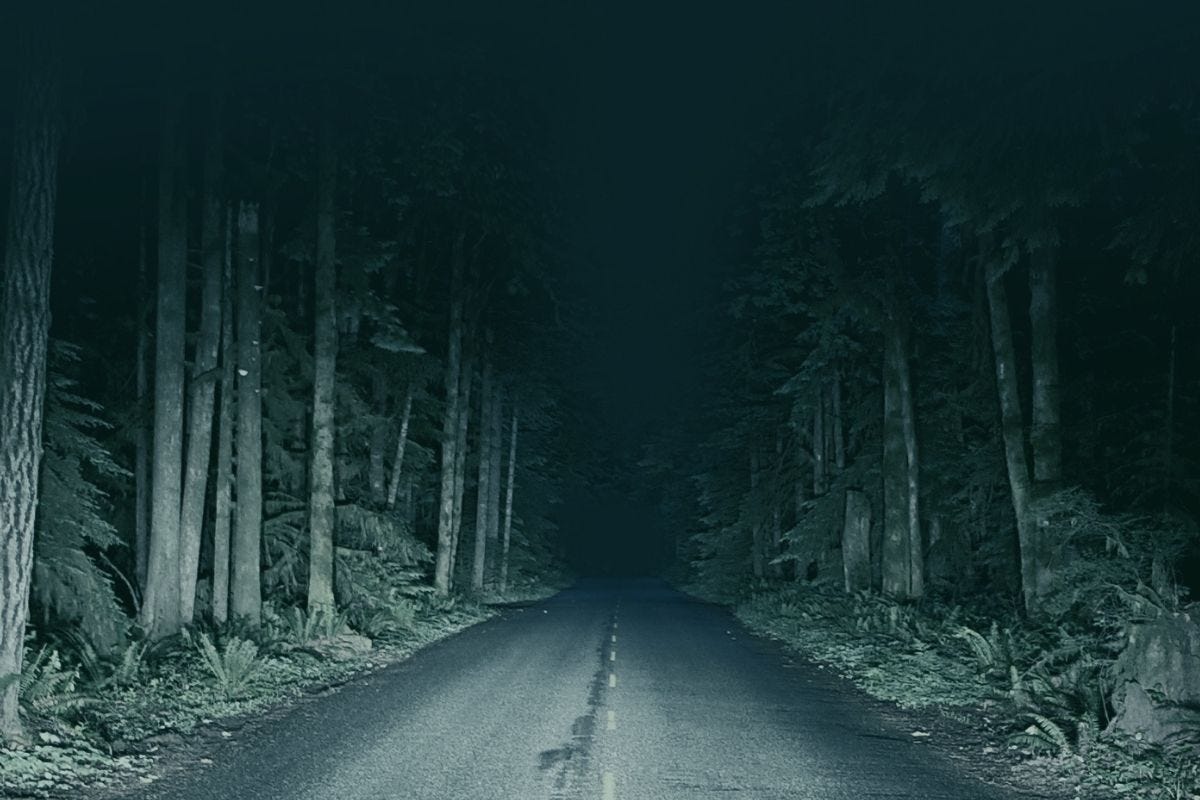
Once I was out on the road, there were too many other cars, and I couldn’t pull over even if I wanted to. So I kept going and got past the major intersections. The road stretched out in front of me, lined densely with trees on either side, mostly cedar. There were no cars in front or behind me. I was going too fast and tried to brake, but the road was going downhill, and the truck kept accelerating.
With every second, it got darker until I couldn’t see the lane anymore. After that, I couldn’t see anything.
The truck was still moving, and though I was scared, I kept going without even trying to brake. It was so completely dark. I squeezed my eyes shut for a second and quickly opened them again in hopes that it would help me see better, but it didn’t.
And then, I woke up.
I knew I was on the sofa even though my eyes were still closed. Pulling out of the dream, I noticed that my heart was not racing as fast as I would have expected. Mostly, I was relieved that I no longer had to keep going down the road in the dark.
After a few deep breaths, I sat up and headed for the kitchen to make coffee.
Everyone in my family knows that I can drive if I have to, but I would rather not. I’ll find any excuse possible not to drive. I’d rather walk, take a train, or cancel an outing. So my dream-state decision to drive left me feeling hopeful.
At the beginning of the dream, driving that truck had been satisfying. I felt in sync with it and enjoyed shifting the gears. Even after waking up, I felt like I wanted to master driving a manual. I wanted to have my own little white truck.
Driving—the big scary action I always avoided—had been fun.
Not in the dark, of course.
Why had it been so dark?
Why weren’t there any streetlights?
Why wasn’t the dashboard lit up?
Why hadn’t I turned on the lights?
The big scary thing I was pushing myself to do would have been so much easier if I had simply turned on the lights. I couldn’t stop thinking about it.
These days, I live in Hiroshima, and we actually own one of those small white kei trucks. The funny part is that it’s an automatic. I don’t have to worry about the clutch at all. My driver’s license only allows me to drive automatics anyway. Even the headlights take care of themselves, turning on and off depending on how light it is outside.
I still think about that dream sometimes—not as a warning exactly, but as a reminder of how much easier things can be when we let support be built in.
The lights were available to me with the flip of a switch.
So why hadn’t I turned them on?
Why hadn’t I even thought about them?
Why had I been so resigned to driving too fast down a pitch-black road?
Why had I made an already challenging task extra difficult for myself?
Later, I wondered how often I’d done the same thing in my waking life.
What big scary actions have I tried to navigate by myself and in the dark?
Were other people doing the same?
Was my subconscious showing me that I needed to turn on the lights for myself?
Or maybe it was time for me to be the lights for another.
I shared the dream with one of my friends. We talked about the symbolism and possible interpretations. We wondered what might have happened if I’d continued down the road without waking.
Would I have crashed?
Would I have remembered the lights?
Would the moon have come out to light the sky?
Or maybe I’d been driving so long that the sun would soon be up.
We laughed over the irony of my destination and the timing. I couldn’t remember exactly where I was going—only that I was on my way to return the truck and meet my husband, Akira. In Japanese, Akira means bright. The character is a combination of the sun and the moon.
Did the fact that I had the dream on the day of the new moon make any part of it more significant?
Oh, the layers of symbolism!
Though I could read all kinds of meaning into the dream, two points stood out.
First, I hadn’t taken advantage of the obvious and available resources in front of me.
Second, even though I was managing a challenging task, I didn’t even consider whether it could be easier. I just kept going.
I take full responsibility for my lack of awareness in the dream. (Duh. It was my dream.) But even so, I could have given myself a few seconds to pause and consider what I was doing. I could have asked a friend to come with me. Or when I realized I couldn’t see, I could have asked myself why.
I could have wondered whether anything might make it easier—or even more enjoyable.
Pushing ourselves to do something challenging is great. But we have to remember that it’s okay to ask for help. It’s okay to use available resources to make our lives easier and more enjoyable.
How could this be easier?
How could this be more enjoyable?
What tools do I have that could help?
Do I know anyone who could help?
I probably should have had these questions taped to the dashboard of my truck.
They’re still good questions.
In the meantime, I’ve got them taped to my PC.
The dream stayed with me longer than most. And as I sat with it, I realized it wasn’t only about asking for help—it was also about visibility. As a fellow Earth-bound being, business owner, and writer, I saw how important it is to let ourselves be seen.
You can’t turn on the lights if you don’t know—or don’t remember—that the lights are there. The same goes for asking for help. You can’t ask someone for help if you don’t know they’re there or how they might help you.
The dream reminded me that it’s also my responsibility to let people know what I do, and how I can help. I have to be visible and within reach so that when someone is ready to turn on the lights, they can find me.
Here goes.
If you’re feeling low on energy or like you’ve been doing everything on your own, my book Finding Yoyu is an invitation to explore a different way of moving through the world.
Comments
Nothing yet. Say the first thing.
Sign in to join the conversation.