
Lately, I’ve been thinking about 2016.
Ten years ago feels like a lifetime. And yet I can still feel it in my body.
That was the year I had to practice saying, out loud, “I’m a web designer.”
I was at a retreat for web designers, and the coordinator asked us to introduce ourselves. When it was my turn, I got hot. My throat tightened. I stammered. I couldn’t say it with a steady voice. I had already built dozens of websites, but claiming it publicly felt terrifying.
Then on the final day of the retreat, I was chatting with someone who worked at the hotel. He asked what I did and what our group was there for. Without thinking, I answered, “I’m a web designer.”
Just like that.
Later, when I told the group, they applauded. It felt like a tiny miracle.
What I remember even more clearly is what happened next.
Barely twenty-four hours later, I found myself struggling to admit a new dream.
I was spending time with a new friend from the retreat. Standing in her living room, I confessed that I didn’t only want to be a web designer. I wanted to be a writer. I had just signed up to contribute a 300-word story to an anthology. It felt bold and embarrassing all at once.
I had barely claimed one identity, and now I was whispering another. Becoming an author felt so far away it was almost laughable.
I had no idea how I would get from one short story to writing my own book. But I knew, deep down, that I couldn’t not try.
Fast forward ten years.
I am an author.
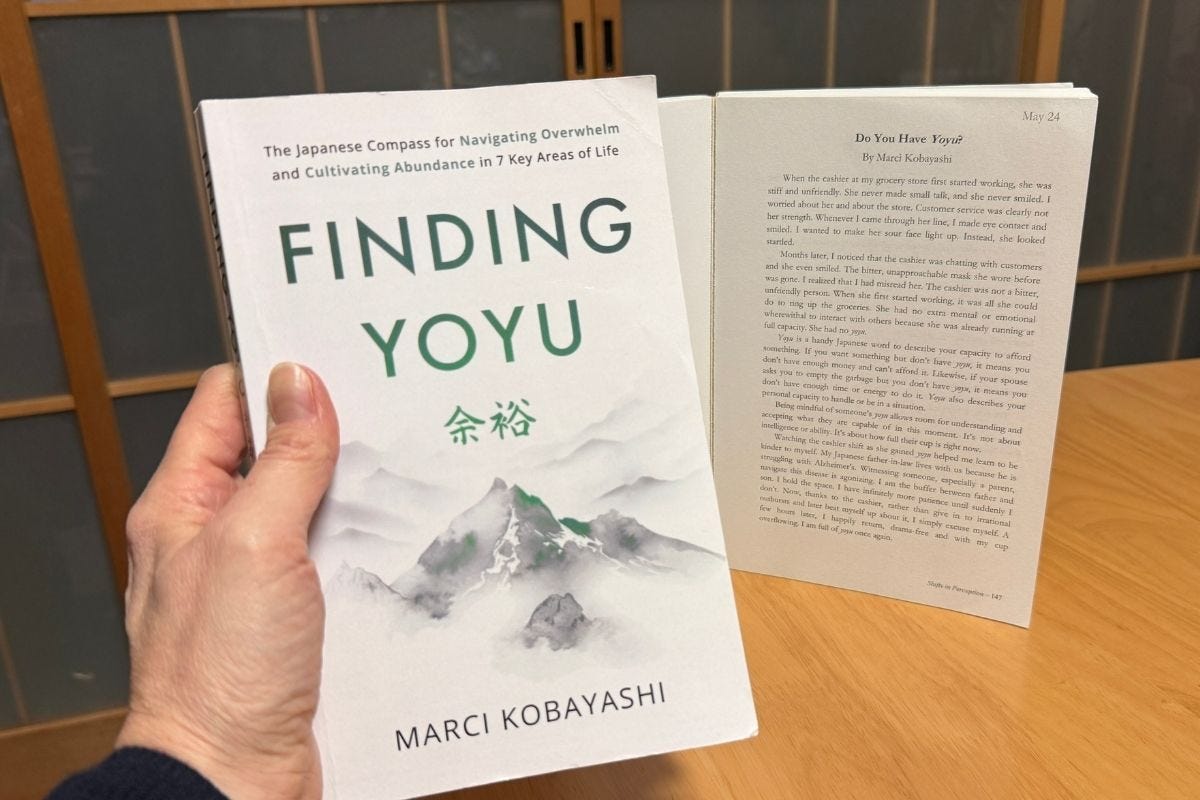
It’s been one year since I published Finding Yoyu. Sometimes that still surprises me.
So much has changed since 2016. And yet that same spark is still here. The same quiet knowing. The same tug toward the page.
And I owe a big part of that to people like you, who have supported this creative work through the shifts, the doubts, the pivots, and the growth.
Today, I want to share the very first story I ever published. The one that helped me see that writing wasn’t just a private longing. It was something I was meant to do.
You can scroll down to read it.
Reflecting feels grounding. Continuing feels brave. I plan to do both.
Here’s what I’m working on now:
• The Japanese translation of Finding Yoyu. Akira is helping me, and we’ve finished through Chapter Four. Almost halfway.
• Reworking the memoir about the five years I cared for my father-in-law into a story people will truly enjoy reading. The first draft was 90,000 words. After working with my editor, we divided it into two projects: Finding Yoyu, which became the self-help book, and a second manuscript that holds the fuller narrative arc of those years.
Thank you for being here for the journey. Here’s to another beautiful ten years.
P.S. If you remember how you first found me or my work, I’d love to hear. Hit reply or leave a comment. I read every response.
Below is the first story I ever published. If you’d rather listen than read, you can hear me read the story on YouTube here.
Do You Have Yoyu?
When the cashier at my grocery store first started working, she was stiff and unfriendly. She never made small talk, and she never smiled. I worried about her and about the store. Customer service was clearly not her strength. Whenever I came through her line, I made eye contact and smiled. I wanted to make her sour face light up. Instead, she looked startled.
Months later, I noticed the cashier was chatting with customers and she even smiled. The bitter, unapproachable mask she wore before was gone. I realized that I had misread her. The cashier was not a bitter, unfriendly person. When she first started working, it was all she could do to ring up the groceries. She had no extra mental or emotional wherewithal to interact with others because she was already running at full capacity. She had no yoyu.
Yoyu is a handy word in Japanese to describe your capacity to afford something. If you want something but don’t have yoyu, it means you don’t have enough money and can’t afford it. Likewise, if your spouse asks you to empty the garbage but you don’t have yoyu, it means you don’t have enough time or energy to do it. Yoyu also describes your personal capacity to handle or be in a situation.
Being mindful of someone’s yoyu allows room for understanding and accepting what they are capable of in this moment. It’s not about intelligence or ability. It’s about how full their cup is right now.
Watching the cashier shift as she gained yoyu helped me learn to be kinder to myself. My Japanese father-in-law lives with us because he is struggling with Alzheimer’s. Witnessing someone, especially a parent, navigate this disease is agonizing. I am the buffer between father and son. I hold the space. I have infinitely more patience until suddenly I don’t. Now, thanks to the cashier, rather than give in to irrational outbursts and later beat myself up about it, I simply excuse myself. A few hours later, I happily return, drama-free and with my cup overflowing. I am full of yoyu once again.
—Excerpt from 365 Life Shifts: Pivotal Moments That Changed Everything
You can pick up a copy of my book, Finding Yoyu, here, in whatever format you like.
Comments
Nothing yet. Say the first thing.
Sign in to join the conversation.