
Howdy.
It’s been a development-heavy week this week as I continue to work on my fourth novel, PROJECT DECADE. On Monday, we did a mini-room for PROJECT MAPMAKER, an animated feature I’m writing and I brought in some of my old partners in crime from Trollhunters. That was great fun and it reminded me how much I miss being in a writers room.
I also wrote up a pitch for a new comic book series that will crossover two beloved characters who have never met before and sent a friends some notes on a shared universe we’ve been talking about building. I also dusted off PROJECT SUMMIT to see if I could get some traction on it. Fun stuff.
ARROW Q&A
An international fan reached out via WhatsApp to ask a few questions about Arrow and I thought I’d answer them here:
When bringing Green Arrow from the comics to television, what were the key parts of Oliver Queen’s character that you felt absolutely had to stay, and where did you feel you had the freedom to take the story in a different direction?
Great question as that’s the first question I ask myself whenever adapting any material. For example, (Absolute Batman aside) I think it’s critical that Bruce Wayne be an orphan. Oliver, on the other hand, doesn’t have to be and that’s why we gave him a mother — and a sister. However, what’s critical to Green Arrow is Oliver’s background as a spoiled rich kid who has to learn to survive by himself on a deserted island. But even that is subject to some interpretation because, as you know, Oliver wasn’t alone on Lian Yu. So, the essence of Green Arrow, really, is Oliver having to go through a crucible in order to become a hero.
Oliver’s journey across the series is one of the biggest character arcs on television, from someone driven by revenge to someone willing to sacrifice everything for others. How early did you have that journey mapped out, and how did you make sure each season pushed him forward naturally?
Thank you. In broad strokes, I would say that this journey was part of the DNA of the show from the very beginning, but we articulated it slightly differently. From the original series document:
“Week to week, we’ll continue to flashback to Oliver’s five years on the island to chronicle his transformation into the vigilante determined to heal his native Starling City — each episode telling another chapter in the ongoing story of how Oliver Queen became a HERO.”
We knew that we’d be exploring the different facets of that journey — the different ways of becoming a hero — over the course of the show but I knew early on that Oliver’s story could only end one way: With him sacrificing himself for the greater good. That not only provided a redemption arc for the killer he’d become but also was, in my estimation, the ultimate manifestation of a hero.
One thing Arrow does really well is balancing a season-long story with Oliver’s overall development. When you’re planning a season, how do you make sure the main story and the character arcs continue to serve one another?
We always started each season and each episode with asking ourselves what Oliver’s emotional journey was. In Season 1, for example, we knew it was going from vigilante to hero. In Season 2, it would be learning not to kill. Etc.
On an episodic basis, however, it could prove to be hard. Coming up with 23 distinct emotional journeys over the course of a season was tricky and, in some cases, could be a bit forced. A short anecdote:
During Season 1, we were getting a lot of notes from the CW that were asking us to have Oliver learn something as a result of the episode’s events. It took about halfway through that first season that I realized that the execs at the network — who I love — were noting Arrow the way they had noted its predecessor, Smallville. Nothing wrong with that. Except that in Smallville’s first season, Clark was a high school student; whereas Oliver was a man in his 30s. If you’re a teenager, you’ve got something to learn each week. But if you’re still learning those lessons in young adulthood, you’re a bit of a schmuck.
I explained this to the CW and they got it and asked if, instead of Oliver learning something each week, he could be changed somehow. Still a tall order to do 23 times but at least Oliver wouldn’t be emotionally immature.
Cut to the penultimate episode of Season 1, which — SPOILER ALERT — ends with Oliver knocked unconscious and at the mercy of Malcolm Merlyn. Michael Roberts called to give notes on the script and basically said, “I love Episode 122. I really don’t have any notes. I just have a question: How is Oliver different at the end of this episode?”
By this point, it had been a very long season — the most challenging of my career before and since — and I was pretty darn tired. So I told Michael that at the beginning of the episode, Oliver is conscious and at the end of the episode, he’s out cold.
Michael paused for a moment — this had been a long season for him as well — and said, “Good enough for me!”
Characters like Diggle, Felicity, Thea and Malcolm Merlyn all grew far beyond where they started. At what point do you realise a supporting character has become integral to the story, and how does that change the way you approach writing them?
That’s a great question. The answer really varies. For example, Diggle and Thea were always designed to be critical to the story. Malcolm Merlyn, on the other hand, was really meant to be a one-season big bad but we became enamored, not just with John Barrowman’s acting, but the idea of making the villain a recurring character. Emily Rickards’ audition and first few day of daillies made it clear to us that we just wanted to write more material for her.
The flashbacks became such an important part of Arrow, often adding as much emotional weight as the present-day story. How challenging was it to make both timelines feel equally important while ensuring they continually shaped Oliver’s development?
Honestly, it was brutally hard; the hardest part of the whole show, to be honest. Even just getting the present day story and the flashbacks to “talk to each other” thematically episode to episode was a real challenge. And that’s just the writing part of the equation. From a production standpoint — cast, sets, locations, costumes — it was like producing an entirely different show.
Looking back now, is there a particular character arc or adaptation from the comics that you’re most proud of because you feel it really captured the heart of Arrow, and why does that one stand out to you?
This is one of those questions where the answer changes depending on when you happen to catch me. To the chagrin of many fans, we didn’t really directly adapt any one particular comic book story. The closest we came, I would say, was with the flashbacks where we were inspired by Andy Diggle and Jock’s Green Arrow: Year One but even then I can’t say we directly adapted it. Same with Oliver’s illegitimate son. Even Crisis On Infinite Earths took a lot of liberties with the source material.
Thanks for the questions!
FEEDBACK
Marcie Campos Mayhorn writes:
I'd love to hear more about your short story process, Marc -- particularly if you self-publish. I know a lot of us out here are interested in that route, but I don't know too many who have actually done it.
Same. And I’ve never tried self-publishing before, so this is new to me as well. I’ll keep you updated on this journey…
Bill Fordes writes:
I love writing prose, MG. So much more fluid and adjustable, if you will, than dialogue. Can’t wait to see your short stories……….
Thanks, buddy. Prose is the thing that’s been keeping me sane amidst all the madness in Hollywood. And after so many years writing TV, movies, and comics, I’m enjoying tackling the learning curve of a new medium. I definitely feel myself improving with each new page, which is very exciting.
Steve Flack writes:
God, I hate these generic "WHAT IF?" cover titles. Give me the full "what if" on the title!
Preaching to the choir, buddy! I miss the full title as well — and the use of the original logos. I also miss the days when, on occasion, the book’s original creative team would tackle the alternate version of their own story.
SHOOTING MY MOUTH OFF: BLAST-FROM-THE-PAST EDITION
So, way back in 2009, I did an interview — which I honestly didn’t even remember — with the Daily News about FlashForward, a show that I co-ran with David Goyer:
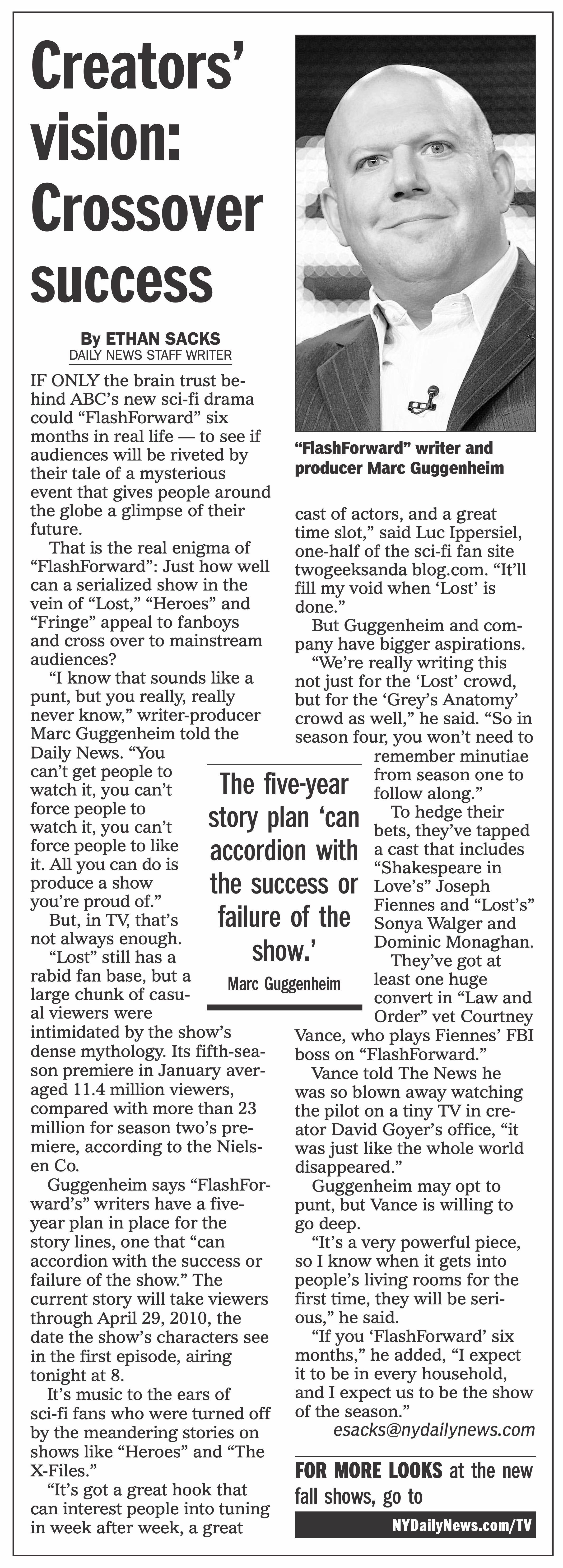
Now, check out the byline. This interview was conducted by phone with a guy named Ethan Sacks. Turns out, this is the same Ethan Sacks who I met through writing Star Wars comics and has become one of my dearest friends.
Life is funny sometimes.
Be good to each other.
Best,
Marc
Encino, California
8.7.26
COMING ATTRACTIONS
A regularly-updated list of upcoming releases and events:
STAR WARS: DARK DROIDS OMNIBUS (August 18, 2026)
LEVIATHAN FREEDOM #3 (August 18, 2026)
LEVIATHAN FREEDOM #4 (September 22, 2026)
NEW YORK COMICCON (October 8-11, 2026)
LEVIATHAN FREEDOM #5 (October 20, 2026)
LEVIATHAN FREEDOM: Digital Collection (December 8, 2026)
Thanks for reading LegalDispatch! This post is public so feel free to share it.
No posts
Comments
Nothing yet. Say the first thing.
Sign in to join the conversation.