
As I’ve been finishing up edits on my book, I found myself fact-checking a detail that you wouldn’t notice unless you worked at one particular large teaching hospital in Philadelphia sometime in the last 25 years.
In the book, I share a story of how my body changed during residency training. I had to start wearing a larger size of scrubs because I gained weight.
But it wasn’t a private event; everyone would know I had gone up a size. Because the size of the hospital-issued scrubs was denoted by the color of the drawstring at the waist. I thought I remembered the colors: small scrubs had white drawstrings, medium had green, and large had blue.
Just a few days before editing this section of my book, I had seen a group of medical residents getting off the bus near my son’s preschool as I dropped him off for the day. They looked like they were going to a post-call brunch. Without even meaning to, I found myself noting the size of their scrubs. A large, a small, two young men wearing extra-large.
The drawstring colors and sizes are a minor detail in my book, but one that would look stupid if I got it wrong. So I emailed a friend who still delivers babies at the same hospital and wears those scrubs all the time. Had I remembered correctly?
Thanks for reading Your Doctor Friend!
She got back to me after her weekend shift. Yes – I got the colors right.
And then I thought to myself: How is it possible I still remember this? Why is this factoid still in my brain?
Why is body shame so hard to shake?

Thinking about all this, I scrolled through my photos and found one of me wearing the offending scrubs.
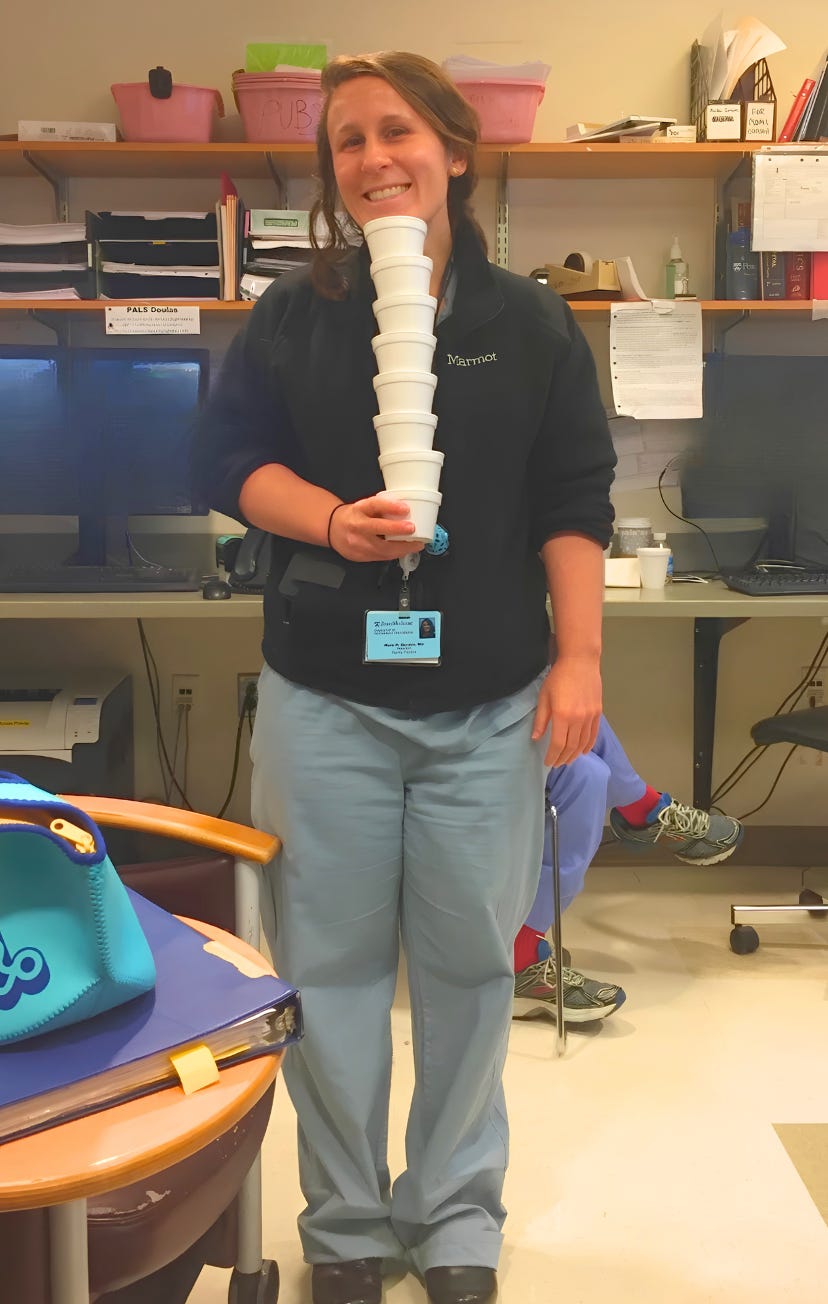
I showed it to a friend from medical school, who immediately commiserated.
I remember having to take out a bigger size in medical school. She texted me.
But as a student, my badge couldn’t operate the machine that dispensed scrubs automatically. I had to ask an operating room tech for help. She said, “What happened?”
Another friend had another memory.
I remember changing in the locker room for anatomy lab, and all the other women talking about how “baggy” and “oversized” the scrubs were. They weren’t baggy on me! It made me feel terrible.
I hated those scrubs with a passion. They never fit my body no matter what size I wore.
They were made for a tall, skinny man – one with no hips or ass. If the scrubs fit my hips correctly, they were way too long, and they’d get caught in my bike as I pedaled to work.
But it was more than that. They made me feel invisible.
Share Your Doctor Friend by Mara Gordon
Medical training was, in retrospect, a very depersonalizing experience. A hallmark of medical school and residency is rotating through different parts of the hospital, sometimes changing teams and work locations as frequently as every week. I never knew the people I was working with, and they didn’t know me.
I felt reduced to a repository of medical facts, judged not by who I was but how quickly I could complete tasks.
And then I was expected to wear those uncomfortable scrubs! I couldn’t even present myself the way I wanted to. The scrubs didn’t fit right, literally and figuratively.
When I finished residency and no longer worked in a hospital – only in an outpatient clinic – I vowed I’d never wear scrubs again.

The first few years out of residency, I took enormous pleasure in dressing myself for work.
I mostly wore clothes on the casual end of the business casual spectrum; lots of Old Navy Pixie Pants and Rothy’s flats. (IYKYK.) I wouldn’t have called myself really into fashion, but I wasn’t disinterested, either.
I was just happy I could choose my own clothes. Clothes that fit me.
When I was early in my training, I was adamantly opposed to the doctor’s white coat. I thought it was a symbol of power, and that wearing it signaled a power imbalance between doctor and patient. I was cool and progressive, I thought, so I never wore it.
But then I realized I didn’t have any place to put my pen. Or my stethoscope. Or my phone. (Which I now use as an AI scribe for my appointments; more on that another time!)
Over the years, I’ve come to appreciate the role that a uniform plays. And the practical benefit of a coat that has lots of pockets.
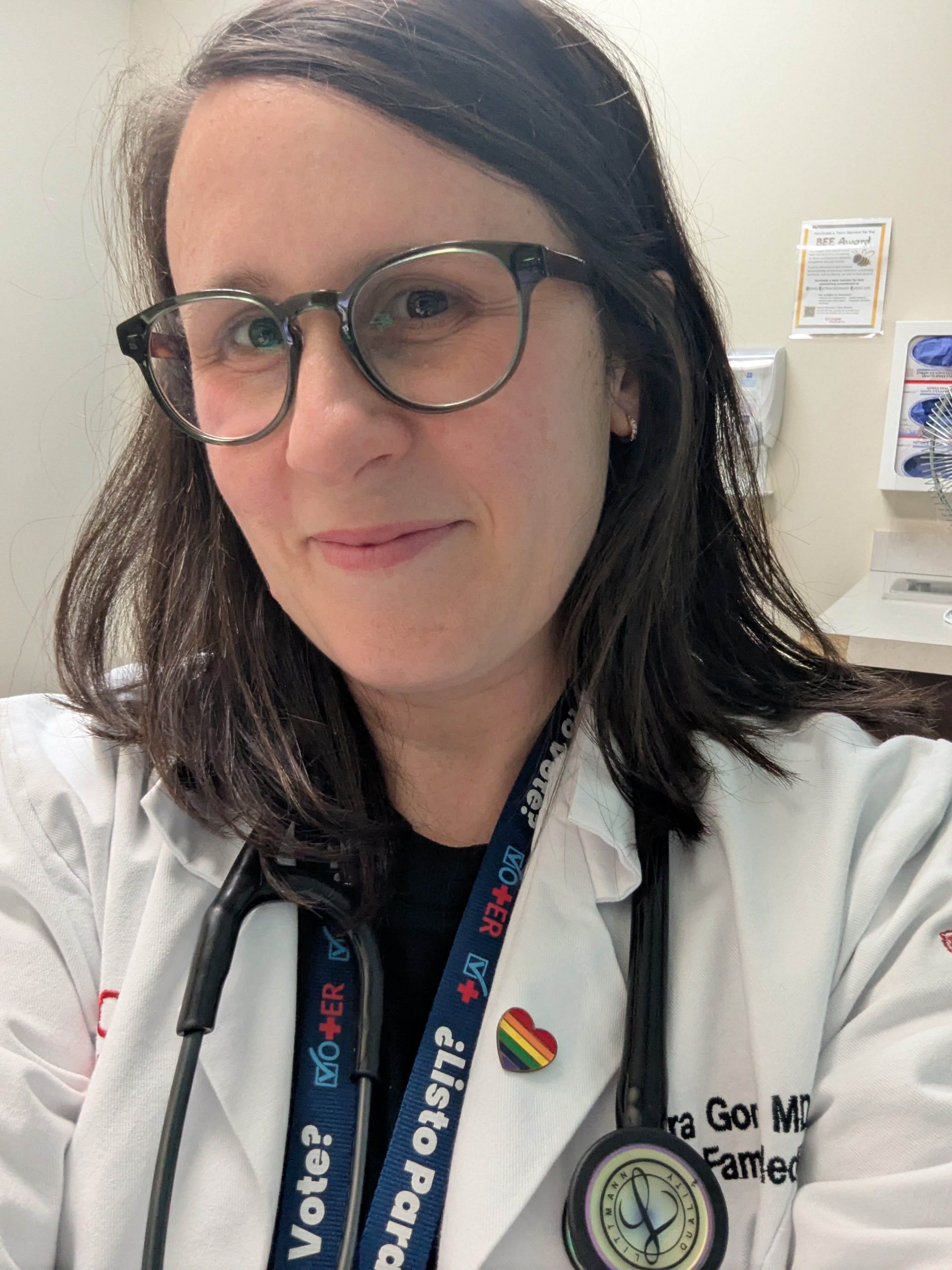
When I wear my white coat – which lately, I do most days in clinic – my role is clarified. It is a practical signal to my patients about who I am and what I will be doing.
I’m not religious about wearing it; if it’s really hot in my office I’ll skip it. (I also roll up the sleeves because, ew, germs.) But when I put it on, I’m putting on my professional identity.
Somewhere along the way, I also had a lightning bolt of a realization: I could buy my own scrubs.
Maybe I finally got the memo as I saw hundreds of students over the years sporting a new generation of cool-looking scrubs. I refuse to buy Figs scrubs – although many of my students wear them – because I’m cheap. (For those not in the know, they’re a Lululemon-esque brand that’s a bit of a status symbol, advertised heavily throughout the Philly area.)
But I found some joggers with petite sizing that fit my 5’1” frame. It turns out that wearing pajamas to work is quite comfortable. More importantly, I wear sneakers with my scrubs, so I can take a walk outside or go the gym at lunch without having to change. That small convenience is priceless.
I’ve realized, now, that I don’t feel threatened by wearing a uniform. As a student, my sense of self was so fragile as I entered the vast, complicated hierarchy of the hospital. The anonymity of the hospital scrubs felt destabilizing. Then add to that the insult of the cheap garments not fitting my butt correctly! And everyone knowing, from the color of the drawstring, when I went up a size!
But nowadays, wearing a uniform feels freeing. My identity as a doctor – and critically, my identity beyond being a doctor – feels more secure, so I don’t mind blending in. Plus my scrubs actually fit, now.
And if I don’t feel like wearing them, I don’t have to.

Do you wear a uniform? Do you love it or hate it? Have you ever had to wear clothing where the size was visible?

Comments
Nothing yet. Say the first thing.
Sign in to join the conversation.