
This project is the essence of Instead of Doomscrolling, and by default, of my self-creation.
All you need to know is that this is an imprint of my mind and my way of understanding the world: a labyrinthine ecology of interconnectedness that has allowed me to cultivate my identity, purpose, attempt to make peace with the paradox of life—and of course—allowed me to connect with you.
This piece was constructed through endless webs comprised of literature, art, philosophy, science, poetry, videos, essays, symbols—all metamorphosed through perception and lived experience into the blooming Garden of the Self.
This is a personal invitation for you to cultivate your own ꩜
How to Turn Attention Into Creation
·
Jul 29
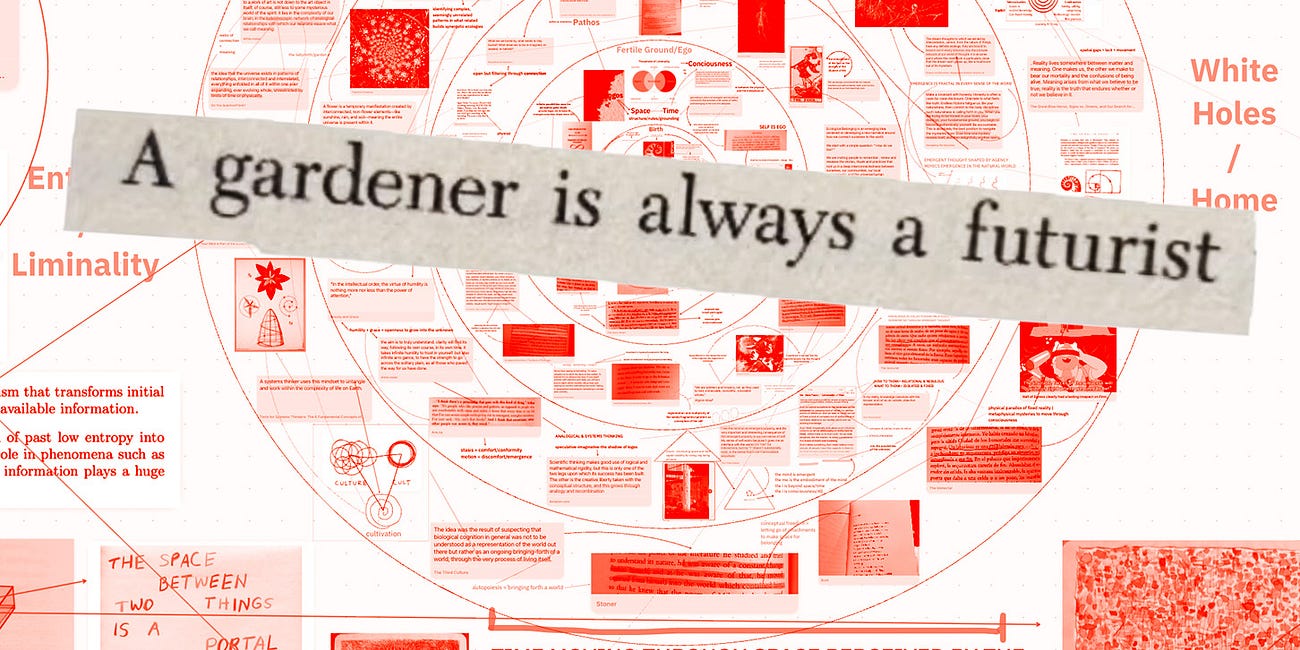
If you want to understand how this piece came to be, the inspiration behind it, a behind-the-scenes into the tools I use, and how I use them to exercise the creative self; here is an in-depth guide into how to actually create—seen from inside the garden
DIARY ENTRY 10/03/2026
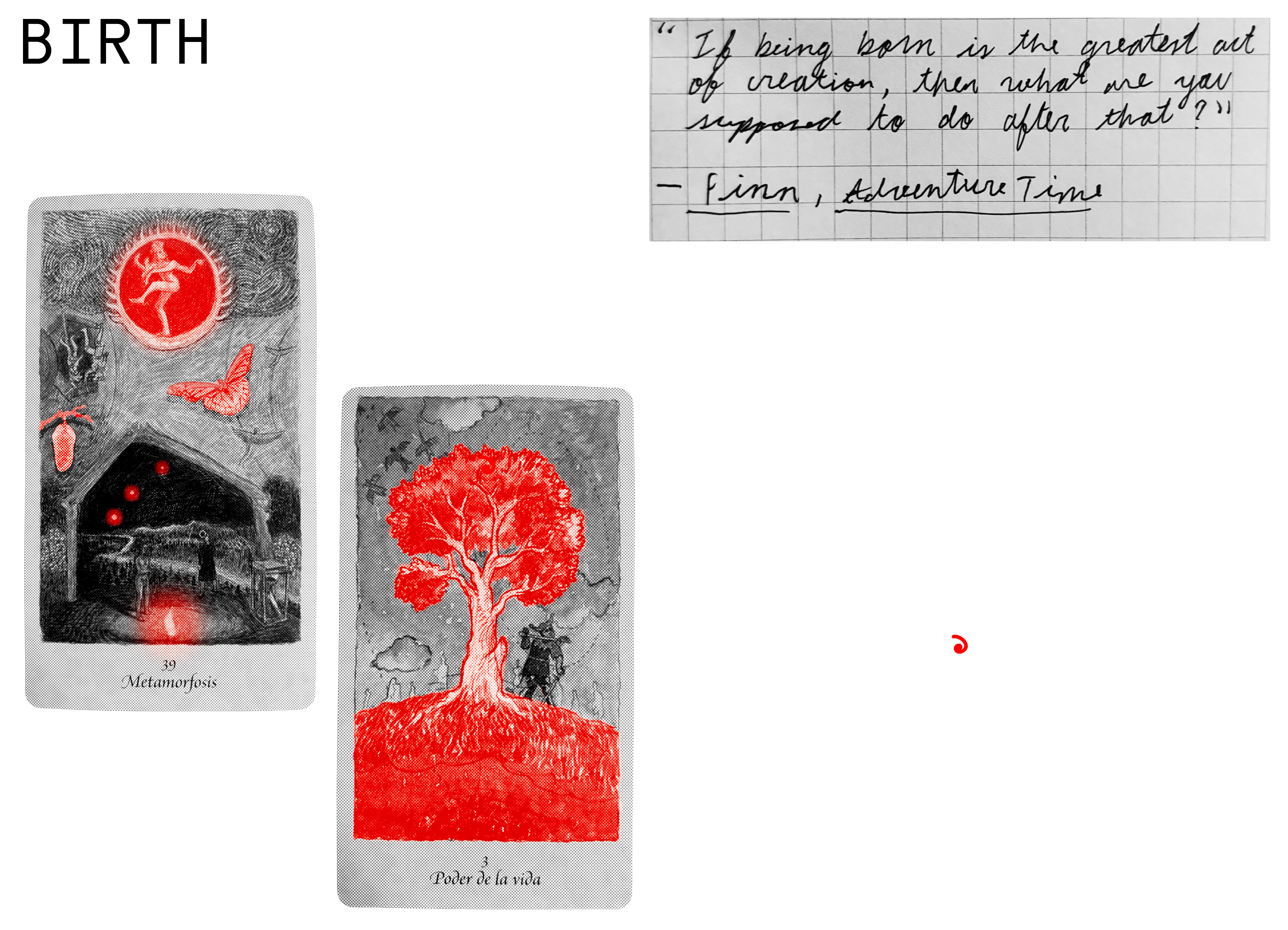
Twenty-three years ago, the sky was pouring as I took my first breath. My fresh consciousness was a seed, not yet watered by the rain that banged ferociously against the hospital windows as I emerged into the room. My particularly deafening wails followed once I was struck by the artificial lights, by the jabs of sharp, sterile needles, and the shock of being alive. My cries echoed the ambivalence of this human experience: pain and fear all jumbled up in the midst of love and joy, pressing against the walls, about to burst through them. I felt it all—until my confusion settled just enough for me to finally go quiet, when my dad’s familiar voice reached me face to face for the very first time.
Today is sunny, though I’m sitting beneath the shade, watching the world spinning around me. Small clouds drift by, reflecting the light of the sun that hides behind the concrete wall to my right—just enough so that I still have to squint my eyes. Even if I’m in the shadow, even if my perception of movement lies outside of the one of myself, even if the sun is nowhere to be seen, I am in a perpetual state of movement with this world. Even as I sit still, my heart pulses beneath my ribs, which cage the breaths that slow to the pace of my thoughts at this moment where my mind isn’t doing laps inside my head.
*
But where even is the mind? I don’t believe it’s in my head.
I see it in the clouds, amorphously shaped.
I see it in every single forking branch on the tree through our cycles of life and death.
I see it in the empty space between the words of the books that attempt to shape it.
I feel it in my dad’s voice.
*
Lulling vibrations easing the fear within my fragile newborn body, showing me how the sun that today is hidden feels warm against my then unscarred skin. Showing me how a deep breath of fresh air cools your worries, lifting the weight as you exhale.
I experienced all of it without ever leaving the stuffy, sterile room that appeared to be where the edges of the universe started and ended.
The edges of my universe expanded as far as my mom let me let her hand go, her arm stretched out in case my wings weren’t strong enough to take flight just yet. Her grip unwavering while I grew heavier and weaker, pulling me up from the precipice as many times as I needed—walking me back home after having them repeatedly cut.
I finally let go and hoped my wings would grow on the way down. Turns out my wings had grown too wide for home—I only discovered how far they could stretch once I jumped past the edge.
But home isn’t a place—or at least that’s what I tell myself when I can’t share the sun and the moon with the people that feel like it. Even though we all see the same celestial bodies in the sky, the distance between our bodies means we must trade them with each other, abiding by the rules of space and time.
But home isn’t a person either, so what is it then?
Maybe home can be found in a type of liminal space, one where consciousness transcends our laws of nature—paradoxically, the only way I can try to see it, is by abiding by them. So I see a garden, one where the first seed was planted today, twenty-three years ago.
\(1 = \text{essential seed}\)
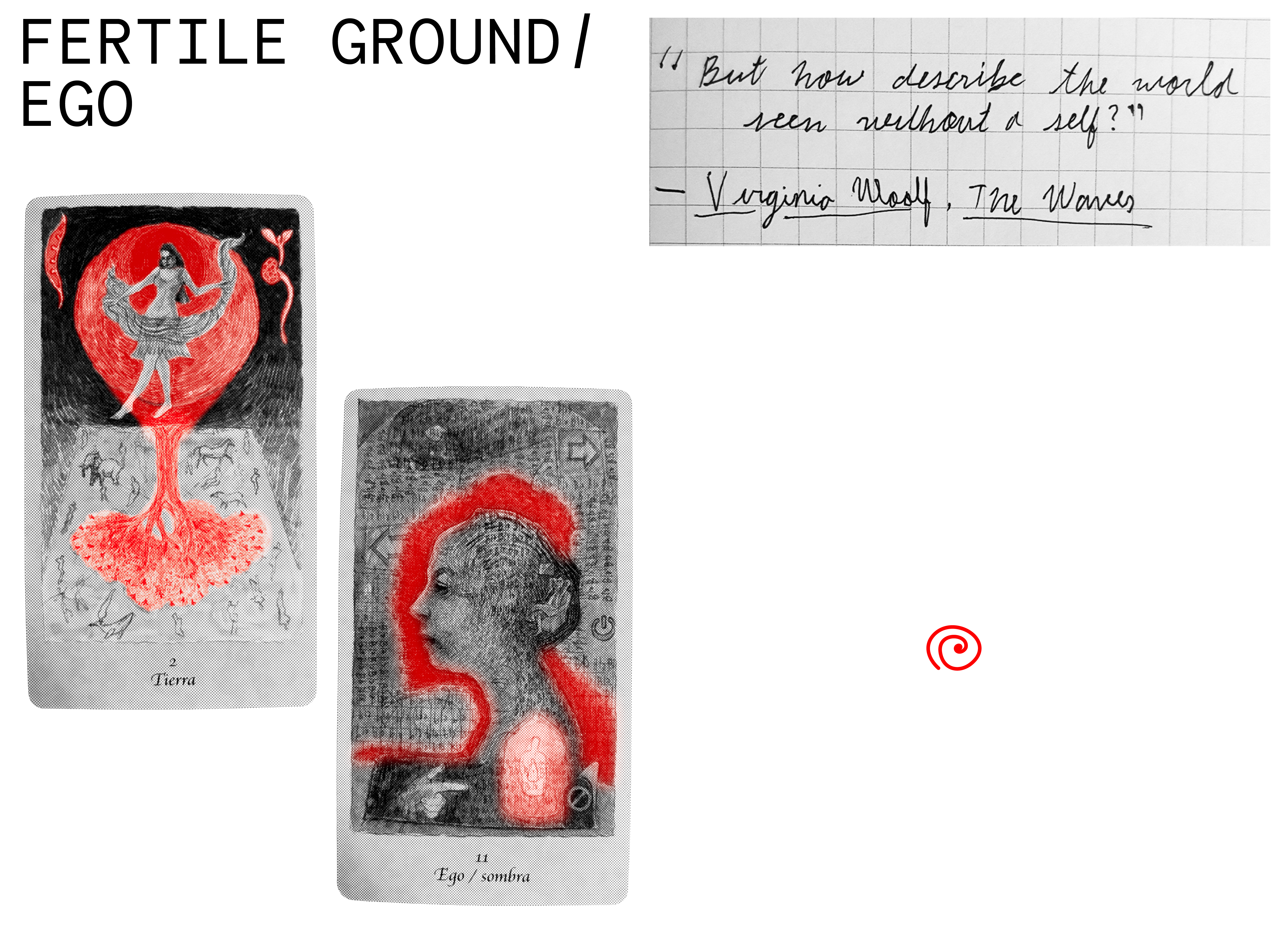
“It’s wonderful that we have an ego, because that makes us ourselves. That makes me me. My attachment to the physical world is the thing that lets me navigate it” -me on a recent interlude live lol
This bright and luminous essential seed of life has now been placed in this flat, two-dimensional space. A plane of soil that meets with the heavens to create a line that marks the frontier of the horizon. But I—in an immovable, still unconscious state of pure being—must begin to take root, to ground and integrate with this physical space if I ever want to grow toward and beyond its very logic and limitations.
Yet, our essence does get the chance to bloom on uneven earth—the duality of the ground spans within a spectrum of fertility and futility. The self is circumstantial. Still, the ego's task is to be pliant enough to transcend whatever fixity we've been handed, to find the path of least resistance to make space to grow our roots—in hopes of lighting our own way out of the depth.
Once this structure takes shape in the physical self, we must remember: being light and being in the light will always, inevitably, cast a shadow. That's how we know we're alive.
In more words from Virginia Woolf: “I am rooted, but I flow”
\(\text{essential seed} \cdot \frac{\text{logos}_{earth}}{2\text{D}} = \text{ego} \)
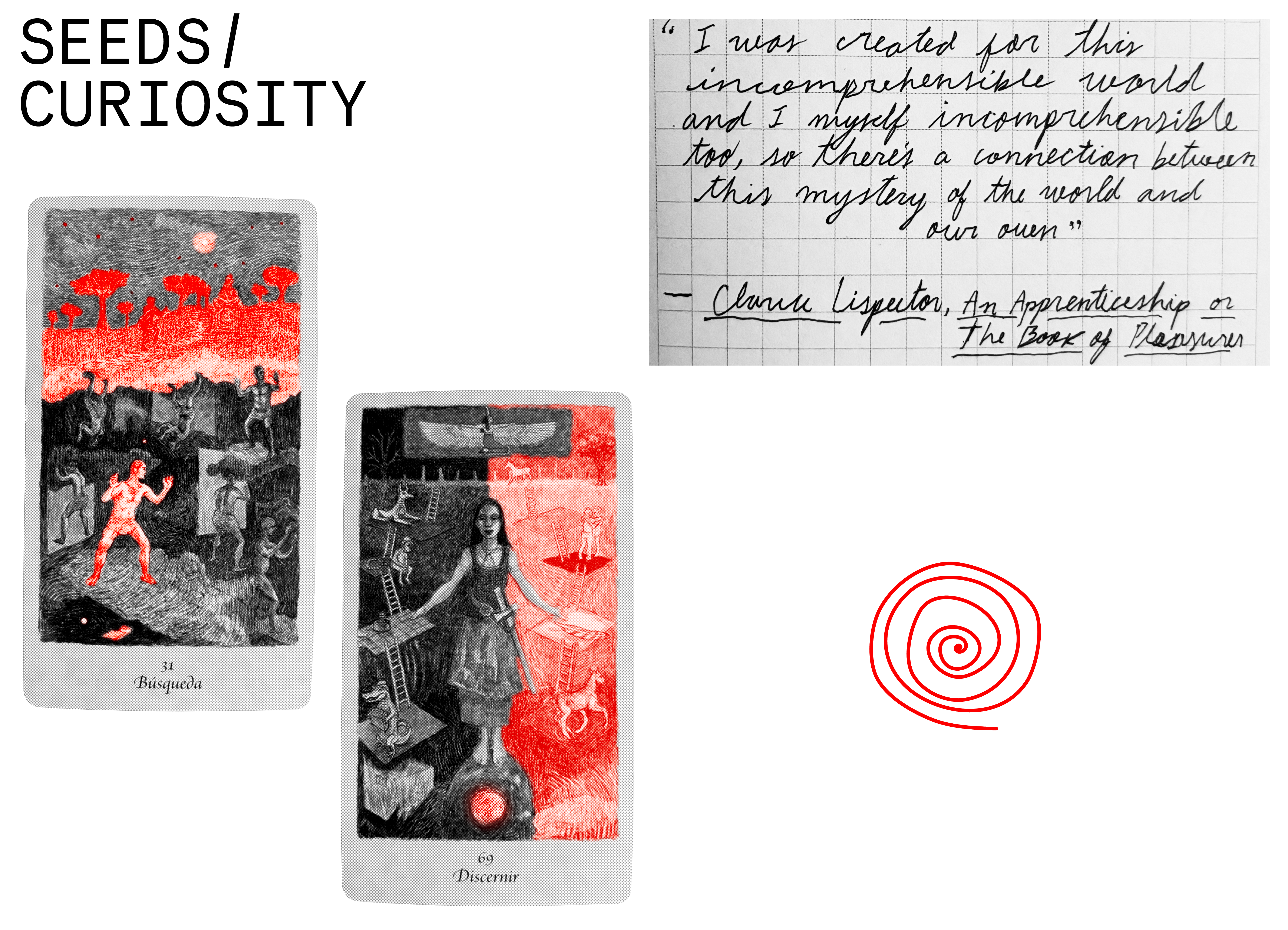
The essential seed must endure the cycles of the seasons, and through nurture and nature, it will grow enough to transform into an agentic being, moving through a current amidst the still barren soil. This singularity maps its dimensions through paths for the seeds that are soon to be buried within it. This essence evolves into The Child—the original carrier and keeper of our vital inner-light—the fruit that's reaped from the original seed, non-rooted, but capable of forming attachments through relational interactions with the novelty of their world.
The inherent curiosity of The Child resembles that of The Fool: ever-expansive, an unconditional wanting-to-know. Without a map or a sense of self, they embark on a journey where the destination is yet to be known—perhaps it asks to be discovered. To pick a direction, though, intuition shapes curiosity into a compass, one where—by navigating the mystery—our energy is drawn toward a sense of wholeness, of completion, of connection, of belonging.
The Child's intuition is the purest of all, not yet contaminated; informed by intrinsic knowledge passed down from their ancestors. Through it, generational patterns may arise and, hopefully, be dismantled to have clarity at the stage of discernment—to eventually, have enough clarity to know which seeds deserve to be collected. It is impossible to gather every seed, much less tend to all of them, for it is precisely the lack of wholeness that allows The Child to expand their world in the first place.
Their essence flows through the mutable stages of the very source of life: water in the state of matter, relative to its current environment—rivers, clouds, glaciers—always dictated by its distance from the sun. The compass points toward the current of the emotional field: empathy, sympathy, apathy, antipathy. The Child gathers seeds through this, ideally, continuous movement. However, some happen to simply be handed to them, mostly by those who seek to guide or shape them to fit the mold of their expectations.
Regardless, the world is brimming with seeds to be collected—even if we aren’t moving through it, we are always moving with it—and whether the ones we end up with germinate or not, our interaction with the biosphere offers insight into our journey of being toward becoming.
\(2\text{D} = \frac{\text{curiosity}_{W} \times \text{intuition}_{H}}{\text{pathos}_{water}} = 1^{seeds} \)
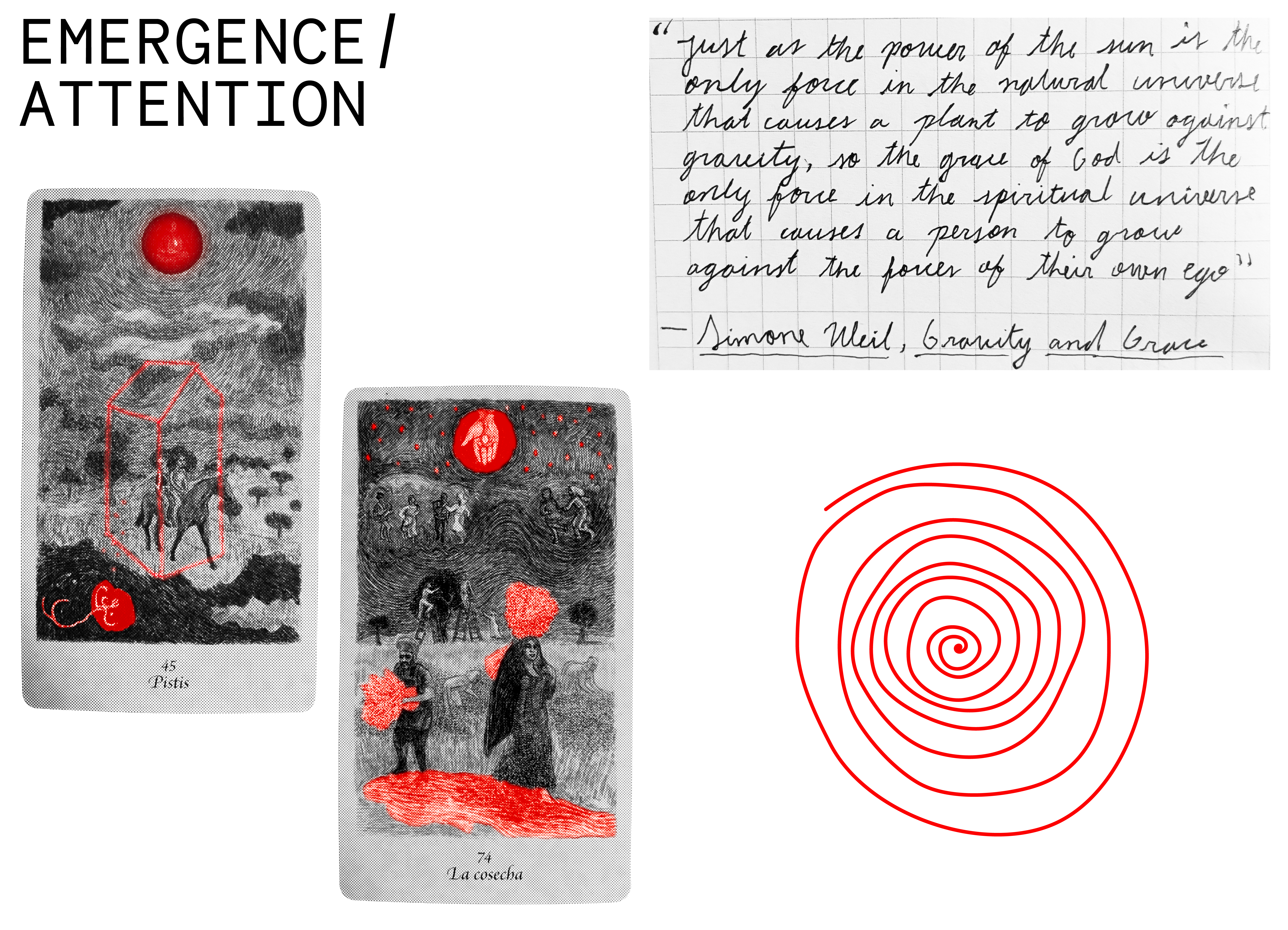
To make this static plane of soil habitable for the germinating seeds to spring past its surface, the elements must come together to bring them forth into a third dimension. For them to initiate the life-cycle toward its very own homeostatic biosphere, earth, water, fire, and air have the potential to be all-encompassed through the manifestation of every sprouting organism that emerges from their synthesis.
The organism not only holds but continues to interact and be exposed to the elements as we cycle through the seasons and stages of life—budding, blossoming, falling, dying—getting the chance to do it all over again through a combination of pistis, synergy, and, if we choose to, cultivation.
At first, pliantly growing against gravity, we have faith that they will endure the seasons, and so we choose to tend to them by manipulating the elements to the best of our abilities.
Earth / Logos: the ground provides far more than structure, it is a composite of mineral, decayed organic matter—everything that died before. It must be packed loosely enough so air and water can permeate through it.
Water / Pathos: it soaks through gravity and then defies it as it travels up the organism. Too much and it suffocates the roots; too little and it withers. It keeps it upright through pressure rather than structure as long as it’s watered just right.
Fire / Attention: produces light, allows us to see, and allows the organism to convert everything else into growth—the photosynthesis of every element of the garden, holding onto what no longer serves us to transform it into energy to keep moving through the cycle. There is the light from the star above and the light from the stardust within.
Air / Pneuma: we cannot grasp it, we cannot see it, though it’s ever-present and nebulous—it is the vital source of life in the biosphere, in a constant cycle of purification, in and out of the organism.
The earth we can move with our hands, the water we can meter, the fire we can only turn toward, and the air we cannot touch at all.
Initially, each organism is precocious, pliant, subject to change; it shows us how we think. Though with time, if it survives this stage, it then goes through a second growth—the one that turns stems into wood—solidifying its structure as a pillar of what we understand as meaning; it shows us what we think. It becomes hardly movable, grounding as a pillar of our beliefs of what persists in the ecosystem. That’s why we need to be wary of the organisms that we choose to attend to, because if we pick the wrong ones, they emerge into a conformity that’s not easily ripped out from the root.
\(3\text{D} = \text{attention}_{fire} \cdot \frac{\text{logos}_{earth} + \text{pathos}_{water} + \text{pneuma}_{air}}{1^{seeds}} = \text{emergence}_{ethos}\)
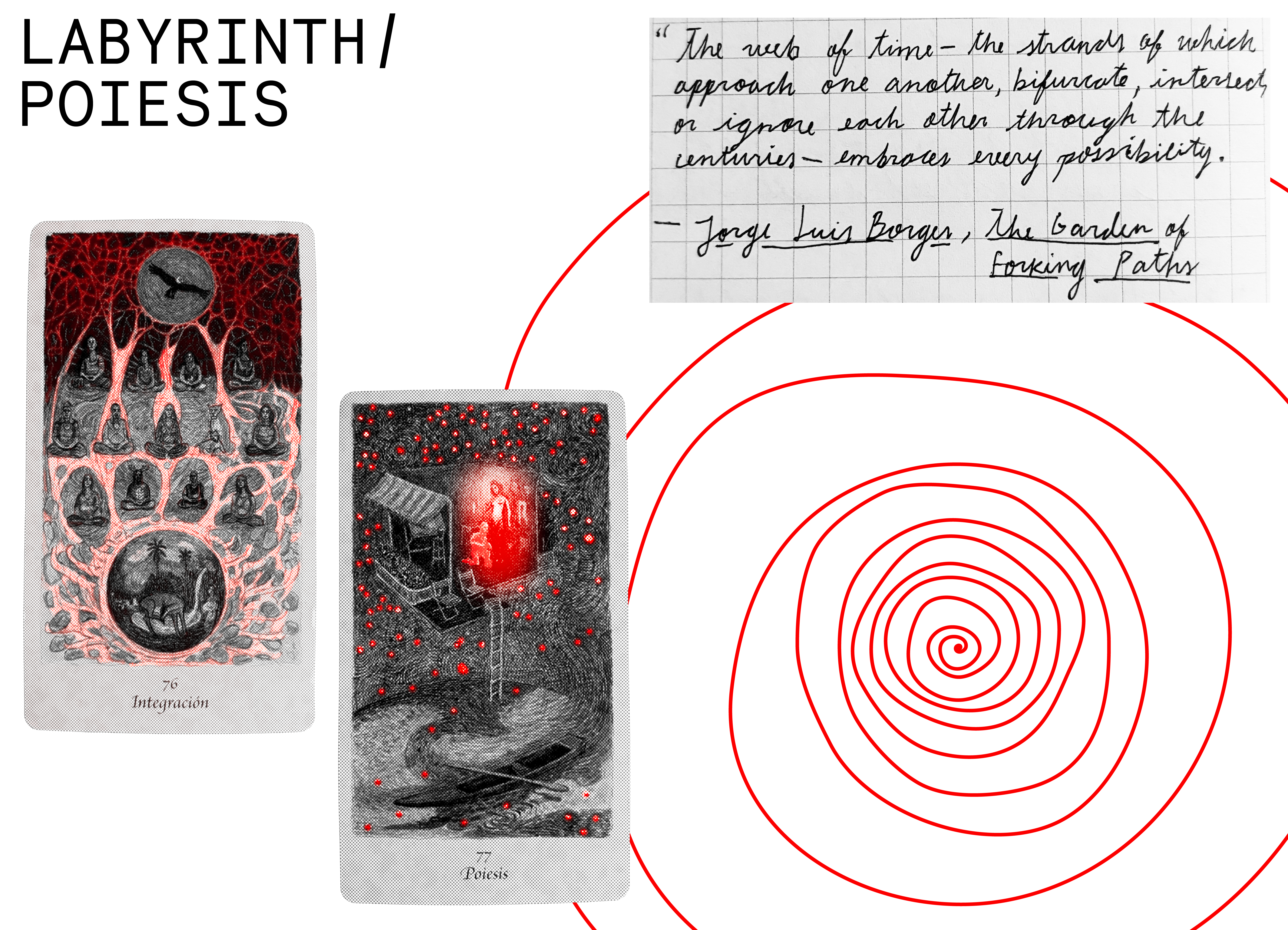
What is a garden but a tended ecology? By this logic, once the soil has been populated by an array of organisms, it is up to us to tend it into our very own garden. If we just leave it be, we will most likely be crowded by overgrowth, much of which keeps us trapped within it—especially if an invasive species has overtaken it; often seeded through imposition rather than intuition.
Even then, plants will often get root-bound, other times we will forget to water some of them, some will die regardless of our efforts, and some others will too because it felt easier to leave them in the dark. And a garden pruned too tightly, purified of everything unplanned, becomes a monoculture—it survives until the season it doesn’t.
We cut without any way of knowing where the path leads; stopping to verify that it’s leading anywhere at all only ever returns us to where we started. The wonder of it all lies at its perpetual state of change, and the mystery of it lies at the edges of the paths we’ve carved within it—the garden is never more unknown than at the moment we’ve expanded it. However, tending to it is as constant as its change, and the more we expand it, the more energy must be expended—we are obliged to return with the knowledge that the paths won’t look the same on the way back. As much as we look to find a way out, unless we dissolve the very garden, no egress will ever arise.
The discomfort of overgrowth is familiar, and familiarity is easily mistaken for belonging; we are not trapped, but leaving requires accepting that we’ll be lost for a while. The moment we make peace with this notion, we get to unlock a new perspective, we finally understand the shape of the garden; its form as a reflection of ourselves through a living labyrinth.
To tend to the garden, to keep it ever-expansive and regenerative, we must be able to see what’s past the overgrowth. By means of rearrangement, and by cross-pollination, we are able to create the paths that allow us to move through it. Furthermore, to reach the freedom to navigate it, letting go of the attachments of what no longer serves the biosphere is the only way we escape the stasis of conformity into the motion of belonging.
\(\text{emergence}_{ethos} \cdot \text{autopoiesis} = \text{labyrinth}\)
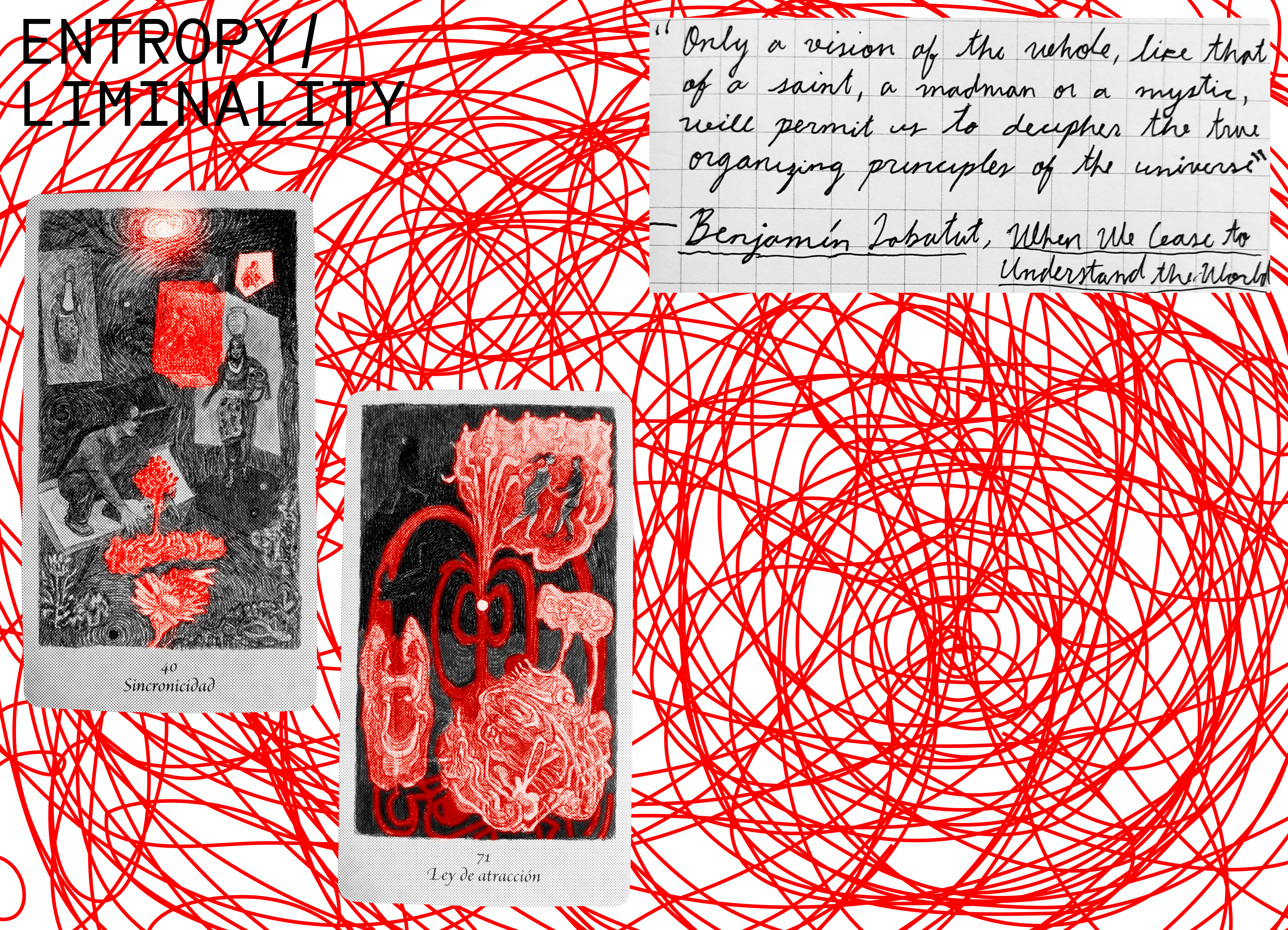
Entropy is often understood as disorder, but in reality, it’s the universe moving toward a state of complete balance. However, if this state were to reach totality, time would be dissolved, along with our ability to move through it or perceive anything within it. The garden would cease to exist as we know it, yet it doesn’t disappear.
We expend energy toward our garden, as every element within it does exactly the same. We are entropying toward decay every second that passes by—it’s a part of the cycle of life, one where death is transformed into birth. We are the garden living and dying over and over again, but only as long as the chaos of inbalance persists.
The fact that entropy isn’t disorder doesn’t change the fact that it feels as so. Perhaps that’s because the body is the ultimate liminal space—the threshold where the metaphysical meets the physical, where essence and ego navigate each other, in the limbo between birth and death. In between the only two things we know for certain. The lack of balance asks us to pay attention, lighting our way through the chaos, through the darkness. It’s the meeting place between I and me. Where we finally see the labyrinthine nature of the self.
entropy = S
\(4\text{D}_{S} = \text{labyrinth} \cdot \frac{\text{lack}_{dark}}{\text{attention}_{fire}} = \text{liminality} \)
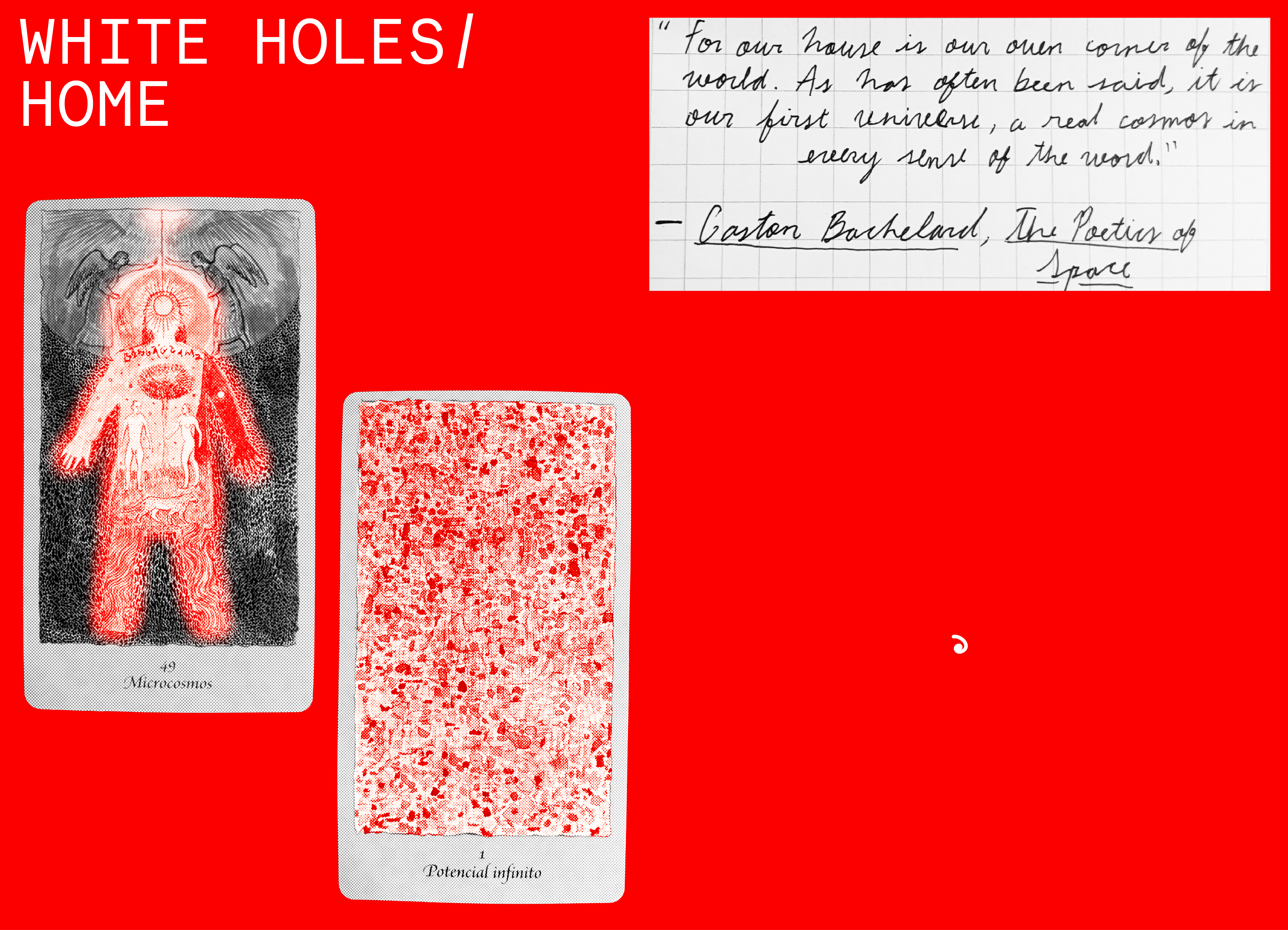
The garden is a labyrinth is me moving toward the I. An imprint of the ground I was given, the seeds I gathered and reseeded, the paths that I’ll keep making and abandoning. The ego attaches meaning to things, so whenever I seemingly see the I, it just grows into the garden, it becomes a part of me.
The I is the essence is the universe is the white hole. Even as I write this, it’s out of grasp, white holes are just a theory, and so is this garden. Then, theoretically, nothing can ever enter a white hole, because energy cannot be created or destroyed, only transformed. This means the light from the stars above is the same one that makes up the essence of the one within—only separated from wholeness by the distance between the human body and the celestial one.
Home was never a place or a person to be found, that’s the nature of a labyrinth; we can’t ever escape it. We are mere perspectives, limited and impermanent—blips in the cosmic calendar that is woven by our connections through space and time. This means that home is not a destination but a process: of being, toward becoming, experienced as belonging. It’s understanding that there are endless forking paths in the garden, where we get to decide amongst the infinite possibilities.
We are just fragments of the universe experiencing itself, a microcosmos we get to call home.
\(\text{liminality}_{I} = \frac{\text{us}}{\text{me}} = 1 = \infty\)
Cosmologies are not purely scientific theories about space like astral physics, but embedded in daily life, in the way our selves relate to other humans, to non-humans, to other natural resources and the environment as a whole.


given that there are a few terms that not everyone may be familiar with, i decided to compile the most relevant concepts to understand this framework in this brief glossary :) just click each term and it will take you to the definition!
Comments
Nothing yet. Say the first thing.
Sign in to join the conversation.