
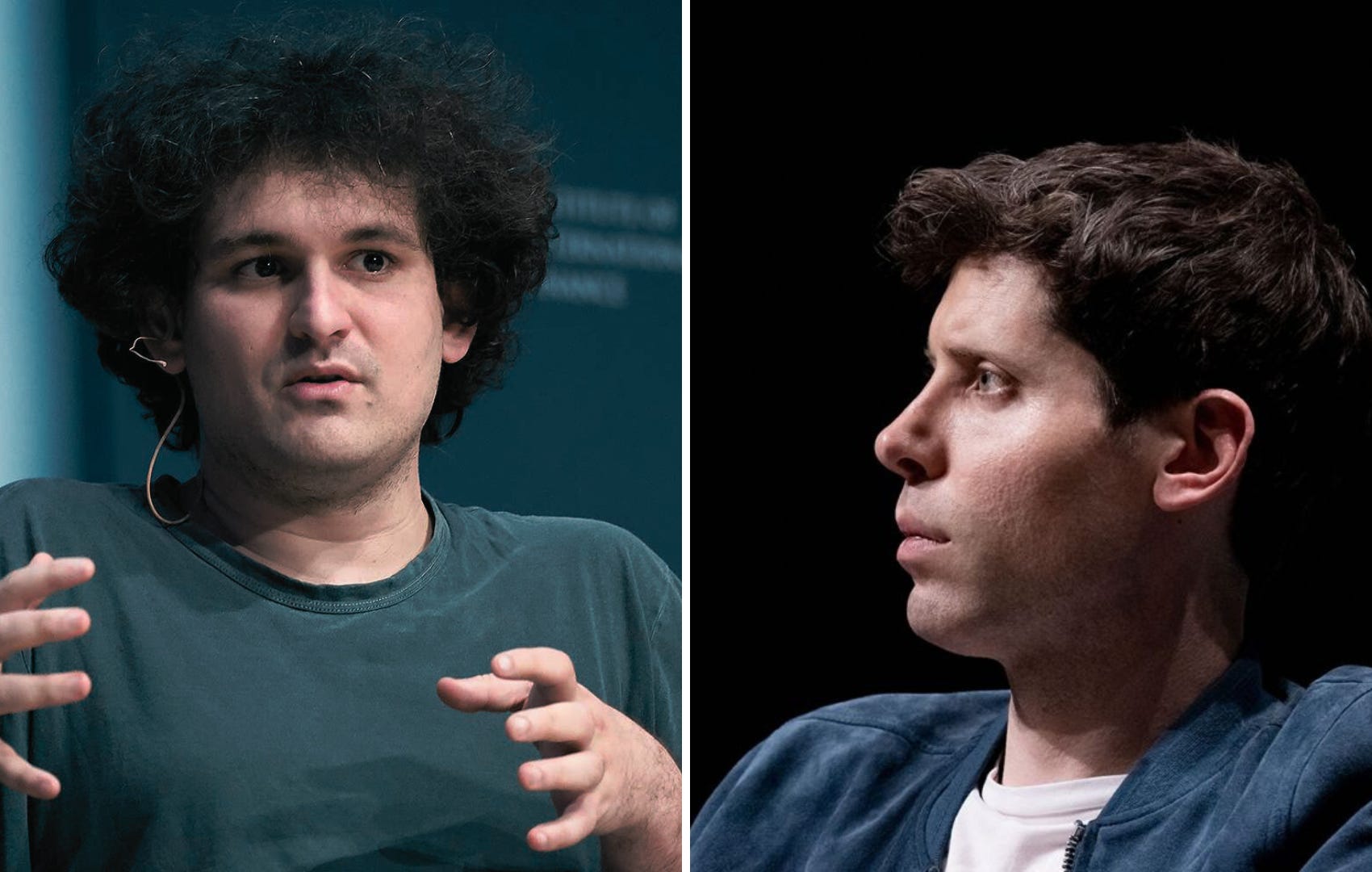
Sam Bankman-Fried was on track to be the world’s first trillionaire.
On November 2, 2023, the former FTX cryptocurrency exchange CEO was convicted of seven counts of felony fraud and conspiracy, having essentially stolen $8 billion from his customers.
On November 24, the OpenAI board fired their CEO, Sam Altman.
After a busy weekend for tech journalists during which Altman entertained an offer from Microsoft and 95% of OpenAI employees demanded his return, Altman was reinstalled as CEO of OpenAI with a reconstituted board.
Two Sams with two very different personal outcomes.
But at the center of both of these stories is the movement known as Effective Altruism.
Effective Altruism is a philanthropic philosophy that has captured the hearts and wallets of tech entrepreneurs in Silicon Valley. It’s a movement of ambitious, analytical leaders seeking to maximize the net good in the world.
The slogan is “Doing Good Better.”
That better or more effective aspect is about amplifying outcomes without sentimental constraints. Effective Altruists advocate for evidence over emotions. They’re driven by data and logical rigor, even if it leads to uncomfortable conclusions.
This means directing efforts away from ineffective charitable strategies that make the giver feel nice but do little to create long-term solutions.
It also quantifies the ethical freight of our personal decisions and purchases. For example, it costs about four thousand dollars to save a life in the developing world. That certainly puts luxury spending in perspective, where every dollar exchanged can be considered in terms of potential lives rescued or lost.
On the other hand, the power of the dollar to accomplish good can incentivize the growth of purchasing power. EAs call this “earn to give.”
Which is more effective—working for a non-profit, or pursuing a high-paying career where you can save lives by donating four thousand dollars by orders of magnitude?
But there’s a double edge here. Effective Altruism might require redirecting resources away from projects or demographics that are less likely to benefit and toward circumstances where there is more probable success. This tension between overall impact and potential bias underscores the complexity of EA in application.
Sam Bankman-Fried has said, “I believe the right action is the one that maximizes total utility in the world.” Whether something is the right thing is determined by whether it leads to total happiness outweighing total pain.
He connected this EA pursuit to his design for FTX: “I’m in on crypto because I want to make the biggest global impact for good.”
He claimed he ran his crypto-casino to give almost all his money away to charity. He saw the big problems humanity faced and realized it would require an enormous amount of capital to make a difference.
He wanted to get rich to buy mosquito nets, prevent the next pandemic, and stop an evil AI from taking over the world. He donated generously to EA causes and organizations and was one of the largest donors to the Democratic party.
But by the time Bankman-Fried was arrested, he was living in a $31 million home in the Bahamas, having blown through ten figures of his customers’ money.
“Earn to give” eventually devolved into old fashion theft.
Sam Altman was fired without warning and without reasoning that made public sense.
The statement that the OpenAI board released contained vague references to his communications not being consistently candid. While social media pundits speculated about what was really going on and anticipated more scandalous revelations, the further the story developed and the more scrutiny that the board received the less the decision seemed to make sense.
OpenAI was founded as a nonprofit in 2015. The 501(c)(3) was set up to help ensure that artificial intelligence would be developed in a way that was safe and good for humanity. There was a desire to protect a research project from the driving forces and speed of capitalism.
However, it turns out that running large language models at the scale of ChatGPT is very expensive. Every time you ask for a dinner recipe in the format of a Seinfeld episode, it contributes to OpenAI’s $700K per day computing costs.
So OpenAI established a for-profit entity within the organization, and Sam Altman did what tech founders do. He went on a fundraising tour at an $86 billion valuation.
While there’s no evidence at this point that Altman was taking the company in a reckless direction, it’s now clear that the board was uncomfortable with the current state of the project—and perhaps with its existence altogether.
This board had strong ties with the Effective Altruist movement. One board member publically criticized OpenAI’s safety from an EA perspective.
They decided now was the time to run the nuclear option and dump their CEO. His laptop was remotely deactivated like anyone else who lost their job in tech this year.
But the attempt to rescue the world from Sam Altman ran into the hard realities of capitalism, as well as a startup staff’s loyalty to their leader.
Effective Altruism helpfully encourages a conscious investment of our efforts and money. It charts a path for capital growth that leads to human flourishing. And it reminds us of the sobering responsibilities we bear in our life and career decisions.
The emphasis on altruism and on finding evidence-based solutions is commendable. But as a guiding ethical principle, it isn’t enough.
Every movement has its scandals. And it wouldn’t be fair to judge Effective Altruism based upon the behavior of a few misguided enthusiasts or bad actors.
But does EA itself have the ethical resources to declare Sam Bankman-Fried’s actions to be wrong?
Effective Altruism aims to quantify how to do the most good for humanity. But it runs these calculations untethered from any objective moral standard.
It is, at heart, a consequentialist ethic. Consequentialism contends that an act should be evaluated solely by the results it brings about and not by whether it conforms to any universal rules.
If you think that sounds like “the ends justify the means,” you’re correct.
EA has its roots in the radical utilitarian Peter Singer, who can’t seem to figure out whether a child or a pig has more intrinsic value. Or whether it’s ok to have sex with that pig.
Consequentialists cannot answer why “earning to give” should not become “earning at any cost [even defrauding people]” if that eventually leads to a better outcome for the global population.
Apart from its consequentialism, EA has an outsized confidence in humanity’s ability to calculate and achieve what produces the greatest societal good—and to pull it off without corruption.
This overconfidence makes its proponents susceptible to fraud and abuse.
Cohere CEO Aidan Gomez has criticized the EA movement as dogmatic and self-aggrandizing. He wrote in a letter to his staff following the ouster of Altman, “When people begin to believe so deeply that they are uniquely qualified to benefit, or even save, humanity, they tend to be willing to take extreme actions towards that end.”
Those extreme actions could look like running a coup on your CEO or making $8 billion disappear.
Ironically, when EA adherents have come to wield real power, they’ve acted like the AI doomsday scenarios they’ve warned us about. There is a fear that rogue AI will seek to optimize reality toward a conceptual greater good without concern for individual human suffering.
Before we’ve come to the moment when AI attempts to solve the trolley problem, it appears that EA tech entrepreneurs have taken the controls into their own hands.
No posts
Comments
Nothing yet. Say the first thing.
Sign in to join the conversation.