
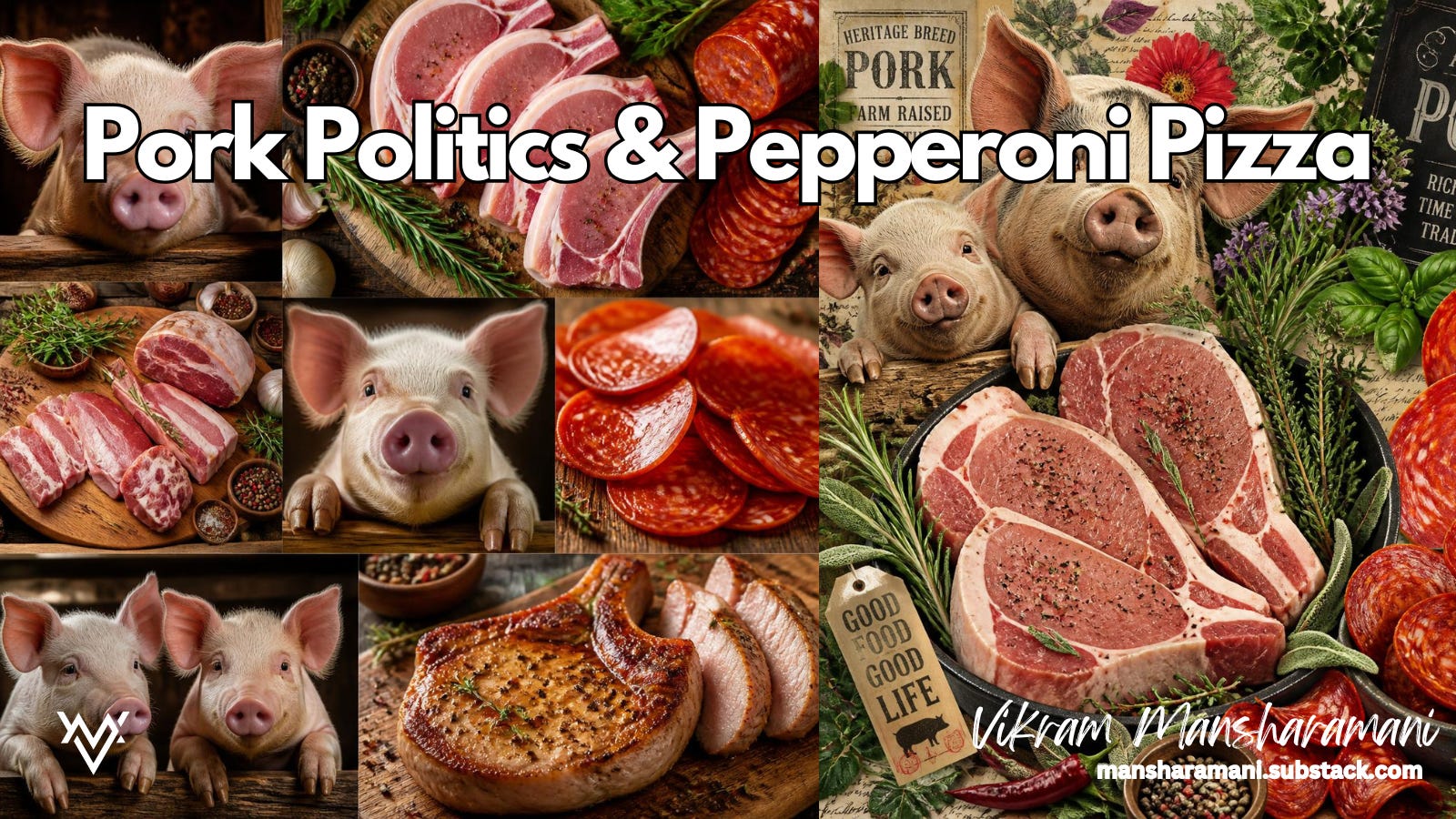
As many of you are aware, I run a frozen pizza factory. Pepperoni pizza is one of our best sellers, so it should not be surprising that I spend a lot of time thinking about pork prices. And while the price of your pizza is obviously impacted by the price of pepperoni on top of it, you may find it interesting that the price is increasingly being set in Beijing, not in Iowa or North Carolina.
How’s that? Well, it turns out that the Middle Kingdom is the world’s largest consumer of pork. China consumes 57 million metric tons of pork per year—roughly half of all the pork eaten on Earth. And pork in China isn’t like chicken in America. The Chinese character for “home” (家) is literally a pig under a roof and pork is deeply intertwined with Chinese culture. So when anything disrupts China’s pork supply (such as a disease, tariff, or trade war), shockwaves flow through global markets. Including, eventually, to the pepperoni we put on pizzas in America.
But there’s an interesting twist to the story that very few people talk about. China doesn’t just buy American pork chops and tenderloins. It buys the parts of the pig that Americans won’t touch: the feet, the heads, the stomachs, the ears, the hearts. China takes 59% of all US pork “variety meat” exports. The National Pork Producers Council puts it bluntly: “There is no alternative market” that can absorb this volume.
Why does this matter for pepperoni? Because the revenue from selling those pig feet to China subsidizes the cost of the rest of the pig. Every part of the animal that gets sold offshore reduces the effective cost of the trim that stays here—the trim that gets cured, fermented, and turned into pepperoni. When China stops buying feet, that revenue vanishes, and the cost of producing the cuts Americans do eat goes up. Pig feet you’ve never thought of and will probably never eat quietly keep your favorite pizza affordable.
·
August 25, 2025

As an academic, author, consultant, entrepreneur, and corporate board member, I have long understood that federal regulations and government overreach were burdening businesses, but as the CEO of a food manufacturing business, I have a specific example worth highlighting.
And of course the buying slows to a trickle whenever the trade war heats up. Over the past several years, US pork tariffs in China have swung from 12% to 81%. At 81%, trade effectively stops. The November 2025 deal brought tariffs down and granted waivers on the worst duties, but those waivers expire at the end of 2026. The pork industry received a reprieve, not a resolution.
But these dynamics, we must remember, work in two directions. When China needs pork, it doesn’t just buy, it hoovers up whatever it can find. In 2018, African Swine Fever killed roughly half of China’s pig herd, hundreds of millions of animals. Chinese pork prices spiked 46.7% in a single year. China bought everything it could find on the global market, pulling supply away from processors everywhere, including the ones making pepperoni for American pizza companies. They also made massive investments into their domestic pork industry, including the now infamous “pig skyscrapers.”
Separately, there’s also a twist steeped in international intrigue. Smithfield Foods (America’s largest pork producer, responsible for 23% of the entire US pork market) is owned by China’s WH Group. The Chinese company bought it for $4.7 billion in 2013.
I remember speaking with Congressional leaders then and many were concerned about the impact the acquisition might have on food safety. Many were concerned that Chinese food safety standards would transform the US food company and put our hot dogs or bacon at risk. I remember discussing it with Smithfield executives at the time who were confused by this suggestion, and correctly (it turns out) noted that the Chinese were seeking to learn US food safety procedures so they could take them to China.
Nevertheless, the concern about Chinese ownership of US agriculture and food assets has not dissipated. In 2023, for instance, Virginia passed a law banning “foreign adversaries” from owning farmland in the state. Well, it turns out that Smithfield has farms in Virginia. One national security critic put the concern simply: “If we get into some sort of world disaster, where do you think China’s going to send their pork? They’re going to send it back to China.” Who would have thought that pepperoni could be a national security issue?
These dynamics are a useful reminder that something as simple as pizza is an amalgamation of countless supply chains, geopolitical dynamics, disease, weather, and politics. Even small events happening on the other side of the globe can ripple through the economy and impact the price of frozen pizza. Connecting these seemingly unrelated dots can help us understand the levers that impact prices and drive supply. The geoeconomics of the pork industry may seem large and lofty and irrelevant to most, but can, via the price of pepperoni, impact the price of your pizza.
The price of pepperoni was shaped by a tariff negotiated in Geneva, a pig disease that started in a province most Americans can’t pronounce, an acquisition that handed a quarter of America’s pork supply to a Chinese conglomerate, and 59% of the pig (parts no one here will eat) being shipped across the Pacific. Think about that next time you take a bite of a slice!

VIKRAM MANSHARAMANI is an entrepreneur, consultant, scholar, neighbor, husband, father, volunteer, and professional generalist who thinks in multiple-dimensions and looks beyond the short-term. Self-taught to think around corners and connect original dots, he spends his time speaking with global leaders in business, government, academia, and journalism. He’s currently the Chairman and CEO of Goodwell Foods, a manufacturer of private label frozen pizza. LinkedIn has twice listed him as its #1 Top Voice in Money & Finance, and Worthprofiled him as one of the 100 Most Powerful People in Global Finance. Vikram earned a PhD From MIT, has taught at Yale and Harvard, and is the author of three books, The Making of a Generalist: An Independent Thinker Finds Unconventional Success in an Uncertain World, Think for Yourself: Restoring Common Sense in an Age of Experts and Artificial Intelligence and Boombustology: Spotting Financial Bubbles Before They Burst. Vikram lives in Lincoln, New Hampshire with his wife and two children, where they can usually be found hiking or skiing.
Comments
Nothing yet. Say the first thing.
Sign in to join the conversation.