
Well, off to better things like a Hip Hop forum
Pass me the rock and I’ll score ‘em with decorum
And proper, what you say, Hammer? Proper
Rap is not pop, if you call it that, then stop
Q-Tip on 1991’s “Check The Rhime” captured a sentiment that was being echoed by several of his contemporaries at the time, as rap music had elevated into the zeitgeist to a level where it could no longer be considered “a fad.” There was a rift forming between those who considered themselves more “purist” as opposed to those who were purposefully leaning toward the “pop” angle.
(As if the first recorded rap song of major acclaim wasn’t spit over a disco track. 🤷 But I digress.)
White boy duo 3rd Bass similarly called out not only “pop rap” as a whole, but decided to include the whole entire ass G known as MC Hammer as the antithesis of “real” rap in their interesting-in-hindsight attempt to posture themselves as… What? More authentic than a Black man from Oakland?!?
But 90s rap was a lot of posturing so I understand.
Of course, the mighty (and honorary-greatest-NBA-finals-comeback-participants) Wu-Tang Clan elevated this argument to an industry level:
First of all, who's your A&R? / A mountain climber who plays an electric guitar / But he don't know the meaning of dope / When he's lookin' for a suit and tie rap / That's cleaner than a bar of soap
Point is (again, to be fair, in hindsight), is despite being labeled “pop,” I think it’s safe to say that few would disown MC Hammer from the Hip Hop artistic lineage. Followers of the genre have come to accept the idea that there can be all kinds of rap music — just because Missy Elliott doesn’t make tracks that sound like Rapsody, she is clearly no less a part of the pantheon of “Hip Hop.”
(Now, purely craft-brewed-rap-music — purposefully designed in a lab to cater to the suit-and-tie rap loving audience — is a different [cough]vanillaice[cough] story of course.)
…though one could argue, as I did during an excellent weekend retreat last year with Hip Hop scholar and connoisseur friends, that even those artists are a part of the overall rap genre — for better or for worse — and so by electricity, a part of “Hip Hop,” even if their authenticity to either can, and should be, vehemently questioned.
But here, my friends, neighbors, supporters, and haters, lies what I posit is actually one of the more self-destructive forces working toward the demise of Hip Hop — one of humanity’s most inventive, industrious, and innovative social, artistic, and creative movements…
No, not what Tricia Rose and Mark Anthony Neal recently lamented about — that “mainstream rap does more harm to Black America than it should” (an understandable though a bit over-litigated and possibly under-nuanced take that warrants a much longer discussion…)
And nope, not the so-called-scourge of “mumble rap,” which actually is not necessarily the scourge that many folks seem to believe it is (ay, don’t argue with me, argue with Dr. Heidi Lewis)…
No, the real issue is semantics.
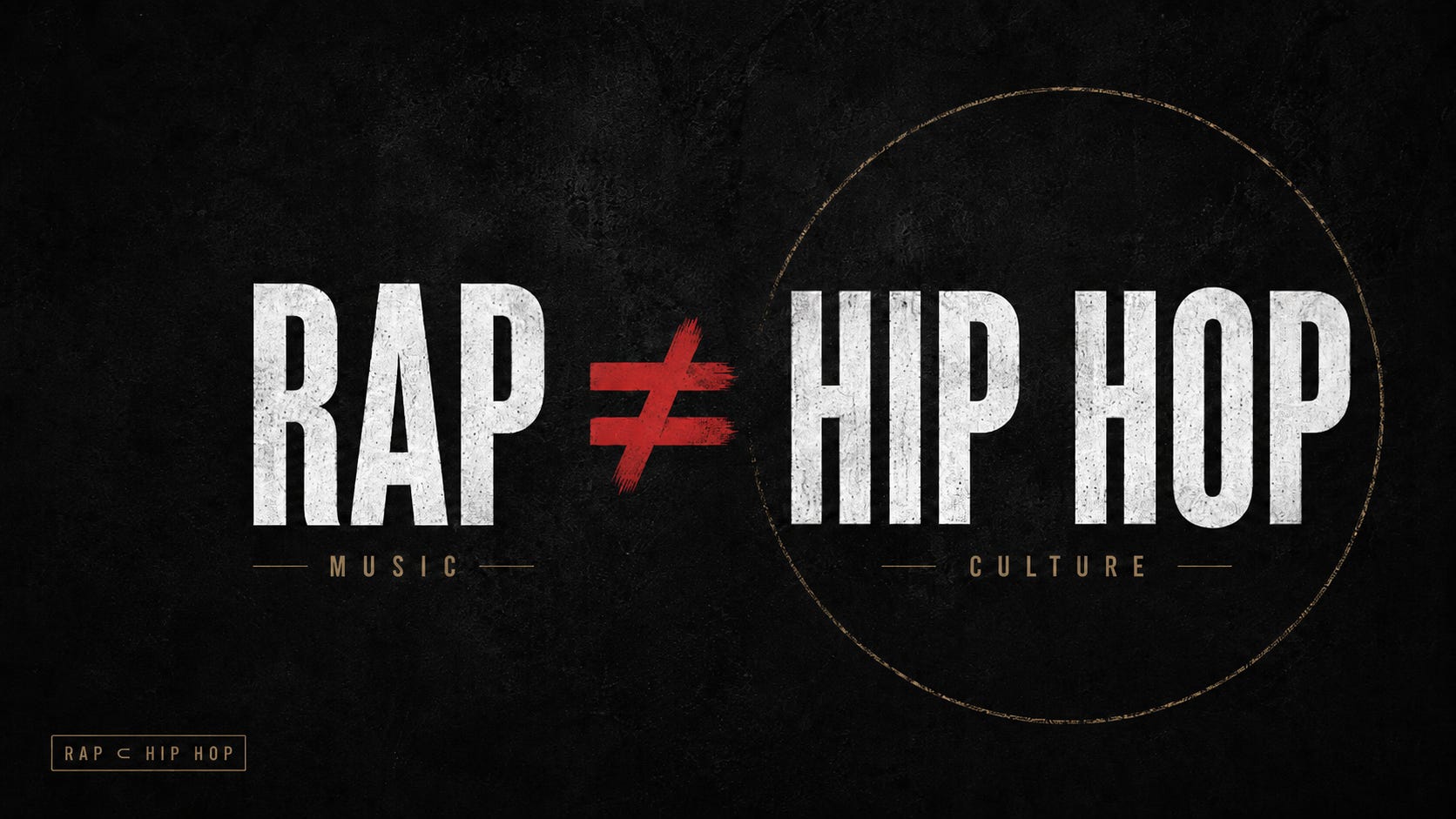
The real problem with “Hip Hop” is that we keep saying there’s a problem with “Hip Hop” — and then solely focus on debate or critique about “rap music.”
SPOILER: The TL;DR here is going to be that we continue to allow “rap” and “Hip Hop” to be used interchangeably. And in doing so, we dilute — and are perhaps helping destroy — both.

I’ve been holding in this line of thinking because I’m truly not about that calling-people-out life, but here’s something that stands out that helps illustrate my point…
Elliott Wilson calls himself the “G.O.A.T. of Hip-Hop Journalism.”
Now, coming from me — someone who has labeled his podcast, newsletter, and YouTube channel collectively “the world’s most enlightening Hip Hop media ecosystem” — I’m hardly going to be critical of braggadocios-and-wholly-unmeasurable marketing hyperbole.
But here’s the thing. Elliott Wilson’s journalism career has undeniably been solely about rap. Not the other elements of Hip Hop. Not the vast cultural aspects (unless it’s something that evolves out of the genre, such as the Kendrick/Drake beef). So pretty much just the genre. (And generally speaking, the more “commercial” aspects of the genre at that).
Now, all of this is perfectly fine.
If he was to call himself the “G.O.A.T. of Rap Journalism,” sure, that case could be made.
But “Hip Hop” journalism?
I feel that’s always struck a weird chord to those who understand Hip Hop to be so much more than rap.
When I say Hip Hop, you say….
…?
Music?
Culture?
It can be either, right?
It can be both also, right?
Yes and yes.
But it really shouldn’t be.
Because at some point in time, “Hip Hop” started to be recognized, studied, and honored as being not just a genre of music, but more so a collection of artforms, a shared group of beliefs, values, customs, behaviors and artifacts that characterize a particular social group.
Which is what defines culture. So yes, “Hip Hop” is a culture. (Ay, don’t argue with me, argue with Merriam-Webster).
But along the way, we collectively decided to refer to the genre (the rap music subsection of Hip Hop culture), also as “Hip Hop.” And that’s where it gets confusing, and if you ask me, problematic.
(Now, to be fair, Billboard has always called it “rap.” Though, to be critical, they’ve also inexplicably always lumped rap and R&B together. And, to be honest, none of this helps when it comes to trying to establish norms and definitions.)
But ironically, and this is the fine line I’m trying to walk here: Establishing norms is not the point. Many would argue there are no set rules when it comes to Hip Hop. Even how it’s stylized. Hip Hop vs Hip-Hop vs hip hop vs hip-hop vs HipHop, etc. Cipher vs cypher, breaking vs breakin’… As for the rap vs. Hip Hop difference, many now will refer to modern rap as “rap”, and use “Hip Hop” to describe more traditional rap (which relies way too much on subjectivity to even be a thing).
It’s endless, and sometimes maddening, but also very much Hip Hop in that we’re not supposed to be able to put into a box perhaps the most unboxably brilliant artistic and cultural creation humans have ever made.
But I do think we’re muddying the waters at a very top-level if we’re going to keep hearing/saying/using “Hip Hop” when we really only mean “rap music,” and not the overarching cultural umbrella that it falls under.
Because we have so much happening in Hip Hop culture, and all the innovative intersections I speak about in areas such as education, health and wellness, science and technology, and social justice that are uplifting lives, livelihoods, and communities — particularly Black lives — that get buried, ignored, unexamined, uninterrogated…
All because all we seem to be able to talk about when we talk about Hip Hop, is rap music.
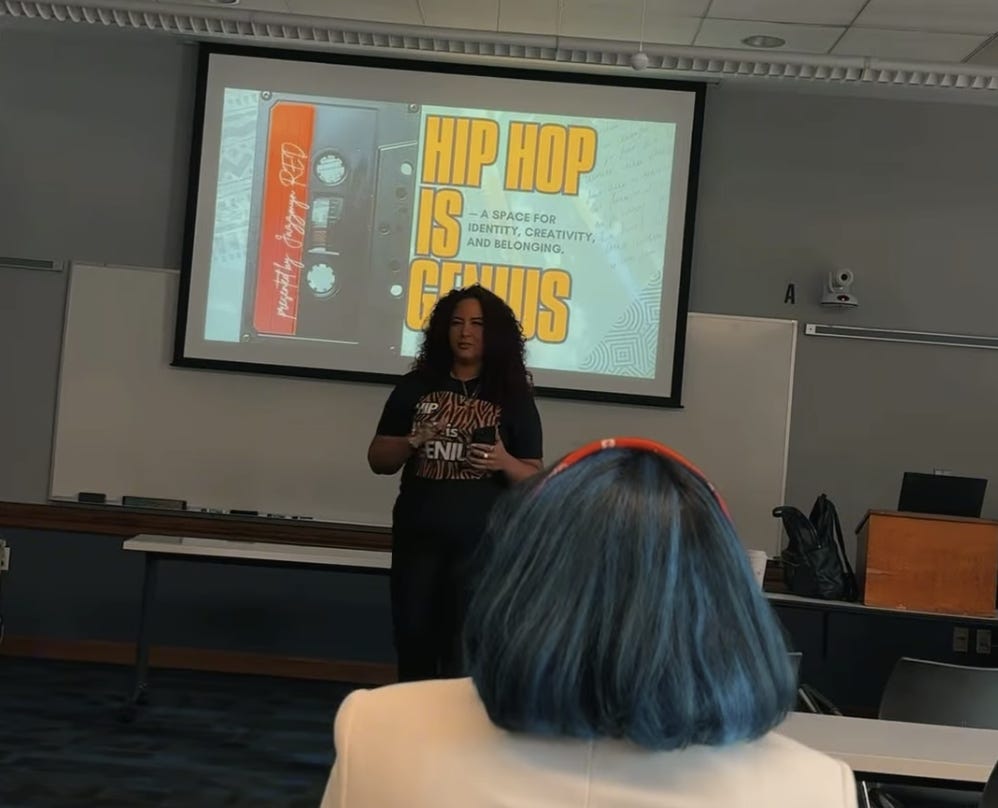
I recently returned from the 9th HipHopEd conference, held at Teachers College at Columbia University. This gathering of brilliant, passionate, creative, and radical thinkers, educators, activists, and advocates epitomizes what Hip Hop as a whole brings to the table when it comes to improving society and uplifting humanity.
I’ve dedicated YEARS to amplifying the work of many of these very individuals and organizations through this newsletter, the podcast, my videos, speaking/keynoting, and my book.
They are teachers, teaching artists, nonprofit leaders, community leaders, mentors, practitioners, and allies, who all have come to realize that an authentic connection to Hip Hop culture can literally help save lives and — as I often like to say — help address, alleviate, and in some cases eliminate, various social injustices that continue to plague our nation and hinder us achieving our true potential greatness.
HipHopEd is just one of many such gatherings that I highlight in this newsletter and personally attend (often on my own dime I might add, which is why your subscriptions truly help) to make sure I am able to advocate for the inspiring and innovative work being done to bring Hip Hop — the culture, the mindset, the ethos — into schools, into institutions, into community centers, into municipalities, into policy discussions, into healthcare spaces…
Today, ask any practitioner or person who claims Hip Hop as a part of their cultural identity, and they will tell you that it has never stopped being about DJing, MCing, breaking, graffiti, and knowledge. It has never stopped being about peace, unity, love, and safely having fun.
This despite everything that gets portrayed to the public as “Hip Hop.”
After all, a barnacle-covered whale, is still a whale.
So maybe, respectfully, if we’re going to talk about “Hip Hop,” and we know there’s a vast difference between what is portrayed as Hip Hop and what is actually Hip Hop… Maybe we should all stop talking only about the barnacles, and talk more about the damn whale.
The first step in this ambitious-but-you-get-it analogy, is to simply stop calling the whale “barnacles.”
Because when people are vocally critical of “Hip Hop” — and they are only speaking about the music aspect or the industry aspect and not using that opportunity to a) make crystal clear the difference and/or b) talk about all the uplifting things that both Hip Hop’s music AND overall culture are doing right now, every day, to help counter so many destructive and harmful systems, and only end up relegating “Hip Hop” to being ‘harmful’ itself… I fear it puts us in an endless cycle where we throw out the Hip-Hop-as-innovative-systems-change-agent baby with the blurred-lines-of-an-ever-evolving-and-overly-commercialized genre bathwater.
(Which, ironically, is what a lot of conspiracy theorists say has been the plan for Hip Hop all along… To dumb it down to its very least compound… And yet despite all the brilliance that permeates its musical and cultural and societal traits, some of our most revered voices continue to talk as if rap is all there is worth speaking about.)
It shouldn’t have to be repeatedly repeated that whatever type of rap music one could ask for — exists. In droves.
And that’s a weird thing as well. Folks tend to keep circling wagons around the idea that “mainstream” Hip Hop is more destructive today than it was in the past…
Longer convo, but we really overromanticize the short amount of time that truly “balanced” rap music was on the airwaves. Sure, we can complain about what our kids hear on the “radio” today but I know for a fact the first time I heard “Put It In Your Mouth” was on KISS-FM. IYKYK.
“Mainstream” AF.
But also, there’s that thing that everyone thinks the music in their teens and early 20s was “the best.”
Everyone.
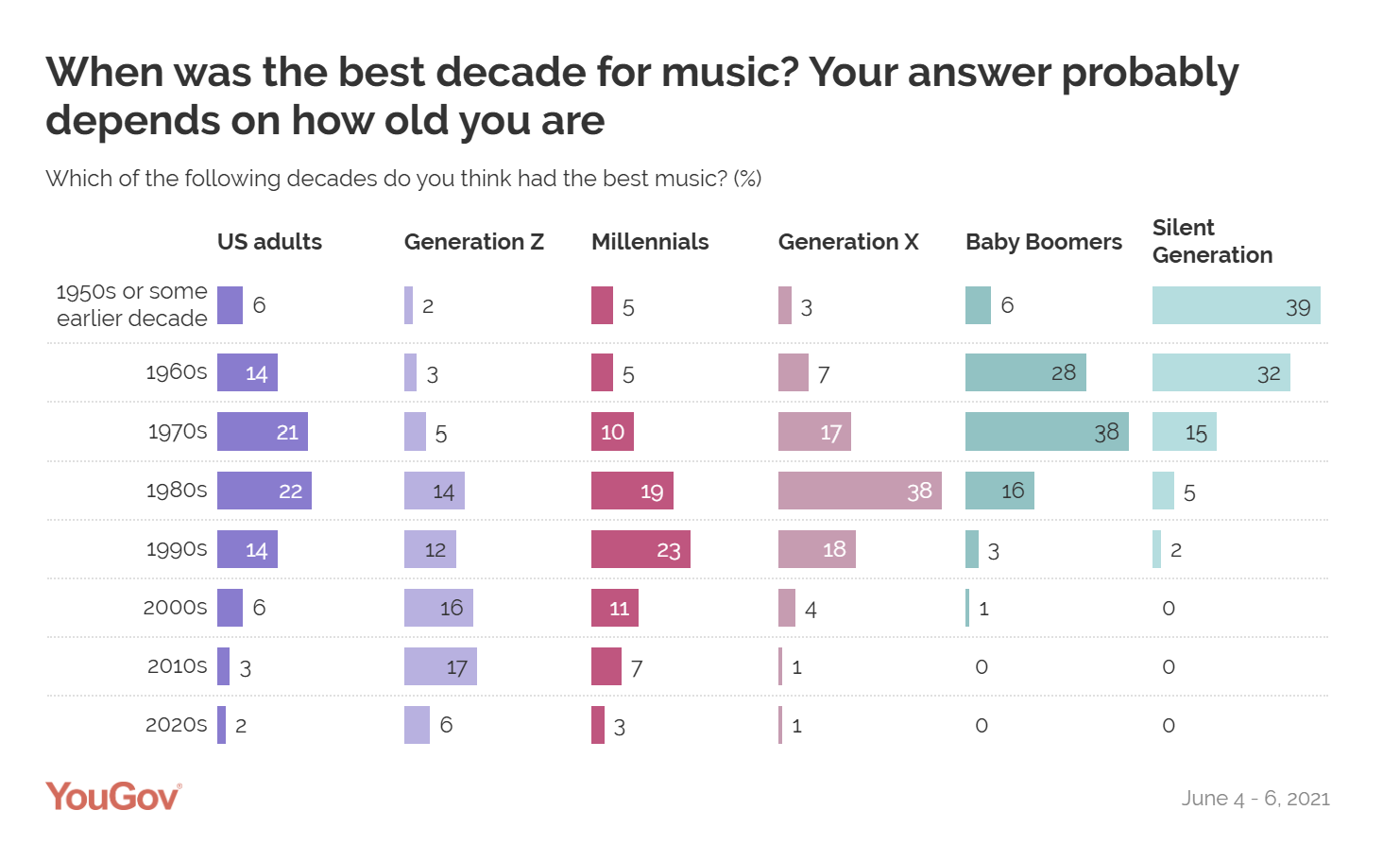
So again, all of this is very skewed by subjectivity, taste, selective nostalgia, and semantics. But OK. Fiiiiine. Let’s say that critics are right about the idea that “mainstream Hip Hop/rap music” today is flat out horribly detrimental to Black people, and by extension (and with a bit of othering sprinkled in), society at large.
I’m fully aware of this argument, and even some studies to back it up, so I’m not even really trying to suggest otherwise. It’s valid, but complicated. And a conversation for later.
Because to get there, we have to start here and admit that, far too many times, discussions about the effect that “Hip Hop” has had on society starts and stops with “rap music.” And that is a problem.
Because the “Hip Hop” that I see and engage with every day — the artistic, cultural, and intersectional aspects being championed largely by Black men and women mind you, as well as people from various minority or marginalized communities, and a good handful of truly ride or die allies — are proving that the good that Hip Hop can do for society has the potential to vastly outweigh whatever harm the capitalistic, bastardized version of one aspect of it could possibly do to the citizens of the communities from whence it came.
I don’t know that we can ever get a consensus on this language. Over the years I’ve at least made sure to say or write “Hip Hop music” when talking about rap, just to do my part to let the world know there’s a difference.
And maybe “rap music” is doing too much harm these days.
Ironically perhaps, I’m convinced that the antidote to that — and to many of the underlying causes that create the “mainstream rap” landscape in the first place — is Hip Hop.
And so I am therefore also convinced that every time “Hip Hop” is uttered when the subject is solely “rap music,” there is harm being done there as well — diminishing the power of the former by only ever focusing on the latter.
Let me know your thoughts.
Here is an picture I took of my House Wren homie George feeding his babies in the birdhouse in my yard.
Follow me on Instagram at MannyFacesOfficial.
Follow my birding activities on Instagram at SoMannyBirds 😁🐦

No posts
Comments
Nothing yet. Say the first thing.
Sign in to join the conversation.