
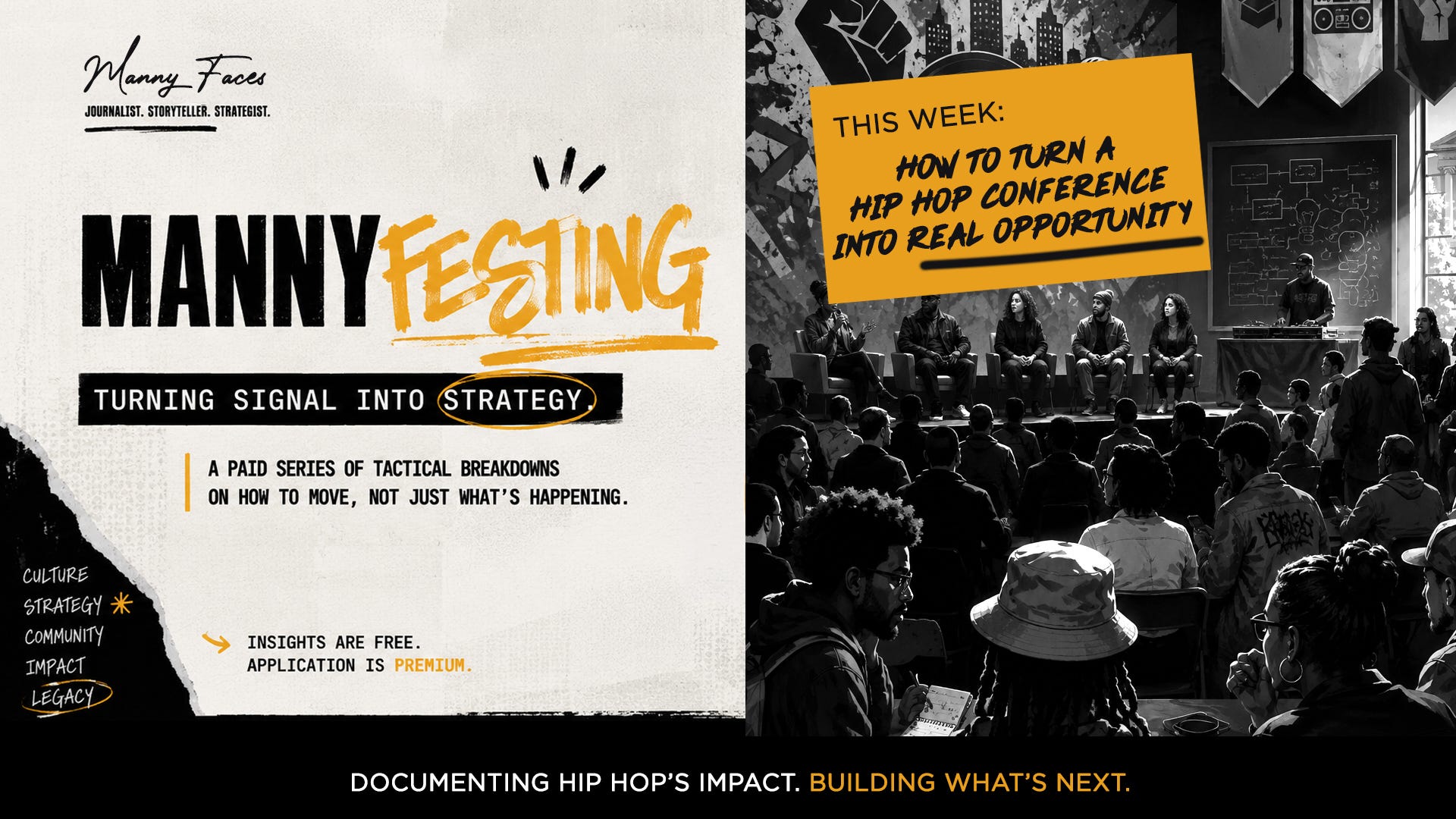
[A new premium series turning everyday signals into strategy through the lens of Hip Hop.]
If you’ve been following my posts, you’ve seen listings of Hip Hop–focused interdisciplinary events — academic conferences, convenings, and other similar gatherings that happen all over the place. If you’re on this newsletter list, these are probably interesting to you.
(For instance, registration is open for the HipHopEd conference, June 5-6, 2026, at Teachers College in NYC) — I’ll see you there (and at the day one afterparty at Aloft Harlem!)
Now, on paper, many of these look like standard university fare with keynotes, panels, and paper presentations. (Of course, because they’re Hip Hop-flavored, there’ll probably be some DJ action or performances here and there, etc.) Still, many people move through these spaces in a pretty typical way: they show up if they can, catch a few sessions, hope for a few “gems,” and then it’s back to life, back to reality.
In my world, that’s leaving way too much on the table.
Despite the culture’s cautious side-eye when it comes to institutions, there is a healthy ecosystem of Hip Hop brilliance happening inside universities and adjacent spaces. From the outside, they can look highly academic. And they are. But they aren’t exclusively so.
That’s important to know. Because what often ends up happening is that the people who could benefit the most from these rooms never even hear the call. I’m talking about teaching artists, independent creatives, community organizers, and parents. I’m even talking about the longtime (and let’s be real, often jaded) Hip Hop heads who desperately want to see this culture used for more than just entertainment or commerce — but don’t see or hear too much of that out in the world.
Then there are the folks who don’t even consider themselves “Hip Hop,” but work in healthcare, or youth development, or civics — fields that Hip Hop influences every single day, often unbeknownst to them.
They aren’t on the university listservs. They aren’t in those internal networks. They don’t read this incredible newsletter (which is their first mistake 😁). So, the signal never reaches them. And even if it does, for many, it feels like it’s “not for them.”
Nothing could be further from the truth.
A lot of people disqualify themselves before they even register.
They think:
“I’m not an academic…”
“I don’t have a research paper…”
“I don’t belong in a Hip Hop space…”
Au contraire. For many people, there is real benefit in attending these gatherings — even if you don’t fully see yourself as part of that world.
And especially if you do.
So yes, these events need more Hip Hop heads, but also, attendees from all walks of life.
And not just to be listeners. These rooms need more voices.
They need to hear from more people inside Hip Hop culture, but working in different lanes. More Hip Hop practitioners and nonprofit leaders and folks working directly with communities. The people seeing life play out in real time, in the streets and in organizations outside of formal, traditionally isolated structures.
They also need to hear from people outside of Hip Hop culture who are wise enough to know that Hip Hop represents a major social and cultural movement that, when tapped into authentically and with purpose, can improve society and uplift humanity across all kinds of fields and disciplines — and they want to learn more about these types of innovations.
Without all of those people in these spaces, the conversations narrow. Conclusions get shaped by whoever happens to be in the room — sometimes by those with the most letters after their name, or the largest platform, or who all belong to a particular closed circle of friends or colleagues.
And those conclusions might not stay in the room. They might show up later in funding decisions, program design, policy direction…
So yes, for those who want to learn more about the music and culture, or utilize them in ways that can improve lives, livelihood, and communities, you should be there. You should go to learn, for sure. But you also should go to make sure that what’s being built actually reflects the full range of the people it’s meant to serve.
There is a two-way value here: you’ll get context you won’t find anywhere else, and the rooms get valuable input from folks actually doing the work.
If you’re someone who usually skips these — because you don’t think you belong, or you’re not sure they’re worth the time or the money — or, if you’re going to be attending and want to maximize your time there, here’s what you really should be considering:
Comments
Nothing yet. Say the first thing.
Sign in to join the conversation.